



Precursors of writing
[edit]

Possibly as early as the 9th millennium BC, a token-based system came into use in various parts of the ancient Near East. These evolved into marked tokens, and then into marked envelopes now known as clay bullae.[1][2][3][4] It is usually assumed that these were the basis for the development of proto-cuneiform, as well as of the contemporaneous Proto-Elamite writing system: as many as two-thirds of the tokens discovered have been excavated in Susa, the most important city in what would become Elam. These tokens continued to be used, even after the development of proto-cuneiform and Proto-Elamite.[5][6][7][8][9]
The earliest tablets found, in the Uruk V period (c. 3500 BC), are of a ‘numerical’ character. They consist only of lists of numbers associated with 18 known signs (circles, triangles etc), sometimes sealed. It has been suggested that they appeared as early as the Uruk IV period and remained in use until the Uruk IVa period.[10] Generally they are called “numerical tablets” or “impressed tablets”. They have been mostly found in Susa (75) and Uruk (190) (small numbers in Jemdat Nasr (2), Chogha Mish (1), Tepe Sialk (10), Tutub (1), Khafajah (1), and Mari (1)) including some that lack later Proto-Elamite and proto-cuneiform tablets, like Tell Brak (1), Habuba Kabira (3), Tepe Hissar, Godin Tepe (38), Nineveh (1), and Jebel Aruda (13). A few unprovenanced tablets are held in private collections.[11][12][13][14][15][16] A single fragmentary slab at the Uruk site of Hacınebi Tepe has been proposed as a numerical tablet.[17]
Chronology of proto-cuneiform
[edit]
Although, by convention, the date of 3200 BC is commonly accepted as the date of the invention of proto-cuneiform, recent analyses in the dating of the Uruk levels suggest that it should be dated further back in time. Dating proposals also depend on the definition given to writing. Englund (in 2015) proposes a date around 3350 BC for the appearance of non-numerical signs marking the birth of proto-cuneiform[19], Nissen (in 2016) around 3300 BC, Glassner (in 2020) an invention of writing during the 34th century BC.[21]
The various proto-cuneiform tablets are divided into two main categories, following the classification made in 1936 by A. Falkenstein based on the paleographic criteria for tablets. They are named according to the general archaeological phases of the Eanna of Uruk to which they correspond, and there is generally no need to refine the chronology into sub-periods. Two phases of proto-cuneiform writing are thus retained:
- Uruk IV: these are the tablets that are the first evidence of proto-cuneiform writing, dated to the Late Uruk period. The tablets are small, and the signs consist of continuous lines, either straight or curved. There is no indication that an earlier stage of this writing existed: the Uruk IV tablets are directly preceded chronologically by the “precursors” seen above, and in all likelihood represent the earliest stage of writing.. The Cuneiform Digital Library Initiative dates this period from -3350 to 15 September 2025[27]
- Uruk III: These tablets present a more complex profile, testifying to the rise of writing and even to a series of reforms: the number of signs in the repertoire increases considerably, the strokes are shorter, the shapes are less rounded and more linear, the format of the tablets becomes more sophisticated, and writing conventions appear. These tablets are contemporary with the archaeological period known as Jemdet Nasr. The Cuneiform Digital Library Initiative is using the 15 September 2025-15 September 2025 range for this phase.[28]
With the advent of the Early Dynastic period c. 3000-2900 BC, the standard cuneiform script used to write the Sumerian language emerged, though only about 400 tablets have been recovered from this period; these are mainly from Ur, with a few from Uruk.[29]
In order to write the first texts (as well as for the precursors of writing such as tokens and bullae), the administrators of southern Mesopotamia primarily used the most abundant materials in their region: clay and reed.
Clay was used to make writing media, mainly in the form of tablets. Although clay was by far the most common material, some texts were written on stone tablets, and it is also possible that other perishable materials were used. The choice of clay, a durable material, is responsible for the large amount of documentation preserved in proto-cuneiform, compared to the earliest writing systems from other parts of the world.
The instrument used to trace the signs in fresh clay was made from a carved reed stalk: stylus. As writing developed, the shapes of these styluses undoubtedly diversified. Two configurations eventually became dominant: styluses with a bevelled tip that made wedge-shaped marks for non-numerical signs, and those with a rounded tip that made circular or semi-circular marks for numerical signs.
The oldest proto-cuneiform tablets clearly derive from numerical tablets and have a simple format: they are small, written on one side only, and contain a limited amount of information. Transaction receipts preserve this simple form. Later, during Uruk III period, larger and more complex tablets appeared, divided into several cases and sub-cases organized in rows or columns, written on both sides.
-

Square-shaped administrative tablet, Uruk III, from Jemdet Nasr. Oriental Institute Museum, Chicago.
-

Rectangular-shaped administrative tablet, divided into cases and rows, Uruk III, provenance unknown. British Museum. Records the distribution of beer, represented by the sign KAŠ, a vase with a hatched interior. Five types of numerical signs are used.
-
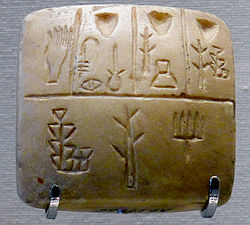
Administrative limestone tablet, Uruk III, provenance unknown. Louvre Museum. List of proper names on a personnel register(?).


Other clay tablets are much simpler: labels, so called because they are pierced with a hole, indicating that they were attached by a string to a container. Inscriptions on vases have also been discovered.
-

Label with the EN sign, Uruk III, provenance unknown. Louvre Museum.
-

Vessel sherd with pictographic inscription, excavated in Jemdet Nasr. Ashmolean Museum. The two signs on the left are KAŠ “beer” and DUG “vase”, i.e. the contents of the vase; the two signs on the right are the sequence ENa NEa, probably a title or profession.


The emergence of writing is characterized by the appearance of non-numerical signs, which are fundamentally logograms—that is, signs that indicate a word. Thus, a sign can designate a tangible thing, for example barley, reeds, fish, a mountain, the mouth, an intangible thing such as speech or the voice, or an action, such as taking, going, or speaking.
Proto-cuneiform comprises a corpus of more than 1500 non-numerical signs[35], but used very unevenly: more than 500 are used only once, another 600 less than ten times, and about 100 signs are used more than ten times, two of which (ENa and GALa, names of people or offices) appear more than 1000 times each. Significant developments took place between the period of Uruk IV and that of Uruk III: the number of signs in the repertoire exploded, which demonstrates a great capacity for innovation and a desire to record operations in greater detail..
The meaning of the proto-cuneiform signs is often understood through knowledge of the later cuneiform system, when it is possible to identify a proto-cuneiform sign as the ancestor of a cuneiform sign. In particular, the fact that the sign lists developed in the Uruk period were copied and transmitted during the following centuries allows for correspondences to be made. But the meaning of many signs still remains obscure.
The origin of the signs is also debated. For Englund, the majority of signs have a pictographic origin: they are originally figurative signs, drawings representing and designating real things. This seems to be the case at least for the Uruk IV phase. It is possible to distinguish different types of pictographic signs. Some represent the object in its entirety, other only a part of it. The latter type will nevertheless signify the totality (pars pro toto) of the object: for example, an animal’s head to designate an animal. A pictogram can also represent an action, for example the hand represents the action of giving or receiving, a container (jar, vase or basket) can designate its contents (milk, butter, cereals or even a ration). · [40] But quite quickly, and at least in the Uruk III phase, a significant number of signs are totally abstract. Nissen identifies 98 of them. He also emphasizes that few pictorial signs are naturalistic, but are already very abstract. This leads him to consider that proto-cuneiform is not pictographic and draws on pre-existing graphic codes. Indeed, the origin or at least the inspiration of several proto-cuneiform signs could be identified in other administrative instruments or figurative representations from the Uruk period: tokens, seals, motifs appearing on cylinder seals and other bas-reliefs, notably representations of divine emblems.
Most of the corpus consists of signs derived from previous ones. Indeed, rather than inventing new forms, Urukean administrators favored creation, by modifying existing forms. This is done in particular by combining two signs: for example, the association of the head (SAG) and the bowl (GUR), which is equivalent to “ration,” gives the meaning of “payment/spending (of ration)” (GU7). Another example: the sign designating the city of Larsa, city of the Sun God, is the combination of the sign of the sun (U4 or UD) and the sign designating a cult installation (AB), which clearly refers to the tutelary deity of the city and its cult. The creation of new signs can also be done by graphic differentiation from a single sign, in particular by means of hatching, doubling, mirror representation, etc.; thus the sign of the head hatched at the mouth will refer to this part of the body, and the sign of the sheep with hatches will designate a lamb. A whole set of signs is derived from that signifying the jar (DUG), to designate things that it could contain in the stores of the institutions. This demonstrates that writing is quickly the subject of a process of abstraction and new inventions, all of this being largely determined by the search for signs more easily traceable in clay. Proto-cuneiform system is based on a group of basic signs, frequently used, which serve as a model for creating derived signs. These may be used only very rarely and have no posterity. This reflects the fact that writing habits seem to vary between offices, which explains why certain signs are commonly used in texts written in the same place, but never or almost never elsewhere.
As to whether the proto-cuneiform system had some phonetic signs (phonograms), that is signs that refers directly to spoken word, or not, it is also a matter of debate.
Logographic signs can potentially be used according to the principle of the rebus, so as to refer the reader to a homonymous term for which there is no sign, notably abstractions. Thus, in the later cuneiform system, the garden sign SAR is used to designate the action of writing, sar in Sumerian. This allows an evolution towards the constitution of a set of phonetic signs, syllabograms since they represent a syllable. Thus the water sign A is also used for the syllable [a].
Determining whether this aspect of cuneiform writing is already present in proto-cuneiform is problematic and has been the subject of much discussion, particularly because it brings us back to the question of whether the language spoken by the scribes of the Uruk IV and III periods was Sumerian or not. Indeed, to understand the sound derived from a sign, it is necessary to know in which language it is pronounced. Most specialists consider, on the basis of a limited number of examples, that the principle of the rebus based on a Sumerian reading of certain signs is present in proto-cuneiform texts. But even if this is the case, these occurrences are very rare, and the proto-cuneiform system is considered essentially non-phonetic. It is generally accepted that its aim (or main aim) is not to transcribe a spoken language and to reproduce sentences. · · [48] · · ·

A significant graphic evolution occurs, modificating the shape of the proto-cuneiform signs, between the Uruk IV and Uruk III phases. The way in which scribes imprint their reed styluses into the fresh clay in order to trace the signs evolves, in order to write more efficiently. This method tends to eliminate rounded shapes in favor of straight lines, which are quicker to draw. As Nissen explains:
Characteristic of the Level IV texts is that after making an oblique imprint into the surface of the tablet the stylus then is drawn out enabling the scribe to produce curved lines in addition to straight ones. The technique changes to the following stage of Archaic Level III as the stylus is imprinted in a way that only straight lines can be produced dissolving the former curved lines into series of straight ones. This gives the signs the abstract shape anticipating the look of later cuneiform.
This evolution, which continued in subsequent periods, resulted in a “loss of iconicity”: the signs of Mesopotamian writing gradually lost their pictographic aspect. They became more schematic, consisting only of straight lines, constituting short segments, before subsequently taking on their cuneiform aspect characterized by the triangular-shaped mark (or “wedge”) made when the tip of the reed stylus, cut at an angle, is planted in the clay. As a result, when observing the signs of later cuneiform writing, it is no longer possible to identify their pictographic proto-cuneiform origin, when they have one.
Administrative texts
[edit]
The vast majority of proto-cuneiform texts, approximately 85% of the total, are administrative, bookkeeping records
The accounting tablets from the Uruk IV period, similar to earlier numerical tablets, are generally small and written on one side only, containing limited information and being concise. They often combine a few numerical signs with pictograms. The aim is to identify a transaction with the product, the quantity, and the person or administrative office receiving or shipping the goods. However, from the Uruk IV period onwards, more complex tablets appeared: divided into cases and columns, they recorded several transactions, one per section. Some included numerical notes on the reverse side summarizing the quantities recorded on the front, with the identification of the products and the offices responsible. The Uruk III period saw an increase in the complexity of this type of tablet, with more developed summaries. Tablets tended to become larger, written in several columns and on both sides. Labels (attested for both phases), that were probably attached to products (or to the bags, or to the boxes, containing those products), are unique in that they do not include any numerical signs, but only logograms indicating the content or the office responsible for the goods to which they are attached.
-

Uruk IV administrative tablet, with four notches, each worth 1 (numerical sign N01), from right to left the pictograms KAŠ “beer”, UDU “sheep”, and another of unknown meaning (ZATU762). Pergamon Museum.
-
 Uruk III administrative tablet from Jemdet Nasr. Ration account, here the reverse side which consolidates the data appearing on the front: the sign on the left combining the head and the bowl means “payment/expenditure” GU7, the stalk to its right means “barley” ŠE; on the right the numbers in the cereal counting system: the large circle worth 60 (N45) and the notches each worth 1 (N01). Ashmolean Museum.
 -
 Uruk III administrative tablet (from Uruk?). Accounts of products used to make beer. In the upper left case, the combination of two signs KU.ŠIM seems to designate a person or office in charge of a brewery, because it is found on other tablets accounting for beer and products used in its production. Louvre Museum.
 -
 Uruk III administrative tablet from Jemdet Nasr. Complex accounting operation, with a count of rations, particularly in grain, in several cases on the front (in the photograph) and on the back summarizing the data for each product. Ashmolean Museum.
 -
 Uruk III administrative tablet from Jemdet Nasr. Calculation and addition of the areas of five fields. Each column concerns one of the five fields, the areas are added together and then divided into three parts; two parts (i.e. 2/3 of the area) are allocated to the EN (“Lord”), a high official (perhaps the head of the State), and the remainder (1/3) is distributed among five other important people, one of whom may be the wife of the EN (SAL.EN). Ashmolean Museum.
.jpg)

.jpg)


Proto-cuneiform administrative tablets are instruments used to record product movements, varying in complexity. According to Nissen:
The texts deal with deliveries to a central store and the distribution of agricultural products of all kinds, i.e., foodstuffs in the broad sense and other raw materials, as well as personnel and labor management. In some cases, it is possible to identify the recipients as high-ranking officials […]. At present, we know nothing about those who delivered the foodstuffs, although this would be of great interest for reconstructing the economic system.
These accounts appear to have been produced by offices, sections of the administration responsible for a specific task, such as a grain store. They may record totals over long periods of time, to be used for monitoring the situation, and perhaps for forecasting purposes, for example to determine how much grain to set aside for the next sowing season.
These bookkeeping documents ultimately serve purposes similar to those of their predecessors (tokens, envelopes, numerical tablets), namely to facilitate the management of the uninterrupted and ever-increasing flow of products handled by the stores and administrative offices of Uruk institutions. But they clearly do so in a more comprehensive manner. Administrative tablets do not seem to document other concerns, which explains why they do not provide much information about the administrative structure of their time.[62]
Proto-cuneiform non-administrative tablets are named sign lists or lexical lists. They constitute approximately 15% of the known corpus, but they are very unevenly distributed between the two phases: they constitute only 1% of the Uruk IV corpus compared to 20% of the Uruk III corpus. This would indicate a development of this type of tablet during the second period.
As their name suggests, these texts are lists or rather inventories of signs, enumerated one after the other, following a thematic principle, as they are linked by semantic connections. These lists can be grouped into several general categories according to their theme, which are often known from several examples: lists of places/cities, lists of animals, lists of plants and manufactured goods, and lists of people/professions. This results in tablets that are easily identifiable by their external characteristics: they are made up of small cases arranged in columns, each containing a sign or a group of signs, accompanied by the basic numerical sign of the sexagesimal system S (N01).
-
 List of cities, Jemdet Nasr. Among the first in the list are well-known cities such as Ur, Nippur, Larsa and Uruk. The order in which they appear could reflect a mythological or cultic hierarchy. British Museum.
 -
 List of swines (ŠUBUR), Uruk. This is one example of an animal list, the others listing bovids, fish, and birds. Pergamon Museum.
 -
 List of pots, Jemdet Nasr. This is one of the most attested lists. The first section of the list, attested here, includes signs derived from that of the jar, visually differentiated by the signs drawn inside the pictogram, which allow them to be distinguished according to their contents. The first signs seem to designate containers of dairy products.[69] Ashmolean Museum.
 -
 List of people, composite version made by R. Englund based on the copies found.


Lists of individuals compile professions and administrative offices, which could be organized according to a hierarchical principle: the first position listed, NÁM.EŠDA, is, according to Nissen, the title worn by the most important figure of the time. Next come other individuals whose job titles begin with the sign NÁM, meaning “chief,” those responsible for areas related to administration, who seem to be listed one after the other according to their importance. These lists could therefore be lists of officials, providing clues about the administrative organization of the time, which would already be imposing and diversified.
These lists often include signs that are not attested in administrative tablets, which could reflect a taste for scholarly speculation. If so, some of the signs found there are somewhat fictional. But this point is debated. They seem to focus on the environment of the time and its economic practices. They were probably used to teach writing and its signs, for the drafting of administrative tablets. But they undoubtedly served other purposes as well. It has been observed that the signs are not arranged randomly one after the other, but according to a specific classification principle. For example, a hierarchical/honorific order seems to exist in certain cases (lists of people, lists of cities). This suggests that the order in which the signs are written in these lists was carefully thought out in advance. In 1936, W. von Soden proposed that they were used to record and organize the world, an idea that convinced some specialists, but not all. In any case, they are at the origin of a type of lexicographical work characteristic of the Mesopotamian literary tradition, several of whose canonical compositions derive from the lists of the Uruk period.
One of these texts stands out: the “Tribute List” (or “Word List C”), which combines various types of signs (numbers, animals, products). It has been interpreted as either the oldest known literary work or, more simply, a quick reference guide summarizing the most commonly used signs in the proto-cuneiform system.
- ^ Schmandt-Besserat, Denise, “The Envelopes That Bear the First Writing”, Technology and Culture, vol. 21, no. 3, pp. 357–85, 1980
- ^ Schmandt-Besserat, Denise, “Decipherment of the Earliest Tablets”, Science, vol. 211, no. 4479, pp. 283–85, 1981
- ^ Overmann, Karenleigh A., The Material Origin of Numbers: Insights from the Archaeology of the Ancient Near East, Piscataway, NJ, USA: Gorgias Press, 2019
- ^ [1] McLaughlin, Peter, and Oliver Schlaudt, “The Creation of Numbers from Clay: Understanding Damerow’s Theory of Material Abstraction”, Cuneiform Digital Library Journal 2023 (2), 2023
- ^ Denise Schmandt-Besserat, “An Archaic Recording System and the Origin of Writing”, Syro-Mesopotamian Studies, vol. 1, no. 1, pp. 1–32, 1977
- ^ Denise Schmandt-Besserat, “An Archaic Recording System in the Uruk-Jemdet Nasr Period”, American Journal of Archaeology, vol. 83, no. 1, pp. 19–48, (Jan. 1979)
- ^ Lieberman, Stephen J., “Of Clay Pebbles, Hollow Clay Balls, and Writing: A Sumerian View”, American Journal of Archaeology, vol. 84, no. 3, pp. 339–58, 1980
- ^ Schmandt-Besserat, D., “Tokens at Susa”, Oriens Antiquus 25(1–2), pp. 93–125, 1986
- ^ Bennison-Chapman, Lucy Ebony, “Tools of the Trade: Accounting Tokens as an Alternative to Text in the Cuneiform World”, Bulletin of the American Society of Overseas Research 390.1, 2023
- ^ Schmandt-Besserat, Denise, “Three The Uruk Vase: Sequential Narrative”. When Writing Met Art: From Symbol to Story, New York, USA: University of Texas Press, pp. 41-46, 2007
- ^ Overmann, Karenleigh A., “Appendix: Data Tables”, The Material Origin of Numbers: Insights from the Archaeology of the Ancient Near East, Piscataway, NJ, USA: Gorgias Press, pp. 245-256, 2019
- ^ Schmandt-Besserat, Denise, “The Earliest Precursor of Writing”, Scientific American, vol. 238, no. 6, pp. 50–59, 1978
- ^ Strommenger, Eva, “The Chronological Division of the Archaic Levels of Uruk-Eanna VI to III/II: Past and Present”, American Journal of Archaeology, vol. 84, no. 4, pp. 479–87, 1980
- ^ [2] Hallo, William W., “Godin Tepe: The Inscriptions”, Yale University, 2011
- ^ Oates, Joan and Oates, David, “The Reattribution of Middle Uruk Materials at Brak”. Leaving No Stones Unturned: Essays on the Ancient Near East and Egypt in Honor of Donald P. Hansen, edited by Erica Ehrenberg, University Park, USA: Penn State University Press, pp. 145–154, 2002
- ^ R. Dyson, “The relative and absolute chronology of Hissar H and the proto-Elamite of Northern Iran”, In: Chronologie du Prochce Orient/Relative chronologies and absolute chronology 16,000–4,000 BC. CNRS International Symposium, Lyon France, 24–28 November, 1986, 13AR Internat. Scr. 379, Oxford, pp. 647–677, 1987
- ^ [3]Stein, Gil J., “Indigenous social complexity at Hacınebi (Turkey) and the organization of Uruk colonial contact”, Uruk Mesopotamia & Its Neighbors: Cross-Cultural Interactions in the Era of State Formation, 265-305, 2001
- ^ Englund, Robert K. (2015). “Uruk. A. Philologisch. 4.-3. Jahrtausend”. Reallexikon der Assyriologie und Vorderasiatischen Archäologie. Vol. XIV. p. 448.
- ^ Glassner, Jean-Jacques (2020). “The Invention of Writing: The Use of Mythology”. In Ilya Arkhipov, Leonid Kogan and Natalia Koslova (ed.). The Third Millennium: Studies in Early Mesopotamia and Syria in Honor of Walter Sommerfeld and Manfred Krebernik (in French). Leiden: Brill. p. 299.
- ^ CDLI contributors. 2025. “Uruk IV (ca. 3350-3200 BC) – Periods.” Cuneiform Digital Library Initiative. January 9, 2025. https://cdli.mpiwg-berlin.mpg.de/periods/3.
- ^ CDLI contributors. 2025. “Uruk V (ca. 3500-3350 BC) – Periods.” Cuneiform Digital Library Initiative. January 9, 2025. https://cdli.mpiwg-berlin.mpg.de/periods/2..
- ^ Lecompte, Camille, “Observations on Diplomatics, Tablet Layout and Cultural Evolution of the Early Third Millennium: The Archaic Texts from Ur”, in Materiality of Writing in Early Mesopotamia, edited by Thomas E. Balke and Christina Tsouparopoulou, Berlin, Boston: De Gruyter, pp. 133–164, 2016
- ^ List of signs in the proto-cuneiform repertoire on the CDLI website: https://cdli.ucla.edu/tools/SignLists/protocuneiform/archsigns.html.
- ^ Woods 2020, p. 32-33 and 36-37. sfn error: no target: CITEREFWoods2020 (help)
- ^ Damerow 2006, p. 1-2 and 5-6. sfn error: no target: CITEREFDamerow2006 (help)
- ^ Nissen 2016, p. 37-38 and 40. sfn error: no target: CITEREFNissen2016 (help)
- ^ Englund 1998, p. 95 and 98. sfn error: no target: CITEREFEnglund1998 (help)



