
|
|
|-
|-
|”[[Lossinia]]<ref name=Ivantsov_2007>{{cite journal| author=Ivantsov, A. Yu.| title = Small Vendian transversely Articulated fossils| journal = Paleontological Journal| volume = 41| issue = 2| date = April 2007| doi = 10.1134/S0031030107020013| url = https://www.academia.edu/2352394| pages=113–122| s2cid = 86636748}}</ref>”
|”[[Lossinia]]<ref name=Ivantsov_2007/>”
|
|
*”L. lissetskii”
*”L. lissetskii”
Geological formation in northwestern Russia
| Ustʹ Pinega Formation | |
|---|---|
| Type | Geological Formation |
| Sub-units | Tamitsa, Lyamtsa, Arkhangelsk, Verkhovka, Syuzma, Vaizitsa and Zimnegory Subformations |
| Underlies | Mezen Formation |
| Overlies | different Archean and Proterozoic rocks |
| Thickness | >751 m |
| Primary | Argillite |
| Other | Sandstone, Siltstone, Clay |
| Region | Arkhangelsk Oblast, Vologda Oblast, Kirov Oblast, Komi Republic, Republic of Karelia |
| Country | Russia |
| Extent | >970 km |
64°9′0.000″N 41°55′59.988″E / 64.15000000°N 41.93333000°E
The Ustʹ Pinega Formation is an Upper Ediacaran geological formation in northwestern Russia. It spans from around 580 Ma to 550 Ma and contains fossils of the Ediacaran biota throughout its sequence.
The formation was first established and described from the core of the Ust-Pinega borehole drilled in the settlement of Ust-Pinega, Arkhangelsk Region of Russia, where its thickness is 284 m. Its natural outcrops within the same region are known from the Onega Peninsula and the Winter Coast of the White Sea, as well as from small, isolated outcrops in the basin of the Onega River and on the northern slope of the Vetreny Poyas (Windy Belt) Ridge.[2]
The formation rests with erosion on Proterozoic terrigenous deposits or Archean crystalline rocks. It is subdivided, from bottom to top, into the following Subformations (initially defined as “Beds” by A.F. Stankovsky, 1985): Tamitsa, Lyamtsa, Arkhangelsk, Verkhovka, Syuzma, Vaizitsa, and Zimnegory. It is unconformably overlain by deposits of the Ediacaran Mezen Formation, as well as by Paleozoic or Quaternary sediments.
In 2003, D.V. Grazhdankin proposed an alternative subdivision scheme for these deposits, based on the original scheme by A.F. Stankovskiy. This scheme includes the Lyamtsa (= Lyamtsa + Arkhangelsk Beds), the Verkhovka (= Verkhovka + Syuzma Beds), and the Zimnegory (= Vaizitsa + Zimnegory Beds) Formations. In this revision, the use of the Ust’ Pinega Formation was abandoned in favor of these three formations[3].
Currently, the Ust’ Pinega Formation and its subformations remain the official stratigraphic scheme used on state geological maps of Russia.
The Lyamtsa, Verkhovka and Vaizitsa Subformations contain volcanic ashes. Zircon U-Pb dating dating of volcanic tuffs from the Verkhovka and Vaizitsa beds has yielded ages of 557.28 ± 0.14 Ma and 552.96 ± 0.19 Ma, respectively[4][5]. Furthermore, an Rb–Sr age of 565 ± 9 Ma was obtained for clays of the Arkhangelsk Subformation[1]. The formation is unconformably overlain by the deposits of the Mezen Formation, from the lower part of which a U-Pb age of 550.2 ± 4.6 Ma has been obtained for tuffites[6].
The Ustʹ Pinega Formation is home to many rare and common Ediacaran fauna, from the well known motile forms such as Dickinsonia and Kimberella,[7] to the rarer, more elusive forms like Ventogyrus and Zolotytsia. All forms within this formation are preserved in layers of ash beds, which are not only good at preserving the fine exterior details of organisms, but also their internals, like Burykhia.[8]
| Color key | Notes Uncertain or tentative taxa are in small text; |
| Genus | Species | Notes | Images |
|---|---|---|---|
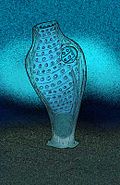
| Burykhia[8] | Sac-like organism, possible tunicate. |
 |
| Genus | Species | Notes | Images |
|---|---|---|---|
| Calyptrina[2] | Tubular organism. |
 |
- ^ a b Golubkova, E. Yu.; Zaitseva, T. S.; Tretyachenko, V. V.; Kushim, E. A.; Kuznetsov, A. B.; Turchenko, T. L.; Silivanov, M. O. (April 2025). “The Redkino Biota and the Rb–Sr Age of Vendian Deposits from the North of the East European Platform”. Stratigraphy and Geological Correlation. 33 (2): 157–175. doi:10.1134/S086959382470031X.
- ^ a b c d e f g h i j k l m n o p q r s t u v w x y z aa ab ac ad ae af ag Sokolov, Boris S.; Fedonkin, Mikhail A. (1 March 1984). “The Vendian as the Terminal System of the Precambrian”. Episodes. 7 (1): 12–19. doi:10.18814/epiiugs/1984/v7i1/004.
- ^ D. V., Grazhdankin (2003). “Structure and Depositional Environment of the Vendian Complex in the Southeastern White Sea Area”. Geology Science. Retrieved 2 May 2025.
- ^ a b c d e f g h i j k l m n o p q r s t u Martin, M. W.; Grazhdankin, D. V.; Bowring, S. A.; Evans, D. A. D.; Fedonkin, M. A.; Kirschvink, J. L. (5 May 2000). “Age of Neoproterozoic Bilatarian Body and Trace Fossils, White Sea, Russia: Implications for Metazoan Evolution”. Science. 288 (5467): 841–845. doi:10.1126/science.288.5467.841.
- ^ Yang, Chuan; Rooney, Aleksey D.; Condon, Daniel J.; Li, Xian-Hua; Grazhdankin, Dmitriy V.; Bowyer, Frederick T.; Hu, Chao; Macdonald, Francis A.; Zhu, Maoyan (5 November 2021). “The tempo of Ediacaran evolution”. Science Advances. 7 (45) eabi9643. doi:10.1126/sciadv.abi9643. PMC 8565906.
- ^ Llanos, M; Tait, J; Popov, V; Abalmassova, A (15 December 2005). “Palaeomagnetic data from Ediacaran (Vendian) sediments of the Arkhangelsk region, NW Russia: An alternative apparent polar wander path of Baltica for the Late Proterozoic–Early Palaeozoic”. Earth and Planetary Science Letters. 240 (3–4): 732–747. doi:10.1016/j.epsl.2005.09.063. hdl:11336/92776.
- ^ a b Fedonkin, M.A.; Simonetta, A; Ivantsov, A.Y. (2007), “New data on Kimberella, the Vendian mollusc-like organism (White sea region, Russia): palaeoecological and evolutionary implications”, in Vickers-Rich, Patricia; Komarower, Patricia (eds.), The Rise and Fall of the Ediacaran Biota, Special publications, vol. 286, London: Geological Society, pp. 157–179, doi:10.1144/SP286.12, ISBN 978-1-86239-233-5, OCLC 156823511
- ^ a b Fedonkin, M. A.; Vickers-Rich, P.; Swalla, B. J.; Trusler, P.; Hall, M. (2012). “A new metazoan from the Vendian of the White Sea, Russia, with possible affinities to the ascidians”. Paleontological Journal. 46: 1. doi:10.1134/S0031030112010042.
- ^ Fedonkin, Mikhail A. (January 2002). “Andiva ivantsovi gen. et sp. n. and related carapace‐bearing Ediacaran fossils from the Vendian of the Winter Coast, White Sea, Russia”. Italian Journal of Zoology. 69 (2): 175–181. doi:10.1080/11250000209356456.
- ^ a b c Ivantsov, A. Yu. (2004). “New Proarticulata from the Vendian of the Arkhangel’sk Region”. Paleontological Journal. 38 (3): 247. CiteSeerX 10.1.1.738.7043.
- ^ a b Ivantsov, Andrey Yu.; Malakhovskaya, Ya.E.; Serezhnikova, E.A. (January 2004). “Some problematic fossils from the Vendian of the southeastern White Sea Region”. Paleontological Journal. 38 (1): 1–9 – via researchgate.net.
- ^ A.Yu. Ivantsov (2017). “The most probable Eumetazoa among late Precambrian macrofossils”. Invertebrate Zoology. 14 (2): 127–133. doi:10.15298/invertzool.14.2.05.
- ^ Ivantsov, A. Yu. (April 2007). “Small Vendian transversely Articulated fossils”. Paleontological Journal. 41 (2): 113–122. doi:10.1134/S0031030107020013. S2CID 86636748.
- ^ Fedonkin, M. A. (1979). “Paleoichnology of Precambrian and Early Cambrian”. In Sokolov, B. S. (ed.). Paleontology of Precambrian and Early Cambrian (in Russian). Leningrad: USSR Academy of Sciences. pp. 183–192.
- ^ M. A. Fedonkin (1985). “Systematic Description of Vendian Metazoa”. Vendian System: Historical–Geological and Paleontological Foundation. 1: Paleontology. Moscow: Nauka: 70–106.
- ^ a b c d Leonov, M. V. (October 2007). “Macroscopic plant remains from the base of the Ust’-Pinega formation (Upper Vendian of the Arkhangelsk Region)”. Paleontological Journal. 41 (6): 683–691. doi:10.1134/S0031030107060123.
- ^ Istchenko, A. A. (1983). “To the question about stages of development of the algal flora of the South-Western part of Eastern-European platform”. Fossil Fauna and Flora of the Ukraine. III Session of the Ukrainian Paleontological Society: 70–75.
- ^ Ivantsov, A. Yu. (May 2013). “Trace fossils of precambrian metazoans “Vendobionta” and “Mollusks”“. Stratigraphy and Geological Correlation. 21 (3): 252–264. doi:10.1134/S0869593813030039.

