
From Wikipedia, the free encyclopedia
Content deleted Content added
|
|
|||
| Line 29: | Line 29: | ||
|
[[Category:Mathematicians from Austria-Hungary]] |
[[Category:Mathematicians from Austria-Hungary]] |
||
|
[[Category:Astronomers from Austria-Hungary]] |
[[Category:Astronomers from Austria-Hungary]] |
||
|
[[Category:Charles University alumni]] |
|||
|
{{CzechRepublic-scientist-stub}} |
{{CzechRepublic-scientist-stub}} |
||
Latest revision as of 12:59, 23 September 2025
Czech surveyor, astronomer, geophysicist and mathematician

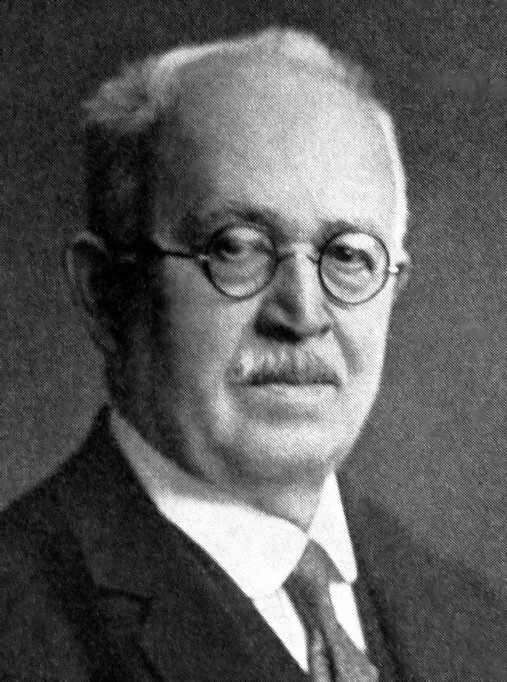
Václav Jan Láska (24 August 1862 – 27 July 1943) was a Czech surveyor, astronomer, geophysicist and mathematician. He was based mainly at Charles University, and was the founding director (1920–1933) of the State Institute of Geophysics, which later became the Institute of Geophysics of the Czech Academy of Sciences.
Láska was born on 24 August 1862 in Prague. He graduated from the Faculty of Arts, Charles University in Prague (that time called Charles-Ferdinand University). After his studies, he worked as an astronomer at the Clementinum observatory, but left due to the low salary and began to study geodesy. He died on 27 July 1943 in Řevnice.[1]
Láska’s empirical rule
[edit]

This empirical rule is one way how to approximate the distance from an earthquake’s epicenter. The rule is most fitting for distance in the range of 2 − 10 Mm (thousand km). The epicentral distance in thousands of km is roughly equal to the difference between arrival times of S and P waves in minutes minus 1.

