


Link suggestions feature: 3 links added.
| ← Previous revision | Revision as of 10:22, 3 January 2026 | ||
| Line 13: | Line 13: | ||
|
The formation also allowed the fliers to see one another and communicate by hand signals and allowed them to stay together in poor visibility or cloud.
|
The formation also allowed the fliers to see one another and communicate by hand signals and allowed them to stay together in poor visibility or cloud.
|
||
|
Later, when bomber and reconnaissance flights came under attack from fighter aircraft, the Vic proved to have good defensive characteristics. Pilots, looking inwards to maintain formation, could overlook one another for attackers, and their observer/rear gunners could use [[crossfire|interlocking fire]] to protect one another.
|
Later, when bomber and reconnaissance flights came under attack from fighter aircraft, the Vic proved to have good defensive characteristics. Pilots, looking inwards to maintain formation, could overlook one another for attackers, and their observer/rear gunners could use [[crossfire|interlocking fire]] to protect one another.
|
||
|
The Vic was the basic flying formation adopted by every major air force. The [[French Air Force]] referred to it as the ”Chevron”, and the [[Imperial German Army Air Service]] it was the ”Kette”.
|
The Vic was the basic flying formation adopted by every major air force. The [[French Air Force]] referred to it as the ”Chevron”, and the [[Imperial German Army Air Service]] it was the ”Kette”.
|
||
|
It remained the standard formation throughout the interwar period and into the [[Second World War]].
|
It remained the standard formation throughout the interwar period and into the [[Second World War]].
|
||
|
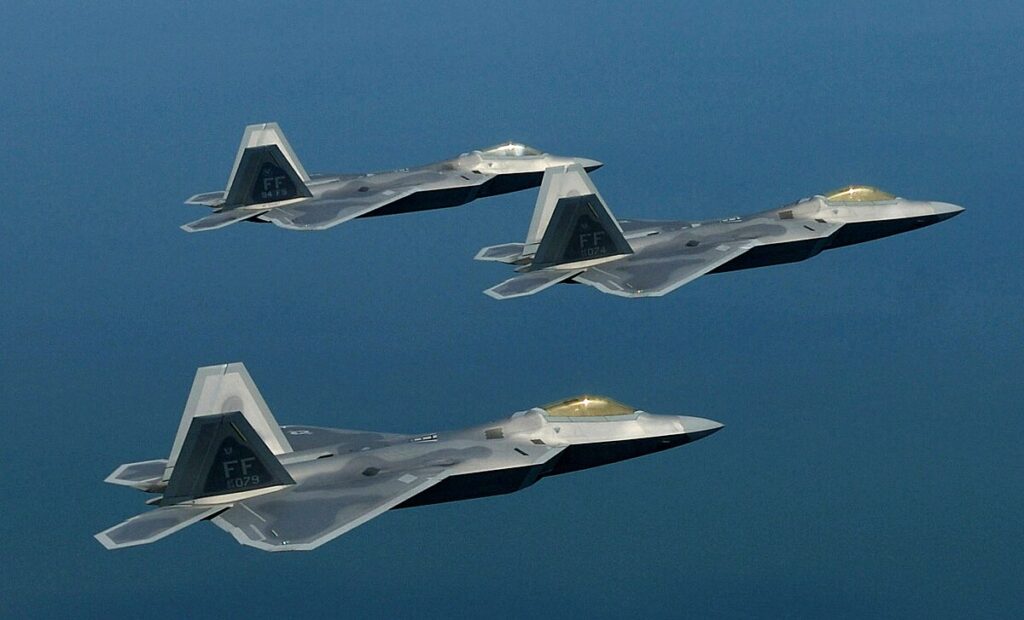
The basic unit was the three-plane section in a Vic. Two sections made up a flight and two flights a squadron. Squadrons would fly in line astern, one Vic behind another, which left the squadron leader effectively the only person looking for the enemy.
|
The basic unit was the three-plane section in a Vic. Two sections made up a flight and two flights a squadron. Squadrons would fly in line astern, one Vic behind another, which left the squadron leader effectively the only person looking for the enemy.
|
||
|
[[File:Royal Air Force Fighter Command, 1939-1945. CH2573.jpg|250px|thumbnail|right|Curtiss P.40s in Vic formation]]
|
[[File:Royal Air Force Fighter Command, 1939-1945. CH2573.jpg|250px|thumbnail|right|Curtiss P.40s in Vic formation]]
|
||
|
At the outbreak of the Second World War, the Vic was still in use by both bombers and fighter formations in most air forces, but the Finnish and German air forces fighter units had changed to the more flexible and aggressive pair (”Rotte”) and four (”Schwarm”) combination. They comprised a pair (leader and wingman) and four (two pairs) in a “[[finger-four]]” arrangement
|
At the outbreak of the Second World War, the Vic was still in use by both bombers and fighter formations in most air forces, but the Finnish and German air forces fighter units had changed to the more flexible and aggressive pair (”Rotte”) and four (”Schwarm”) combination. They comprised a pair (leader and wingman) and four (two pairs) in a “[[finger-four]]” arrangement
|
||
| Line 24: | Line 24: | ||
|
The ”[[Luftwaffe]]” pilots were disparaging about the RAF’s use of the Vic formation during the Battle of Britain, but in practice, there was little else that Allied pilots could do. Germany, as the aggressor, had the choice of how and when to attack, and, based on its experience during the [[Spanish Civil War]], it had changed and developed its tactics accordingly. [[Fighter Command]] could only improvise until the battle was over before it reviewed and made changes. As an interim method, RAF adopted the line astern formation on which four-plane flights flew behind one another. Luftwaffe related to them derisively by calling them ”Idiotenreihen” (“rows of idiots”)<ref>Holmes p 61</ref>
|
The ”[[Luftwaffe]]” pilots were disparaging about the RAF’s use of the Vic formation during the Battle of Britain, but in practice, there was little else that Allied pilots could do. Germany, as the aggressor, had the choice of how and when to attack, and, based on its experience during the [[Spanish Civil War]], it had changed and developed its tactics accordingly. [[Fighter Command]] could only improvise until the battle was over before it reviewed and made changes. As an interim method, RAF adopted the line astern formation on which four-plane flights flew behind one another. Luftwaffe related to them derisively by calling them ”Idiotenreihen” (“rows of idiots”)<ref>Holmes p 61</ref>
|
||
|
Bob Oxspring, a pilot officer in 66 Squadron and a future ace, commented:
|
Bob Oxspring, a pilot officer in 66 Squadron and a future ace, commented:
|
||
|
<blockquote>
|
<blockquote>
|
||
|
“We knew there was a lot wrong with our tactics during the [[Battle of Britain]] but it was one hell of a time to alter everything we had practiced.
|
“We knew there was a lot wrong with our tactics during the [[Battle of Britain]] but it was one hell of a time to alter everything we had practiced.
|
||



