


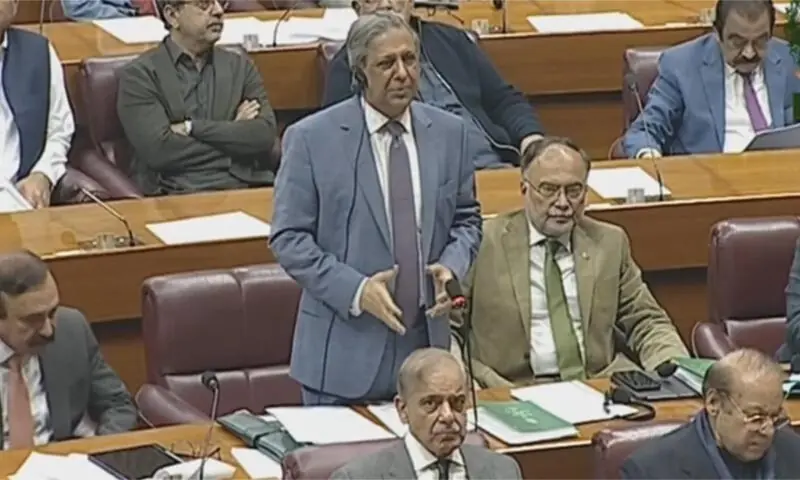
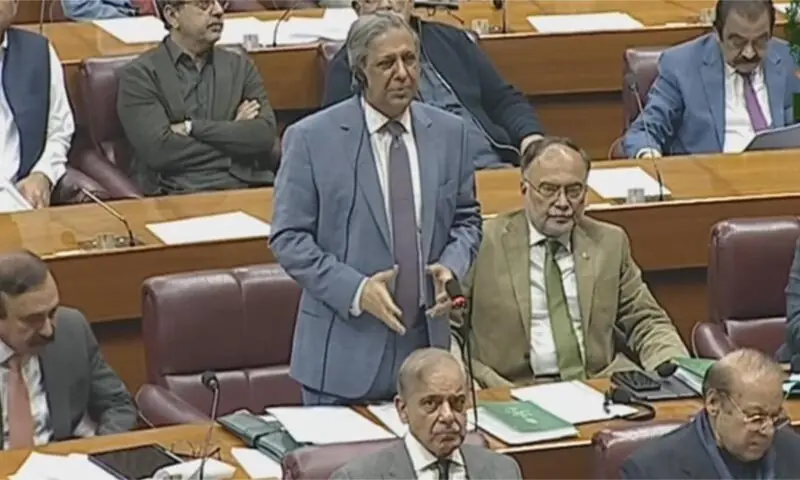
The National Assembly on Wednesday passed the 27th Constitutional Amendment Bill during a ruckus-marred session attended by political heavyweights, including Prime Minister Shehbaz Sharif, PML-N President Nawaz Sharif and PPP Chairman Bilawal Bhutto-Zardari.
The bill was passed by a two-way voting process — voting by division and clause-by-clause voting. Presented in the house for voting by Law Minister Azam Nazeer Tarar, the bill will now be referred back to the Senate for the new amendments to be debated upon again and then will be passed by the upper house.
During the session, Tarar presented a list of amendments to the bill, while also omitting some of the bill’s clauses.
Amendments and substitutions
Substitution of Clause 2
Clause 2 of the 27th Amendment Bill, 2025, dealt with an amendment to Article 10(4)(1) of the Constitution (safeguards as to arrest and detention), which deals with the formation of a review board in case someone is detained under a federal law, with the board appointed by the chief justice of Pakistan. The amendment sought to insert the words “Supreme Court of” in front of the “Chief Justice of”.
In a later change to Clause 2 of the bill, the amendment to Article 10 was substituted with an amendment to Article 6 of the Constitution, which deals with high treason. It sought to amend Clause 2A of the Article, which reads as follows:
An act of high treason mentioned in clause (1) or clause (2) shall not be validated by any court including the Supreme Court and a High Court.
In the later amendment, it was stated that after the word “the”, the words “Federal Constitutional Court” and a comma would be inserted.
Insertion of Clause 2A to the bill
The law minister added that Clause 2A would be inserted into the bill, which reads as follows:
2A: Amendment of Article 10. In the Constitution, in Article 10, in clause (4), in Explanation I, after the word “of” occurring for the second time, the words “Supreme Court of” shall be inserted.
Substitution of Clause 23
In the bill, Clause 23 would deal with an amendment to Article 176, which deals with the composition of the Supreme Court. The proposed amendment sought to insert the words “of Supreme Court” after the second mention of “Justice”.
In the later amendment, a substitution was proposed to Clause 23 of the bill, where the full stop at the end of the Article would be replaced by a colon and the following:
“For the full stop, at the end, a colon shall be substituted and thereafter the following proviso shall be added, namely: ‘Provided that and notwithstanding anything contained in the Constitution, the incumbent Chief Justice shall be and continue to be known as the Chief Justice of Pakistan during his term in office’.”
Amendment of Clause 56
In the bill, an amendment to Clause 1 of Article 260 (definitions) was proposed, specifically for the definition of the chief justice. The article states:
“Chief Justice”, in relation to the Supreme Court or a High Court, includes the Judge for the time being acting as Chief Justice of the Court.
The amendment in the bill sought to add the words “Federal Constitutional Court” to clauses and sub-clauses of Article 260. A later amendment stated that Sub-clause AB would be inserted in Clause 56, sub-clause A of the bill, which states:
In the definition of “Chief Justice“, after the word “the”, occurring for the first time, the words “Federal Constitutional Court or the” shall be inserted. [sic]
Sub-clause AB states that after the amended definition of the chief justice, the following new definition will be inserted:
“Chief Justice of Pakistan” means the senior amongst the Chief Justice of the Federal Constitutional Court and the Chief Justice of Supreme Court.“
Omissions
Omission of Clause 4
Some of the proposed changes in the bill were omitted during the reading, one of which was Clause 4 of the bill.
Clause 4 would amend Article 42 of the Constitution, which reads as follows:
Before entering upon office, the President shall make before the Chief Justice of Pakistan oath in the form set out in the Third Schedule.
The proposed amendment would have seen the word “Pakistan” replaced with “the Federal Constitutional Court”.
Omission of Clause 19
Clause 19 of the bill proposed an amendment to Article 168 of the Constitution, which mandates that there will be an Auditor-General who is appointed by the president. There was meant to be an amendment to Clause 2 of Article 168, which reads as follows:
Before entering upon office, the Auditor-General shall make before the Chief Justice of Pakistan oath in the form set out in the Third Schedule.
The amendment in the bill would insert the words “Supreme Court of” after the words “Chief Justice of”.
Omission of Clause 51
Clause 51 of the bill proposed an amendment to Article 214 of the Constitution, which states that the Chief Election Commissioner must swear an oath to the chief justice before assuming office, as follows:
Before entering upon office, the Commissioner shall make before the Chief Justice of Pakistan [and a member of the Election Commission shall make before the Commissioner] oath in the form set-out in the Third Schedule
The amendment was to replace the word “Pakistan” in the Article with the words “Federal Constitutional Court”.
Omission of Clause 55
Clause 55 of the bill proposed an amendment to Clause 2 of Article 255 (oath of office), which states that if someone cannot take the oath of office before “a specified person”, the chief justice can swear them in, as follows:
Where, under the Constitution, an oath is required to be made before a specified person and, for any reason, it is impracticable for the oath to be made before that person, it may be made before such other person as may be nominated by 3 [the Chief Justice of a High Court, in case of a Province and by the Chief Justice of Pakistan, in all other cases]
The bill proposed an amendment to the second clause of Article 255, substituting the word “Pakistan” with the words “Federal Constitutional Court”.



