
From Wikipedia, the free encyclopedia
Content deleted Content added
| Line 221: | Line 221: | ||
|
* [[User:Ryanhong1|Ryanhong1]] ([[User talk:Ryanhong1|talk]]) 21:44, 30 September 2025 (UTC) |
* [[User:Ryanhong1|Ryanhong1]] ([[User talk:Ryanhong1|talk]]) 21:44, 30 September 2025 (UTC) |
||
|
* [[User:Shriyahk|Shriyahk]] ([[User talk:Shriyahk|talk]]) 21:44, 30 September 2025 (UTC) |
|||
Revision as of 21:44, 30 September 2025
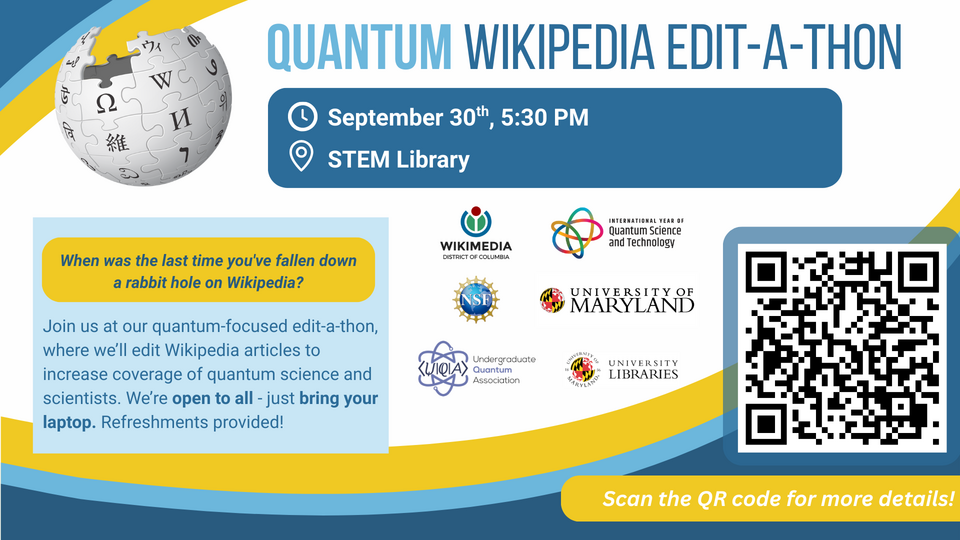
Quantum Wikipedia Edit-a-thon
Presented by the University of Maryland Libraries with support from the Undergraduate Quantum Association and Wikimedia DC
When
- September 30, 2025 – 5:30pm-8:30pm

Where
- University of Maryland STEM Library
- 4176 Campus Drive William E. Kirwan Hall, Room 1403
- College Park, MD 20742
Description
- Join the Undergraduate Quantum Association, University of Maryland Libraries and Wikimedia DC for a special Wikipedia editing session focused on expanding and improving articles about notable figures and key concepts in quantum science and engineering. Whether you’re new to editing or already have experience, you’ll get the tools and support you need to make meaningful contributions. The event will include hands-on training and dedicated time for research and editing.
- Please bring your laptop if you can. If you will need a computer please indicate this when you register.
- The public entrance to the STEM library can be found inside William E. Kirwan Hall at the north end of the building. From the main entrance at 4176 Campus Drive, follow the signs to the end of the right hand hallway. Accessible entrances are located north of the main entrance and in the rear courtyard via Chemistry Lane. More information can be found on the library’s website.
Register
START HERE
Step 1:
- Create a Wikipedia username if you don’t already have one (top right) and log-in
- Already have an account? Simply log-in (top right)
- Usernames are public. You do not have to use your real name.
Step 2:
- Check-in for this event using the blue button below. This helps us to track editing progress during the edit-a-thon.
- 1) Select ‘Check in’
- 2) Scroll down on the page that follows and click ‘Publish changes’. DO NOT ADD TEXT TO THE FIELD.
- Your username will automatically be added to the list of attendees.
Articles to create or edit
Instructions
- Go to this Google sheet and add your username next to the article you would like to edit or create
- Return here to the event page and select your article’s red or blue link. Red=New draft articles for creation, Blue=Existing articles
- Select ‘Create’ (for new articles), and ‘Edit’ for existing articles
- For new articles, start by adding a ‘References’ header at the bottom. Return to the top and start writing. Publish as you go to avoid losing your work.
- Use the sources below each article name to find information and build your article/s. Be sure to cite your sources.
- Use this research guide to help find further sources if needed.
Tip: Open this event page in multiple tabs. You will need it quite often (mostly for sourcing) and it’s easy to close inadvertently.
IF CREATING A DRAFT – DO NOT HIT THE ‘SUBMIT FOR REVIEW’ BUTTON THAT WILL EVENTUALLY APPEAR AT THE TOP OF THE PAGE. On-wiki review is optional. An experienced editor in the room can review your draft and offer feedback if you choose to have them do so.
Biographies
- Jessica Gaskin – Dr. Jessica Gaskin, NASA Marshall Space Flight Center. (n.d.). PBS LearningMedia.[1][2]
- Jean Dalibard – Physicist Jean Dalibard awarded the 2021 CNRS Gold Medal | CNRS. (2021, June 24). [6][7]
- Niels Quack – Not updated since 2020. Doesn’t reflect recent location.
Science concepts and topics
Quantum Tech Organizations
Article ratings
Learn more about the article rating system
- Wikimedia movement
- Wikipedia, a web-based encyclopedia
- Wikimedia Commons, a data repository of media (images, videos and sounds). (See * Wikiproject Wikimedia Commons:GLAM Wikiproject)
- Wikidata, a common source of data, also accessible by the other projects
- Wiktionary, a dictionary
- Wikibooks, educational textbooks
- Wikinews, news articles
- Wikiquote, a collection of quotations
- Wikisource, a library of source texts and documents
- Wikiversity, educational material
- Wikivoyage, a travel guide
- Wikispecies, a taxonomic catalogue of species
Wikipedia Policies
-
- Chapters
- Wikimedia chapters are independent organizations founded to support and promote the Wikimedia projects in a specified geographical region (in most cases, a country). Like the Wikimedia Foundation, they aim to “empower and engage people around the world to collect and develop educational content under a free license or in the public domain, and to disseminate it effectively and globally”. There are currently 39 chapters, with at least one on every inhabited continent., i.e. Wikimedia DC
- Chapters
-
- Wikimedia thematic organizations
- Thematic organizations are incorporated independent non-profits representing the Wikimedia movement and supporting work focused on a specific theme, topic, subject or issue within or across countries and regions. i.e., Wikimedia Medicine.
- Wikimedia thematic organizations
-
- User groups
- Wikimedia user groups are intended to be simple and flexible affiliates that are an alternative to chapters and thematic organizations – which require more formal requirements. User groups are highly valued as equal players in the Wikimedia movement, i.e., Art+Feminism
- User groups
WikiProjects
Quick Editing Tips

