


Marvel Comics fictional character
Comics character
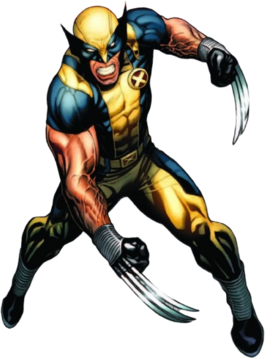
Wolverine is a superhero who appears in American comic books published by Marvel Comics. The character first appeared in the comic book The Incredible Hulk #180 in 1974, but is best known as a member of the superhero team the X-Men. Wolverine is the alias of James Howlett (also known as Logan), a mutant born in Canada in the late 19th century. He possesses a range of superpowers including highly advanced self-healing abilities, a significantly prolonged lifespan, animal-keen senses, and retractable claws. His skeleton is reinforced with the unbreakable fictional metal adamantium, which he acquired after becoming an unwilling test subject in the Weapon X super soldier program. Wolverine is commonly depicted as a gruff loner susceptible to animalistic “berserker rages” who struggles to reconcile his humanity with his wild nature.
The character was co-created by writer Len Wein and Marvel art director John Romita Sr., with his first published appearance written by Wein and drawn by artist Herb Trimpe. After joining the X-Men in 1975, the character was significantly developed by writer Chris Claremont, artist Dave Cockrum, and artist-writer John Byrne. He appeared in his first solo story in 1979, and gained greater prominence as a standalone character when artist Frank Miller collaborated with Claremont on a four-part eponymous limited series in 1982, which debuted Wolverine’s catchphrase “I’m the best there is at what I do, but what I do best isn’t very nice.”
Wolverine quickly emerged as the breakout character of the X-Men, and is among the most popular Marvel Comics characters. His willingness to use deadly force and his brooding loner nature became defining attributes of the many comic book antiheroes that emerged in the aftermath of the Vietnam War. In addition to his comic appearances, Wolverine has been depicted in a wide range of adapted and spin-off media, including televison, video games, and film. Actor Hugh Jackman has portrayed the character in eleven films, beginning with X-Men (2000) and most recently in Deadpool & Wolverine (2024).
Publication history
Creation and development

Marvel Comics editor-in-chief Roy Thomas wanted to create a Canadian superhero, and decided that wolverines were a characteric Canadian animal that could inspire such a hero. He asked artist John Romita Sr. and writer Len Wein to devise a character of Canadian origin named Wolverine. Romita designed Wolverine’s costume, and believes he introduced the retractable claws, saying: “When I make a design, I want it to be practical and functional. I thought, ‘If a man has claws like that, how does he scratch his nose or tie his shoelaces?'”[3] Wolverine first appeared in the final “teaser” panel of The Incredible Hulk #180 (cover-dated October 1974), written by Wein and penciled by Herb Trimpe. The character then appeared in a number of advertisements in various Marvel Comics publications before making his first major appearance in The Incredible Hulk #181 (November 1974), again by the Wein–Trimpe team. In 2009, Trimpe said he “distinctly remembers” Romita’s sketch and that, “The way I see it, [Romita and Wein] sewed the monster together and I shocked it to life”. According to him, Wolverine was initially conceived as a minor character and there were no plans for his continuing popularity.[4] Though sometimes credited as co-creator, Trimpe denied having had any role in Wolverine’s creation.[5] The character’s introduction was ambiguous, revealing little beyond his being a superhuman agent of the Canadian government. He appears briefly in the following issue’s conclusion to the story.
Wolverine’s next appearance was in Giant-Size X-Men (May 1975), written by Wein and penciled by Dave Cockrum, in which Wolverine is recruited for a new team of X-Men in order to rescue the original group.[7] Wolverine eventually became a fan favorite of the new team. Gil Kane illustrated the cover artwork but drew Wolverine’s mask with larger headpieces. Cockrum liked Kane’s accidental alteration, as he thought the original was too similar to Batman‘s mask, and decided to incorporate it into his own artwork for the actual story.[10]
At the time of his initial appearances, basic ideas about Wolverine’s abilities and origins remained in development. While some sources indicate that Wein originally intended for Logan to be a mutated wolverine cub, evolved to humanoid form by the High Evolutionary, an established geneticist in the Marvel Universe, Wein has denied this:
While I readily admit that my original idea was for Wolvie’s claws to extend from the backs of his gloves … I absolutely did not ever intend to make Logan a mutated wolverine. I write stories about human beings, not evolved animals (with apologies for any story I may have written that involved the High Evolutionary). The mutated wolverine thing came about long after I was no longer involved with the book. I’m not certain if the idea was first suggested by Chris Claremont, the late, much-missed Dave Cockrum, or John Byrne when he came aboard as artist, but it most certainly did not start with me.[13]
In an article about the evolution of Wolverine included in Incredible Hulk and Wolverine (1986), a reprint of The Incredible Hulk #180–181, Cockrum confirmed that he considered having the High Evolutionary play a vital role in making Wolverine a human.[14] In Wein’s original conception, Wolverine was a young adult, and his claws were retractable and part of his gloves, with both made of adamantium. Wein believes that it was Cockrum who first suggested that the claws were installed in Wolverine’s forearms.
1970s
Following Giant-Size X-Men, the X-Men comic was revived with issue #94 (August 1975), drawn by Cockrum and written by Chris Claremont. Wolverine is initially overshadowed by the other characters, although he creates tension in the team as he is attracted to Cyclops’ girlfriend, Jean Grey. As the series progressed, Claremont and Cockrum considered dropping Wolverine from the comic; Cockrum’s successor, artist John Byrne, championed the character, later explaining that, as a Canadian himself, he did not want to see the only Canadian character dropped. Byrne modeled his rendition of Wolverine on actor Paul D’Amato, who played Dr. Hook in the 1977 sports film Slap Shot.[17] Byrne also designed a new brown-and-tan costume for the character;[18] Cockrum had introduced a different new costume for Wolverine in the final issue of his run, but it was dropped one issue into Byrne’s run because he found it difficult to draw.[19]
Cockrum was the first artist to draw Wolverine without his mask, in X-Men #98 (April 1976); his distinctive hairstyle became a trademark of the character. Byrne had also drawn a possible face for Wolverine, without knowing Cockrum had already depicted the character unmasked. After realizing this, Byrne later used the drawing for the face of Sabretooth, an enemy of the martial artist superhero Iron Fist, also written by Claremont. Issue #98 also definitively established that Wolverine’s claws are an integrated part of his anatomy. X-Men #100 introduces the “fastball special”, a combat maneuver in which the super-strong Colossus throws Wolverine at a distance as if he were a projectile weapon; this tactic recurs in many future battles. Stories of the late 1970s establish Wolverine’s murky past and unstable nature, which he battles to keep in check. Wolverine’s name was revealed as “Logan” in X-Men #103 (February 1977); Claremont drew inspiration from Canada’s Mount Logan, liking the “the idea [of] the tallest mountain being the name of the shortest character”.[23] X-Men #116 (December 1978) first introduces Wolverine’s healing factor, and issue #124 (August 1979) first suggests that he has a reinforced skeleton.
1980s
In the last years of Byrne’s collaboration with Claremont, Wolverine played in a pivotal role in “The Dark Phoenix Saga” and “Days of Future Past” story arcs. Following Byrne’s departure in 1981, Wolverine remained a prominent character in Uncanny X-Men (as X-Men was retitled at this time) throughout the decade. Wolverine’s appearance and characterization were influenced by the film roles of Clint Eastwood, particularly the Revisionist Western antihero films featuring the Man with No Name; dialogue and scenes also pay homage to Eastwood’s 1971 neo-noir detective film Dirty Harry. The character’s growing popularity led to a solo, four-issue series, Wolverine (September–December 1982), by Claremont and Frank Miller. Elliott Serrano, a comic writer and commentator, argues that this series was particularly significant in establishing the character’s popularity: “Before Claremont and Miller created the Wolverine series, Logan wasn’t a key figure, but the creation of this series is when Wolverine became Marvel’s Batman.” The Claremont and Miller miniseries introduced Wolverine’s connection to traditional Japanese culture and his identity as a masterless samurai. The mini-series was followed by the six-issue Kitty Pryde and Wolverine by Claremont and Al Milgrom (Nov. 1984 – April 1985).
Barry Windsor-Smith, who had come to prominence illustrating Marvel’s Conan the Barbarian series, collaborated with Claremont for the “Wounded Wolf” story that was published as Uncanny X-Men #205 (May 1986), focusing entirely on Wolverine. The story introduced a new adversary for Wolverine, Lady Deathstrike. The “Mutant Massacre” story arc of 1986 brought Sabretooth, a villain Claremont and Byrne had earlier created for Iron Fist, into conflict with the X-Men and particularly Wolverine. Marvel launched an ongoing solo book written by Claremont with art by John Buscema in November 1988. In the late 1980s, Wolverine featured in crossover graphic novels with two other characters: Spider-Man, in Spider-Man versus Wolverine (1987), by Christopher Priest and M.D. Bright, and Nick Fury, in Wolverine/Nick Fury: The Scorpio Connection (1989), written by Archie Goodwin with art by Howard Chaykin.
1990s
In the early 1990s, Wolverine featured as a prominent character in X-Men vol. 2, initially written by Chris Claremont and illustrated by Jim Lee. The first issue of this comic book series is the highest selling comic book in history. Larry Hama took over the ongoing solo series and had a seven-year run, from 1990 to 1997. In the first years of the 1990s, the series was usually illustrated by Marc Silvestri. Hama’s run included a storyline inspired by Ernest Hemingway‘s For Whom the Bell Tolls. Hama introduced “Albert,” a cyborg copy of Wolverine.
During this period, Wolverine also regularly appeared in cover stories for the anthology series Marvel Comics Presents. Among these stories was “Weapon X“, by writer-artist Barry Windsor-Smith, serialized in issues #72–84 (1991). The story depicts Wolverine’s past, how adamantium was grafted to his skeleton, and his experience of extreme psychological and physical trauma. Subsequent stories in this publication were often illustrated by Sam Kieth and had a more psychedelic aesthetic and storytelling style.[41]
In the main solo title, Hama also delved into Wolverine’s mysterious past in the Weapon X program, which was often highly convoluted and unreliable because of the false memories implanted by the program’s designers. In 1992, Hama revisited the Japanese setting and characters of Claremont’s and Miller’s earlier limited series, ending the story with the poisoning of Mariko Yashida and her mercy killing at the hands of Wolverine. Hama credited the influence of Yakuza films as well as Ridley Scott’s Black Rain. Himself a Japanese American, Hama argued that his depiction was somewhat more authentic than previous American superhero stories told in Japan.[42]
In 1991, Wolverine also appeared in a one-shot story written by Howard Mackie and penciled by John Romita Jr., co-starring Punisher and Ghost Rider. John Romita Jr. acknowledged primarily commercial motivations, because, as he said at the time, these three “are the top characters, right now.”[43]
In 1993, Wolverine’s adamantium is ripped out by Magneto in X-Men (Vol 2) #25. Writers were inspired by a suggestion of Peter David‘s. The story goes on to reveal that Wolverine has natural bone claws, in contrast to previously established narrative continuity that his claws were entirely bionic. Wolverine himself is confused by this realization, and his healing factor is also greatly weakened by recovery from this extraordinary injury. He leaves the X-Men temporarily as a result.
In 1995, all of the X-Men related comic books were temporarily replaced by a storyline in an alternate reality, named Age of Apocalypse. The Wolverine series was replaced by a series called Weapon X (not to be confused with the origin story published in 1991), in which Logan is generally referred to by this code name rather than as Wolverine. In this reality, Logan still has his adamantium, but is missing a hand. He and Jean Grey are lovers in this reality.
Following the return to the original timeline, a follower of Apocalypse captures Wolverine and attempts to bond adamantium to his skeleton a second time, with the goal of making him one of Apocalypse’s warriors. However, Wolverine’s healing factor and willpower reject the process; the ensuing stress leads him to regress into a bestial state. Stick, the former mentor of Daredevil, sends Elektra to re-train Wolverine, and heal his psyche. For a few issues, Wolverine remains in a bestial state in which he is less articulate and shrewd.
2000s
Sales for X-Men comics declined somewhat at the turn of the 21st century, and Grant Morrison was hired to revive interest in the characters, including Wolverine, by means of the more experimental New X-Men. Frank Quitely and Chris Bachalo drew many of these issues, as well as a returning Mark Silvestri. Subsequently, he featured in the Astonishing X-Men series initially written by Joss Whedon and illustrated by John Cassaday.[48]
When the Ultimate Marvel imprint was created with reimagined versions of Marvel’s characters, an alternate Wolverine appeared in 2001 with the Ultimate X-Men. The series was initially written by Mark Millar, who went on to write a number of other influential stories about Wolverine, in both mainstream continuity and alternate versions. This version of the character is significantly more aggressive and amoral.
Another publication expanded upon the character’s past: Origin, a six-issue limited series by co-writers Joe Quesada, Paul Jenkins, and Bill Jemas and artist Andy Kubert (Nov. 2001 – July 2002). This story first provided Wolverine’s birth name (James Howlett) and fleshed out many details of his childhood and adolescence that were previously mysterious. Tom DeSanto, a writer and producer for the X-Men film franchise, indicates that Marvel felt the necessity to provide a definitive origin for Wolverine because of his success as a film character and concern that the films would begin to answer these questions if the comic books did not do so first.[52]
Following Larry Hama’s exit from the Wolverine solo title, Mark Millar became a particularly influential writer for the character. In 2004, Millar wrote the “Enemy of the State” storyline in Wolverine vol. 3, in which Wolverine is brainwashed by the ninja secret society the Hand. Before returning to consciousness, he kills numerous innocent people. As in his previous bestial state, Elektra helps him to recover humanity. In 2008, Millar and artist Steve McNiven explored a possible future for Wolverine in an eight-issue story arc entitled “Old Man Logan” that debuted with Wolverine #66.
In 2005, at the conclusion of the House of M storyline, Wolverine regains the memories he had lost or repressed. The following year, a second solo series, Wolverine: Origins, written by Daniel Way with art by Steve Dillon, ran concurrently with the second Wolverine solo series. In the series, Wolverine delves into the ramifications of his newly remembered past. The series introduces Daken, Wolverine’s son, in issue #11 (April 2007). In the “Decimation” storyline, 90% of mutants lose their powers. Wolverine is among the 198 mutants who retain their powers.
In 2007, Jason Aaron became a prominent writer for the character, in a new ongoing series as well as in a new X-Men storyline, X-Men: Schism.
In Uncanny X-Men #493 (February 2008), part of the Messiah Complex storyline, Cyclops asks Wolverine to re-form and lead X-Force. This new, more militaristic sub-team of the X-Men initially includes X-23 (Wolverine’s daughter), Warpath, Hepzibah, Caliban, and Wolfsbane. The new team featured in its own ongoing series, written by Craig Kyle and Christopher Yost, from 2008 to 2010.
2010s and 2020s
Jason Aaron continued writing Wolverine stories prolifically in this decade. In addition to multiple solo stories, Aaron wrote Wolverine and the X-Men, in which Wolverine becomes the headmaster of the Jean Grey School for Higher Learning and must mentor a younger generation of mutants as well as leading one of the X-Men teams.
Wolverine also joins the Avengers. He appears as a regular character throughout both the 2010–2013 Avengers series and the 2010–2013 New Avengers series. In the Avengers vs. X-Men storyline of 2012, Wolverine sides with the Avengers against his previous team.
In 2014, Charles Soule wrote the Death of Wolverine storyline. In this story, Wolverine contracts a virus that disables his healing factor, allowing his enemies to finally kill him. He is eventually resurrected.
2019 begins a new era for the X-Men. Beginning in House of X and Powers of X, by Jonathan Hickman, the mutants found a new nation on the living island of Krakoa, where they are capable of regularly resurrecting mutants after their death. In 2019, Wolverine also features as part of the Savage Avengers, along with Punisher, Elektra, Venom, Brother Voodoo, and Conan the Barbarian.
Wolverine continued to appear in a number of series in the 2020s, both as a solo character and as part of multiple teams. As the Krakoa era continued for all of the X-Men characters, Benjamin Percy wrote a new Wolverine ongoing series beginning in 2020, along with his leadership role in the X-Force series.
Fictional character biography
Wolverine was born as “James Howlett” in northern Alberta, Canada (approximately near Cold Lake), during the late 19th century, purportedly to rich farm owners John and Elizabeth Howlett. However, Wolverine is actually the result of an extramarital affair between Elizabeth and the family’s groundskeeper Thomas Logan. Thomas is also the father of Dog Logan, Wolverine’s half-brother. Thomas is expelled from the Howletts’ property following an attempted sexual assault by Dog, Thomas returns to the Howlett manor and kills John Howlett. In retaliation, young James kills Thomas with bone claws that emerge from the back of his hands, as his mutation manifests. He flees with his childhood companion, Rose, and grows into manhood on a mining colony in the Yukon, adopting the name “Logan”. When Logan accidentally kills Rose with his claws, he flees the colony and lives in the wilderness among wolves.
Logan returns to civilization, residing with the Blackfoot people. Following the apparent death of his Blackfoot lover, Silver Fox, at the hands of Victor Creed, now known as Sabretooth, he is ushered into the Canadian military during World War I.
During World War II, Logan teams up with Captain America, and continues a career as a mercenary. He serves with the 1st Canadian Parachute Battalion during D-Day. He spends time in Madripoor before settling in Japan, where he marries Itsu. While Logan is away from home, Romulus sends the Winter Soldier to kill the pregnant Itsu and has her baby taken from her womb. The boy would later become Daken. Logan believed his son to be dead for many years. He later works for the Central Intelligence Agency before being recruited by Team X, a black ops unit.
As a member of Team X, Logan is given false memory implants. Eventually breaking free of this mental control, he joins the Canadian Defense Ministry. Logan is subsequently kidnapped by the Weapon X program, where he remains captive and experimented on, until he escapes. It is during his imprisonment by Weapon X that he has adamantium forcibly fused onto his bones. James and Heather Hudson help him recover his humanity following his escape, and Logan begins work as an intelligence operative for the Canadian government’s Department H.
He becomes Wolverine, one of Canada’s first superheroes. In his first mission, he is dispatched to stop the destruction caused by a brawl between the Hulk and the Wendigo. Professor Charles Xavier recruits Wolverine to a new iteration of his superhero-mutant team, the X-Men, along with Banshee, Storm, Nightcrawler, and Colossus. He competes with Cyclops for the affection of Jean Grey.
Jean Grey apparently sacrifices herself after transforming into the Phoenix Force, thereby temporarily ending the love triangle among herself, Wolverine, and Cyclops. While his teammates often distrust him, Wolverine is invaluable in rescuing the others and defeating their enemies, particularly in their conflict with the Hellfire Club.
He becomes engaged to Mariko Yashida and battles The Hand. However, the engagement is broken because of the intervention of a member of the Hellfire Club. He becomes a close defender and mentor for Kitty Pryde. He battles Sabretooth during the Mutant Massacre story line, though he later discovers that he had many previous interactions with Sabretooth that his traumatic amnesia concealed. Separate from the X-Men, he has adventures in Madripoor disguised as his alter ego “Patch.”
He is a mentor for Jubilee. Jean Grey is resurrected, leading to resumption of his rivalry with Cyclops.
He also discovers some aspects of the trauma and brainwashing he received from the Weapon X program, although his memories remain unreliable. He meets Maverick, another former participant in the Weapon X project, and discovers that he had previously worked together with Sabretooth in a covert team subsequent to the project.
The supervillain Magneto forcibly removes the adamantium from Wolverine’s skeleton. This massive trauma causes his healing factor to burn out and also leads to the discovery that his claws are actually bone. Wolverine leaves the X-Men for a time, embarking on a series of adventures during which his healing factor returns. After his return to the X-Men, Cable‘s son Genesis kidnaps Wolverine and attempts to re-bond adamantium to his skeleton. This is unsuccessful and causes Wolverine’s mutation to accelerate out of control. Feral by nature, Wolverine’s mutation process will eventually cause him to degenerate physically into a more primitive, bestial state. Elektra helps him to recover his humanity. Eventually, the villain Apocalypse captures Wolverine, brainwashes him into becoming the Horseman Death, and successfully re-bonds adamantium to his skeleton. Wolverine overcomes Apocalypse’s programming and returns to the X-Men. Jean Grey becomes again possessed by the Phoenix Force, and Wolverine has no other choice but to kill her with his claws.
Wolverine learns about the existence of X-23. He initially believes her to be a clone, raised to be a perfect assassin. X-23 later goes by the name Laura. She is eventually enrolled at the Xavier Institute, with her true origin being kept secret as Logan’s way of protecting her. She quickly accepts Wolverine as a father figure, and eventually learns that he is actually her biological father. Wolverine is brainwashed by the Hand. He battles S.H.I.E.L.D., but eventually turns against the Hand with the help of Elektra. Scarlet Witch drastically transforms reality. As a consequence, Wolverine is able to recall memories of his previous life, overcoming his previous traumatic amnesia. He discovers that he has a son named Daken, who has been brainwashed and made a living weapon. Cyclops orders Wolverine to reform X-Force.
.jpg)
Wolverine splits with Cyclops and opens a new school in Westchester, New York, the “Jean Grey School for Higher Learning“. The Phoenix Force returns to Earth, and this produces conflict between the X-Men and the Avengers. Wolverine takes the side of the Avengers. Cyclops becomes possessed by the Phoenix Force and kills Professor X.
A virus turns off Wolverine’s healing factor. Wolverine determines that Doctor Abraham Cornelius, the founder of the Weapon X program, has placed a bounty on his head. Wolverine gets covered in adamantium after confronting him, and dies from suffocation. X-23 begins wearing a variation of Wolverine’s costume and adopts his codename. The X-Men set up Wolverine’s ‘public’ grave in the cabin and remove his body from the adamantium shell by having Kitty phase his corpse out of it. They bury him in a secret place. Wolverine is eventually resurrected by Persephone, a mutant who can raise the dead.
Wolverine joins the X-Men to attack Orchis‘s Mother Mold solar orbiting space station. Wolverine and Nightcrawler volunteer for a suicide mission to teleport into the vacuum of space. Wolverine and Nightcrawler are both killed. Wolverine, along with the other X-Men who perished in the attack on the Mother Mold space station, are then resurrected in the Arbor Magus’ hatchery on the Pacific island of Krakoa using a new 48 hour cloning process. In this era, the X-Men have learned how to resurrect any mutant who has died. He enters into a violent conflict with Beast, who has become aggressive and paranoid in his defense of Krakoa.
Personality and themes
Animal and human nature
Chris Claremont indicates that one of the main themes of Wolverine’s character is his struggle to maintain his humanity and to reconcile it with his wild, animal nature.[92] This theme recurs through Wolverine stories, such as in the period in which he temporarily regresses into a bestial state. Claremont compared Wolverine to Hulk, because of his tendency to lapse into a “berserker rage” while in close combat. In this state, he lashes out with the intensity and aggression of an enraged animal.
Military experience and samurai aspiration
The essence of [Logan’s] character [is] a “failed samurai”. To Samurai, duty is all, selfless service the path to their ultimate ambition, death with grace. – Chris Claremont[95]
Claremont says that he drew some of his characterization of Wolverine from Conan the Barbarian, declaring that “Wolverine in his essence is a lot closer to Conan than any other Marvel hero we have.”[92] Like Conan, Wolverine is a perennial warrior. Various stories depict Wolverine’s experiences in various historical and fictional wars, such as World War I, the Spanish Civil War, World War II, the Vietnam War, and various Cold War conflicts; as well as attempts to train him or brainwash him into a weapon to be controlled by larger institutions or entities.[96] Despite his apparent ease at taking lives, he mournfully regrets this and does not enjoy killing or giving in to his berserker rages. Logan adheres to a firm code of personal honor and morality, and he generally only responds in a violent or deadly manner to enemies attacking him with deadly force. He often tries to restrict killing to a “last resort,” though he will often respond to deadly force with deadly force.
Mental health struggles and psychological profile
Wolverine is frequently depicted as a gruff loner, often taking leave from the X-Men to deal with personal issues or problems. He is often irreverent and rebellious towards authority figures, though he is a reliable ally and capable leader, and has occasionally displayed a wry, sarcastic sense of humor. J. Andrew Deman points out that while Wolverine is commonly associated with hypermasculinity, at least in Claremont’s characterization he also “consistently demonstrates an emotional intelligence and sense of empathy,” to an extraordinary degree.
Psychologist Suzana E. Flores writes that Wolverine demonstrates clinical psychological symptoms of post-traumatic stress disorder, bipolar disorder, antisocial personality disorder, dissociative disorder, and even sociopathy, but does so in a way that can be understood and empathized. She interprets his origin story as a depiction of complex childhood trauma, and its effects of dissociative amnesia and hypervigilance.
Larry Yarbrough, a clinical psychologist and Navy veteran, says that some of Wolverine’s personality traits are typical of combat veterans: “The violent/kind demeanor of vets who witnessed war is paradoxical. Logan has an extremely reactive temper, but he’s also a kind person. The violent mood swings are a symptom of trauma, not a reflection of his character.” Yarbrough also observes Wolverine’s habitual smoking and drinking, as coping mechanisms for this experience of trauma.
In addition, Wolverine practices zazen sitting meditation to maintain self-control and restore mental health.
Canadian identity
Wolverine is the best known Canadian superhero. In civilian clothes, he usually dresses in Western wear characteristic of Saskatchewan and Alberta (one of the early Wolverine artists, John Byrne, was raised in the latter of these provinces). Vivian Zenari has written about Wolverine’s Canadian patriotism: “Wolverine must have national pride, almost out of structural necessity, in order to justify the Canadianness that coalesces around him.” His primary connection to Canada is his affinity for the wild outdoors.
Powers and abilities
Wolverine is a mutant with a number of natural and artificial abilities far beyond normal possibility, as well as many extraordinary skills.

Wolverine’s primary mutant power is an accelerated healing process, typically referred to as his mutant healing factor, that regenerates damaged or destroyed tissues of his body far beyond that of normal humans. In addition to accelerated healing of physical traumas, Wolverine’s healing factor makes him extraordinarily resistant to diseases, drugs and toxins. As a result of his healing factor, he has the appearance of a man in his early forties, although he is more than 100 years old.
His healing factor allowed him to survive the experimental surgical binding of the virtually indestructible metal adamantium to his bones and claws, to which he was subjected under the Weapon X program (in later comics called the Weapon Plus program). While the adamantium in his body prevents or reduces many injuries, such as broken bones and decapitation, his healing factor must also work constantly to prevent metal poisoning from killing him. The Muramasa blade, a katana of mystic origins that can inflict wounds that nullify superhuman healing factors, can suppress Wolverine’s powers.
Wolverine’s healing factor also affects a number of his physical attributes by increasing them to superhuman levels. His stamina is sufficiently heightened to the point that he can exert himself for hours. Wolverine’s agility and reflexes are also enhanced to levels that are beyond the physical limits of the finest human athlete. Due to his healing factor’s constant regenerative qualities, he can push his muscles beyond the limits of the human body without injury. He also has superhuman strength.
Wolverine’s senses of sight, smell, and hearing are all superhumanly acute. He can see with perfect clarity at greater distances than an ordinary human, even in near-total darkness. His hearing is enhanced in a similar manner, allowing him to hear sounds ordinary humans cannot and also hear to greater distances. A perfect example is him being able to hear the heartbeats of hostile living things before conflict begins.

He has three retractable claws made of bone housed within each forearm. Wolverine’s hands do not have openings for the claws to move through: they cut through his flesh every time he extrudes them. In most stories featuring Wolverine, his entire skeleton, including his claws, has been molecularly infused with adamantium. Due to their coating, his claws can cut almost any known solid material, including most metals, wood, and some varieties of stone. During and after the Return of Wolverine, he showcased a mysterious new ability where the adamantium in his claws can turn red-hot.
During Wolverine’s time in Japan and other countries, he became proficient in many forms of martial arts, with experience in many different fighting styles. He has trained in jiu-jitsu, judo, karate, escrima, and muay thai. He is proficient in many weapons, although he prefers bladed weapons to firearms.
In contrast to his brutish nature, Wolverine is extremely knowledgeable. Due in part to his longer lifespan, he has traveled around the world and amassed extensive knowledge of foreign languages and cultures, being fluent or near fluent in Japanese, Russian, Spanish, Cheyenne, and Lakota, among other languages. He is particularly fluent in Japanese due in part to his significant time spent in Japan and his relationship with Mariko Yashida.
Supporting cast
Wolverine was originally introduced as an antagonist of the Hulk. Subsequently, he became a member of the X-Men and has had extensive interactions with all of them and their associates. In particular, he has a complex ambivalent relationship with Cyclops, for whom he was initially a rival for the affections of Jean Grey. He is also a member of the Avengers and at times has joined the Fantastic Four.
He has been a mentor and father figure to several younger women, especially Jubilee, Kitty Pryde and X-23.
Enemies
Wolverine’s prominent enemies include Sabretooth, the Hellfire Club, Viper (Madame Hydra), and Lady Deathstrike.
Romantic interests
His first love was Rose O’Hara, a close friend who did not reciprocate his affection. She died accidentally at his hands when she intervened in Wolverine’s adolescent fight with an adversary, Dog. Subsequently, he had a long relationship with Silver Fox. He had an intimate relationship with Mariko Yashida and had a failed engagement to her. Mariko was eventually poisoned by The Hand and Wolverine had no choice but to kill her in order to spare her a long agony. He also had a mutual, but unfulfilled attraction to Jean Grey, leading to arguments with her boyfriend (and later husband), Scott Summers. He was briefly married to Viper, against his will. Wolverine has had an on-again, off-again romantic relationship with longtime teammate and friend, Storm. He also had romantic relationships with Yukio, Domino, and Mystique, all of whom are morally ambiguous warriors like himself.
Children
Wolverine has a number of children, most notably his daughter, Laura (X-23), and his son, Akihiro (Daken). A group of his other children, the Mongrels, were used in a plot to torture him by the Red Right Hand. He also has many children in other realities, such as Jimmy Hudson and Raze Darkhölme.[127]
Other versions
A number of alternate universes and alternate timelines in Marvel Comics publications allow writers to introduce variations on Wolverine, in which the character’s origins, behavior, and morality differ from the mainstream setting. For example, the Wolverine of the alternate future of Days of Future Past is a resistance fighter in a future where Sentinels rule the United States of America;. In the Age of Apocalypse story arc, Apocalypse dominates the earth, and Wolverine is missing a hand. In the alternate reality of Ultimate Marvel, Wolverine is initially an agent of Magneto. In the future of Old Man Logan, Wolverine has been tricked into killing the other X-Men and has subsequently renounced violence..
Reception and legacy
Popularity
Woverine is a very popular character. In 2008, Wizard magazine ranked Wolverine 1st in their “200 Greatest Comic Book Characters of All Time” list.[131] The same year, Empire ranked Wolverine 4th in their “50 Greatest Comic Book Characters” list.[132] In 2014, Entertainment Weekly ranked Wolverine 1st in their “Let’s rank every X-Man ever” list.[133]
Status as anti-hero
Wolverine is typical of the many tough antiheroes that emerged in American popular culture after the Vietnam War; his willingness to use deadly force and his brooding loner nature became standard characteristics for comic book antiheroes by the end of the 1980s.
Wolverine was considered groundbreaking among comic book superheroes in demonstrating the traits of an antihero. As psychologist Suzana E. Flores describes it, an antihero is “often psychologically damaged, simultaneously depicted as superior due to his superhuman abilities and inferior due to his impetuousness, irrationality, or lack of thoughtful evaluation.” Subsequent to Wolverine’s appearance, many more such antiheroes became popular in comic books (especially in the 1990s), such as Punisher, Marv, Spawn, and Deadpool.
Mental health analysis
Flores identified that Wolverine’s extraordinary popularity partly stems from his illustration of various mental health challenges, particularly recovery from major trauma or psychological trauma. She argues that his first formative trauma was his poor relationship with his mother, who was unable to properly attach to him because she lost her first son. In adulthood, he also suffered the trauma of torture by the Weapon X program. While the character is usually physically invincible, he demonstrates emotional and psychological vulnerability. He exemplifies values and aspirations of resilience for his audience. His fan base is primarily men, and generally he exemplifies a masculine perspective on recovery from trauma. However, Flores says that she also found the character therapeutic in her own recovery from rape.[140] Nnedi Okorafor, a Nigerian American science-fiction author, also writes that Wolverine was a therapeutic role model for her during her experience of paralysis following surgical treatment of scoliosis.[141]
Queer appeal and fandom

Wolverine is straight in the main continuity of the comics. One of the comics series, X-Treme X-Men (2012–2013), featured an alternate version of Wolverine who was in a relationship with Hercules,[144] and the two characters shared an on-panel kiss in issue #10.[145][146] In the fan community there are various memes and fan fiction stories that depict his relationship with Cyclops as homoerotic.[147] According to David Caballero of Comic Book Resources (CBR), the live-action film series “did a considerable yet unintentional job encouraging the ship”, which is one of the most popular X-Men-related ships on the fanfiction website Archive of Our Own.[148] It has been argued that one of the reasons for the pairing’s popularity is that “enemies-to-lovers stories remain a popular source of romantic entertainment”.[148]
Outside of his relationship with Cyclops, Screen Rant‘s Alex Schlesinger has argued that taking into account their history in comics, there is “some precedent set for Wolverine and Nightcrawler to be in an intimate relationship together”.[142] Wolverine #6 (2003), written by Greg Rucka, features a cover drawn by Esad Ribić.[143] The cover depicts Wolverine sitting on a chair, drinking beer, and staring at Nightcrawler.[143] Screen Rant noted how Nightcrawler is depicted in the nude, and that Wolverine is suggestively staring at his penis,[142] with CBR also noting that the beer he is holding resembling an erection.[143] According to Rucka, Ribić intentionally made the cover suggestive.[142] Collins described the cover as helping “bring [Wolverine’s queer appeal] to mainstream attention”.[149] According to Rucka, Ribić intentionally made the cover “salacious”, finding comedy in the fact that “nobody at Marvel noticed”.[142]
In 2012, ComicsAlliance assembled a panel consisting of various LGBT cartoonists, writers, editors, and journalists, to vote on which comics and characters had the biggest impact on them. As a group, the X-Men came in 13th place, with science fiction author and Doom Patrol writer Rachel Pollack stating that “the X-Men’s themes are indelibly queer”.[150] Wolverine was one of the individual X-Men singled out by many panel members as being of great importance to them, with some of the reasons provided being that he is “inspirational”,[150] while for others being their “first crush” as young queer comic readers.[150]
Writing for Bleeding Cool, comics writer and columnist Rich Johnston described Wolverine as a “gay icon amongst many”,[151] arguing that this was the case before Hugh Jackman first played the character in the live-action film series.[151] Hannah Collins of CBR also described Wolverine as a gay icon and argued that his appeal to queer fans is “largely invisible to heterosexual fans”.[149] Collins also described Wolverine’s muscular physique as similar to that of “the idealized men found [in] ‘Bara‘ manga“.[149] Echoing Collins’ statement over the character’s body, Ray Kampf described Wolverine in The Bear Handbook as an example of a bear in animation, with a contributor in the book who is gay admitting his attraction to the character growing up.

Wolverine is one of the few X-Men characters appearing in nearly every media adaptation of the X-Men franchise, including the 20th Century Fox X-Men films, television, computer and video games. Australian actor Hugh Jackman portrayed Wolverine in the X-Men films and until December 2021 shared the Guinness World Record of the “longest career as a live-action Marvel superhero” with Patrick Stewart.[154][155] Jackman would have regained that record in the 2024 film, Deadpool & Wolverine, but for the fact that Wesley Snipes reprised his even earlier role as the half-vampire Blade in the same film.[156][157]
References
- ^ The Incredible Hulk #181 Archived July 22, 2013, at the Wayback Machine at the Grand Comics Database.
- ^ Lovece, Frank (April 23, 2009). “Bellerose artist created X-Men’s Wolverine”. Newsday. Archived from the original on October 7, 2012.
- ^ Lovece, Frank (April 24, 2009). “Wolverine Origins: Marvel artists recall the creation of an icon”. Film Journal International. Archived from the original on May 5, 2009. Retrieved June 21, 2013.
- ^ Aushenker, Michael (April 2007). “The Son of Satan: A Trident True Devil Hero”. Back Issue! (21). TwoMorrows Publishing: 6–13.
- ^ Kreps, Daniel (September 11, 2017). “Len Wein, Comic Book Writer and Wolverine Co-Creator, Dead at 69”. Rolling Stone. Archived from the original on January 3, 2018. Retrieved January 2, 2018.
- ^ Cunningham, Brian (1996). “Dressed to Kill”. Wizard Tribute to Wolverine.
- ^ Wein, Len (February 24, 2009). “WeinWords”. Say What?. Archived from the original on October 18, 2010. Retrieved April 23, 2009.
- ^ Sanderson, Peter (w). “Wolverine: The Evolution of a Character” The Incredible Hulk and Wolverine, no. 1 (October 1, 1986). Marvel Comics.
- ^ Cronin, Brian (November 20, 2014). “Foggy Ruins of Time – John Byrne’s Inspiration for Wolverine” Archived August 1, 2016, at the Wayback Machine. Comic Book Resources.
- ^ Cronin, Brian (August 16, 2024). “Why Did Wolverine Stop Wearing His Brown Costume?”. Comic Book Resources. Valnet Inc. Retrieved October 15, 2025.
{{cite web}}: CS1 maint: url-status (link) - ^ Nickerson, Al (August 2008). “Claremont and Byrne: The Team that Made the X-Men Uncanny”. Back Issue! (29). Raleigh, North Carolina: TwoMorrows Publishing: 10.
- ^ Meenan, Devin (May 11, 2024). “Here’s Why Wolverine Is Called Logan”. Slashfilm. Retrieved May 14, 2024.
- ^ Cronin, Brian. “The Wolverine Artist Who Decided the Hero Didn’t Need Clothes.” CBR, Jan 2, 2024. [1]
- ^ Interview in Marvel Age #87, April 1990, collected in Wolverine Omnibus vol. 3.
- ^ John Romita Jr. interview, Marvel Age 108, January 1992, collected in Wolverine Omnibus vol. 3.
- ^ Lawson, Corrina. “Joss Whedon’s Astonishing X-Men in Animated Form.” Wired. April 4, 2012. [2]
- ^ Tom DeSanto, Wolverine: The Origin HC introduction, reprinted in Wolverine: Origin Deluxe Edition.
- ^ a b “The Mutant Report” vol. 3, Marvel Age 67, Oct. 1988, collected in Wolverine: Madripoor Nights, 2022.
- ^ Claremont, Chris (1987). Wolverine TPB.
- ^ “Every War Wolverine Fought in Marvel Comics, CBR
- ^ Hearn, Kayleigh (June 22, 2022). “All Of Wolverine’s Children Explained”. Looper.com. Looper. Retrieved January 31, 2025.
- ^ Wizard Staff (May 23, 2008). “The 200 Greatest Comic Book Characters of All Time: Numbers 20 to 1!”. WizardUniverse.com. Archived from the original on May 27, 2008. Retrieved January 2, 2018.
- ^ “The 50 Greatest Comic Book Characters”. Empire. July 2008. Archived from the original on January 6, 2010.
- ^ Franich, Darren. “Let’s rank every X-Man ever”. EW.com. Archived from the original on October 23, 2022. Retrieved November 15, 2022.
- ^ Flores, Suzana; TEDx Talks (March 30, 2018). “Untamed: What Wolverine Teaches Us About Rage | TEDxGrandCanyonUniversity”. YouTube.
- ^ Nnedi Okorafor, “Foreword”, Black Panther by Don McGregor, Rich Buckler, Billy Graham, Stan Lee, and Jack Kirby, Penguin Books, p. xviii-xix.
- ^ a b c d e Schlesinger, Alex (November 5, 2021). “Yes, Marvel Published a Steamy Wolverine Cover Without Realizing”. Screen Rant. Valnet Inc. Archived from the original on November 28, 2021. Retrieved March 17, 2022.
- ^ a b c d Cronin, Brian (December 29, 2017). “Comic Legends: The Racy Wolverine Cover That Got Past Marvel Editorial”. Comic Book Resources. Valnet Inc. Archived from the original on November 15, 2020. Retrieved March 17, 2022.
- ^ Scott, Marcus (August 6, 2013). “17 Gay Superhero Power Couples”. Out. Pride Media. Archived from the original on May 21, 2022. Retrieved March 11, 2023.
- ^ Peeples, Jase (February 26, 2013). “Wolverine and Hercules Share Kiss in Latest X-Men Issue”. The Advocate. Pride Media. Archived from the original on November 11, 2020. Retrieved March 17, 2022.
- ^ Sieczkowski, Cavan (February 25, 2013). “Wolverine, Hercules Share Gay Kiss In Alternate Universe”. HuffPost. BuzzFeed. Archived from the original on January 17, 2023. Retrieved January 17, 2023.
- ^ Schlesinger, Alex (November 10, 2022). “Wolverine Cosplay Adds a New Spin to Hilarious Meme Moment”. Screen Rant. Valnet Inc. Archived from the original on November 19, 2022. Retrieved January 27, 2023.
- ^ a b Caballero, David (September 10, 2022). “9 Most Popular X-Men Ships, Ranked By Ao3”. Comic Book Resources. Valnet Inc. Archived from the original on September 15, 2022. Retrieved March 11, 2023.
- ^ a b c Collins, Hannah (October 10, 2017). “Queer Heroes: 15 Superheroes Who Are Gay Icons”. Comic Book Resources. Valnet Inc. Archived from the original on October 19, 2021. Retrieved March 17, 2022.
- ^ a b c Wheeler, Andrew (June 29, 2012). “Comics Pride: 50 Comics and Characters That Resonate with LGBT Readers”. ComicsAlliance. Townsquare Media. Archived from the original on July 27, 2017. Retrieved March 17, 2022.
- ^ a b Johnston, Rich (September 27, 2012). “Marvel Presents… A Very Gay Wolverine”. Bleeding Cool. Avatar Press. Archived from the original on December 22, 2021. Retrieved March 17, 2022.
- ^ “Hugh Jackman surprised with record title to mark 17-year Wolverine career”. Guinness World Records. February 19, 2019. Archived from the original on January 27, 2022. Retrieved February 20, 2019.
- ^ “Longest career as a live action Marvel character”. Guinness World Records. Archived from the original on February 15, 2022. Retrieved March 5, 2022.
- ^ “Longest career as a live action Marvel character”. Guinness World Records. Archived from the original on February 15, 2022. Retrieved March 5, 2022.
- ^ Schaefer, Sandy (August 2, 2024). “Wesley Snipes Broke A Big Marvel Record With Blade’s Deadpool & Wolverine Return”. SlashFilm.
Bibliography
- Cebulski, C.B., ed. (2024). Marvel Encyclopedia: New Edition. DK. ISBN 978-0-5938-4611-7.
- Cowsill, Alan (2021). The Way of the Warrior: Marvel’s Mightiest Martial Artists. DK. ISBN 978-0-7440-2719-8.
- Cowsill, Alan (2025). Wolverine: The First 50 Years. Titan Publishing Group. ISBN 978-1787744028.
- DeFalco, Tom (May 1, 2006). Comics Creators on X-Men. Titan Books. p. 110. ISBN 978-1-84576-173-8.
- Deman, J. Andrew (2023). The Claremont Run: Subverting Gender in the X-Men. University of Texas Press. ISBN 978-1-4773-3075-3.
- Flores, Suzana E. (2018). Untamed: The Psychology of Marvel’s Wolverine. McFarland & Company. ISBN 978-1-4766-7442-1.
- Soule, Charles (2016). Death of Wolverine. Marvel. ISBN 978-0-7851-9163-6.
- Wein, Len. “Interview with Wolverine Co-Creator Len Wein”. In Soule (2016).
- Kampf, Ray (2000). The Bear Handbook: A Comprehensive Guide for Those Who Are Husky, Hairy and Homosexual, and Those Who Love ‘Em. Haworth Press. ISBN 978-1-56023-997-0.
- Manning, Matthew K. (2009). Wolverine: Inside the World of the Living Weapon. DK. ISBN 978-0-7566-4547-2.
- Wolk, Douglas (2021). All of the Marvels: A Journey to the Ends of the Biggest Story Ever Told. Penguin Press. ISBN 978-0-7352-2216-8.
- Wright, Bradford W. (September 18, 2003). Comic Book Nation. Johns Hopkins University Press. ISBN 978-0-8018-7450-5.



