
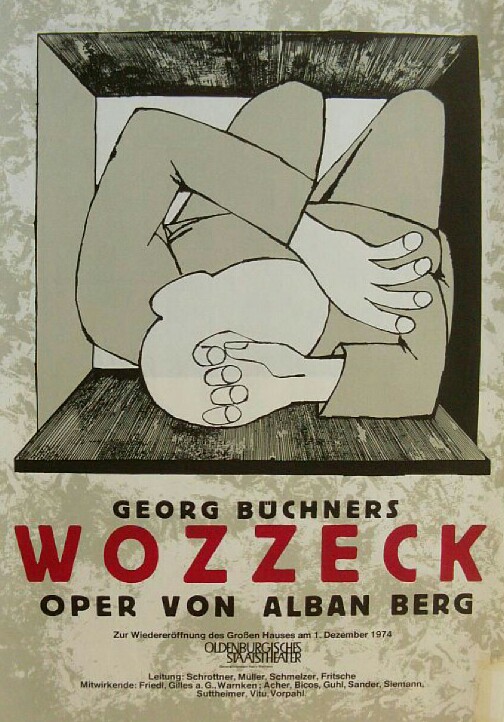
1925 opera by Alban Berg; Berg’s first opera
Wozzeck (German pronunciation: [ˈvɔtsɛk]) is the first opera of Austrian composer Alban Berg and a landmark modernist opera, written 1914–1922 and premiered in 1925. Based on Georg Büchner‘s unfinished play Woyzeck (1836), it depicts a soldier’s tragic slide into madness and murder amid militarism and oppression. Berg intensified the psychological drama with his innovative approach to musical form and Expressionist music, to which he added themes and topics related to fate and nature. A succès de scandale at its premiere, Wozzeck often faced ideological backlash but remains a cornerstone of the repertoire, celebrated for its narrative power and complex musical structure.
Composition
Background


- (left) Georg Büchner, illustration in an 1879 French edition of his complete works
- (right) Plaque marking Wozzeck’s composition at the present-day Alban Berg Villa in Trahütten
Alban Berg began writing Wozzeck in 1914, before World War I, which delayed his work. He wrote his own libretto after Junges Deutschland writer Georg Büchner‘s unfinished drama Woyzeck (1836), inspired by its 5 May 1914 Vienna premiere. (Editor Karl Emil Franzos misread the name in Büchner’s faint, tiny manuscript.) Berg adapted Büchner’s unordered fragments to retain the play’s jagged brutality and eerie realism.[1][2]
Berg sought the rank of Einjährig-Freiwillige Korporal (lit. ‘one-year volunteer corporal‘) for his short service term, attaining it in 1916, and was never sent to the front line. As his notebooks and letters show, he struggled to compose, writing his wife Helene, “For months I haven’t done any work on Wozzeck. Everything suffocated. Buried!”[4]
He composed much of the opera at the piano in Helene’s small family villa in Trahütten during frugal Sommerfrischen (summer vacations), partly while on regiment leave (1917–18).[5] He nurtured his creativity through reading, mushroom hunting, and hiking, enjoying the mountains, lakes, and springs—habits of a “love of nature” that Helene identified in his music, including Wozzeck.[6]
But the war troubled Berg and shaped his opera. He wrote Helene in 1918: “There is a little bit of me in [Wozzeck], … spending these war years just as dependent on people I hate, … in chains, sick, captive, resigned, … humiliated.” He passed “horrible” news to his mentor Arnold Schoenberg that a large bell’s sound, perhaps evoking a “past time” or “beloved place”, was used to lure Russian heads from trenches for “fatal bullets”, adding, “had I been declared fit … my spirit … would have broken.”
Berg nonetheless found solitude and independence amid hardship, away from friends and life in Vienna. He finished act 1 by summer 1919, act 2 in August 1921, and act 3 two months later,[10] then spent six months revising the orchestration, completing Wozzeck in April 1922.
Drama
Roles
-
Roles, voice types, premiere cast
Role Voice type Premiere cast, 14 December 1925
Conductor: Erich KleiberWozzeck baritone Leo Schützendorf Marie, his common-law wife soprano Sigrid Johanson Marie’s son treble Ruth Iris Witting Captain buffo tenor Waldemar Henke Doctor buffo bass Martin Abendroth Drum Major heldentenor Fritz Soot Andres, Wozzeck’s friend lyric tenor Gerhard Witting Margret, Marie’s neighbor contralto Jessika Koettrik First Apprentice deep bass Ernst Osterkamp Second Apprentice high baritone Alfred Borchardt Madman high tenor Marcel Noé A Soldier baritone Leonhard Kern Soldiers, apprentices, women, children
Synopsis
The plot depicts the militarism, callousness, social exploitation, and casual sadism of a small town.[citation needed] Transitions between day and night reflect cyclical wartime themes of life and death, as in Schoenberg’s Lied “Der verlorene Haufen” (referring to forlorn hope) or the popular soldiers’ Volkslied “Morgenrot“.[a]
Act 1
Scene 1 (Suite)
Wozzeck shaves the Captain, who orders him to slow down and lectures him on morality. Wozzeck dutifully replies, “Jawohl, Herr Hauptmann” (“Yes sir, Captain”). The Captain scorns his illegitimate son. Wozzeck says poverty makes virtue hard. He quotes Mark 10:14, “Lasset die Kleinen zu mir kommen” (“Let the children come to me”). The Captain asks what he means. Growing agitated, Wozzeck cries that if the poor reached Heaven, “we’d all have to manufacture thunder!” to crackling, tumultuous music. Unnerved, the Captain concedes Wozzeck is “a decent man, only you think too much!”
Scene 2 (Rhapsody and Hunting Song)

Wozzeck and his fellow soldier Andres gather firewood at sunset. Andres sings a hunting song, while Wozzeck is terrified by visions. Calmed by Andres, Wozzeck ominously murmurs that all is still, as if the world were dead. They must return by nightfall, Andres reminds him, and a funeral march begins as they do.
It is the next day. The music turns into an upbeat military march as a parade passes Marie’s window. She has a wandering eye for the soldiers. Her neighbor Margret notices and teases her about it. Marie slams the window shut and sings a self-soothing lullaby to her son. Wozzeck arrives, shares his visions, and leaves in a hurry without looking at the boy. Marie laments their poverty.
Scene 4 (Passacaglia)
The Doctor scolds Wozzeck for disobeying orders: Wozzeck is part of an experiment involving a restricted diet and urine collection. The Doctor is delighted when Wozzeck’s mental illness becomes apparent.
Scene 5 (Rondo)
Marie admires the Drum Major from her doorway. He makes advances. She briefly resists, then yields.
Act 2
Scene 1 (Sonata-Allegro)
Marie admires the Drum Major’s gift (earrings) and puts her son to bed. Wozzeck arrives and asks about the earrings. Doubting that she found a matching pair, as she claims, he gives her money and leaves her wracked with guilt.
Scene 2 (Fantasia and Fugue on Three Themes)
Echoing the opening, the Captain urges the Doctor to slow down. The Doctor mocks him with dire diagnoses of his ailments. As Wozzeck passes, they hint at Marie’s infidelity.
Scene 3 (Largo)
Wozzeck confronts Marie about her infidelity. She does not deny it. Enraged, he nearly strikes her. She stops him: “Better a knife in my belly than your hands on me”. Thinking aloud, he repeats her words.
Scene 4 (Scherzo)
Marie and the Drum Major dance in the tavern. Wozzeck watches. Soldiers sing a hunter’s chorus. Andres notices him alone and asks why. A drunken Apprentice preaches. An Idiot stumbles toward him, crying, “Lustig, … aber es riecht … Ich riech Blut!” (“Joyful, … but it reeks … I smell blood!”)
Scene 5 (Rondo)
At night in the barracks, soldiers snore. Unable to stop thinking about Marie, Wozzeck talks to Andres and prays. The Drum Major enters and humiliates Wozzeck with a beating. Roused, some watch. Wozzeck dissociates.
Act 3
Scene 1 (Invention on a Theme)
At night in her room, Marie reads the Bible and cries for mercy.
Scene 2 (Invention on a Single Note (B))
At a forest pond, Wozzeck stabs Marie as she tries to run, declaring that if he can’t have her, no one can. A blood-red moon rises.
Scene 3 (Invention on a Rhythm)
Wozzeck and Margret dance in the tavern among others as he celebrates doom and the Devil‘s arrival. He pulls her onto his lap, insults her, and demands she sing. Others see blood on him, raising alarm. He runs.
Scene 4 (Invention on a Hexachord)
Wozzeck frantically searches the pond for his knife. Paranoid and psychotic, he speaks to Marie, imagining the blood-red moon exposing him to the world. He drowns (possibly by suicide) in the red, moonlit water, which he sees as blood. The Captain and Doctor, walking slowly nearby, are disturbed by the sound of it and return to town.
Interlude (Invention on a Key (D minor))
This interlude provides some catharsis.
Scene 5 (Invention on an Eighth-Note moto perpetuo, quasi toccata)
The next morning, children play and sing in the sunny street outside Marie’s door. News of her death spreads. They run to see her body. Marie’s son appears unaffected by this, even when it is shouted at him. After some delay, he follows, oblivious.
Music
A typical performance lasts about 90 minutes.
Instrumentation
Wozzeck uses a large orchestra. There are onstage musicians four times: a marching band (act 1, scene 3), a chamber orchestra (act 2, scene 3), a tavern band (act 2, scene 4), and an out-of-tune upright piano (also at the tavern; act 3, scene 3).[16]
Pit orchestra
Onstage musicians
Marching band
|
|
|
Berg marks when marching band musicians may be taken from the pit orchestra in a footnote near the end of act 1, scene 2.
Chamber orchestra
|
|
This instrumentation matches Schoenberg’s Chamber Symphony No. 1.
Tavern band
|
|
Form
Berg avoided conventional operatic form, with arias and trios. Each act and scene has an increasingly abstract musical form as word painting: a passacaglia as the Doctor methodically examines Wozzeck, and a prelude and triple fugue as the Doctor and Captain hint at Marie’s infidelity. Variation techniques dominate act 3, monomaniacally focusing on a pitch (B♮, scene 2), rhythm (scene 3), hexachord (scene 4), key (D minor, interlude), or duration (a perpetuum mobile of quavers, scene 5).
Fritz Mahler summarizes the drama and forms:
-
Drama Music Expositions Act 1 Five character pieces Wozzeck and the Captain Scene 1 Suite Wozzeck and Andres Scene 2 Rhapsody Wozzeck and Marie Scene 3 Military march and Lullaby Wozzeck and the Doctor Scene 4 Passacaglia Marie and the Drum Major Scene 5 Andante affettuoso (quasi Rondo) Dramatic development Act 2 Symphony in five movements Marie and her child, later Wozzeck Scene 1 Sonata movement The Captain and the Doctor, later Wozzeck Scene 2 Fantasia and fugue Marie and Wozzeck Scene 3 Largo Garden of a tavern Scene 4 Scherzo Guard room in the barracks Scene 5 Rondo con introduzione Catastrophe and epilogue Act 3 Six inventions Marie and her child Scene 1 Invention on a theme Marie and Wozzeck Scene 2 Invention on a note (B♮) Tavern Scene 3 Invention on a rhythm Death of Wozzeck Scene 4 Invention on a hexachord Interlude Invention on a key (D minor) Children playing Scene 5 Invention on a regular quaver movement
Leitmotifs
Leitmotifs are given to characters like the Captain, Doctor, and Drum Major, whose music recurs when Marie muses on him. Wozzeck has two: one as he runs, and one languidly expressing his misery and helplessness. Marie’s motifs convey sensuality, as when she accepts a pair of earrings from the Drum Major.
The central “anguish” motif, sung by Wozzeck to “Wir arme Leut” (“we poor folks”; act 1, scene 1), traces a minor chord with an added major seventh:
![\new Staff \with { \remove "Time_signature_engraver" \remove "Bar_engraver" } \relative c' { \clef bass r8 dis-- b--[ e,--] g4-- } \addlyrics { Wir ar- me Leut! }](https://upload.wikimedia.org/score/t/1/t1x965b865yvzp42nlew3iun364f9o7/t1x965b8.png)
The smallest leitmotif is the single pitch B, symbolizing the murder. Soft at the end of act 2, when Wozzeck, beaten, whispers “Einer nach dem andern” (“one after the other”), it intensifies during the murder, expanding from unison B3 into crescendoing octaves. Marie’s last cry for help spans two octaves, B5 down to B3.
A pair of chords closes each act, oscillating into a blur.
Idioms
Expressionism
Expressionist music evokes Wozzeck’s and other characters’ emotions and thought processes, especially his madness and alienation. Though atonal, it generally has some function in its voice leading, extended tonicizations, or tonal passages. Pitch and harmony structure the drama, with recurring pitch sets for continuity: the dyad B–F, a tritone, signifies the struggle of and tension between Wozzeck and Marie, while the dyad B♭–D♭, a minor third, reflects Marie’s bond with her child.
Berg adapted tonal juvenilia for Wozzeck. In Marie’s Bible scene, he reworked a sonata fragment in F minor that has been called Schumannesque in its abiding melancholy. After Wozzeck’s mad scene, “Wo ist das Messer?” (“Where is the knife?”; act 3, scene 4), there is an adagio interlude adapted from a Mahlerian student piece in D minor; its climax is a loud, dominant-functioning aggregate sonority crescendoing into a potent statement of the “anguish” leitmotif (act 3, scene 5, mm. 364–365).
Folk and popular music
Folk song and popular dance idioms appear in the field and tavern scenes. Berg transforms a polka into a danse macabre in the later tavern episode (act 3, scene 3). Its opening rhythm is a retrograde of a tango, alluding to Karl Kraus’s play Die letzten Tage der Menschheit (1915–1922; The Last Days of Mankind), drafts of which appeared in Die Fackel by 1916. Marie’s orphan plays among children singing “Ringel, Ringel, Rosenkranz, Ringelreih’n” (like “Ring a Ring o’ Roses“) in the epilogue.
Berg’s notes and sketches for Wozzeck (and for the March from his Three Orchestral Pieces, 1913–1915) were mingled with fragments of military papers. Drafts include Austrian army bugle calls rendered atonal in the final score (act 1, scene 2). His war experience of sleeping in barracks informed his word painting of snoring soldiers (act 2, scene 5), which he described as “polyphonic breathing, gasping, and groaning … the most peculiar chorus I’ve ever heard … like some primeval music that wells up from the abysses of the soul”.[20]
Reception
Wozzeck is among the most renowned 20th-century modernist operas. John Deathridge called it “one of the undisputed masterpieces of modern opera”. Its dissonant, psychological idiom recalls Schoenberg’s Erwartung, and its tormented, outcast antihero has prompted comparisons to operas with similar male title roles, such as Giuseppe Verdi’s Macbeth and Nabucco, Modest Mussorgsky’s Boris Godunov, and Benjamin Britten’s Peter Grimes. Wozzeck has also been described as more “highbrow” than Grimes, sometimes polemically.
Berg’s critical engagement with militarism and war in Wozzeck faded from view as the work became a repertoire standard increasingly separated from its original context, not unlike Maurice Ravel’s Le Tombeau de Couperin.
Cultural context
Wozzeck comes from the same Expressionist milieu, rooted in Symbolism,[b] as novelist Franz Kafka, painters Oskar Kokoschka[c] and Emil Nolde, and poets Gottfried Benn, Rainier Maria Rilke,[d] and Franz Werfel. In German opera, Richard Strauss’s Elektra is an early example, followed by Schoenberg’s more radical Erwartung and Die glückliche Hand. Wozzeck, Paul Hindemith’s Cardillac, Kurt Weill’s Protagonist, and Ernst Krenek’s Zwingburg and Der Sprung über den Schatten all premiered within a year of each other.
Gurlitt’s Wozzeck
The delayed discovery and staging of Büchner’s incomplete Woyzeck inspired Berg and Manfred Gurlitt. Gurlitt’s Wozzeck, premiered four months after Berg’s[42] and also published by Universal Edition, discomfited Berg. They worked without any knowledge of each other,[42] and Gurlitt’s work has remained in the shadow of Berg’s.[42] Examining Gurlitt’s piano–vocal score, Berg found it “not bad or unoriginal” but a weak “broth … even for arme Leut [poor folks]”. Gurlitt’s leaner musical textures and polystylism align with Hindemith and Weill, with frequent, socially oriented use of the chorus. His opera may be closer to Büchner’s original conception.
Influences
The other main composers of the Second Viennese School, Schoenberg and Anton Webern, influenced Berg most, but his operas show openness. Viennese coffee house culture at forums like the Café Museum exposed him to innovative figures across styles, including the popular composers Franz Lehár, Oscar Straus, Erich Korngold, and Strauss. In Wozzeck, he drew on Schoenberg’s Erwartung and possibly Schreker’s Der ferne Klang, having prepared its piano-vocal score in 1911. But he valued Schreker, whose work remained more Wagnerian, less than Mahler or Schoenberg, and disliked Schreker’s next opera, Das Spielwerk und die Prinzessin.
In his 1929 “Lecture on Wozzeck“, Berg said he preferred strict musical form to “the Wagnerian recipe of ‘through-composing‘”, prompting comparisons of Wozzeck to Ferruccio Busoni’s Doktor Faust and Hindemith’s Cardillac. Yet the opera remains Wagnerian, and he may have stressed form to counter his reputation for quasi-Romantic music. Werfel, likely the Bergs’ closest literary friend, disparaged Wagner’s “bloated excess” and “garrulous monotony” in favor of Verdi, perhaps shaping Berg’s 1920s view of Wagner as “antiquated”.
Performance history
Background and publication
Berg gained fame with Wozzeck through performances, praise, and promotion.[50][51] Sure of its worth, he sold few but sent many self-printed piano–vocal scores to critics, conductors, and theaters in early 1923.[52] In April, Die Musik published Ernst Viebig‘s glowing review with the lullaby.[53] Then Universal Edition published the Three Orchestral Pieces for Wozzeck,[54] and Berg had Webern debut two of them (the Präludium and Reigen) at Heinrich Jalowetz‘s and Paul Pella‘s “Austrian Music Week” in Berlin, drawing press.[55]
That summer, Gustav Havemann‘s Quartet played Berg’s String Quartet at the Salzburg International Society for Contemporary Music festival, where Hermann Scherchen asked for a Wozzeck suite. Berg gave him the march, lullaby, and Bible scene as Three Fragments for Voice and Orchestra from the Opera Wozzeck. Intended for Berlin, Scherchen premiered it at Frankfurt’s 1924 Allgemeiner Deutscher Musikverein (ADMV) festival to acclaim.[56]
Premieres
1925: World premiere in Berlin
In late 1923, Berg had coached pianist Ernst Bachrich to play Wozzeck excerpts for Berlin State Opera conductor Erich Kleiber in Vienna. Kleiber agreed to stage it. Universal Edition deemed this the best premiere offer.[57]
Berg helped with staging and rehearsals. Many were held, and intendant Max von Schillings quit over a funding clash. The dress rehearsal drew composers Hans Heinz Stuckenschmidt and Stefan Wolpe, music writers Paul Stefan from Vienna and Erich Steinhard from Prague, and Berg’s pupil Theodor W. Adorno.[57]
The 14 December 1925 premiere was a succès de scandale with some disruptions.[10] Wozzeck achieved sustained expressive coherence despite its post-tonal musical language. It got substantial press coverage from Germany to London and New York,[58] and was staged
throughout Germany and Austria until Nazi Germany forbade “degenerate music“.[10]
1926: Czech Vojcek
In 1926, Otakar Ostrčil translated and led the Czech-language premiere of Wozzeck (Vojcek)[58] at Prague’s National Theatre. Some “Czech Nationalists (virtually Nazis)” and “clerical lobbies” staged “purely political!” disruptions, Berg wrote Adorno: “To them I am the Berlin Jew Alban (Aaron?) Berg. Ostrčil bribed by the Russian Bolsheviks, the whole thing arranged by the ‘Elders of Zion‘ etc.”[59] Antonín Šilhan wrote as much in Národní listy, and Emanuel Žak linked the opera’s degeneracy to Jewish Bolshevism in Čech, while Zdeněk Nejedlý mocked them, praising Wozzeck in Rudé právo. The Bohemian State Committee quickly banned it.[60][61][e]
1927: Soviet Russia
In 1927, the Association for Contemporary Music, led by Nikolai Roslavets, staged Wozzeck at Leningrad’s Mariinsky Theatre with Boris Asafyev‘s assistance, Vladimir Dranishnikov conducting. Berg rode trains for three days to attend the first performances and wrote journalist Soma Morgenstern that he was “celebrated [as] never … before”.[63] Here Wozzeck was, he continued, “a sensation … in purely artistic, not political, terms”.[63] He wired Helene “huge, tumultuous success”, but reviews were mixed. Dmitri Shostakovich attended all eight or nine performances.[65]
It was not restaged in Russia amid Stalinism and worsening relations with Germany until 2008.
1929: Oldenburg arrangement and lecture
Oldenburgisches Staatstheater conductor Johannes Schüler proved the opera could succeed in a small theater with few rehearsals.[63] Berg and Erwin Stein cut sections from fours to threes for an orchestra of about 60.[69] Berg gave his “Lecture on Wozzeck” before this premiere and in eleven more cities.[63]
1930: Vienna
For Wozzeck’s 1930 Austrian premiere, led by Clemens Krauss in Vienna, Berg gave tickets to friends, family, and his illegitimate daughter, Albine Wittula. While on better terms with Kleiber, Berg was pleased with Krauss’s performance and touched by his opera’s hometown success.[70] But he faced Neue Freie Presse critic Julius Korngold‘s polemical review:[70]
If there is … “atonal” music, it is … a music that cannot be … deduced given its fanatic attachment to chromaticism—in both vertical [harmonic] and horizontal [melodic] dimensions. … [W]e have here “negative composing” … with its conscious dethronement of the evolving tonal system and rejection of tonal relationships and a tonal center.
Berg replied in a revised “Lecture on Wozzeck” he called “The ‘Atonal Opera'”, delivered at the Kulturbund (lit. ‘Cultural Association‘), and in a scripted Radio Wien talk with critic Julius Bistron, “What Is Atonal?”, framing atonality as tradition-based harmonic innovation.[70]
1931: Philadelphia and New York
Kleiber gave the Wozzeck Fragments their 1930 United States premiere at the New York Philharmonic, priming opera-goers. Berg “probed … consciousness” like Claude Debussy in Pelléas et Mélisande, wrote Lawrence Gilman in the New York Herald Tribune.[70]
In 1931, the Philadelphia Grand Opera Company, working with the Curtis Institute of Music and Philadelphia Orchestra, staged the U.S. premiere of Wozzeck at Philadelphia’s Metropolitan Opera House under Leopold Stokowski. Composer George Gershwin rode a special Wozzeck train from New York (he’d met Berg in 1928 via mutual friend and Rudolf Kolisch‘s soon-to-be wife Josefa Rosanska, or Josephine Rosensweet, and heard the Kolisch Quartet play Berg’s Lyric Suite).[71] Calling the audience “brilliant”, The New York Times‘ conservative critic Olin Downes wrote of an “astonishing” success and hailed Berg’s word painting:[72]
You may hear the military band approaching, the crackling and cutting of the wood for the captain’s fire, feel the approach of darkness and find reflected in the instruments the sulphurous sky of the field scene, and the setting of the sun. Or you will feel the blinding, insane thought of murder in Wozzeck’s brain, and may be conscious, with weird distinctness and psychology of effect, of bubbles rising into the pool into which Wozzeck’s body has sunk. All … synthesized and reflected as in a transparent mirror […]. … [T]his score … is beautiful.
Gilman agreed:[72]
The layman, if he can accustom himself … will find … bitter and piercing loveliness, … intensity, a compassionate wisdom [and] suffusing tenderness … reveal[ing] Berg [as a] poet … a pitiful humanitarian, even (let us whisper it!) a shameless romanticist—a social and spiritual rebel, no less than an aesthetic one.
Later that year, Stokowski’s Philadelphia team staged Wozzeck’s second U.S. premiere at New York’s Metropolitan Opera, prompting a second Downes review:[72]
[Berg] is Wozzeck himself, and we … know Wozzeck’s terrors of the strange things … his premonitions which he cannot explain, of the evil that dogs him, his hallucinations, his murderous revolt. This is the psychological and emotional quality of the music.
1932–1952: From radio to stage in the United Kingdom
In 1932, Henry Wood led the BBC Symphony Orchestra in a studio performance of the Wozzeck Fragments broadcast by Schoenberg pupil Edward Clark.[73] In 1934, Adrian Boult conducted Wozzeck in a Queen’s Hall concert performance also broadcast by Clark.[74][75] In 1952, it was staged at the Royal Opera House, Covent Garden.[10]
Effect on Berg
.jpg)
Wozzeck brought Berg financial comfort, mostly via royalties from performances in Central Europe,[citation needed] nearly until his 1935 death. He traveled not only to Germany, Czechoslovakia, Soviet Russia, and England, but also to Switzerland, Belgium, Holland, France, and Italy for performances of and talks about the opera. Busy attending to his success and enjoying independence, he declined vacations with Schoenberg and Schreker’s offers of a Berlin Musikhochschule appointment. He benefited from new relationships with Kleiber, Karl Böhm, and Gian Francesco Malipiero, and was appointed to the ADMV jury.
Influence on others
Krenek
Berg and Krenek were acquainted at the salons of Alma Mahler, a close friend of the Bergs and the wife or lover of Gustav Mahler, Kokoschka, and Werfel. Krenek studied Wozzeck’s piano–vocal score and wrote Berg with praise and questions about vocal writing while working with Kokoschka on Orpheus und Eurydike in 1923. Berg replied with examples from Wagner, Mozart, and Bach, stressing music adapted to singers’ limits and his use of voice (“the supreme instrument”) for dramatic effect (as in Sprechgesang, or speech singing). Krenek denied modeling Orpheus on Wozzeck, but Berg likely influenced him. Hans Hartleb saw parallels in the operas’ violence and music of “fatalism, melancholy, and sensuality” for Eurydike and Marie (whose role such music elevated).
Berio
In Sinfonia (1968–69), Luciano Berio quotes the rising orchestral chords Berg uses in the word painting of Wozzeck’s drowning.[citation needed]
Other arrangements
Besides Stein’s arrangement, John Rea‘s arrangement is for 22 singers and 21 instrumental parts.[16]
Recordings
Film adaptation
The Hamburg State Opera‘s 1970 production was filmed at a deserted castle for director Joachim Hess‘s 1972 TV film Wozzeck, broadcast on Norddeutscher Rundfunk.[81]
References
Notes
- ^ Anton Webern explored such themes in, among other Lieder, his 1915 setting of “Der Tag ist vergangen (“The day has ended”), a pious Volkslied from Des Knaben Wunderhorn.
- ^ For example, Symbolist Stefan George‘s poetry was often set by the Second Viennese School.[27] Shreffler described his poems as “hyperexpressive”, eliciting “equally vivid and extreme music”. They may have influenced Schoenberg’s atonal turn in the String Quartet No. 2.[29] Webern set fourteen George texts, ten as atonal Lieder Opp. 3–4. George translated Baudelaire’s Les Fleurs du mal, from which Berg took the hidden text of his Lyric Suite and three poems for Der Wein.[31]
- ^ Schoenberg called Kokoschka “the greatest living painter”. Kokoschka was nearly arrested at the 1909 production of his play Murderer, the Hope of Women, on which Paul Hindemith’s first Expressionist opera Mörder, Hoffnung der Frauen is based. Its gender conflict may have influenced Schoenberg’s Die glückliche Hand. After the Nazis’ defeat, in 1951, Kokoschka expressed interest, at Will Grohmann‘s suggestion, in producing Wozzeck, though this never transpired.
- ^ Berg set Rilke’s “Traumgekrönt” in Seven Early Songs.[37]
- ^ Brian S. Locke called the “Wozzeck Affair” the “most important event at the Czechs’ National Theater in the interwar period”.[60]
- ^ The set included a bonus LP of Berg’s lecture on Wozzeck, read in English by Noël Goodwin, with music examples conducted by Boulez.
Citations
- ^ Hall, Patricia (2011). Berg’s Wozzeck. Oxford University Press. pp. 26–38. ISBN 978-0195342611. Retrieved 2015-05-09.
- ^ Watkins, Glenn (2003). Proof Through the Night: Music and the Great War. Sponsors, Sukey and Gil Garcetti, Michael P. Roth, and the Roth Family Foundation (First hardcover ed.). Berkeley: University of California Press. pp. 232–241. ISBN 978-0-520-23158-0.
- ^ Hall, Patricia (2011). Berg’s Wozzeck. Oxford University Press. pp. 26–38. ISBN 978-0195342611. Retrieved 2015-05-09.
- ^ Hailey 2010, 12–13, quoting Helene Berg‘s “Dokumentation”.
- ^ Hailey 2010, 12–13, quoting Helene’s “Dokumentation”.
- ^ a b c d Walsh 2001, pp. 61–63
- ^ a b “Alban Berg – Wozzeck – Reduzierte Fassung (21 instrumente) – John Rea”. Universal Edition. Retrieved 9 December 2010.
- ^ Rose, Michael (2013). The Birth of an Opera: Fifteen Masterpieces from Poppea to Wozzeck. W. W. Norton. p. 375. ISBN 978-0393060430. Retrieved 2015-05-09.
- ^ Barnouw 1999, 73–74; Schroeder 1999, 232–233, 236; Shreffler 1999, 253; Simms 1999a, xiii–xiv; Simms 1999b, 136–137, 157–158, 182n33; Simms and Erwin 2021, 4, 281, 306, 308, 485n62.
- ^ Barnouw 1999, 73–74; Simms 1999a, xiii–xiv; Simms 1999b, 136–137, 157–158, 182n33; Simms and Erwin 2021, 4.
- ^ Schroeder 1999, 232–233, 236; Simms and Erwin 2021, 281, 306, 308, 485n62.
- ^ Simms and Erwin 2021, 71, 75.
- ^ a b c “Gurlitt: Wozzeck (Roland Hermann, Celina Lindsley, Anton…) – review”. Classical-music.com.
- ^ Hailey 2010, 17; Simms and Erwin 2021, 211–213, 216.
- ^ Moldenhauer, Hans (1978). Anton von Webern: A Chronicle of His Life and Work. Victor Gollancz Ltd. pp. 253, 663n20. ISBN 978-0-394-47237-9.
- ^ Simms and Erwin 2021, 211–212.
- ^ Simms and Erwin 2021, 194, 211–212.
- ^ Simms and Erwin 2021, 146, 211–212.
- ^ Hailey 2010, 17; Moldenhauer 1978, 253, 663n20; Simms and Erwin 2021, 145–146.
- ^ Simms and Erwin 2021, 212–213.
- ^ a b Simms and Erwin 2021, 213.
- ^ a b Simms and Erwin 2021, 214.
- ^ Adorno and Berg 2005, 85.
- ^ a b Locke, Brian S. (2008). “The “Wozzeck Affair”: Modernism and the Crisis of Audience in Prague”. The Journal of Musicological Research. 27: 63–98. doi:10.1080/01411890701804788.
- ^ Adorno and Berg 2005, 85; Simms and Erwin 2021, 215.
- ^ a b c d Simms and Erwin 2021, 215.
- ^ Loomis, George (1 December 2009). “A Firmly Middle-Class Wozzeck“. The New York Times. Archived from the original on 7 March 2017. Retrieved 19 October 2025.
- ^ “Alban Berg – Wozzeck – reduced version (Stein)”, Universal Edition. Retrieved 12 November 2013.
- ^ a b c d Simms and Erwin 2021, 216.
- ^ Simms and Erwin 2021, 216–217, 274, 481n50.
- ^ a b c Simms and Erwin 2021, 217.
- ^ Nicholas Chadwick. “Alban Berg and the BBC” (PDF). Bl.uk. Retrieved 27 January 2018.
- ^ Bray, Trevor. “Frank Bridge: A Life in Brief ~ Isolation: 62”. Trevor-bray-music-research.co.uk.
- ^ Denis Apivor. “Memories of ‘The Warlock Circle’“. Musicweb-international.com.
- ^ Levine, Robert. “Berg: Wozzeck, 1970/Hamburg DVD”. Classics Today.
Bibliography
- Adorno, Theodor W. and Alban Berg. 2005. Correspondence 1925–1935, ed. Henri Lonitz, trans. Wieland Hoban. Cambridge, UK and Malden, MA: Polity Press. ISBN 978-0-7456-2336-8. (Trans. of Briefwechsel 1925–1935. Frankfurt: Suhrkamp Verlag, 1997.)
- Barnouw, Dagmar. 1999. “Wiener Moderne and the Tensions of Modernism”. Schoenberg, Berg, and Webern: A Companion to the Second Viennese School, ed. Bryan R. Simms, 73–128. Westport, Connecticut and London: Greenwood Press. ISBN 978-0-313-29604-8.
- Deathridge, John. 2005. “Wagner and beyond”. The Cambridge Companion to Twentieth-Century Opera, ed. Mervyn Cooke, 14–25. Cambridge: Cambridge University Press. ISBN 978-0-521-78009-4 (hbk). ISBN 978-0-521-78393-4 (pbk).
- Fisher, Burton D. 2000. Macbeth. Opera Journeys Mini Guide Series. Miami: Opera Journeys Publishing. ISBN 978-1-930841-10-9 (pbk).
- Franklin, Peter. 2024. Britten Experienced: Modernism, Musicology, and Sentiment. London and New York: Routledge. ISBN 978-1-032-66660-0 (hbk). ISBN 978-1-032-66663-1 (ebk). ISBN 978-1-032-66664-8 (pbk). doi:10.4324/9781032666631.
- Görner, Rüdiger. 2020. Kokoschka: The Untimely Modernist, trans. Debra S. Marmor and Herbert A. Danner. London: Haus Publishing. ISBN 978-1-912208-82-1 (ebk).
- Hailey, Christopher. 2010. “Berg’s Worlds”. Alban Berg and His World, ed. Christopher Hailey, 3–32. Princeton: Princeton University Press. ISBN 978-0-691-14855-7 (hbk). ISBN 978-0-691-14856-4 (pbk).
- Headlam, David J. 1996. The Music of Alban Berg. Composers of the Twentieth Century. New Haven: Yale University Press. ISBN 978-0-300-06400-1 (hbk).
- Ho, Allan B. and Dmitry Feofanov. 2011, rev 2014. The Shostakovich Wars.
- Griffel, Margaret Ross. 2018. “A Brief History of Operas in German”. Vol. 1, Operas in German: A Dictionary, ed. Margaret Ross Griffel, xv–xxvi. London: Rowman & Littlefield. ISBN 978-1-44-224797-0 (ebk). ISBN 978-1-44-224796-3 (hbk).
- Perle, George. 1980. The Operas of Alban Berg, Vol. I: Wozzeck. Berkeley: University of California Press. ISBN 978-0-520-06617-5.
- Pople, Anthony (24 April 1997). The Cambridge Companion to Berg. Cambridge Companions to Music. Cambridge: Cambridge University Press. ISBN 0521563747.
- Ross, Alex (2008). The Rest Is Noise: Listening to the Twentieth Century (1st Picador ed.). New York: Picador. ISBN 978-0-312-42771-9.
- Shreffler, Anne C. 1999. “Anton Webern”. Schoenberg, Berg, and Webern: A Companion to the Second Viennese School, ed. Bryan R. Simms, 251–314. Westport, Connecticut and London: Greenwood Press. ISBN 978-0-313-29604-8 (hbk).
- Schroeder, David. 1999. “Alban Berg”. Schoenberg, Berg, and Webern: A Companion to the Second Viennese School, ed. Bryan R. Simms, 185–250. Westport, Connecticut and London: Greenwood Press. ISBN 978-0-313-29604-8.
- Simms, Bryan R. (1996). Alban Berg: A Guide to Research. Routledge.
- Simms, Bryan R. 1999. “Introduction”. Schoenberg, Berg, and Webern: A Companion to the Second Viennese School, ed. Bryan R. Simms, xi–xiv. Westport, Connecticut and London: Greenwood Press. ISBN 978-0-313-29604-8.
- Simms, Bryan R. 1999. “Arnold Schoenberg”. Schoenberg, Berg, and Webern: A Companion to the Second Viennese School, ed. Bryan R. Simms, 129–184. Westport, Connecticut and London: Greenwood Press. ISBN 978-0-313-29604-8 (hbk).
- Simms, Bryan R. and Charlotte Erwin. 2021. Berg. Oxford: Oxford University Press. ISBN 978-0-19-093144-5 (hbk).
- Stewart, John Lincoln. 1991. Ernst Krenek: The Man and His Music. Berkeley and Los Angeles: University of California Press. ISBN 978-0-520-07014-1 (hbk).
- Walsh, Stephen. 2001. “Alban Berg”. In The New Penguin Opera Guide, ed. Amanda Holden. New York: Penguin Putnam. ISBN 0-14-029312-4.
Further reading
- Adorno, Theodor W. (1991), Alban Berg: Master of the Smallest Link. Trans. Juliane Brand and Christopher Hailey. Cambridge: Cambridge University Press. ISBN 0-521-33016-5
- Bailey Puffett, Kathryn. 1997. “Berg’s aphoristic pieces”. The Cambridge Companion to Berg, ed. Anthony Pople, 83–110. Cambridge and New York: Cambridge University Press. ISBN 978-1-139-82807-9.
- Bonds, Mark Edward (June 2020). “ ’Wozzeck‘s Worst Hours’: Alban Berg’s Presentation Copy of Wozzeck to Eduard Steuermann“. Notes, 76(4), 527–534. JSTOR 27079692
- Hall, Patricia (2011), “Berg’s Wozzeck“. Studies in Musical Genesis, Structure, and Interpretation. New York: Oxford University Press. ISBN 978-0-19-534261-1 (accessed 29 October 2012).
- Jarman, Douglas (1979), The Music of Alban Berg. London and Boston: Faber & Faber ISBN 0-571-10956-X; Berkeley: University of California Press. ISBN 0-520-03485-6
- Jarman, Douglas (1989), “Alban Berg, Wozzeck“. Cambridge Opera Handbooks. Cambridge: Cambridge University Press. ISBN 0-521-24151-0 (cloth) ISBN 0-521-28481-3 (pbk).
- Schmalfeldt, Janet (1983), “Berg’s Wozzeck“, Harmonic Language and Dramatic Design. New Haven: Yale University Press ISBN 0-300-02710-9.

