


1925 opera by Alban Berg; Berg’s first opera
Wozzeck (German pronunciation: [ˈvɔtsɛk]) is the first opera by Austrian composer Alban Berg, created between 1914 and 1922 and premiered on 14 December 1925 at the Berlin State Opera. Based on Georg Büchner‘s play Woyzeck (1836), it depicts a soldier’s tragic slide into madness and murder amid militarism and oppression.
Berg’s expressionist musical language and innovative approach to musical form heightened the opera’s psychological realism. He used atonality and leitmotifs to show individuals’ emotional and existential plight under forces of authority. Drawing on tonal and rhythmic idioms from folk and dance music, he linked psychological and social dimensions and exposed social alienation. He also invoked latent themes and topics of fate and nature, reflecting an understanding of humanity as shaped by universal forces.
A succès de scandale at its premiere, Wozzeck faced backlash but became a landmark of early 20th-century modernist opera. It remains a cornerstone of the repertoire, celebrated for its narrative power and complex musical structure.


- (left) Georg Büchner, illustration in an 1879 French edition of his complete works
- (right) Plaque marking Wozzeck’s composition at the present-day Alban Berg Villa in Trahütten
Berg created the Literaturoper (literary opera) Wozzeck from 1914 to 1922, stalled by World War I.[1][2] He had first pursued a literary career, writing lyrical and dramatic juvenilia, including after Henrik Ibsen‘s play Ghosts.[3] But in 1904, he diaried that music was “a higher form of revelation”.[4] Arnold Schoenberg, his mentor, advised, “let poetry lead you … to music”.[5] Schoenberg premiered some of Berg’s aphoristic Altenberg Lieder (1911–1912), which caused the 1913 Skandalkonzert. He told Berg to write a suite of character pieces (the Three Orchestra Pieces, 1913–1915) before trying a planned vocal symphony after Gustav Mahler, but affirmed Berg’s operatic interest in the chamber plays of August Strindberg.[6]
Then Berg twice attended the May 1914 Vienna premiere of Georg Büchner‘s play Woyzeck (1836) at the Residenzbühne. He recalled seeing Albert Steinrück as Wozzeck among visitors from the Munich Residenz Theatre and said he “immediately” decided to make it an opera.[7] Berg wrote his own libretto, which is indebted partly to writer Karl Emil Franzos. Franzos had misread “Wozzeck” from Büchner’s difficult manuscript. His version, based on papers shared by Büchner’s brother, physician Ludwig Büchner, had appeared in a Neue Freie Presse serial (1875) and in his “critical, complete” Büchner edition (1879).[9]
Büchner, Woyzeck, and Berg
[edit]
Büchner and Woyzeck
[edit]
Trained in biology and medicine,[10] Georg Büchner taught comparative anatomy at the University of Zurich.[11] A Romantic in science like his patron Lorenz Oken,[12] he treated taboo topics like sex, religion, and politics in literature[13] and stressed characterization over narrative.[10][14] He had proto-Marxian or similarly radical politics and studied the French Revolution for his first play, Danton’s Death (1835), which left him feeling “crushed” by forces he sought to describe in an 1834 letter to his fiancée Minna Jaeglé: “I find in human nature a terrible sameness […]. Individuals are but froth on the waves, … a ridiculous struggle against an iron law […].”[16][17]
His work expresses a unity of opposites, or complements, from Hegel and Spinoza.[18] Philosopher György Lukács called him a literary realist after the hero of Büchner’s Lenz fragment (1835), who calls for artists to “submerge themselves in the life of the … humblest person and … reproduce it with all its faint agitations, hints of experience, the subtle … play of his features [expressions].”[19][20] German literature scholar John Reddick argued his style expressed paradoxes in mosaics, as in a “shattered whole“: “All my being is in this single moment”, says Leonce at the climax of Leonce und Lena (1836).[21]

In Woyzeck, Büchner mixed the grotesque with tragicomedy. He used case reports of romantic femicide, mainly physician Johann Christian August Clarus‘s on Johann Christian Woyzeck, a barber and military veteran,[23] published in a medical journal to which Büchner’s brother contributed.[24] At the competency evaluation, Clarus reported that his patient had “freier Vernunftgebrauch” (free use of reason) and “Willensfreiheit” (free will) despite a medical history notable for recurrent episodes of psychosis, leading to Woyzeck’s 1821 conviction and 1824 beheading.[25] Büchner died of typhus in 1837, leaving an untitled, fragmentary script with shifting character names,[23] perhaps as an open drama.
Toward Berg’s Wozzeck
[edit]
Berg came from the same expressionist milieu, rooted in Symbolism with its exaltation of outcast artists,[a] as novelist Franz Kafka, painters Oskar Kokoschka[b] and Emil Nolde, and poets Gottfried Benn, Rainier Maria Rilke,[c] and Franz Werfel. In German opera, Wozzeck followed Richard Strauss’s Elektra and Schoenberg’s more radical Erwartung and Die glückliche Hand. Erwartung and Strauss’s Salome had recently explored the grotesque, and Berg saw operatic potential in Büchner’s mad murderer and dark social criticism.[40]
Berg grew up playing a broad opera repertoire piano four hands with his sister Smaragda, and his taste was wider than Schoenberg’s or Webern’s.[41] A frequent opera-goer, he attended multiple rehearsals for the 1908 Vienna premiere of Paul Dukas’ Ariane et Barbe-bleue, and studied the score and its “thousands of splendid passages”.[42] He may have learned from Schreker’s Der ferne Klang, having prepared its piano-vocal score in 1911 (but disliked Schreker’s next opera Das Spielwerk und die Prinzessin). At forums like the Café Museum, he met innovative figures across styles, including popular composers Erich Korngold, Franz Lehár, and Oscar Straus, through Viennese coffee house culture. He knew Claude Debussy’s Pelléas et Mélisande as a model of modernist Literaturoper, a direction he had explored in drafting a libretto (without music) from Franz Grillparzer‘s play Die Ahnfrau. As in Pelléas, Berg linked Wozzeck‘s scenes with short interludes,[46] yet he kept Büchner’s jagged brutality and eerie realism.
He worked mainly from writer Paul Landau‘s Wozzeck–Lenz: Zwei Fragmente (Wozzeck and Lenz: Two Fragments; 1909, reprinted 1913; Insel–Verlag), which mostly just resequenced Franzos’s 26 scenes.[48] Theater director Arthur Rundt, whose scene cuts Berg mostly followed, had used it in 1914.[49] That year, scholar Hugo Bieber tied the play to Clarus’s Woyzeck.[50] In 1919, scholar Georg Witkowski issued a critical edition claiming Franzos’s omissions, edits, and additions ruined Büchner’s play.[51] Berg mostly chose Franzos’s freer, livelier text over Witkowski’s. Franzos’s publisher lost rights, so Berg left his title. Franzos’s dramatic form shaped Berg’s operatic acts (exposition, development, catastrophe). Berg’s staging and lighting synced time and action as Franzos’s sequential flow suggested (“The drama … must go forward … breathlessly”, Berg replied to writer Hanns Heinz Ewers‘s 1925 offer to collaborate).[52] As became habit, Berg added bits of his life: scripted coughs echo his asthma, and the Doctor’s salamanders line mocks Paul Kammerer, the scientist–musician once loved by his wife, Helene.[53][d] Berg’s epilogue was not Franzos’s or Landau’s final scene, but it was more Franzos’s invention than Büchner’s.[52]
1914–22: History of composition process
[edit]
1914–1917: Genesis amid war
[edit]

Driveway

From as early as 1914 on frugal Sommerfrischen (summer vacations), starting at his wife’s family’s farm and villa in Trahütten, Berg precomposed Wozzeck, conceptualizing and sketching perhaps two scenes while continuing Three Orchestra Pieces. He hesitated when Schoenberg said the play was unsuitable.[56] Then war erupted, and his patriotism was cooled by Karl Kraus‘s attack on “the cash register of world history”.[57] Long fearing death from severe asthma, then a possibly allergy-related somatic symptom disorder, he was first deemed unfit.[58] Pupil Theodor W. Adorno saw the substance dependence and hypochondriasis of a tortured artist in his self-medication and physician visits, including to Sigmund Freud.[59] “[H]ad I been declared fit … my spirit would … have broken”, he wrote Schoenberg, rejecting “a past time and a beloved place” as evoked by a bell to bait “curious Russian heads” from trenches as “targets”. In mid-1915, Berg was conscripted anyway and bought the play while finishing Three Orchestra Pieces.[61]
_cr.jpg)
That winter, he began another opera with the working title Nacht (Nokturn) (Night/Nocturne; 1915–1917, unfinished).[e] In it, a semi-autobiographical “He” falls asleep discussing philosophy with the subconscious “Other“, and a dream sequence by turns nostalgic, erotic, and nightmarish ends with a film[f] showing a dark mountain forest thinning upon the snow line to sky and snow fields at dawn. This echoes other monodramas like Schoenberg’s Erwartung and Die glückliche Hand (The Lucky Hand), and Strindberg’s Jakob brottas (Jacob Wrestles).[64] Berg used musicodramatic ideas from Nacht (Nokturn), like snoring, in Wozzeck, which he had not given up.
He outlined Wozzeck‘s scenes by February 1916.[66] He never saw combat and served as a one-year volunteer (Einjährig-Freiwillige) officer, including at the Imperial War Ministry—more likely via his brother Karl (Charly or Charley), also posted there, than Helene’s illegitimate father Franz Joseph I of Austria.[68] He wrote Helene of Austrian prisoners of war “imprisoned and starving in unheated stalls” under the Allies and was himself assigned 30-hour guard-duty shifts in Vienna.[70] While on office duty at a military base in Bisamberg that April, he wrote of having seen fellow soldiers, including deserters, confined and strappadoed:[71]
Their arms are crossed and tied behind … then hoisted up on a tree so that the prisoner can only stand on his toes. When he can do that no more, he hangs until he faints from the pain. The barracks are atop a remote hill … an hour up a path through a sea of dust and excrement. It is surrounded by pickets and barbed wire, and we can leave only on Sundays. The barracks outdo any description. Completely lice-ridden. […] I’ll have to tell you [more] in person.
In August, he wrote Helene: “For months I haven’t done any work on Wozzeck. Everything suffocated, buried!”
1917–1918: Resolve and state collapse
[edit]
In early 1917, Berg wrote playwright Erhard Buschbeck that his two opera ideas were “equally old”.[73] That summer, he worked on Wozzeck while on several weeks’ leave at Trahütten, as was his habit, composing at the piano from early morning. In the afternoon, he sketched outside while foraging mushrooms and hiking the mountains, lakes, and springs, before reading himself to sleep. Helene identified this “love of nature” in his music, including Wozzeck.[74] He marked 1917 as the symbolic year he committed to Wozzeck in one of then few letters to Schoenberg that August.[75] He saw more subjugation than poverty in Wozzeck, likely from his war service,[76] which in the same letter he called “slavery” that might go on “for years”. Asked what “inner point of contact” moved him to adapt the play in a 1930 interview, he said:[78]
There was probably some natural relationship between me and this poem.[g] But … Wozzeck is no simple ‘we-poor-people’ play. What happened to Wozzeck can happen to any poor person, regardless of what type of clothing he wears. It can happen to anyone who is subjugated by others and cannot defend himself.

In summer 1918, on regiment leave at Trahütten, Berg continued working on Wozzeck.[74] That June, he wrote Schoenberg that he had been “degraded to the point of self-loathing” during the war (in 1924, he drafted a letter to Kraus confiding he had experienced suicidal ideation).[70] “There’s a bit of me in [Wozzeck]”, he wrote Helene that August, “since I have been spending these war years just as dependent on people I hate … in chains, sick, captive, resigned, humiliated.”[79] Days later, he wrote his friend and colleague Anton Webern, “the fate of this poor man [Wozzeck], exploited and tormented by all the world … touches me”, praising the drama’s “unheard-of intensity of mood”. He planned to use traditional song forms and variations, and to alternate thematic and Erwartung-inspired scenes. He gave the Captain and Doctor more Sprechstimme (half-singing, half-speaking) roles, as in melodrama, later shifted to conventional singing ones.[81]
_-_4277_-_%C3%96sterreichische_Galerie_Belvedere.jpg)
That fall, Schoenberg hired him at the Society for Private Musical Performances to help with administration, rehearsals, music arrangements, and writing.[83] The Bergs caught Spanish flu, and the pandemic worsened labor shortages and hunger[h] prevalent amid the war and its aftermath.[84] Berg emphasized he was “happy” to Schulhoff, “despite … freezing and having nothing to live on”,[85] but his family’s farm and country estate at Lake Ossiach, the Berghof,[86] faced nearby food riots[87] and business failure.[88] Writer Stefan Zweig recalled “starving and freezing millions crowd[ing Vienna]”, where “revolution or … catastrophe” seemed possible amid unfolding state collapse, including the dissolution of Austria-Hungary and nearby German revolution of 1918–1919.[89] Berg’s military service ended in November with several armistices and Austro-Hungarian defeat. “I am again a person!”, he told Buschbeck.[90]
1918–1922: Progress through war’s aftermath
[edit]
After “years of … not … a single note”, he recalled to composer and pianist Erwin Schulhoff,[91] he composed intensively, revising the libretto as he finished two scenes (likely the second scenes of acts 1 and 2).[92] In 1919, Schulhoff, a wounded veteran, tied the revolutions of 1917–1923 to a “revolution in art”, including Berg’s music, as he tried to organize the premiere of Three Orchestra Pieces.[93] Sympathetic to Schulhoff’s internationalism, Berg prioritized Austro–German art music like Schoenberg,[94] writing Schulhoff that a nation like Germany[i] might “deserve” its defeat for how it “treats its greatest”.[95][96][j] In the same letter, he blamed the war and its aftermath on capitalism, militarism, the press, and, uncharacteristically, Jews.[98] He called himself an “antimilitarist” and asked who among the Entente, “outside Russia”, had the same “ring of idealism” to their names as Karl Liebknecht and Rosa Luxemburg, recently murdered Spartacist uprising leaders.[99]
At the same time, Berg and Helene were being drawn into the “Berghof Catastrophe”: having enabled his composing with an appanage, his mother Johanna (née Braun) sought their help (and received only his) co-managing their landed property, where wartime mismanagement bred lasting feuds.[100] He set the final, symmetrical order of Wozzeck‘s scenes, finishing act 1 before pausing to copy parts for Three Orchestra Pieces.[101] He resisted his family’s demands, writing Webern in March 1920 that he planned to earn income by editing, teaching, and writing, including for Musikblätter des Anbruch, the music journal of Universal Edition, though he might not be able to compose as much.[102] That April, Johanna sold the Berghof as Berg wished and as another family member advised,[103] and he then finished three scenes (likely 1, 3, and 5) of act 2, planned in the shape of four- or five-movement symphony.[104]
In 1921, nearing the Austrian hyperinflation, the Society closed,[101] and Johanna kept planning her family’s future,[105] having disparaged Helene’s passive income (in Austrian kronen) as a kind of miserliness,[106] as well as Berg’s “componiererei” (fooling around composing).[107] With dollars from her late son Herman’s Florida estate, she funded New York trusts managed by Geo. Borgfeldt & Co., a firm long tied to the family,[108] thereby re-enabling Berg’s composing career. He finished act 2 in Vienna with Helene at Bad Hofgastein, then act 3 in Trahütten by October.[109] While polishing and orchestrating Wozzeck, Berg recalled that Schoenberg had “tried to take away all my pleasure in [the opera]”.[110] In June, he wrote Schoenberg it was done.[111]
Wozzeck is scored for voices, choirs (men’s, women’s, and children’s), and large orchestra, including onstage musicians four times: a military band (act 1, scene 3), a chamber orchestra (act 2, scene 3), a tavern band (act 2, scene 4), and an out-of-tune, upright tavern piano (act 3, scene 3).[112]
-
Roles, voice types, premiere cast
Role Voice type Premiere cast, 14 December 1925
Conductor: Erich KleiberWozzeck baritone Leo Schützendorf Marie, his common-law wife soprano Sigrid Johanson Marie’s son treble Ruth Iris Witting Captain buffo tenor Waldemar Henke Doctor buffo bass Martin Abendroth Drum Major heldentenor Fritz Soot Andres, Wozzeck’s friend lyric tenor Gerhard Witting Margret, Marie’s neighbor contralto Jessika Koettrik First Apprentice deep bass Ernst Osterkamp Second Apprentice high baritone Alfred Borchardt Madman high tenor Marcel Noé A Soldier baritone Leonhard Kern Soldiers, apprentices, women, children
The pit orchestra is large with several sections. The woodwind section has 4 flutes (all double piccolo), 4 oboes (4th doubles cor anglais), 4 clarinets in B♭ (1st doubles clarinet in A, 3rd and 4th double clarinet in E♭), bass clarinet, 3 bassoons, and contrabassoon. The brass section has 4 horns in F, 4 trumpets in F, 4 trombones (1 alto, 2 tenor, 1 bass), and tuba. The percussion section has 4 timpani, 2 bass drums (1 with rute), several cymbals (1 suspended, 1 attached to bass drum), snare drum, 2 tam-tams (1 small), triangle, and xylophone. There is a celesta, a harp, and a standard string section.
The military band has three sections. Woodwinds include piccolo, 2 flutes, 2 oboes, 2 clarinets in E♭, and 2 bassoons. Brass includes 2 horns in F, 2 trumpets in F, 3 trombones, and tuba. Percussion includes bass drum with cymbals, snare drum, and triangle. Berg marks when these musicians may be taken from the pit in a footnote near the end of act 1, scene 2.
The chamber orchestra matches Schoenberg’s Chamber Symphony No. 1. It is mostly wind instruments: flute (doubles piccolo), oboe and cor anglais, 2 clarinets (in E♭ and A) and bass clarinet, and bassoon and contrabassoon, plus 2 horns. It also has a string quintet plus double bass.
The tavern band has a clarinet in C, a bombardon in F (or muted tuba as substitute), an accordion, a guitar, and 2 fiddles.
Like earlier composers, Berg innovated on the operatic tradition. Not wanting Wozzeck to seem simply post-Wagnerian,[113][k] he said he preferred strict musical form to “the Wagnerian recipe of ‘through-composing‘”, though the opera remains Wagnerian in many respects.[l] His hybrid approach is a kind of integrated number opera, where each act and scene instead has an old or abstract musical form, often as a kind of word painting, like the serious passacaglia for the Doctor’s exam, or the prelude and triple fugue as the Doctor and Captain hint at Marie’s infidelity.[118]
Büchner repeats short phrases as motifs in the text, like “ein guter Mensch” (a good person), “wir arme Leut” (we poor folk), and “eins nach dem andern” (one after the other). He develops some ideas into short, recurring sections, whether from Bible quotes or, like Wozzeck’s visions, from Apocrypha. Berg follows this in the music. Variation techniques dominate act 3, monomaniacally focusing on a pitch (B♮, scene 2), rhythm (scene 3), hexachord (scene 4), key (D minor, interlude), or duration (a perpetuum mobile of quavers, scene 5). He knew few, if any, would hear all these structures but used their patterns and the play’s linked scenes and repeated lines to structure musicodramatic repetition.[119]
Fritz Mahler summarizes the opera’s form:
-
Drama Music Expositions Act 1 Five character pieces Wozzeck and the Captain Scene 1 Suite Wozzeck and Andres Scene 2 Rhapsody Wozzeck and Marie Scene 3 Military march and Lullaby Wozzeck and the Doctor Scene 4 Passacaglia Marie and the Drum Major Scene 5 Andante affettuoso (quasi Rondo) Dramatic development Act 2 Symphony in five movements Marie and her son, then Wozzeck Scene 1 Sonata movement The Captain and the Doctor, then Wozzeck Scene 2 Fantasia and fugue Marie and Wozzeck Scene 3 Largo Garden of a tavern Scene 4 Scherzo Guard room in the barracks Scene 5 Rondo con introduzione Catastrophe and epilogue Act 3 Six inventions Marie and her son Scene 1 Invention on a theme Wozzeck kills Marie Scene 2 Invention on a note (B♮) Tavern Scene 3 Invention on a rhythm Wozzeck drowns Scene 4 Invention on a hexachord Interlude Invention on a key (D minor) Children playing Scene 5 Invention on a regular quaver movement
Leitmotifs are given to characters like the Captain, Doctor, and Drum Major, whose music recurs when Marie muses on him. Wozzeck has two: one as he runs, and one languidly expressing his misery and helplessness. Marie’s motifs convey sensuality, as when she accepts a pair of earrings from the Drum Major.
The central “anguish” motif, sung by Wozzeck (act 1, scene 1), traces a minor chord with an added major seventh:

![\new Staff \with { \remove "Time_signature_engraver" \remove "Bar_engraver" } \relative c' { \clef bass r8 dis-- b--[ e,--] g4-- } \addlyrics { Wir ar- me Leut! }](https://upload.wikimedia.org/score/t/1/t1x965b865yvzp42nlew3iun364f9o7/t1x965b8.png)
As in his next opera, Lulu, an isolated C-major major triad signifies affection and money. In his Wozzeck Lecture, Berg joked, “How could the objectivity [Sachlichkeit] of money … be better represented?”[121]
The smallest leitmotif is the single pitch B, symbolizing the murder. Soft at the end of act 2, when Wozzeck, beaten, whispers “einer nach dem andern” (one after the other), it intensifies during the murder, expanding from unison B3 into crescendoing octaves. Marie’s last cry for help spans two octaves, B5 down to B3.
A pair of chords closes each act, oscillating into a blur.
The plot depicts the militarism, callousness, social exploitation, and casual sadism of a small town.[citation needed] Transitions between day and night reflect cyclical wartime themes of life and death, as in Schoenberg’s Lied “Der verlorene Haufen” (referring to forlorn hope) or the popular soldiers’ Volkslied “Morgenrot“.[m]
Expressionist music evokes Wozzeck’s and other characters’ emotions and thought processes, especially his madness and alienation. Though largely atonal, it generally has some function in its voice leading and extended tonicizations, and there are tonal passages. Pitch and harmony structure the drama, with recurring pitch sets for continuity: the dyad B–F, a tritone, signifies Wozzeck and Marie’s struggle and interpersonal tension, while the dyad B♭–D♭, a minor third, reflects Marie’s bond with her son.
Berg adapted tonal juvenilia for Wozzeck. In Marie’s Bible scene, he reworked a sonata fragment in F minor that has been called Schumannesque in its melancholy. After Wozzeck’s mad scene, “Wo ist das Messer?” (“Where is the knife?”; act 3, scene 4) comes an adagio interlude adapted from a Mahlerian student piece in D minor; its climax is a loud, dominant-functioning aggregate sonority crescendoing into a statement of the “anguish” leitmotif (act 3, scene 5, mm. 364–365).
Folk song and popular dance idioms appear in the field and tavern scenes. Berg transforms a polka into a danse macabre in the later tavern episode (act 3, scene 3). Its opening rhythm is a retrograde of a tango, alluding to Kraus’s play Die letzten Tage der Menschheit (1915–1922; The Last Days of Mankind), drafts of which appeared in Die Fackel by 1916. Marie’s orphan plays among children singing “Ringel, Ringel, Rosenkranz, Ringelreih’n” (like “Ring a Ring o’ Roses“) in the epilogue.
Berg’s notes and sketches for Wozzeck (and for the march from Three Orchestra Pieces) mingled with fragments of military papers. Drafts include Austrian army bugle calls rendered atonal in the final score (act 1, scene 2). His war experience of sleeping in barracks informed his word painting of snoring soldiers (act 2, scene 5), which he described as “polyphonic breathing, gasping, and groaning … the most peculiar chorus I’ve ever heard … like some primeval music that wells up from the abysses of the soul”.[127]
Musicodramatic synopsis
[edit]
Berg asserted a reciprocal relationship between the music and the drama. In an interview, Oskar Jancke asked whether “the text … facilitates the understanding of your music”, which he said “the public … grappl[ing] with … finds unfamiliar”. Berg replied: “Yes, but also the reverse. The music also aids in understanding the poem. Basically I have done nothing more than to produce it on a higher level.” The music, he added, “neutralize[s] the fragmentary character”.
Scene 1 (Suite)
Wozzeck shaves the Captain, who orders him to go slow and lectures him on morality. Wozzeck dutifully replies, “Jawohl, Herr Hauptmann” (“Yes sir, Captain”). The Captain scorns his illegitimate son. Wozzeck says it is hard to be good when you are poor, quoting Mark 10:14, “Lasset die Kleinen zu mir kommen” (“Let the children come to me”). The Captain asks what he means. Growing agitated, Wozzeck cries that if the poor reached Heaven, “we’d all have to manufacture thunder!” to crackling, tumultuous music. Unnerved, the Captain concedes Wozzeck is “a decent man, only you think too much!”
Scene 2 (Rhapsody and Hunting Song)
Wozzeck and his fellow soldier Andres gather firewood at sunset. Andres sings a hunting song, while Wozzeck is terrified by visions. Calming down, he ominously murmurs that all is still, as if the world were dead. They must return before dark, Andres reminds him. As they do, a funeral march begins. It transforms as night falls and the scene segues.
Morning brings a rowdy military band marching toward Marie’s window.[130] She has a wandering eye for the soldiers. Her neighbor Margret notices and teases her about it. Marie slams the window shut and sings a self-soothing lullaby to her son. Wozzeck arrives and shares not only his visions, but also his affection and money (C-major triad).[131] As he leaves in a hurry, Marie reminds him to look at their boy. She laments their poverty. He runs to the doctor.
Scene 4 (Passacaglia)
The harried but rational Doctor, whom Wozzeck hails as “Herr Coffin Nail”,[131] scolds Wozzeck for disobeying medical orders (Wozzeck is part of a paid experiment requiring adherence to a restricted diet and urine collection). The Doctor is so angry that, to medically reassure himself, he takes his own pulse. Then Wozzeck’s mental illness becomes apparent, and the Doctor is thrilled at the prospect of publishing a case report.
Scene 5 (Rondo)
Marie admires the Drum Major from her doorway. He makes advances. She briefly resists, then yields.
Scene 1 (Sonata-Allegro)
Marie admires the Drum Major’s gift (earrings) and puts her son to bed. Wozzeck arrives and asks about the earrings. Doubting that she found a matching pair, as she claims, he gives her money and leaves her wracked with guilt.
Scene 2 (Fantasia and Fugue on Three Themes)
Echoing the opening, the Captain urges the Doctor to slow down. The Doctor mocks him with dire diagnoses of his ailments. As Wozzeck passes, they hint at Marie’s infidelity.
Scene 3 (Largo)
Wozzeck confronts Marie about her infidelity. She does not deny it. Enraged, he nearly strikes her. She stops him: “Better a knife in my belly than your hands on me”. He repeats her words, thinking aloud.
Scene 4 (Scherzo)
Marie and the Drum Major dance in the tavern. Wozzeck watches. Soldiers sing a hunter’s chorus. Andres notices him alone and asks why. A drunken Apprentice preaches. An Idiot stumbles toward him, crying, “Lustig, … aber es riecht … Ich riech Blut!” (“Joyful, … but it reeks … I smell blood!”)
Scene 5 (Rondo)
At night in the barracks, soldiers snore. Unable to stop thinking about Marie, Wozzeck talks to Andres and prays. The Drum Major enters and humiliates Wozzeck with a beating. Roused, some watch. Wozzeck dissociates.
Scene 1 (Invention on a Theme)
At night in her room, Marie reads the Bible and cries for mercy.
Scene 2 (Invention on a Single Note (B))
At a forest pond, Wozzeck stabs Marie as she tries to run, declaring that if he can’t have her, no one can. A blood-red moon rises.
Scene 3 (Invention on a Rhythm)
Wozzeck and Margret dance in the tavern among others as he celebrates doom and the Devil‘s arrival. He pulls her onto his lap, insults her, and demands she sing. Others see blood on him, raising alarm. He runs.
Scene 4 (Invention on a Hexachord)
Wozzeck frantically searches the pond for his knife. Paranoid and psychotic, he speaks to Marie, imagining the blood-red moon exposing him to the world. He drowns (possibly by suicide) in the red, moonlit water, which he sees as blood. The Captain and Doctor, walking slowly nearby, are disturbed by the sound of it and return to town.
Interlude (Invention on a Key (D minor))
This interlude provides some catharsis.
Scene 5 (Invention on an Eighth-Note moto perpetuo, quasi toccata)
The next morning, children play and sing in the sunny street outside Marie’s door. News of her death spreads. They run to see her corpse. Marie’s son appears unaffected by this, even when it is shouted at him. After some delay, he follows, oblivious.
Wozzeck is among the most renowned 20th-century modernist operas. John Deathridge called it “one of the undisputed masterpieces of modern opera”. Its dissonant, psychological idiom recalls Schoenberg’s Erwartung, and its tormented, outcast antihero has prompted comparisons to operas with similar male title roles, such as Giuseppe Verdi’s Macbeth and Nabucco, Modest Mussorgsky’s Boris Godunov, and Benjamin Britten’s Peter Grimes. Wozzeck has also been described as more “highbrow” than Grimes, sometimes polemically.
Berg’s critical engagement with militarism and war in Wozzeck faded from view as the work became a repertoire standard apart from its original context, not unlike Maurice Ravel’s Le Tombeau de Couperin. Publicly, Berg mostly focused on his music in Wozzeck but backed Alexander Landau’s 1926 socialist view (Wozzeck’s suffering is not his, but ours: we must act, not blame) and Otto Brües‘s 1929 view, from the Book of Job (Wozzeck as Job).[139]
Wozzeck, Paul Hindemith’s Cardillac, Kurt Weill’s Protagonist, and Ernst Krenek’s Zwingburg and Der Sprung über den Schatten all premiered within a year of each other. Berg’s mixed-form opera has been compared to Cardillac, Ferruccio Busoni’s Doktor Faust, and Strauss’s Ariadne auf Naxos.[141]
Wozzeck‘s Vienna premiere also inspired Manfred Gurlitt. Premiered four months after Berg’s opera[143] and also published by Universal Edition, Gurlitt’s Wozzeck discomfited Berg. They worked without any knowledge of each other,[143] and Gurlitt’s work has remained in the shadow of Berg’s.[143] Examining Gurlitt’s piano–vocal score, Berg found it “not bad or unoriginal” but a weak “broth … even for arme Leut [poor folks]”. Gurlitt’s leaner musical textures and polystylism align with Hindemith and Weill, with frequent, socially oriented use of the chorus. His opera may be closer to Büchner’s original conception.
Performance history
[edit]
Wozzeck and Berg’s strategy made him famous.[144]
1921–23: Promotion, funding, and publication
[edit]
Schoenberg saw Wozzeck‘s Particell (short score) in 1921 and urged Universal Edition’s Emil Hertzka to publish the imminent piano–vocal score by Berg’s pupils (mostly Fritz Heinrich Klein but also Gottfried Kassowitz): “This is an opera! Genuine theater music! Everything is flawlessly done, as though Berg had never composed anything but theater music!”[145]
With funds from dedicatee Alma Mahler and a loan from May Keller, with whom his sister Smaragda then had a lesbian relationship,[n] Berg paid Universal Edition to print private piano–vocal score copies in 1922. He sold few but sent many to critics, conductors, and theaters in early 1923.[148] In April, Die Musik published the lullaby with Ernst Viebig‘s rapt review: “It is in the form of the piece that the composer opens up new paths”, “perhaps” to a “truly ‘musical opera'”.[149]
In exchange for Wozzeck, Universal Edition published Three Orchestra Pieces,[150] two of which (Präludium and Reigen) Webern debuted at Heinrich Jalowetz‘s and Paul Pella‘s “Austrian Music Week” in Berlin, drawing more press.[151][152]
1923–24: Scherchen premieres requested suite
[edit]
When Gustav Havemann‘s Quartet played Berg’s String Quartet at the 1923 Salzburg International Society for Contemporary Music festival, Hermann Scherchen asked for a Wozzeck suite. Berg gave him the march, lullaby, and Bible scene as Three Fragments for Voice and Orchestra from the Opera “Wozzeck”. Intended for Berlin, Scherchen premiered them at Frankfurt’s 1924 Allgemeiner Deutscher Musikverein (ADMV) festival to acclaim.[153]
1925: Kleiber premieres Wozzeck
[edit]
In late 1923, Berg had pianist Ernst Bachrich play Wozzeck excerpts for Berlin State Opera conductor Erich Kleiber in Vienna. Kleiber agreed to stage it. Universal Edition deemed this the best premiere offer.[154] Berg helped with staging and rehearsals. Many were held, and intendant Max von Schillings quit over a funding clash. The dress rehearsal drew music writers Paul Stefan from Vienna and Erich Steinhard from Prague, and composers including Hans Heinz Stuckenschmidt, Adorno, and Stefan Wolpe.[154]
The 14 December 1925 premiere was a succès de scandale with some disruptions.[155] Wozzeck achieved sustained expressive coherence despite its post-tonal musical language. From Germany to London and New York, the press covered it at length.[156]
It was staged throughout Germany and Austria until Nazi Germany forbade “degenerate music“.[155]
1926: Protests at Czech Vojcek
[edit]
In 1926, Otakar Ostrčil translated and led the Czech-language premiere of Wozzeck (Vojcek)[156] at Prague’s National Theatre. Some “Czech Nationalists (virtually Nazis)” and “clerical lobbies” staged “purely political!” disruptions, Berg wrote Adorno: “To them I am the Berlin Jew Alban (Aaron?) Berg. Ostrčil bribed by the Russian Bolsheviks, the whole thing arranged by the ‘Elders of Zion‘ etc.”[157]
Antonín Šilhan wrote as much in Národní listy, and Emanuel Žak tied the opera’s degeneracy to Jewish Bolshevism in Čech, while Zdeněk Nejedlý mocked them, praising Wozzeck in Rudé právo. The Bohemian State Committee quickly banned it.[158][159][o]
1927: Leningrad triumph and silence
[edit]
In 1927, the Association for Contemporary Music, led by Nikolai Roslavets, staged Wozzeck at Leningrad’s Mariinsky Theatre with Boris Asafyev‘s assistance, Vladimir Dranishnikov conducting. Berg rode trains for about three days to attend the first performances and wrote journalist Soma Morgenstern that he was “celebrated [as] never … before”.[161] Here Wozzeck was, he continued, “a sensation … in purely artistic, not political, terms”.[161] He wired Helene “huge, tumultuous success”, but reviews were mixed. Dmitri Shostakovich attended all eight or nine performances.[163]
Amid Stalinism and worsening relations with Germany, Wozzeck was not restaged in Russia until 2008.
1929: Small-town arrangement and lectures
[edit]
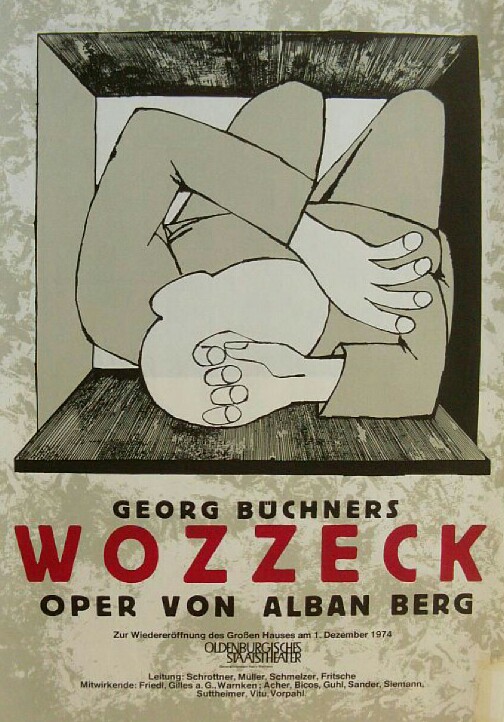
Oldenburgisches Staatstheater conductor Johannes Schüler proved that Wozzeck could succeed in a small-town theater with few rehearsals.[161] Berg and Erwin Stein cut sections from four to three musicians, yielding an orchestra of about 60.[167] Berg first gave his “Lecture on Wozzeck” before this premiere, then in 11 more cities.[161]
1930: Viennese premiere and polemic
[edit]
For Wozzeck’s 1930 Austrian premiere, led by Vienna’s Clemens Krauss, Berg gave tickets to friends, family, and his illegitimate daughter, Albine Wittula. While on better terms with Kleiber, Berg was pleased with Krauss’s performance and touched by his opera’s hometown success. Neue Freie Presse critic Julius Korngold wrote a polemical review:[168]
If there is … “atonal” music, it is … a music that cannot be … deduced given its fanatic attachment to chromaticism—in both vertical [harmonic] and horizontal [melodic] dimensions. … [W]e have here “negative composing” … with its conscious dethronement of the evolving tonal system and rejection of tonal relationships and a tonal center.
In reply, Berg framed atonality as tradition-based harmonic innovation in a revised “Lecture on Wozzeck” (“The ‘Atonal Opera'”) he delivered at the Kulturbund (cultural association) and in a scripted Radio Wien talk “What Is Atonal?” with critic Julius Bistron.[168]
1931: Philadelphia and New York
[edit]
Kleiber gave the Wozzeck Fragments their 1930 U.S. premiere at the New York Philharmonic, priming opera-goers. “Like Debussy in his Pelléas, Berg sought … to probe the depths of consciousness”, wrote Lawrence Gilman in the New York Herald Tribune.[168]
In 1931, the Philadelphia Grand Opera Company, working with the Curtis Institute of Music and Philadelphia Orchestra, staged the U.S. premiere of Wozzeck at Philadelphia’s Metropolitan Opera House under Leopold Stokowski. Composer George Gershwin rode a special Wozzeck train from New York (he met Berg in 1928 via pianist Josefa Rosanska, called Josephine Rosensweet, Rudolf Kolisch‘s soon-to-be wife, and heard the Kolisch Quartet play Berg’s Lyric Suite).[169] Calling the audience “brilliant”, The New York Times‘s conservative critic Olin Downes wrote of an “astonishing” success and hailed Berg’s word painting:[170]
You may hear the military band approaching, the crackling and cutting of the wood for the captain’s fire, feel the approach of darkness and find reflected in the instruments the sulphurous sky of the field scene, and the setting of the sun. Or you will feel the blinding, insane thought of murder in Wozzeck’s brain, and may be conscious, with weird distinctness and psychology of effect, of bubbles rising into the pool into which Wozzeck’s body has sunk. All … synthesized and reflected as in a transparent mirror […]. … [T]his score … is beautiful.
Gilman agreed:[170]
The layman, if he can accustom himself … will find … bitter and piercing loveliness, … intensity, a compassionate wisdom [and] suffusing tenderness … reveal[ing] Berg [as a] poet … a pitiful humanitarian, even (let us whisper it!) a shameless romanticist—a social and spiritual rebel, no less than an aesthetic one.
Later that year, Stokowski’s Philadelphia team staged Wozzeck’s second U.S. premiere at New York’s Metropolitan Opera, prompting another Downes review:[170]
[Berg] is Wozzeck himself, and we … know Wozzeck’s terrors of the strange things … his premonitions which he cannot explain, of the evil that dogs him, his hallucinations, his murderous revolt. This is the psychological and emotional quality of the music.
1932–52: British broadcasts and premiere
[edit]
In 1932, Henry Wood led the BBC Symphony Orchestra in a studio performance of the Wozzeck Fragments broadcast by Schoenberg pupil Edward Clark.[171] In 1934, Adrian Boult conducted Wozzeck in a Queen’s Hall concert performance also broadcast by Clark.[172][173] In 1952, it was staged at the Royal Opera House, Covent Garden.[155]
.jpg)
Wozzeck brought Berg financial comfort, mostly via royalties from performances in Central Europe,[citation needed] nearly until his 1935 death. He traveled not only to Germany, Czechoslovakia, Soviet Russia, and England, but also to Switzerland, Belgium, Holland, France, and Italy for performances of and talks about the opera.
Busy attending to his success and enjoying independence, he declined vacations with Schoenberg and Schreker’s offers of a Berlin Musikhochschule appointment. He benefited from new relationships with Kleiber, Karl Böhm, and Gian Francesco Malipiero, and was appointed to the ADMV jury.
Berg and Krenek were acquainted at the salons of Alma Mahler, a close friend of the Bergs and the wife or lover of Gustav Mahler, Kokoschka, and Werfel. Krenek studied Wozzeck’s piano–vocal score and wrote Berg with praise and questions about vocal writing while working with Kokoschka on Orpheus und Eurydike in 1923. Berg replied with examples from Wagner, Mozart, and Bach, stressing music adapted to singers’ limits and his varied use of voice (“the supreme instrument”) for dramatic effect.
Krenek denied modeling Orpheus on Wozzeck, but Berg likely influenced him. Hans Hartleb saw parallels in the operas’ violence and music of “fatalism, melancholy, and sensuality” for Eurydike and Marie (whose role, he wrote, such music elevated).
In Sinfonia (1968–69), Luciano Berio quotes the rising orchestral chords Berg uses in the word painting of Wozzeck’s drowning.[citation needed]
Besides Stein’s arrangement, John Rea‘s arrangement is for 22 singers and 21 instrumental parts.[112]
The Hamburg State Opera‘s 1970 production was filmed at a deserted castle for director Joachim Hess‘s 1972 TV film Wozzeck, broadcast on Norddeutscher Rundfunk.[179]
- ^ For example, Symbolist Stefan George‘s poetry was often set by the Second Viennese School.[27] Shreffler described his poems as “hyperexpressive”, eliciting “equally vivid and extreme music”. They may have influenced Schoenberg’s atonal turn in the String Quartet No. 2.[29] Webern set fourteen George texts, ten as atonal Lieder Opp. 3–4. George translated Baudelaire’s Les Fleurs du mal, from which Berg took the hidden text of his Lyric Suite and three poems for Der Wein.[31]
- ^ Schoenberg called Kokoschka “the greatest living painter”. Kokoschka was nearly arrested at the 1909 production of his play Murderer, the Hope of Women, on which Paul Hindemith’s first expressionist opera Mörder, Hoffnung der Frauen is based. Its gender conflict may have influenced Schoenberg’s Die glückliche Hand. After the Nazis’ defeat, in 1951, Kokoschka expressed interest, at Will Grohmann‘s suggestion, in producing Wozzeck, though this never transpired.
- ^ Berg set Rilke’s “Traumgekrönt” in Seven Early Songs.[37]
- ^ Kammerer was scandalized by fraud allegations and died by suicide in 1926.[54]
- ^ Drafts surfaced in 2006.[62]
- ^ Berg used film in his next opera, Lulu.[63]
- ^ In German literary and aesthetic thought since the Sturm und Drang, Dichter (poet) has been applied to any creative artist and poem any creative work.[citation needed]
- ^ This hunger led to the creation of the Volksernährung and featured in the Lebensfähigkeitsdebatte Österreichs.[citation needed]
- ^ The First Austrian Republic had just been created from the Republic of German-Austria.
- ^ Innovative classical music had long faced unreliable support despite successes, as with Wozzeck. Amid widespread poverty, Schoenberg’s Society was a subscription business model for sustaining Neue Musik (new music) by composers across Europe through performance. It grew out of open rehearsals. Schulhoff soon co-founded a Prague Society for Private Musical Performances.[97]
- ^ Werfel, likely the Bergs’ closest literary friend, had disparaged Wagner’s “bloated excess” and “garrulous monotony” in favor of Verdi, perhaps shaping Berg’s view of Wagner as “antiquated”.
- ^ Berg may have stressed form partly to counter his reputation for quasi-Romantic music.
- ^ Webern explored such themes in, among other Lieder, his 1915 setting of “Der Tag ist vergangen (“The day has ended”), a pious Volkslied from Des Knaben Wunderhorn.
- ^ Smaragda briefly married Adolf Freiherr von Eger, son of the Austrian Southern Railway director, in 1907. Her lesbianism became evident through affairs with diseuse Marya Delvard, actress Erika Stiedry-Wagner, and her sister-in-law Alice Berg. She also competed with Berg for Helene. They accepted her. Helene wrote Berg, “Did I come out and say that same-sex love was degenerate? … Let’s call it a love of beauty.” Still, when Berg sought the blessing of Helene’s (legitimate) father, he wrote that Smaragda’s sexuality was his family’s “desperate sorow”.[146] Berg altered the form and text of Frank Wedekind‘s plays in Lulu to humanize the lesbian Countess Geschwitz, whose near-final music has two motifs linked to Marie in Wozzeck: the F–B “waiting” ostinato and an F♯–G–B–C♯ chord.[147]
- ^ Brian S. Locke called the “Wozzeck Affair” the “most important event at the Czechs’ National Theater in the interwar period”.[158]
- ^ The set included a bonus LP of Berg’s lecture on Wozzeck, read in English by Noël Goodwin, with music examples conducted by Boulez.
- ^ Watkins, Glenn (2003). Proof Through the Night: Music and the Great War. Sponsors, Sukey and Gil Garcetti, Michael P. Roth, and the Roth Family Foundation (First hardcover ed.). Berkeley: University of California Press. pp. 232–241. ISBN 978-0-520-23158-0.
- ^ Hall 2011, 26–38; Simms and Erwin 2021, 176.
- ^ Simms and Erwin 2021, 17–21, citing Berg’s “long love epic” titled “Hanna” as well as his “Bergwerk” or “Mining Drama” project.
- ^ Simms and Erwin 2021, 56, quoting Berg on Brahms’s German Requiem, with phrasing likely from the Beethoven-attributed epigraph to Spemanns Goldenes Buch der Musik: “Music is a form of revelation higher than all wisdom and philosophy”.
- ^ Simms and Erwin 2021, 4–5, quoting Schoenberg.
- ^ Simms and Erwin 2021, 119–124, 140–142, 175, quoting Berg’s letter to Schoenberg.
- ^ Berg 2014, 327; Simms and Erwin 2021, 175–176.
- ^ Simms and Erwin 2021, 179, 181–185.
- ^ a b Simms and Erwin 2021, 180.
- ^ Reddick, John (1990). “The shattered whole: Georg Büchner and Naturphilosophie“. In Cunningham, Andrew; Jardine, Nicholas (eds.). Romanticism and the Sciences (Hardcover ed.). Cambridge: Cambridge University Press. pp. 326, 328. ISBN 978-0-521-35602-2. Retrieved 11 November 2025.
- ^ Dedner, Burghard (2017). “Producing ‘thoughts by means of the body’. Büchner and the Enigma of Consciousness”. In Gillett, Robert; Schonfield, Ernest; Steuer, Daniel (eds.). Georg Büchner: Contemporary Perspectives. Amsterdamer Beitrage zur neueren Germanistik (in English and German). Vol. 89. Founding editor, Gerd Labroisse; series editors: William Collins Donahue, Norbert Otto Eke, Martha B Helfer, Sven Kramer; cover, Armin Smailovic (Hardcover ed.). Leiden: Brill. pp. 31, 34. ISBN 978-90-04-33859-3. ISSN 0304-6257. Archived from the original on 15 July 2024. Retrieved 11 November 2025.
- ^ Reddick, John (1994). Georg Büchner: The Shattered Whole (Hardcover ed.). Oxford: Oxford University Press. p. 5. ISBN 978-0-19-815812-7. Retrieved 11 November 2025.
- ^ Guthrie, John (1995). “Introduction”. In Reddick, John (ed.). Georg Büchner: Woyzeck (2nd revised ed.). London: Duckworth Books. pp. 17–20. ISBN 978-1-85399-374-9. Retrieved 11 November 2025.
- ^ Perle 1980, 24; Reddick 1994, 108–110; Simms and Erwin 2021, 180–181.
- ^ Büchner, Georg (1993). “Selected Letters”. In Reddick, John (ed.). Georg Büchner: Complete Plays, Lenz and Other Writings (Revised paperback ed.). London: Penguin Publishing Group. pp. 195–196. ISBN 978-0-14-044586-2. Retrieved 11 November 2025.
- ^ Thompson, Peter (2017). “Büchner, Science and the Metaphysics of Contingency”. In Gillett, Robert; Schonfield, Ernest; Steuer, Daniel (eds.). Georg Büchner: Contemporary Perspectives. Amsterdamer Beitrage zur neueren Germanistik (in English and German). Vol. 89. Founding editor, Gerd Labroisse; series editors: William Collins Donahue, Norbert Otto Eke, Martha B Helfer, Sven Kramer; cover, Armin Smailovic (Hardcover ed.). Leiden: Brill. pp. 55–59. ISBN 978-90-04-33859-3. ISSN 0304-6257. Archived from the original on 15 July 2024. Retrieved 11 November 2025.
- ^ Lukács, György (1993). “The Real Georg Buchner and his Fascist Misrepresentation [1937]”. In Livingstone, Rodney (ed.). German Realists in the Nineteenth Century [translated reprint, with editor’s introduction, of Ferenc Jánossy‘s Deutsche Realisten des 19. Jahrhunderts (1951)]. Translated by Gaines, Jeremy; Keast, Paul (First hardcover ed.). Cambridge, MA: The MIT Press. pp. 86–88. ISBN 978-0-262-12171-2. Retrieved 11 November 2025.
- ^ Lukács, György (19 February 1937). Blunden, Andy (ed.). “The Real Georg Büchner and his Fascist Misrepresentation” [“Der faschistisch verfälschte und der wirkliche Georg Büchner“, originally published in Das Wort]. Marxists Internet Archive. Georg Lukács Archive. Translated by P, Anton. Archived from the original on 15 February 2025. Retrieved 11 November 2025.
As a great realist, however, he portrayed Woyzeck […]. And in the short story fragment Lenz, Büchner has his hero, the well-known friend of Goethe‘s from his youth, express the following commitment to true realism: ‘[…] Try once to immerse yourself in the life of the little one and reproduce it in the twitches, the hints, the whole delicate, hardly noticed play of expressions […]. They are the most prosaic men under the sun; but the vein of feeling is the same in almost everyone, only the shell through which it has to break is more or less dense. You just have to have an eye and an ear for it.’
- ^ Reddick, John (1993). Georg Büchner: Complete Plays, Lenz and Other Writings (Revised paperback ed.). London: Penguin Publishing Group. pp. xiv–xvii. ISBN 978-0-14-044586-2. Retrieved 11 November 2025.
- ^ a b Simms and Erwin 2021, 180–181.
- ^ Perle 1980, 23, 25, 32; Simms and Erwin 2021, 180–181.
- ^ Reddick 1994, 327, quoting Clarus: “Freiheit des Willens”, “Willensfreiheit”, “freier Vernunftgebrauch”; Simms and Erwin 2021, 180–181.
- ^ Barnouw 1999, 73–74; Schroeder 1999, 232–233, 236; Shreffler 1999, 253; Simms 1999a, xiii–xiv; Simms 1999b, 136–137, 157–158, 182n33; Simms and Erwin 2021, 4, 281, 306, 308, 485n62.
- ^ Barnouw 1999, 73–74; Simms 1999a, xiii–xiv; Simms 1999b, 136–137, 157–158, 182n33; Simms and Erwin 2021, 4.
- ^ Schroeder 1999, 232–233, 236; Simms and Erwin 2021, 281, 306, 308, 485n62.
- ^ Simms and Erwin 2021, 71, 75.
- ^ Simms and Erwin 2021, 175, 181.
- ^ Schroeder 1999, 185–186, 209–210; Simms and Erwin 2021, 175–176.
- ^ Simms and Erwin 2021, 175–176, quoting Berg’s letter to Helene.
- ^ Simms and Erwin 2021, 181, quoting Berg’s letter to Webern.
- ^ Perle 1980, 24, 28n16; Simms and Erwin 2021, 179.
- ^ Simms and Erwin 2021, 179.
- ^ Simms and Erwin 2021, 182, citing Hugo Bieber’s “Wozzeck und Woyzeck”.
- ^ Simms and Erwin 2021, 182–183, citing Georg Witkowski’s 1919 “Büchners Woyzeck”.
- ^ a b Simms and Erwin 2021, 183–184.
- ^ Simms and Erwin 2021, 38–43, 182, 243, 319.
- ^ Simms and Erwin 2021, 53.
- ^ Simms and Erwin 2021, 36, 46, 108, 147, 175–178, 185–186, 295.
- ^ Simms and Erwin 2021, 147–149, quoting Karl Kraus’s 1914 “In dieser grossen Zeit” (“In these great times”).
- ^ Perle 1980, 19; Simms and Erwin 2021, 23–26, 150–151, quoting Berg’s 1912 letter to Schoenberg: “I went to a professor in Vienna [whose] opinion is that it is a nervous irritability or an oversensitivity of the mucous membranes … of the nose [which] are extremely irritated by pollen in the air … caus[ing symptoms]”.
- ^ Simms and Erwin 2021, 23–26, 393, et pass.; Berg’s remedies included opioid analgesics, laxatives, cocaine solution, menthol, Arsenferratone, and Brunswick Mum; quoting Adorno: “Part of this hypochondria came from addiction”; “Berg lived, as he once said, from aspirin and tea, and he probably enjoyed the euphoric aspects of illness”; “[he was of] that generation of artists who felt the ailing Tristan to be a model”.
- ^ Simms and Erwin 2021, 141, 150, 175–178, 181, 473n5.
- ^ Simms and Erwin 2021, 175–178, 473n9.
- ^ Simms and Erwin 2021, 328.
- ^ Busch 2010, 94–103; Simms and Erwin 2021, 175–178.
- ^ Hall 2011, 28–31; Simms and Erwin 2021, 151, 474n38, citing one of Berg’s Wozzeck notebook with the Wozzeck scene outline.
- ^ Simms and Erwin 2021, 12, 31–32, 150–153, 223, 435, 442, citing Karl Berg’s letter of having “offered [Berg] a position at the War Ministry” and questioning Soma Morgenstern‘s account.
- ^ a b Simms and Erwin 2021, 151.
- ^ Simms and Erwin 2021, 151, quoting Berg’s 14 April 1916 letter to August Göttel.
- ^ Simms and Erwin 2021, 177, quoting Berg’s letter to Buschbeck.
- ^ a b Hailey 2010, 12–13, quoting Helene’s “Dokumentation”; Simms and Erwin 2021, 147, 185–186, 295.
- ^ Simms and Erwin 2021, 178, 473n10: “as always the date was largely symbolic”; quoting Berg’s 13 August 1917 letter to Schoenberg.
- ^ Simms and Erwin 2021, 185, 474n31, citing Berg.
- ^ Berg, Alban (2014). “A Conversation with Alban Berg, by Oskar Jancke”. In Simms, Bryan (ed.). Pro Mundo–Pro Domo: The Writings of Alban Berg, edited with commentaries by Bryan R. Simms. Oxford: Oxford University Press. p. 327. ISBN 978-0-19-976406-8. Retrieved 26 October 2025.
- ^ Simms and Erwin 2021, 181, 474n22, quoting Berg’s 7 August 1918 letter to Helene.
- ^ Simms and Erwin 2021, 187–188, 474n41, quoting Berg’s 19 August 1918 letter to Webern.
- ^ Brand, Hailey & Harris 1987, vii, 93, 95–98.
- ^ Simms and Erwin 2021, 161–162.
- ^ Simms and Erwin 2021, 161–163.
- ^ Simms and Erwin 2021, 161, quoting Berg’s letter to Schulhoff.
- ^ Simms and Erwin 2021, 12–13, 16, 108.
- ^ Simms and Erwin 2021, 161, quoting Johanna’s 5 August 1918 letter to Berg.
- ^ Simms and Erwin 2021, 164.
- ^ Simms and Erwin 2021, 161, quoting Zweig’s memoir The World of Yesterday.
- ^ Simms and Erwin 2021, 5–9, 161.
- ^ Simms and Erwin 2021, 161, 471n52, quoting Berg’s 27 November 1919 letter to Schulhoff.
- ^ Simms and Erwin 2021, 181, citing Berg’s second Wozzeck sketchbook.
- ^ Hall 2011, 40–41, quoting Berg’s and Schulhoff’s letters.
- ^ Simms and Erwin 2021, 149–150: Schulhoff circulated an internationalist “declaration of mind” led by writer Romain Rolland. Berg followed Kraus and Schoenberg in not signing. Schoenberg “sp[oke] out”: “Even before the war [World War I], the greatest German composers were pushed aside and virtually every ‘modernist’ was proud to take his modernism from Debussy while wanting nothing to do with me or Mahler. … Are we now to lose our hegemony in music too? Certainly art is a common inheritance of all nations, but if this common inheritance is to be spread equally everywhere, then we Germans will have to give our music away with nothing in return. The victors even before the war treated us differently […]. I’m not for a politics of art but [… w]hen I think of music, I think only of German music!”.
- ^ Ljubibratić, Vanja (2024). “Aesthetic Contrasts and Symbolic Correlations Between Alban Berg and Erwin Schulhoff in Their Letters and Opera Narratives” (PDF). Musicologica Slovaca. 15 (41): 9–11. doi:10.31577/musicoslov.2024.1.1. Archived (PDF) from the original on 14 November 2025. Retrieved 14 November 2025.
Schulhoff [sent] Berg a large extract from Schoenberg’s letter, where the latter attacks Schulhoff […]. Schulhoff then continued that Schoenberg … suffers from ‘war psychosis’ […]. [O]n 27 November 1919, Berg partially responds: ‘[Y]ou are very much mistaken if you think of me as an imperialist or even a militarist. … I asked myself whether a nation that treats its greatest [people] like the Germans did does not deserve to be defeated. … I still believe in the German people … who name Beethoven and all the greats up to Mahler and Schoenberg. For example, France (despite Debussy, Ravel, Satie) and other lesser countries, did not produce the people who finally had a Karl Kraus … who was able to prove and show … the depth of the most impotent government of a Franz Joseph, and the … idiotic militarism and mercantilism etc. in Prussia.’
- ^ Hall 2011, 40–41, 195n10, quoting Berg’s 27 November 1919 letter to Schulhoff: “whether a people [Volk] who treat their greatest the way the Germans did and do, don’t deserve to be conquered”.
- ^ Brand, Juliane; Hailey, Christopher; Harris, Donald, eds. (1987). The Berg–Schoenberg Correspondence: Selected Letters [with Introduction, Translator’s Preface, and Annotations]. Book design, Jacques Chazaud (Softcover reprint ed.). London: The Macmillan Press Ltd. pp. xiv–xvii, 263–264, 274n11, 275n1. ISBN 978-1-349-09831-6. Retrieved 14 November 2025.
- ^ Simms and Erwin 2021, 149, quoting Berg’s 27 November 1919 letter to Schulhoff.
- ^ Perle 1980, 20–21, quoting Berg’s 27 November 1919 letter to Schulhoff: “fierce antimilitarist”; “I don’t think you will soon again find such an enraged antimilitarist as I am”; “What names does the Entente have (outside of Russia) that ring of idealism as these [Luxemburg and Liebknecht] do?”.
- ^ Simms and Erwin 2021, 162–174, 429–430, quoting Helene Berg’s name for the affair.
- ^ a b Simms and Erwin 2021, 188–189.
- ^ Simms and Erwin 2021, 167–174, quoting Berg’s letter to Webern.
- ^ Simms and Erwin 2021, 165–166, 167, 188, 295.
- ^ Simms and Erwin 2021, 188, 191, citing Berg’s August letter to Kassowitz.
- ^ Simms and Erwin 2021, 15–16, 55–58, 162–167, 188, 370–371.
- ^ Simms and Erwin 2021, 108, 163, 165–167, 188, quoting Johanna: “You have only me … provid[ing] for you because we can’t depend on Helene, who won’t touch any of her money. That we—Charly and I—work all the time to bring in money and to maintain our assets, this you know […]”.
- ^ Simms and Erwin 2021, 163, quoting Johanna: “You can’t live in penury, that I must concede”.
- ^ Simms and Erwin 2021, 12–15, 30, 161, 188, 291, 474n42, quoting Johanna’s 9 May 1922 letter to Geo. Borgfeldt & Co. in English.
- ^ Simms and Erwin 2021, 188.
- ^ Simms and Erwin 2021, 177, 188, 473n7, quoting Berg’s May 1922 letter to Helene.
- ^ Simms and Erwin 2021, 189.
- ^ a b “Alban Berg – Wozzeck – Reduzierte Fassung (21 instrumente) – John Rea”. Universal Edition. Retrieved 9 December 2010.
- ^ Simms and Erwin 2021, 175, 192–193.
- ^ Simms and Erwin 2021, 176, 192–193.
- ^ Simms and Erwin 2021, 192–193.
- ^ Simms and Erwin 2021, 200, quoting Berg.
- ^ Rose, Michael (2013). The Birth of an Opera: Fifteen Masterpieces from Poppea to Wozzeck. W. W. Norton. p. 375. ISBN 978-0393060430. Retrieved 2015-05-09.
- ^ Simms and Erwin 2021, 235–236; Watkins 2003, 217, quoting Olin Downes.
- ^ a b Simms and Erwin 2021, 200.
- ^ Simms and Erwin 2021, 185, citing Alexander Landau’s “Die Musik und das soziale Problem” and Otto Brües’s “Über Georg Büchner”.
- ^ Simms and Erwin 2021, 176.
- ^ a b c “Gurlitt: Wozzeck (Roland Hermann, Celina Lindsley, Anton…) – review”. Classical-music.com.
- ^ Hailey 2010, 17; Simms and Erwin 2021, 189, 211–213, 216.
- ^ Simms and Erwin 2021, 115, 154–155, 166, 177, 188–189, 474n43.
- ^ Simms and Erwin 2021, 13, 46–47, 51, quoting Helene and Berg.
- ^ Simms and Erwin 2021, 198–199, 324–327, 330–331, 475n61.
- ^ Simms and Erwin 2021, 189, 211–212.
- ^ Simms and Erwin 2021, 193–194, 211–212.
- ^ Simms and Erwin 2021, 146, 211–212.
- ^ Hailey 2010, 17; Simms and Erwin 2021, 145–146.
- ^ Moldenhauer, Hans (1978). Anton von Webern: A Chronicle of His Life and Work. Victor Gollancz Ltd. pp. 253, 663n20. ISBN 978-0-394-47237-9.
- ^ Simms and Erwin 2021, 212–213.
- ^ a b Simms and Erwin 2021, 213.
- ^ a b c Walsh 2001, pp. 61–63
- ^ a b Simms and Erwin 2021, 214.
- ^ Adorno and Berg 2005, 85.
- ^ a b Locke, Brian S. (2008). “The “Wozzeck Affair”: Modernism and the Crisis of Audience in Prague”. The Journal of Musicological Research. 27: 63–98. doi:10.1080/01411890701804788.
- ^ Adorno and Berg 2005, 85; Simms and Erwin 2021, 215.
- ^ a b c d Simms and Erwin 2021, 215.
- ^ Loomis, George (1 December 2009). “A Firmly Middle-Class Wozzeck“. The New York Times. Archived from the original on 7 March 2017. Retrieved 19 October 2025.
- ^ “Alban Berg – Wozzeck – reduced version (Stein)”, Universal Edition. Retrieved 12 November 2013.
- ^ a b c Simms and Erwin 2021, 216.
- ^ Simms and Erwin 2021, 216–217, 274, 481n50.
- ^ a b c Simms and Erwin 2021, 217.
- ^ Nicholas Chadwick. “Alban Berg and the BBC” (PDF). Bl.uk. Retrieved 27 January 2018.
- ^ Bray, Trevor. “Frank Bridge: A Life in Brief ~ Isolation: 62”. Trevor-bray-music-research.co.uk.
- ^ Denis Apivor. “Memories of ‘The Warlock Circle’“. Musicweb-international.com.
- ^ Levine, Robert. “Berg: Wozzeck, 1970/Hamburg DVD”. Classics Today.
- Adorno, Theodor W. and Alban Berg. 2005. Correspondence 1925–1935, ed. Henri Lonitz, trans. Wieland Hoban. Cambridge, UK and Malden, MA: Polity Press. ISBN 978-0-7456-2336-8. (Trans. of Briefwechsel 1925–1935. Frankfurt: Suhrkamp Verlag, 1997.)
- Barnouw, Dagmar. 1999. “Wiener Moderne and the Tensions of Modernism”. Schoenberg, Berg, and Webern: A Companion to the Second Viennese School, ed. Bryan R. Simms, 73–128. Westport, Connecticut and London: Greenwood Press. ISBN 978-0-313-29604-8.
- Busch, Regina. 2010. “A Descriptive Overview of Berg’s Night/Nocturne“. Alban Berg and His World, intro. Regina Busch, ed., trans, and cmt. Christopher Hailey, 91–132. Princeton: Princeton University Press. ISBN 978-0-691-14855-7 (hbk). ISBN 978-0-691-14856-4 (pbk).
- Deathridge, John. 2005. “Wagner and beyond”. The Cambridge Companion to Twentieth-Century Opera, ed. Mervyn Cooke, 14–25. Cambridge: Cambridge University Press. ISBN 978-0-521-78009-4 (hbk). ISBN 978-0-521-78393-4 (pbk).
- Fisher, Burton D. 2000. Macbeth. Opera Journeys Mini Guide Series. Miami: Opera Journeys Publishing. ISBN 978-1-930841-10-9 (pbk).
- Franklin, Peter. 2024. Britten Experienced: Modernism, Musicology, and Sentiment. London and New York: Routledge. ISBN 978-1-032-66660-0 (hbk). ISBN 978-1-032-66663-1 (ebk). ISBN 978-1-032-66664-8 (pbk). doi:10.4324/9781032666631.
- Görner, Rüdiger. 2020. Kokoschka: The Untimely Modernist, trans. Debra S. Marmor and Herbert A. Danner. London: Haus Publishing. ISBN 978-1-912208-82-1 (ebk).
- Griffel, Margaret Ross. 2018. “A Brief History of Operas in German”. Vol. 1, Operas in German: A Dictionary, ed. Margaret Ross Griffel, xv–xxvi. London: Rowman & Littlefield. ISBN 978-1-44-224797-0 (ebk). ISBN 978-1-44-224796-3 (hbk).
- Hailey, Christopher. 2010. “Berg’s Worlds”. Alban Berg and His World, ed. Christopher Hailey, 3–32. Princeton: Princeton University Press. ISBN 978-0-691-14855-7 (hbk). ISBN 978-0-691-14856-4 (pbk).
- Hall, Patricia (2011). Berg’s Wozzeck. Studies in Musical Genesis, Structure, and Interpretation. New York: Oxford University Press. ISBN 978-0-19-534261-1.
- Headlam, David J. 1996. The Music of Alban Berg. Composers of the Twentieth Century. New Haven: Yale University Press. ISBN 978-0-300-06400-1 (hbk).
- Ho, Allan B. and Dmitry Feofanov. 2011, rev 2014. The Shostakovich Wars.
- Perle, George. 1980. The Operas of Alban Berg, Vol. I: Wozzeck. Berkeley: University of California Press. ISBN 978-0-520-06617-5.
- Pople, Anthony (24 April 1997). The Cambridge Companion to Berg. Cambridge Companions to Music. Cambridge: Cambridge University Press. ISBN 0521563747.
- Ross, Alex (2008). The Rest Is Noise: Listening to the Twentieth Century (1st Picador ed.). New York: Picador. ISBN 978-0-312-42771-9.
- Shreffler, Anne C. 1999. “Anton Webern”. Schoenberg, Berg, and Webern: A Companion to the Second Viennese School, ed. Bryan R. Simms, 251–314. Westport, Connecticut and London: Greenwood Press. ISBN 978-0-313-29604-8 (hbk).
- Schroeder, David. 1999. “Alban Berg”. Schoenberg, Berg, and Webern: A Companion to the Second Viennese School, ed. Bryan R. Simms, 185–250. Westport, Connecticut and London: Greenwood Press. ISBN 978-0-313-29604-8.
- Simms, Bryan R. (1996). Alban Berg: A Guide to Research. Routledge.
- Simms, Bryan R. 1999. “Introduction”. Schoenberg, Berg, and Webern: A Companion to the Second Viennese School, ed. Bryan R. Simms, xi–xiv. Westport, Connecticut and London: Greenwood Press. ISBN 978-0-313-29604-8.
- Simms, Bryan R. 1999. “Arnold Schoenberg”. Schoenberg, Berg, and Webern: A Companion to the Second Viennese School, ed. Bryan R. Simms, 129–184. Westport, Connecticut and London: Greenwood Press. ISBN 978-0-313-29604-8 (hbk).
- Simms, Bryan R. and Charlotte Erwin. 2021. Berg. Oxford: Oxford University Press. ISBN 978-0-19-093144-5 (hbk).
- Stewart, John Lincoln. 1991. Ernst Krenek: The Man and His Music. Berkeley and Los Angeles: University of California Press. ISBN 978-0-520-07014-1 (hbk).
- Walsh, Stephen. 2001. “Alban Berg”. In The New Penguin Opera Guide, ed. Amanda Holden. New York: Penguin Putnam. ISBN 0-14-029312-4.
- Adorno, Theodor W. (1991), Alban Berg: Master of the Smallest Link. Trans. Juliane Brand and Christopher Hailey. Cambridge: Cambridge University Press. ISBN 0-521-33016-5
- Bailey Puffett, Kathryn. 1997. “Berg’s aphoristic pieces”. The Cambridge Companion to Berg, ed. Anthony Pople, 83–110. Cambridge and New York: Cambridge University Press. ISBN 978-1-139-82807-9.
- Bonds, Mark Edward (June 2020). “ ’Wozzeck‘s Worst Hours’: Alban Berg’s Presentation Copy of Wozzeck to Eduard Steuermann“. Notes, 76(4), 527–534. JSTOR 27079692
- Jarman, Douglas (1979), The Music of Alban Berg. London and Boston: Faber & Faber ISBN 0-571-10956-X; Berkeley: University of California Press. ISBN 0-520-03485-6
- Jarman, Douglas (1989), “Alban Berg, Wozzeck“. Cambridge Opera Handbooks. Cambridge: Cambridge University Press. ISBN 0-521-24151-0 (cloth) ISBN 0-521-28481-3 (pbk).
- Schmalfeldt, Janet (1983), “Berg’s Wozzeck“, Harmonic Language and Dramatic Design. New Haven: Yale University Press ISBN 0-300-02710-9.



