
From Wikipedia, the free encyclopedia
Content deleted Content added
Latest revision as of 12:38, 27 November 2025
Ship built in 1997

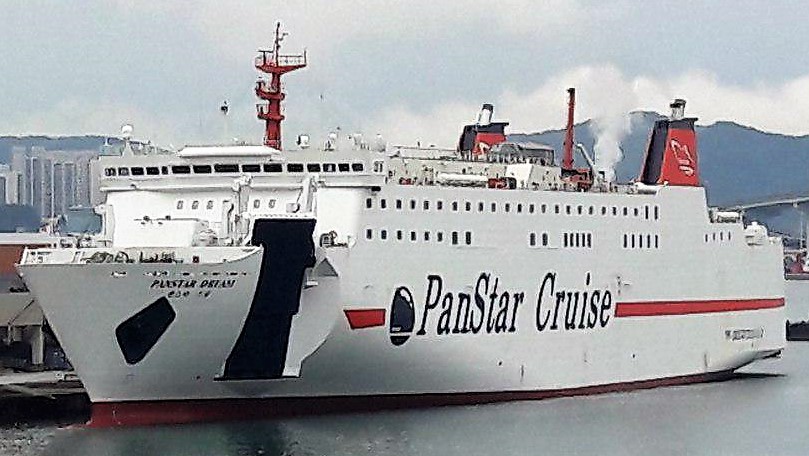
Panstar Dream (c. 2018) |
|
| Name |
|
|---|---|
| Namesake | Kuroshio current |
| Port of registry | Tokyo |
| Builder | MHI Shipbuilding Shimonoseki Shipyard |
| Yard number | 1034 |
| Launched | 21 March 1997[1] |
| In service | 18 June 1997[1] |
| Homeport | Tokyo |
| Identification | |
| Name |
|
| Namesake | Dream |
| Operator | Panstar Line Dot Com Ltd (PanStar Cruise) |
| Port of registry | Jeju |
| Acquired | 2002 |
| In service | 2002-2025 |
| Homeport | Busan |
| Identification | |
| Name | |
| Namesake | Yaima (Yaeyama Islands) |
| Owner | Shosen Yaima Panama SA |
| Operator | Shosen Yaima Co Ltd (YaimaLine) |
| Port of registry | Panama |
| Acquired | August 2025 |
| In service | December 2025 (scheduled) |
| Identification | |
| Tonnage | |
| Length | 160 m (520 ft) LOA[1] |
| Beam | 25.0 m (82.0 ft)[1] |
| Draft |
|
| Installed power | 27,000 hp (20 MW) [1] |
| Propulsion | 2 × Pielstick-Nippon NKK18PC-6V 27,000 hp (20 MW)[1] |
| Speed | 22.7 knots (42.0 km/h; 26.1 mph)[1] |
| Capacity | 560[2] |
| Crew | 40 |
Yaimamaru is a roll-on/roll-off passenger ship (ROPAX) launched in 1997 at Mitsubishi Heavy Industries Shipbuilding Shimonoseki Shipyard for Nippon Kosoku Ferry (later acquired by Blue Highway Line, currently MOL Sunflower). She sailed under the Japanese flag as the Sunflower Kuroshio until 2001. The Korean shipping company PanStar Cruise acquired her in 2002, and she began operating on the Busan–Osaka route as the PanStar Dream until a newer ship took her place. Since August 2025, she’s been sailing under the Panamanian flag and is set to serve the Ishigaki–Keelung route by the Japanese shipping company YaimaLine.[3]
Design and construction
[edit]
Sunflower Kuroshio, built to replace Sunflower Tosa, was constructed under yard number 1034 in Shimonoseki and launched on 21 March 1997. Named after the Kuroshio Current, which flows through the Pacific Ocean along her intended service route.[4]
Sunflower Kuroshio started ferry service connecting Tokyo, Nachi-Katsuura, and Kōchi after her delivery on 18 June 1997. Although the service is off to a fresh start, revenues dropped significantly after passenger capacity fell sharply from around 1,100 under her predecessor. This was further impacted by upgrades to the road network, including National Route 42, the growth of air travel with large passenger planes flying into Nanki-Shirahama Airport, and a decrease in freight transport due to weak timber demand after the rise of prefabricated materials. Consequently, annual deficits accumulated 400-600 million yen, and accumulated losses exceeded 4 billion yen. As a result, the route ended scheduled services from 1 October 2001.[5]

