
==See also==
==See also==
{{Portal|Italy|Food}}
{{Portal|Italy|Food}}
* [[Acqua pazza (wine)|”Acqua pazza” (wine)]]
* ”[[Cacciucco]]”
* ”[[Cacciucco]]”
Italian poached white fish or broth

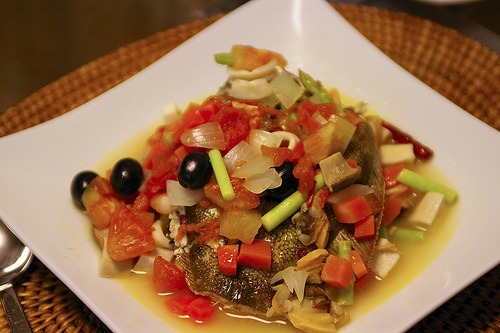
The term acqua pazza (Italian: [ˈakkwa ˈpattsa]; lit. ‘crazy water‘) is used in Italian cuisine to refer to a recipe for poached white fish,[1] or to simply refer to the lightly herbed broth used to poach it.[2] There are many variations of this sauce, from light broths to thick tomato based sauces, which have been found on all types of seafood (not just the traditional white fish) and even chicken.
Several explanations exist for how the name acqua pazza came about. According to food writer Arthur Schwartz, the most credible gives the name as an incredulous reaction to local fisherman cooking their catch in sea water. An alternative explanation has “crazy” referencing the inclusion of chilis in the dish; Schwartz describes this as less likely, because he believes the dish likely predated the introduction of chilis and tomatoes to Italy in the early 16th century. Accordingly, Schwartz describes the earliest preparations of acqua pazza as a combination of water, salt, garlic, parsley and olive.[3] Acqua pazza became a very popular dish with tourists on the island of Capri in the 1960s,[1] and as of the 1990s, it was the most popular way of preparing small whole fish in Campania.[3]
Aside from the white fish (bass, cod, halibut, sea bream, sea bass, sea perch, etc.), the standard ingredients are cherry tomatoes, water, salt, and olive oil (preferably extra virgin). Larger tomatoes, whole or timmed are also used.[3] However, recipes using a variety of other ingredients as additions or substitutions exist—for instance red snapper,[4] shrimp,[5] and Maine lobster[6] instead of white fish; vegetables such as garlic, celery, carrots and scallions;[7] and herbs and spices such as pepper, capers, bay leaves, olives, parsley, fennel and lemon. Some recipes also call for bread (for dipping in the broth).[4] In Campania in modern times, a version of the dish using fillets is sometimes made by first making a broth with fish head and trimmings.[3]
Many restaurants, such as the Acqua Pazza in San Marco, known for seafood and neapolitan pizzas,[8] and Acqua Pazza in Bologna, which specializes in seafoods and sauces,[9] either share the name with or are named after this dish.
- ^ a b Volpi, Anna Maria. “Pesce all’Acqua Pazza”. Archived from the original on 2008-12-24. Retrieved 4 February 2009.
- ^ Murphy, Bruce; de Rosa, Alessandra (2007). Italy for Dummies. For Dummies. p. 522. ISBN 0-470-06932-5.
- ^ a b c d Schwartz, Arthur (1998). Naples at Table: Cooking in Campania. New York: HarperCollins. pp. 229. ISBN 0-06-018261-X.
- ^ a b Ray, Rachael. “Red Snapper in Crazy Water: Acqua Pazza”. Archived from the original on 13 February 2009. Retrieved 7 February 2009.
- ^ Dunea, Melanie (5 December 2007). “Shrimp in Crazy Water (Gamberoni all’Acqua Pazza)”. The Washington Post. Retrieved 8 February 2009.
- ^ Williams, Jody. “Maine Lobster Acqua Pazza”. Archived from the original on 12 February 2009. Retrieved 8 February 2009.
- ^ Callen, Anna Teresa. “Sea Bass all’Acqua Pazza”. Retrieved 7 February 2009.
- ^ Belford, Ros; Martin Dunford; Robert Andrews; Celia Woolfrey (2003). Italy. Rough Guides. p. 333. ISBN 1-84353-060-0.
- ^ Donald, Ben (2005). Footprint Bologna. Footprint Travel Guides. p. 156. ISBN 1-904777-41-4.

