
Content deleted Content added
|
|
|||
| Line 20: | Line 20: | ||
|
==History== |
==History== |
||
|
===Saxon Origins== |
===Saxon Origins== |
||
|
The church of All Saints, Weybourne has Saxon orgins. The present medieval structure was built upon an earlier late Saxon cruciform church. The remains of the original Saxon church tower can still be seen to the north of the modern chancel. The north aisle of the present church was built on the site of the nave of the Saxon church<ref>[http://www.norfolkchurches.co.uk/weybourne/weybourne.htm www.norfolkchurches.co.uk] Retrieved 29 October 2025</ref> |
The church of All Saints, Weybourne has Saxon orgins. The present medieval structure was built upon an earlier late Saxon cruciform church. The remains of the original Saxon church tower can still be seen to the north of the modern chancel. The north aisle of the present church was built on the site of the nave of the Saxon church<ref>[http://www.norfolkchurches.co.uk/weybourne/weybourne.htm www.norfolkchurches.co.uk] Retrieved 29 October 2025</ref> |
||
Latest revision as of 10:39, 29 October 2025
Church in Norfolk, England
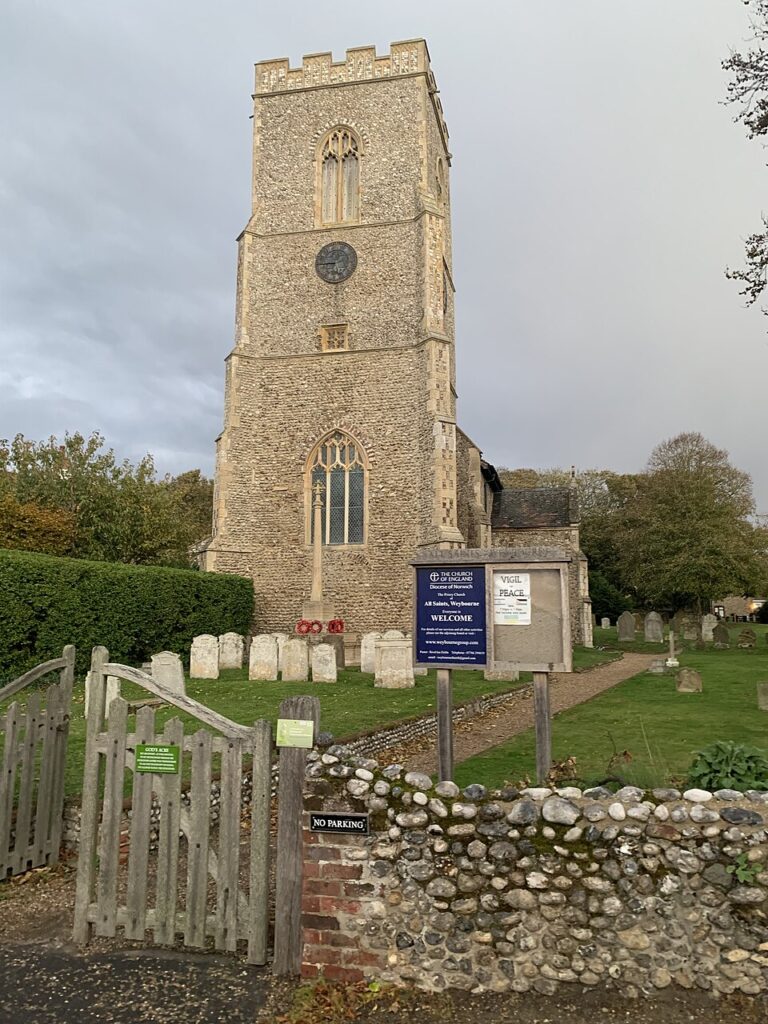
All Saints’ Church, Weybourne is the parish church of the village of Weybourne in North Norfolk, England. The building is principally medieval in origin, though built on Saxon foundations, and remains today as the surviving element of a medieval Augustinian priory complex. It is a Grade II* listed building.
The church of All Saints, Weybourne has Saxon orgins. The present medieval structure was built upon an earlier late Saxon cruciform church. The remains of the original Saxon church tower can still be seen to the north of the modern chancel. The north aisle of the present church was built on the site of the nave of the Saxon church[1]
The present parish church was originally part of Weybourne Priory. The priory was an Augustinian monastic house founded c.1200. The parish church retains the fabric of its medieval origin. [2]
The church was altered and repaired over subsequent centuries. Notable restoration work was carried out in the 19th century (including 1886 additions such as the north aisle and vestry) and further refurbishments of the interior were recorded in the late 19th and early 20th centuries. [2]
Architecture and fittings
[edit]
All Saints is constructed in local flint with stone dressings and displays a mixture of medieval and later features. The tower and some early masonry elements reflect the church’s medieval origins; Victorian-era additions and restorations (including internal fittings and the north aisle/vestry) are also evident. The churchyard contains a First World War/Second World War memorial cross, listed separately as a Grade II structure. [2]
Internally the church retains historic fittings and memorials; the layout and surviving fabric demonstrate the building’s development from a priory setting to a parish church. Several local histories and architectural surveys note the complex stratigraphy of the site, where medieval monastic remains lie adjacent to the church. [2]
All Saints remains an active Church of England parish church and is part of the local benefice/group of churches serving communities on the North Norfolk coast. Regular services and community events are held and the church is open to visitors during normal visiting hours. [2]

