


==Battle==
==Battle==
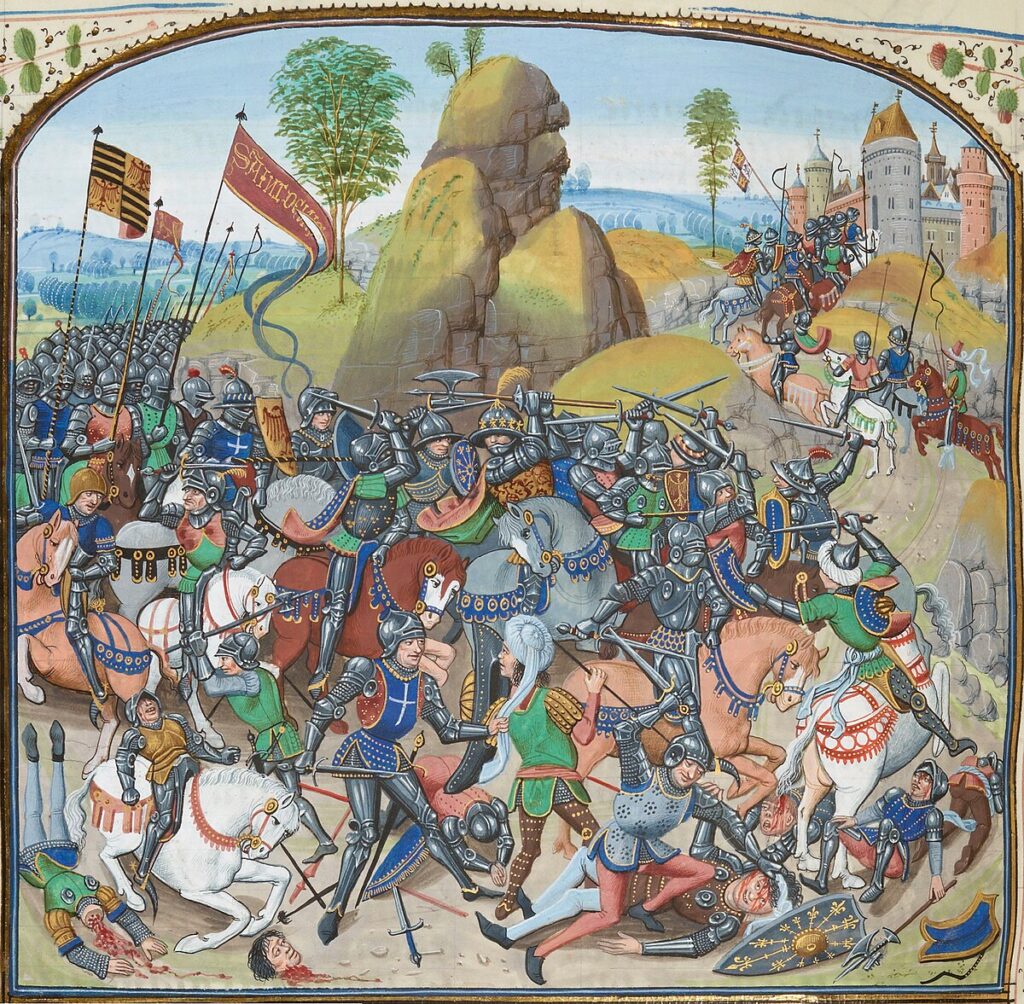
After a night’s march, Henry’s army arrived within sight of Montiel at dawn, finding King Peter already on alert. News had arrived that the approaching force, battling the darkness with the light of bonfires, was very large, and the Castilian king had been forming his troops before the town since dawn, although not all the scattered forces had yet managed to join him.
The Franco-Castilian force was led by [[Bertrand du Guesclin]], while Peter of Castile led a Castilian-Granadine force.
Once the two armies faced each other, Henry ordered the vanguard to advance without altering the aforementioned formation. As the chronicle succinctly recounts, the clash with the royal army’s vanguard occurred in a valley “which they could not cross,” and then, in what we assume was a swift maneuver, Henry managed to outflank the valley with his rearguard and attack Peter’s army from behind, sowing confusion in its ranks. Seeing themselves surrounded, Peter’s forces chose to abandon the field.
According to the chronicle, the attackers seized Pedro’s banners, disrupting his army’s formation to such an extent that neither the Castilian king’s forces, nor those of his supporters, nor the Nasrid reinforcements could do anything but abandon the field.
Then the pursuit began, which the chronicler describes as follows: “And some of King Henry’s men pursued the Moors, and overtook and killed some of them; and the others remained fighting with those of King Pedro, until King Pedro took refuge in the castle of Montiel, which was nearby, and some of his men went with him; some died, and others fled.”
López de Ayala then specifies that none of the nobles in Pedro’s army fell in the battle, with the exception of a Cordoban knight named Juan Jiménez, and that the reason so few died was simple: they weren’t there, either because they hadn’t yet arrived from the villages where they were scattered, or because upon arriving they found Pedro already in retreat, or if they had fought, they took refuge with Pedro in the castle of Montiel.
Given that the chronicle, as we have already mentioned, was written during the reign of Henry and by one of his supporters, we can assume that it withholds certain information and only hints at others. The night march to Montiel and the immediate attack seem to indicate that Henry knew Pedro’s army was scattered and would take time to unite and prepare for battle. The direct and unexpected attack may seem to us today a bold tactic that, in fact, resulted in a swift victory on the battlefield. However, considering the stature of the opposing sides, this was unacceptable according to the military customs of the time, given that the customary preliminary parliament, in which the contenders introduced themselves and sought ways to avoid battle if possible, was not held.
The fact that King Peter was also denied the opportunity to finalize the organization of his army was a less than noble act, although, evidently, doing so would have been very much against Henry’s interests.<ref>Montiel 1369. El fin de una dinastía. Jaque al rey. </ref>
==Aftermath==
==Aftermath==
1369 battle in La Mancha, Castile
The Battle of Montiel was fought on 14 March 1369 between the Franco-Castilian forces supporting Henry of Trastámara and the Granadian-Castilian forces supporting the reigning Peter of Castile.
In 1366 there was a civil war of succession in Castile. The ruling Peter of Castile‘s forces were pitched against those of his half brother Henry of Trastámara, a bastard of the former king. Peter was supported by England, Trastámara by the French. Edward, Prince of Wales (known as the Black Prince), in his capacity as Prince of Aquitaine, led the English forces and the French were led by Bertrand du Guesclin.[1] The reason Edward represented Aquitaine rather than England, was to avoid the breach of a peace treaty between the French and English that was in place at the time.[2]
The armies in support of Trastámara were defeated at the battle of Nájera in 1367, but Peter of Castile lost the advantage because he did not remunerate his ally the Black Prince. The Black Prince, also affected by dysentery, withdrew his support from Peter and returned to Aquitaine.[3]
After a night’s march, Henry’s army arrived within sight of Montiel at dawn, finding King Peter already on alert. News had arrived that the approaching force, battling the darkness with the light of bonfires, was very large, and the Castilian king had been forming his troops before the town since dawn, although not all the scattered forces had yet managed to join him.
Once the two armies faced each other, Henry ordered the vanguard to advance without altering the aforementioned formation. As the chronicle succinctly recounts, the clash with the royal army’s vanguard occurred in a valley “which they could not cross,” and then, in what we assume was a swift maneuver, Henry managed to outflank the valley with his rearguard and attack Peter’s army from behind, sowing confusion in its ranks. Seeing themselves surrounded, Peter’s forces chose to abandon the field.
According to the chronicle, the attackers seized Pedro’s banners, disrupting his army’s formation to such an extent that neither the Castilian king’s forces, nor those of his supporters, nor the Nasrid reinforcements could do anything but abandon the field.
Then the pursuit began, which the chronicler describes as follows: “And some of King Henry’s men pursued the Moors, and overtook and killed some of them; and the others remained fighting with those of King Pedro, until King Pedro took refuge in the castle of Montiel, which was nearby, and some of his men went with him; some died, and others fled.”
López de Ayala then specifies that none of the nobles in Pedro’s army fell in the battle, with the exception of a Cordoban knight named Juan Jiménez, and that the reason so few died was simple: they weren’t there, either because they hadn’t yet arrived from the villages where they were scattered, or because upon arriving they found Pedro already in retreat, or if they had fought, they took refuge with Pedro in the castle of Montiel.
Given that the chronicle, as we have already mentioned, was written during the reign of Henry and by one of his supporters, we can assume that it withholds certain information and only hints at others. The night march to Montiel and the immediate attack seem to indicate that Henry knew Pedro’s army was scattered and would take time to unite and prepare for battle. The direct and unexpected attack may seem to us today a bold tactic that, in fact, resulted in a swift victory on the battlefield. However, considering the stature of the opposing sides, this was unacceptable according to the military customs of the time, given that the customary preliminary parliament, in which the contenders introduced themselves and sought ways to avoid battle if possible, was not held.
The fact that King Peter was also denied the opportunity to finalize the organization of his army was a less than noble act, although, evidently, doing so would have been very much against Henry’s interests.[4]
After the battle, Peter fled to the castle of Montiel, where he became trapped. In an attempt to bribe Bertrand du Guesclin, Peter was lured into a trap outside his castle refuge. In the confrontation his half-brother Henry stabbed Peter multiple times. His death on 23 March 1369 marked the end of the Castilian Civil War. His victorious half-brother was crowned Henry II of Castille.[citation needed]
Henry made du Guesclin Duke of Molina and formed an alliance with the French King Charles V.
Between 1370 and 1376, the Castilian fleet provided naval support to French campaigns against Aquitaine and the English coast while du Guesclin recaptured Poitou and Normandy from the English.[2]
- Curry, Anne (2002). The Hundred Years War 1337-1453. Oxford: Osprey Publishing. ISBN 1-84176-269-5.
- DeVries, Kelly (2006). Battles of the Medieval World. New York: Barnes & Noble. pp. 148–157. ISBN 0-7607-7779-9.
- Wagner, John A (2006). Encyclopedia of the Hundred Years War. Westport CT: Greenwood Press. ISBN 0-313-32736-X.



