
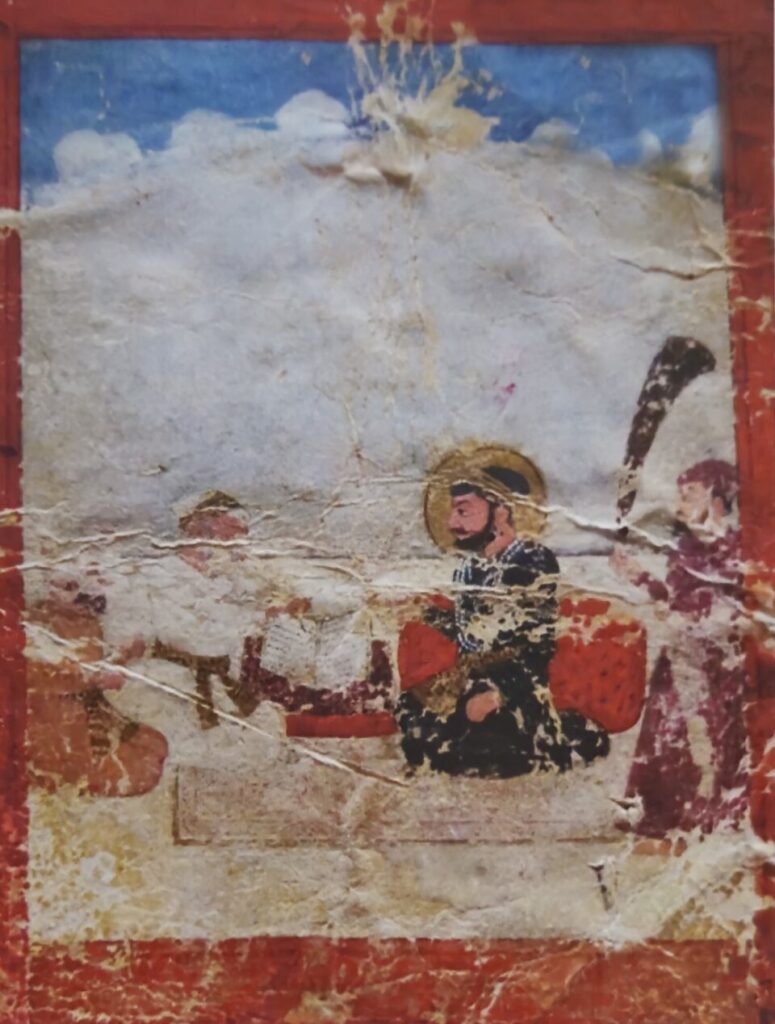

Bhai Banno, also spelt as Bhai Bhanno, was a Sikh figure.[1] Banno lived in Mangat village in Gujrat district.[1] He paid a visit to Guru Arjan and was interested in the Ād Granth, whose original manuscript had been recently compiled by Guru Arjan.[1]
Creation of a copy of the Ād Granth
A recension of the Guru Granth Sahib, known as the Bhai Banno Bir (also known as the Bhai Bhannowali Bir[2]), was in circulation during the historical-period.[3] The composition of this recension is traced back to 1604 by Bhai Banno, a prominent follower of the Guru, who prepared an unauthorized copy of the composition of Guru Arjan when the Guru asked him to get the leafs bound together into a manuscript at Lahore.[3][4][5][6][7] Another view is that it was prepared in 1642 by a certain Banno of Khara Mangat (located in modern-day Gujrat district).[3] This composition contains many extraneous, superfluous, and apocryphal writings, including sectoral Mina compositions and compositions of the female Bhakti saint, Mirabai.[3][8][9][10][11] Guru Gobind Singh would later publish the Damdami recension (also spelt as ‘Damdama’) of the Adi Granth with Bhai Mani Singh acting as the scribe.[12] The reason for him doing so has been said to be the unauthorized recensions of the Adi Granth scattered around, especially the Banno recension which contained unauthorized additions.[13]

According to Sikh lore, Banno asked the guru if he could take the manuscript to his village on-loan, a request that the guru granted along as Banno only spent one-night in his village with the volume.[1] Banno found a way to adhere to this condition but still have enough time to produce a copy by only travelling a small amount each day on his way to his village and back, which gave him enough time to produce an exact-copy of the manuscript, which would come to be known as the Banno Bir.[1] However, there is an alternative story that explains how Bhai Banno created a copy of the manuscript. According to this version, Bhai Banno was tasked with taking the original Ād Granth manuscript to Lahore to be binded and managed to produce his own copy of it while carrying-out this task.
Bhai Banno is said to have made an exact-copy of the original manuscript of the Ād Granth that had been compiled by Guru Arjan.[1] However, Banno’s copy (known as the Khari bir) contained extra works authored by Mirabai, Surdas, and Guru Arjan appended at the end, along with the work Hakikat rah mukam raje shivanabh ki, which were not found/included in the canonical edition finalized by Guru Arjan in 1604.[1]
Much of the early Sikh manuscripts of the Guru Granth Sahib that still survive are of the Banno recension, such as those kept at the India Office Library and British Museum.[1]
There is a debate regarding if the Kartarpur Bir or Banno Bir is closer to the original Ād Granth manuscript.[note 1]
Notes
- ^ Another controversy has been the discovery of two blank folios in the Kartarpur manuscript (near page 703) and why the Ramakali hymn on that page is just two opening lines. In contrast to the Kartarpur manuscript, the Banno manuscript of Adi Granth, discovered in Kanpur and dated to 1644, is identical in all respects but it has no blank pages and on the folio pages near 703 is a complete hymn. The Banno bir has been controversial because it includes many Hindu rites-of-passage (sanskara) in that version of the Adi Granth.[14] According to W.H. McLeod, the difference in the two versions can be because of three possibilities, from which he withholds judgment:[15] first, Guru Arjan deliberately left the blank folio pages to complete it later, but was unable to because he was arrested and executed by the Mughal emperor Jehangir; second, the hymn and pages existed in the original manuscript, the Banno bir is older, the pages were removed by Khalsa Sikhs from the Kartarpur manuscript and replaced with blank folios in their attempt to carve out a separate Sikh identity from the Hindus during the Singh Sabha Movement; third, the blank pages were intentionally left by Guru Arjan for unknown reasons, and the complete hymn in the Banno bir is an interpolation added by a Sikh follower who wanted to insert Brahminical rites-of-passage rituals in the text. According to G.B. Singh – a Sikh scholar who pioneered study of the early Sikh manuscripts, the evidence supports the second theory.[14][16] According to Pashaura Singh, his examination of the manuscripts and linguistic evidence yields support for the third theory, noting that the smaller hand and different writing implement in which the remaining 22 lines were written, the lines themselves do not match earlier manuscripts and differ in structure and lexicon from the rest of Guru Arjan’s writings, the presence of other short verses in all manuscripts like Vār Basant with only three stanzas, and points to the fact that G.B. Singh had made the claim without actually examining the text, positing that he seemed to have been serving the interests of the Arya Samaj based on his writings.[14]
References
- ^ a b c d e f g h Hawley, John Stratton; Mann, Gurinder Singh, eds. (Jul 1, 1993). “The Adi Granth”. Studying the Sikhs: Issues for North America. State University of New York Press. pp. 52–60. ISBN 9781438406190.
- ^ Singh, Harbans (2002). Encyclopedia of Sikhism. Vol. 1: A-D (4th ed.). Punjabi University, Patiala. p. 374.
BIR, a term used for a recension or copy of the Guru Granth Sahib, is derived from Skt. [Sanskrit] verb vid. meaning “to make strong or firm, strengthen, fasten, or to be strong, firm or hard.” The Punjabi verb birana which means “to fix, bind or fasten (something) firmly, or to lay (a gun)” is from the same root. Guru Arjan having compiled the Holy Book deputed one of his leading disciples, Bhai Banno, to go and get the volume bound in Lahore, perhaps because facilities for proper binding did not then exist at Amritsar. Bhai Banno utilized the opportunity to have another copy transcribed and he got both volumes “fastened and bound.” These bound copies came to be called the Adi Bir and Bhai Bannovali Bir. Further copies made from these two recensions were also called birs. For birs (recensions) of Sikh Scripture, see SRI GURU GRANTH SAHIB. The word bir in Punjabi is also used for reserved forest or village land set aside as common pasture.
- ^ a b c d Nayar, Kamala Elizabeth; Sandhu, Jaswinder Singh (2020). The Sikh View on Happiness: Guru Arjan’s Sukhmani (1st ed.). Bloomsbury Publishing. pp. 48–49. ISBN 9781350139893.
- ^ Clary, Randi Lynn. ‘Sikhing’a husband: Bridal imagery and gender in Sikh scripture. Rice University, 2003.
- ^ Singh, Pashaura. “Recent Research and Debates in Adi Granth Studies.” Religion Compass 2.6 (2008): 1004-1020.
- ^ Zelliot, Eleanor. “The Medieval Bhakti Movement in History: An Essay on the Literature in English.” Hinduism. Brill, 1982. 143-168.
- ^ Singh, Pashaura. “Scriptural adaptation in the Adi granth.” Journal of the American Academy of Religion 64.2 (1996): 337-357.
- ^ Clary, Randi Lynn. ‘Sikhing’a husband: Bridal imagery and gender in Sikh scripture. Rice University, 2003.
- ^ Singh, Pashaura. “Recent Research and Debates in Adi Granth Studies.” Religion Compass 2.6 (2008): 1004-1020.
- ^ Zelliot, Eleanor. “The Medieval Bhakti Movement in History: An Essay on the Literature in English.” Hinduism. Brill, 1982. 143-168.
- ^ Singh, Pashaura. “Scriptural adaptation in the Adi granth.” Journal of the American Academy of Religion 64.2 (1996): 337-357.
- ^ Singh, Harjinder (12 September 2022). “From Pothi to Guru Granth Sahib: The Perfect-Genius of Guru Arjan Sahib”. Sikh Research Institute.
The collection of those Sabads was safeguarded in the Pothi by each Guru and handed over to the next Guru, who added more sabads. In Indic tradition, even today, Pothi refers to a text, manuscript, or book. … Guru Arjan Sahib collected all the Pothis and initiated the definitive anthology. It was commenced in 1604. It is also known as Adi Granth or Kartarpuri Bir. Guru Gobind Singh Sahib added the sabads of Guru Teghbahadar Sahib and elevated its status to Guru Granth Sahib in 1708. It is also known as Damdami Bir.
- ^ Nayar, Kamala Elizabeth; Sandhu, Jaswinder Singh (2020). The Sikh View on Happiness: Guru Arjan’s Sukhmani (1st ed.). Bloomsbury Publishing. pp. 48–49. ISBN 9781350139893.
- ^ a b c Arjan, Guru; Singh, Pashaura (1996). “Guru Arjan’s Rāmakalī Hymn: The Central Issue in the Kartarpur-Banno Debate”. Journal of the American Oriental Society. 116 (4): 724–729. doi:10.2307/605443. JSTOR 605443.
- ^ W.H. McLeod (1979), The Sikh scriptures: Some Issues, in Sikh Studies: Comparative Perspectives on a Changing Tradition by Mark Jurgensmeyer and N Gerald Barrier (editors), University of California Press, Berkeley Religious Studies Series and Theological Union, pp. 101–103
- ^ G.B. Singh (1944), Sri Guru Granth Sahib dian Prachin Biran, Modern Publishers Lahore, (Original (Gurmukhi script); For discussion in English, see Chapter 22 of G Kumar

