
| commander2 =
| commander2 =
{{flagicon|Nicaragua}} [[Adolfo Calero]]
{{flagicon|Nicaragua}} [[Adolfo Calero]]
{{flagicon|Nicaragua}} [[Enrique Bermúdez]]
{{flagicon|Nicaragua}} [[Enrique Bermúdez]]
{{flagicon|United States}} [[Ronald Reagan]]
| strength1 = Estimates vary; tens of thousands of EPS and militia
| strength1 = Estimates vary; tens of thousands of EPS and militia
| strength2 = Estimates vary; several thousand Contra fighters
| strength2 = Estimates vary; several thousand Contra fighters
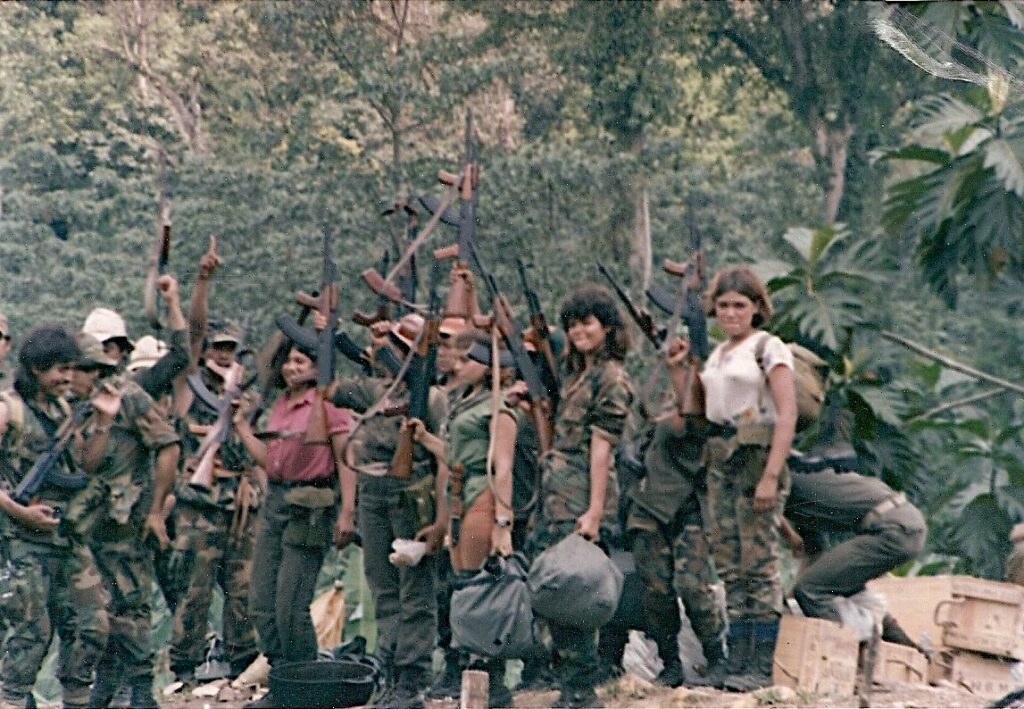
The Contra War was an armed conflict in Nicaragua from 1981 to 1990 between the socialist government led by the Sandinista National Liberation Front (FSLN) and various anti‑Sandinista rebel forces collectively known as the Contras. The war took place within the broader context of the Cold War, drawing significant involvement from the United States, which provided financial, logistical, and covert military support to Contra factions. The conflict resulted in substantial military and civilian casualties, widespread displacement, and economic disruption, and concluded after negotiated peace agreements and national elections in 1990 that brought an opposition government to power.[1]
After the overthrow of the Somoza dictatorship in 1979, the Sandinista National Liberation Front (FSLN) established a revolutionary government that enacted widespread social and economic reforms. Opposition to Sandinista rule developed from former regime supporters, rural conservatives, and indigenous communities. Beginning in the early 1980s, several anti‑government groups coalesced under the umbrella term “Contras” and began armed resistance against the Sandinista government.[1]
The United States Central Intelligence Agency (CIA) was authorized by President Ronald Reagan to provide funding, training, and logistical support to Contra groups as part of a broader U.S. policy to counter perceived Soviet influence in Central America.[2]
Course of the conflict
[edit]
The Contra War was primarily fought through guerrilla tactics by rebel forces, including ambushes, sabotage, and raids on government outposts. Sandinista forces responded with conventional military operations, conscripted troops, and militia units to defend territory, infrastructure, and population centers.[1]
Throughout the 1980s, the conflict drew international attention. In 1986, revelations about covert arms transfers from the United States to Contra forces, circumventing congressional restrictions, became central to the Iran–Contra affair.[3]
Tactics and strategy
[edit]
Contra forces primarily used hit‑and‑run guerrilla tactics, focusing on disrupting Sandinista supply lines, attacking rural installations, and avoiding large‑scale engagements. The Sandinista government deployed conventional forces and militia units to secure towns, roads, and key infrastructure, often responding to rebel incursions with patrols and fortified defenses.[1]
Battles and operations
[edit]
Impact and casualties
[edit]
Estimates vary widely, but thousands of combatants on both sides were killed or wounded during the conflict. Civilians were also affected through displacement, loss of livelihood, and damage to infrastructure. The war significantly disrupted Nicaragua’s economy and social structures, particularly in rural areas near the Honduran border.[1]
Resolution and peace
[edit]
By the late 1980s, international pressure and war fatigue contributed to negotiations for a peace settlement. Regional leaders, i.ncluding Costa Rican President Óscar Arias, promoted peace plans aimed at ending hostilities in Central America. Although fighting continued sporadically, a negotiated settlement and the 1990 general elections led to the election of Violeta Barrios de Chamorro and the eventual demobilization of Contra forces.[1]
The Contra War remains a subject of historical debate regarding foreign intervention, human rights, and national reconciliation. The conflict’s effects on Nicaragua’s political landscape persisted into subsequent decades, influencing the country’s democratic and social development.[1]

