


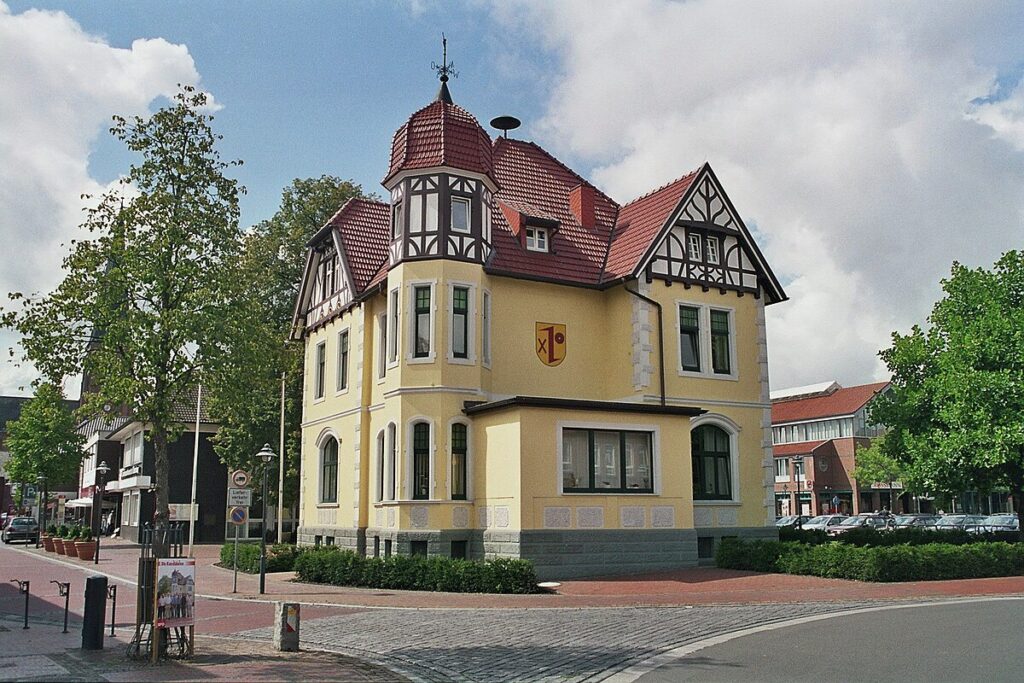
Municipality in Lower Saxony, Germany
Dinklage (German pronunciation: [ˈdɪŋkˌlaːɡə] ⓘ) is a town in the district of Vechta, in Lower Saxony, Germany. It is situated approximately 13 km southwest of Vechta, and 45 km north of Osnabrück.
Dinklage is located in the North German Plain (Norddeutschen Tiefebene), within the so-called Dinklage Basin, an extensive lowland area approximately 60 Miles south of the North Sea coast and about 40 miles east of the Dutch border, roughly midway between Bremen and Osnabrück.
To the east and northeast, beyond the municipal boundaries, there are extensive peatland areas (Südlohner Moor, Diepholzer Moor, and Goldenstedter Moor). To the northwest lies the Cloppenburg Geest, to the southeast the Dammer Berge (hills), to the west the Hase Valley, and to southwest the Ankumer Höhe.
The municipal area is predominantly flat and slopes gently from southeast to northwest. The highest elevation, at 31.5 m above sea level, is located in the southern part of the municipality, in the rural district of Langwege near Federal Highway B 214. The lowest point, at 23 m above sea level, lies in the northwest of the municipal area along the Lager Hase in the rural district of Wulfenau. The town center is situated at an elevation of approximately 26 to 28 m above sea level. The landscape is characterized by rows of trees and hedgerows, which give structure to the area.
Several lowland streams (creeks) flow near Dinklage from the right into the creek Dinklager Mühlenbach – from south to north these are the creek Trenkampsbach, the creek Dinkel, and the creek Hopener Mühlenbach. The creek Dinklager Mühlenbach flows northward to the municipal boundary of Dinklage, where it joins the stream Aue, a boundary stream also flowing in from the east, to form the stream Lager Hase. Via the Hase river and the Ems river, the water ultimately drains into the North Sea. From the left, the creek Bünner Bach flows into the creek Dinklage Mühlenbach.
The creak Handorfer Mühlenbach, flowing from the southeast from the rural district of Langwege, discharges into the canal Bünne–Wehdel Grenzkanal, which forms the western boundary of Dinklage and thus of the Vechta district. This canal flows into the canal Essener canal, a branch of the inland Hase delta, which merges with the river Lager Hase west of the town of Essen. Part of the surface water from Dinklage drains north of Quakenbrück via the Lager Hase river, while another part flows via the boundary canal and the Essen Canal into the Große Hase river. Via the lower reaches of the Hase river and the Ems river, the water eventually reaches the North Sea.
Stream Restoration and Flood Protection
[edit]
- Hopener Mühlenbach: The creek was ecologically stressed for a long time; in 2009 its condition was assessed as “moderate.” Since 2013, continuous restoration measures have been implemented, including the installation of large woody debris, gravel, a riffle structure to improve longitudinal connectivity, and more dynamic flow patterns, all of which have enhanced habitat quality.
- Dinklage Mühlenbach & Aue: These watercourses exhibit significant ecological deficits and have been rated as being in poor condition, with substantial losses in ecological quality. Designated floodplain areas have been established to reduce flood risks.
Peatlands and Other Wetlands
[edit]
The “Burgwald Dinklage” is a designated nature reserve (NSG WE 291) covering approximately 126 hectares. In addition to drier oak–beech forest, the area includes moist and groundwater-influenced zones with wet woodland and small water bodies. These habitats support amphibians such as the protected great crested newt. The “Burgwald Dinklage” is not a classic peat bog with extensive peat deposits, but rather a near-natural forest and wetland area featuring small ponds, wet forest, and localized wet biotopes.
The “Bockhorster Moor” is designated as a landscape protection area within the district of Vechta (LSG VEC 00075). In the southern part of the “Bockhorster Moor”, at least two ponds are documented as habitats for amphibians and insects (e.g. dragonflies) and as hunting grounds for birds such as the kingfisher. Owing to its water bodies, wet areas, and riparian vegetation, the site offers strong potential for biodiversity. Amphibians, dragonflies, birds, and other water- and moisture-dependent species are known or expected to occur in the area.
Subsurface Conditions
[edit]
The subsurface in the Dinklage area consists predominantly of glaciofluvial sediments from the Pleistocene, mainly loamy and sandy deposits. Borehole investigations have shown that the upper soil layer is approximately 5–7 m thick. Beneath this lies a roughly 10 m thick layer of loamy and marl-bearing sediments.
Groundwater Conditions
[edit]
Hydrogeologically, the area of Dinklage is part of the “North and Central German unconsolidated sediment regions,” a large area of Lower Saxony shaped by glacial deposits. These sediments give rise to specific aquifer systems and hydraulic conditions. Such regions are characterized by good groundwater recharge and storage, particularly in sandy layers such as those found in the Dinklage area.
The shallowest usable aquifer lies relatively close to the surface, at approximately 2–6 m below ground level. A deeper aquifer, located in sandy layers at depths of around 25–30 m, is considered productive for groundwater abstraction. Due to the alternation of loamy and sandy layers, permeability varies considerably: loam and marl tend to act as confining layers with lower permeability, influencing infiltration and soil filtration processes, while the underlying sandy layers generally allow more effective groundwater flow.
Since 2017, the Burgwald Dinklage has been under formal protection. However, the site’s water balance remains critical, as development pressure and the isolation of the biotope by commercial and industrial areas threaten groundwater levels and ecological connectivity.
Dinklage has a temperate maritime climate influenced by moist northwesterly winds from the North Sea, characterized by mild winters, warm summers, and moderate precipitation evenly distributed throughout the year. Summers are often dry and sunny, while snowfall occasionally occurs in winter.
In 2023, the average annual temperature was 11.2 °C and shows an upward trend. Over the past ten years, the average temperature was 10.6 °C, while the long-term average over the past 100 years was 9.2 °C.
Between May and August, an average of 20–25 summer days can be expected (a climatological term referring to days on which the maximum temperature exceeds 25 °C).
Depending on measurement methods and definitions, the area receives approximately 1,627 to 2,275 hours of sunshine per year.
The average annual precipitation for the period 2012–2021 was 528 mm.
King Heinrich I (916–936) founded a mounted army that developed into a group of knights. Moated castles were built to provide refuge in times of war. The Dersgaugraf of Calvelage (today Brockdorf) built a castle at Dinklage around 980. The builder may have been named Heiß Ferdinand.
- Count Bernhard I – 980
- Count Hermann I – 1020
- Count Bernhard II – 1051
- Count Hermann II married Ethelinde, daughter of the heroic Otto of Nordheim, in 1075. The sphere of influence shifted northward and she wanted a larger, more magnificent castle, so they moved to Vechta around 1080. He left the castle to his vassals, who then called themselves the “Lords of Dincklage” (Herren von Dinklage).
The settlement of Dinklage was first documented in 1231 in connection with the noble family known as the “Lords of Dincklage (Thinclage, later Dynclage and finally Dinklage). Bertram von Dincklage and his sons Johannes and Bertram initially served as ministeriales to the Counts of Ravensberg-Vechta and became vassals of the Bishopric of Münster in 1252. In the 14th century, the family rose to become the leading noble house in the region.
Southeast of the settlement, a motte-and-bailey castle (tower hill castle), the Ferdinandsburg, was probably constructed in the 13th century; the exact date of its construction is unknown.
Around 1372, the Lords of Dincklage attempted to establish their own territorial lordship. This led to conflicts with the Bishop of Münster, who had their castle destroyed in 1374. As a result of an inheritance division, four new castles were built by around 1400: the Hugoburg, the Herbordsburg, the Dietrichsburg, and the Johannsburg. Of these, only the Dietrichsburg survives today, although in a later architectural style. The former Herbordsburg (demolished by 1677) and Hugoburg (demolished by 1840) are commemorated only by the former rent office (on the site of the Herbordsburg) and the castle chapel (on the site of the Hugoburg). The location of the Johannsburg is unknown.
On 4 June 1349, the first church in the settlement was consecrated, Dinklage was elevated to an independent parish, and it was separated from the mother parish of Lohne. The region was affected by outbreaks of plague in 1360 and 1380.
Early Modern Period
[edit]
Further plague epidemics occurred during the 16th and 17th centuries.
Johann von Dincklage, an important member of the Dincklage family, supported Martin Luther’s Reformation in 1543, and a large proportion of Dinklage’s inhabitants adopted the Protestant faith.
In 1575, a devastating fire destroyed many houses in Dinklage.
In 1588, the Dincklage family faced severe financial difficulties. In this context, Magdalene von Dincklage married Caspar of Ledebur. As a result, the Dietrichsburg passed by inheritance into the possession of the Ledebur family. After her husband’s death in 1597, Magdalene von Dincklage-Ledebur continued the expansion of the Dietrichsburg. In 1614, she commissioned the construction of a barn that today serves as the church of the Benedictine community.
During the Thirty Years’ War (1618–1648), marauding Protestant troops under the command of Count Mansfeld invaded the region in 1622. From autumn 1623 until spring 1630, Dinklage was occupied by foreign troops. When the occupiers withdrew, the church was left in a state of severe disrepair.
In 1641, the Bishop of Münster sent his confidant Johann Heinrich von Galen to Dinklage, granting him the title of Drost (district administrator) of the Vechta district along with the corresponding authority. As the town of Vechta was still occupied by Swedish troops, he took up residence at Dinklage Castle by leasing the Dietrichsburg from Caspar of Ledebur. From there, he sought to regain control of and consolidate the Vechta district.
After the end of the Thirty Years’ War in 1648, the Counter-Reformation—originally begun in 1613—was resumed, despite opposition from the majority of the population. By the end of his tenure as Prince-Bishop of Münster in 1678, Christoph Bernhard von Galen had almost completely re-Catholicized the Lower Bishopric of Münster, to which Dinklage then belonged. In that same year, the church was restored under the direction of the Counts of Galen.
The von Galen Family as Lords of the Castle and Territory
[edit]
In 1667, Prince-Bishop Christoph Bernhard von Galen took over the Dinklage estates of the impoverished Dincklage-Ledebur family on behalf of his brother Johann Heinrich von Galen, Drost of the Vechta district. This action was prompted by an inheritance dispute within the Ledebur family. In this context, Christoph Bernhard placed the estate under compulsory administration by his brother. The Ledebur family challenged this in court; an amicable settlement with the heirs of Clemens August Baron von Galen was not reached until 1801.
The von Galen family moved their seat to Dinklage, residing in the Dietrichsburg. The Herbordsburg was used as a warehouse, while the Hugoburg served as a storage facility, courthouse, and prison. In 1677, Dinklage was elevated to the status of a so-called Herrlichkeit—an imperial territory with its own administration and jurisdiction under the von Galen family. However, feudal ties to the Bishopric of Münster prevented full independence. From as early as 1665, members of the von Galen family were entitled to use the title of Imperial Barons, and they served as Drosten of the Vechta district until 1803.
With the Imperial Recess (Reichsdeputationshauptschluss) of 25 February 1803, the ecclesiastical principalities were dissolved, and Dinklage, together with the districts of Cloppenburg and Vechta, fell to the Duchy of Oldenburg. In 1826, Matthias Count von Galen and the Oldenburg government councillor Carl Friedrich Ferdinand Suden signed a treaty formally ending the Herrlichkeit of Dinklage.
The most famous member of the von Galen family was Clemens August Graf von Galen, Bishop of Münster and later a cardinal. He was born at Burg Dinklage (Dinklage Castle) in 1878 and spent his childhood there. In the 1980s, following the insolvency of the SMH Bank and the family’s involvement in it, the von Galen family lost their last remaining properties in Dinklage.

In 1803 Dinklage was absorbed into the Duchy of Oldenburg. Dinklage remained the seat of the von Galens’ district until the Herrlichkeit ended in 1827. In 1843 the Hugoburg was demolished and a chapel for the castle was built on its site. Many members of the von Galen family served as members of the South Oldenburg Reichstag. Count Clemens August, who served as the bishop of Münster from 1933 to 1946, was born in the castle. He became known as the “Lion Of Münster” and took an active stand against the Nazi government. After World War II the castle became a Benedictine monastery.
At the beginning of the 19th century, Napoleon I attempted to gain control of all of Europe and Germany was an early part of his plans. His armies dominated Austria, Prussia and Russia. Prussia submitted to the Peace of Tilsit (1807), and all areas to the west of the Elbe became part of the newly defined Kingdom of Westphalia under Napoleon’s brother Jerome. Napoleon had already established the Rhine Association in 1806, placing under his protectorate sixteen German princes. Pressure was also applied on the Duke of Oldenburg. In 1808, he joined the German princes’ Rhine Association. This move by Friedrich Ludwig did not long satisfy the French. On December 13, 1810, they declared that all areas between the North Sea and a certain line became part of the French Empire.[citation needed] The French military confiscated all public treasuries. From Hamburg, the Prefect of Keverberg seized the territory. The duke protested in vain, but had to give up the power on February 26, 1811,[citation needed] and went to St Petersburg at the invitation of Czar Alexander.[citation needed]
On February 28, 1811, the Prefect went to Lambertikirche in Oldenburg and swore allegiance to France. French laws and customs came into force. The personal relationships of the farmers as property owners, the patrimonial jurisdiction, and all facilities of a fief nature were lifted. Civilian records replaced church registers as the official records of the state. French became the official style.
Northern Germany was divided into four departments. One department was the Oberems Department, with Osnabrück as the headquarters. Karl Ludwig Wilhelm of Keverberg served as the Prefect. In this department, there were four arrondissements. A sub-prefect at Quakenbrück governed the area of the former offices Vechta and Cloppenburg. The Arrondissement of Quakenbrück was then divided into 10 cantons. One was the Dinklage Canton, which included the communities of Dinklage, Lohne, and Steinfeld.[3]
At the beginning of the 19th century, the von Galens transferred their home to Westphalia (the House of Assen).
Civil leaders called Maire (Mayors) were appointed for the communities. The maire of Dinklage was the former constable, Johann Conrad Böckmann. The maire of Lohne was Karl Heinrich Nieberding. In Steinfeld, the maire was August Hildebrand. The maires were given the responsibility of maintaining public birth, death, and marriage records; this service had formerly been provided by the priests in the community.
The mayors could perform civil weddings. They were also responsible for the supervision and administration of the financial affairs of the community. They supervised conscription and the maintenance of public safety. One difficult task was the supervision and enforcement of the excessive demands of France for the delivery of livestock and grain. This was especially difficult when the levy involved manpower, as in the construction of the Hamburg-Wesel road.
The citizens were subjected to stricter tax-laws and levies. Napoleon’s Grande Armée was involved in a war with Russia and required escalating financial support. The following taxes were raised:
- A property tax, based on the value of the property,
- Personal and furniture taxes, based on the number of people and the value of their furniture,
- A livestock tax, based on the type and number of existing animals.
In 1812, the entire community of Dinklage paid a property tax of 1975 francs, a personal and furniture tax of 181 francs, and a livestock tax of 1473 francs. In 1813 the taxes were 1925 Frs., 165.91 Frs. and 1210.43 Frs, respectively. In the Arrondissement of Quakenbrück there were 25 active tax collectors. The collected taxes were delivered to the main tax treasury in Osnabrück.
Livestock, grain, and feed were collected for use by the troops in the cities of Magdeburg and Wittenberg, as illustrated by the following records for the year 1813. On April 8, Dinklage was to deliver 22 head of cattle at 5500 pounds, but only 2690 pounds could be found. A payment of 28 francs per 100 pounds of missing beef was due, but the funds were not immediately available. The 2810 pound shortage had to be settled with money.
On April 29, a new delivery was due in the amount of 100 hundredweight of hay, 105 hundredweight of oats, and 62 hundredweight of straw. In May and June, the community had to deliver 19,421 pounds of wheat-flour and 7050 pounds of rye meal, along with oats, hay and straw to Osnabrück. On June 23, Dinklage was supposed to deliver 25,000 pounds of meat in the form of live cattle to Wittenberg. For this, the community made available 133 head of cattle. On July 6 and 7 a new demand was made for the delivery of 353 hundredweight of wheat and 252 hundredweight of rye in 200 pound sacks to the fortresses at Magdeburg and Wittenberg. For the transportation the community provided 30 wagons each drawn by four horses.
A special financial burden was encumbered by 15 Dinklage citizens in the amount of 2193 francs, 90 centimes for the provisioning of a French honorary guard. Each honorary guard received a special uniform allotment of 150 francs.
Road construction and other manual labour were required. In Northern Germany, an obstacle to Napoleon’s plans was the lack of adequate roads for the rapid movement of troops. A highway was planned from Hamburg, by way of Bremen, to Osnabrück and Wesels. Although this was not in Oldenburg, inhabitants from the county of Dinklage were forced to work on the section from Barnstorf to Cornau. The assignment of work was based on the relationship to the land: the Heuerman had one[clarification needed], the Kötter two, the farmer and noblemen four. Also women and children age 12 and over worked with the teams.
Each worker had to supply spades and other tools. A deployment lasted eight days before replacement by another team. The work was reimbursed. A man got 16+1⁄2 grotes, a woman 13+1⁄2 grotes, a boy or girl 9+1⁄4 grotes per day. Marie Böckmann reported on July 4, 1814 that “from March through October of the year 1813 the community Dinklage, for the purpose of transporting soldiers, war ammunition, etc. to Diepholz provided 538 wagons each drawn by four horses plus 600 leader-horses.”[clarification needed]
Already in April 1811, the people in Dinklage county were to supply troops for Napoleon. He wanted to subjugate England, and demanded sailors for his warships. On May 7, 1811, 25 young people left Lohne, traveled to Quakenbrück, and then on to Antwerp and Toulon, where they served as sailors on the admiral’s ship Commerce de Paris. The French army also required soldiers. On August 28, the district of Quakenbrück provided a contingent of 303 men, including 30 from the Canton Dinklage.
In June 1812, Napoleon moved eastwards with the biggest army in history – 400,000 soldiers, a third of them Germans – to Russia. Many men tried to desert. They punished deserters without leniency. Those who helped deserters were imprisoned for up to six months. Dr. Anton Tapehorn, along with the farmer Hugo Westendorf, hid in Bünne to escape service. Those who deserted escaped from a certain death penalty when Napoleon was defeated in Russia.
Peace courts, judges, servants
[edit]
French courts of justice and tribunals were established in August 1811. Hamburg was the seat of the imperial court of justice. Each arrondissement received a tribunal of first instance (primary jurisdiction). In each canton, a peace court was established to handle minor infractions. In Dinklage, it was established in the Amtshaus, which later became the first Dinklage hospital. Serving as magistrate was Friedrich Christian Lentz from Höfften, who had previously served as the county court assessor in Vechta. The Canton paid the salary. The Huissier (usher) in Dinklage was the resident Friedrich Christian Harm. As an usher, he was required to deliver court information. The Greffier (court writer) at the peace court was Henricus Antonius Bahlman. He was also a tax collector during the French occupation. The files of the peace court of Dinklage are partially bilingual, with the left half of the page in French and the right in Low German.
On the occasion of the birth of the Emperor’s son, Napoleon II, in March 1811, the inhabitants of Wiek and Dinklage were granted a license to hold a party. They were allowed to dance and amuse themselves as they could at 3:00 in the afternoon on March 31.
Baron Carl Ludwig Wilhelm of Keverberg was born on March 14, 1768, in Haelen in the Flemish part in Lüttich. He belonged to an elegant and affluent family and had studied at Prussian universities. He was chosen as prefect because of his knowledge and experience. During his term of office, he visited the canton of Dinklage. On one such visit in August 1812, he stayed at the Mäkel Inn. The proprietor served the prefect and his companions “6 mugs of Brantwein at 28 Grs., 59 Glasses of Brantwein at 1½ Grs., and 80 mugs of beer at 3 Grs.”
Decline of the French Reign
[edit]
The populace knew about the retreat of the army from Russia and the resulting military casualties. The national resistance of Prussia was awakened, with the King of Prussia allying with Russia against and declaring war on France. Unrest broke in the middle of March 1813 in all of Northern Germany.[citation needed] The Oberems-Department, with the Arrondissement Quakenbrück, was affected when Hamburg was occupied by Russian troops. The sub-prefect in Quakenbrück provided security with Citizen-guards.
In August 1813, Austria joined the Russian-English-Prussian alliance. By October 1813 France faced a large coalition. It would end with Napoleon’s total defeat. On October 15, the Prefect of Keverberg threatened the mayors with release from office if payment of the backlogs and the contributions to the honorary guard were not fulfilled within 24 hours. The population was relieved when the Gendarmerie withdrew from the Arrondissement. The Prefect and his officials left Osnabrück on November 2, 1813.[citation needed]
Duke Peter Friedrich Ludwig of Oldenburg returned from Russia and took control of the government on December 12, 1813.[citation needed] Economic depression necessitated the energetic reconstruction of the entire Oldenburger State. The old laws gradually took effect. The old officials were put in charge again, even if they had served the French. Serfdom remained abolished and a new criminal legal system secured personal freedom for each citizen.
The French presence as foreign masters was felt as a harsh restriction. Heavy taxes and conscription were enormous burdens that brought the country no advantage. This, and the short existence (hardly 3 years) of the Oberems-Department, meant that the French administration was not successful.[3]
Dinklage early industrial activities
[edit]
The Wiek Dinklage, which was already the industrial centre of the parish in the time of the Herren of Dinklage, also developed into a significant regional centre for trade. Theoder Hörstmann (Contribution to the History S. 42) describes Dinklage in 1837: it lists four distilleries (schnapps), eight breweries, five oil mills, a tobacco factory, one candle factory, three grain mills, 21 merchants and grocers, as well as 223 craftsmen, of whom 85 were rope weavers. The industries began as family businesses and contracted for additional workers, and became known as factories.
In the 19th century, widespread poverty among day laborers and tenant farmers led to rural depopulation, and many inhabitants of Dinklage emigrated to North America. They settled mainly in the U.S. states of Ohio, Kansas, Michigan, Wisconsin, Kentucky, Missouri, New York, and Illinois. And to Kings County, New York many of the Family of Von Fricken. Brooklyn and some moved to Troy, NY and to many parts of Long Island, NY..James Von Fricken of Smithtown/NY
After the First World War, further emigration occurred due to wartime experiences, economic hardship, and political instability. Many emigrants moved to Brazil, particularly to the southern states of Paraná, Santa Catarina, and Rio Grande do Sul. To this day, Dinklage maintains close ties with regions in both North and South America.
First local parliament
[edit]
The first local parliament was established on 1 May 1856. The members of parliament were Mr Renze zu Bahlen (farmer), Mr Többe-Schwegmann (farmer), Mr Klöcker (farmer), Mr Brunkenkel (farmer), Mr Hörstmann (innkeeper), Mr Diers-Bünnemeyer (farmer), Mr Böckmann (farmer), Mr Sextro (farmer), Mr Schulte (farmer), Mr Hörstmann (farmer), Mr Meyer (farmer), Mr Bornorst (farmer), Mr Niemann (farmer), Mr Hugo (farmer), and Mr Keppel (pharmacist). Johann Ostendorf served as parliamentary head.
During the period of the German Empire (1871–1918), Dinklage was an agriculturally oriented settlement within the Grand Duchy of Oldenburg. The population grew slightly, but many residents emigrated to North America for economic reasons.
Between 1875 and 1878, the present Catholic church (St. Catharina) was built and consecrated in 1884.
During this period, the school system was expanded in cooperation with the Catholic Church, and Catholic elementary schools were established in Dinklage.
From around 1880 onwards, numerous associations (Vereine) were founded, including sports clubs, shooting clubs, choral societies, and the Kolping Association.
In 1904, Dinklage was connected to the network of the German Railway System via the Lohne–Dinklage railway line. The representative station building at the terminus northwest of the town center—now known as the Old Station—was completed in 1907. The line was closed in 2002.
Between 1919 and 1933, Dinklage belonged to the Free State of Oldenburg.
As early as 17 November 1918, a workers’ and soldiers’ council was established in Dinklage.
In March 1919, the first democratic elections to the National Assembly were held; in Dinklage, many votes went to the Catholic Zentrumspartei.
The first free municipal council elections in Dinklage took place on 16 April 1919.
National Socialist Period
[edit]
In the last Reichstag elections on 5 March 1933, the NSDAP received just under 6 percent of the vote in Dinklage.
After the Nazi seizure of power, membership and support for the party increased locally. Other political parties were eliminated, and in 1938 the NSDAP appointed a loyalist from northern Oldenburg as mayor.
The Catholic Church, represented by the Vechta officialdom and by the Bishop of Münster, Clemens August Graf von Galen, who originated from Dinklage, assumed a mediating role.
During the Nazi dictatorship, Eastern European forced laborers were employed at the B. Holthaus Maschinenfabrik AG (1850–1955), which the regime designated a “National Socialist model enterprise.”
From 1941 to 1945, Benedictine nuns from the Vinnenberg Abbey in Warendorf, who had been expelled by the Nazis, found refuge at Burg Dinklage. They returned to Warendorf after the war.
In 1943, Ferdinand van der Wal, who was born in Dinklage, was murdered in the Sachsenhausen concentration camp, where the SS classified him as a prisoner under Paragraph 175.
According to the Arolsen Archives, suspected forced laborers from Russia and Poland were buried in the Catholic cemetery in Dinklage in 1942 and 1943; the circumstances of their deaths are unknown.
Dinklage remained largely undamaged during the Second World War. In 1945, several buildings in the town center were destroyed by rocket fire from advancing British troops. No ground combat took place in the town.
After 1945, Dinklage took in numerous displaced persons from Silesia, East Prussia, and Pomerania; at times, they accounted for around 30 percent of the population. In the 1950s, new residential areas and many new buildings were constructed. Street names such as Königsberger Straße, Glatzer Straße, and Breslauer Straße commemorate this immigration.
In 1949, Christoph Bernhard Count von Galen donated the moated castle (Dietrichsburg) to the Benedictine order. Since then, it has been known as Dinklage Abbey.
Between 1951 and 1952, the Protestant Trinity Church was built in Dinklage.
20th and 21st Centuries
[edit]
Since around 1990—particularly between 1995 and 2000—Dinklage has experienced strong population growth. In 1995, Dinklage was granted town status (“Stadtrechte”), followed by comprehensive urban redevelopment.
In August 2002, Deutsche Bahn removed the connecting switch of the Lohne–Dinklage railway line, permanently closing the route. Passenger services had already ceased in 1954, and public freight transport ended in 1999. On 15 December 2003, the Dinklage town council formally resolved to dissolve the small railway operation. Large parts of the former railway line were subsequently converted into a high-speed cycle route between Dinklage and Lohne.
Industry and Economy
[edit]
Industrial development
[edit]
The large increase in population, with the resulting expansion of available manpower, brought about mechanization among the craftsmen of Dinklage; the first were the weavers. The brothers van der Wal from the Netherlands wanted to use the existing specialists to place an industrial weaving and printing work near the Mühlenbach (mill brook). In 1837, a corresponding proposition went out to the Amt (government office). Despite some protest from the jurisdiction of Vechta, a dyer named Mertz from Vechta and a calico manufacturer named Bremswig from Bakum were authorized to found businesses.
A second pioneer of the industrialization of Dinklage, in the second half of the century, was the miller and cartwright Bernard Holthaus. He profited from the increasing modernization of agriculture. His machines and appliances found wide sales nationwide and finally led to the foundation of a factory for agricultural machines. It was one of the largest businesses in the entire dukedom in the nineteenth century.[4]
To this day, Dinklage’s economy remains strongly shaped by agriculture and by the production and processing of food products. These sectors are closely linked with animal feed manufacturers and suppliers of livestock housing and agricultural technology. The local economy is further complemented by industrial, craft, and commercial enterprises as well as a range of service providers.
Among the companies of supra-regional importance headquartered in Dinklage are, among others:
- Bröring Group (animal feed production and agricultural trade)
- Oldenburger Interior GmbH & Co. KG (interior outfitting of yachts, ships, and aircraft)
- Hilgefort GmbH (steel processing)
- Heller Tools GmbH
- Alwid GmbH (manufacture of filling and sealing machines for the food, chemical, and pharmaceutical industries)
- Erich Stallkamp ESTA GmbH
- Gigant – Trenkamp + Gehle GmbH
- Kaubit Chemie AG
Agriculture and Forestry
[edit]
In the past, the von Galen family owned extensive agricultural and forest lands in Dinklage and had a significant role as landlords for local farmers. Over time, various parcels of land were sold. In connection with the insolvency of the SMH Bank and the involvement of the von Galen family, the family lost its last agriculturally used lands in Dinklage during the 1980s.
Today, agriculturally used land in the town of Dinklage covers 5,181 hectares (71.2% of the municipal area), while forestry land accounts for 783 hectares (10.8% of the municipal area). Agricultural production in Dinklage focuses primarily on crops for animal feed and food production, including barley, rye, wheat, oats, and maize, as well as potatoes, vegetables, and sugar beets. Fruit cultivation is also practiced, for example apples, cherries, and strawberries.
In addition, intensive livestock farming is prevalent in Dinklage and the surrounding area, particularly pig production, as well as cattle and broiler farming, egg production, and dairy farming.
- Bünne Wind Farm
- Höne Wind Farm
- Langwege Wind Farm
- Wulfenau Wind Farm
Dinklage is located west of the Federal Motorway A 1 (the Hansalinie), roughly halfway between Bremen and Osnabrück, and is accessible via Exit 65 (Lohne/Dinklage).
Federal Highway B 214 runs through the district of Langwege in the southern part of the municipal area.
The network of state and district roads in Dinklage totals approximately 35 km, while municipal roads account for about 133 km.
The nearest operational railway stations or stops are located in Lohne, Holdorf, and Quakenbrück. Long-distance rail stations are available in Diepholz, Osnabrück, and Bremen.
The Dinklage–Brockdorf–Lohne bus route operates on weekdays.
In 2013, the district-wide on-demand bus service moobil+ was launched. More than 70 bus stops were established within the Dinklage municipal area. On weekdays, moobil+ services connect Dinklage and its districts with the municipality of Holdorf, the town of Lohne, and the town of Quakenbrück. An additional moobil+ route to the district capital, Vechta, commenced operation in 2016.
The nearest intercontinantal airport is the Amsterdam Airport, located app. 150 miles to the west.
The nearest international commercial airports are Bremen Airport (approximately 45 miles to the north) and Münster/Osnabrück Airport (approximately 50 miles to the south).
The closest regional airfield is located in Damme.
Kindergartens and Childcare
[edit]
- Six kindergartens/childcare centers (including one center with integration groups for children with physical disabilities). An additional childcare center is currently under construction.
- After-school care facilities
- Special-needs educational groups
- Child day care services
- Primary schools: Kardinal-von-Galen Schule and Grundschule Höner Mark
- Oberschule Dinklage: a partially comprehensive all-day secondary school combining all three lower secondary education tracks; includes an academic (grammar school) track up to Grade 10
- Kardinal-von-Galen-Haus: special education school with a focus on physical and motor development, including a boarding facility (operated by the Josefs-Gesellschaft)
- General education grammar schools (Gymnasien), vocational grammar schools, and private grammar schools are located in neighboring towns: Lohne (Gymnasium Lohne; Lohne Business Grammar School; Lohne Technical Grammar School); Quakenbrück: Artland-Gymnasium Quakenbrück, Vechta: Gymnasium Antonianum Vechta; Liebfrauenschule (private girls’ grammar school under church sponsorship); Kolleg St. Thomas (private grammar school under church sponsorship)
- Nearby vocational schools and colleges are located in Vechta, Bersenbrück, Lohne, and Diepholz.
- Romberg Music School
- Adult Education Center (Volkshochschule), Clemens August Werk
The next general universities in a 60 miles circle (100 km) are located in Vechta, Osnabrück, Oldenburg, Bremen and Münster
Religion and Statistics
[edit]
From 1543 onward, Dinklage was initially shaped by Protestant Christianity after the population adopted the teachings of Martin Luther. Since the Counter-Reformation in the 17th century, Catholicism has been the dominant denomination in the region.
In recent years, the number of people leaving the churches has increased significantly, and many residents now no longer belong to a Christian denomination.
- Roman Catholic Parish of St. Catharina, Dinklage
- Evangelical Lutheran Parish of Dinklage and Wulfenau
- Benedictine Abbey of Burg Dinklage
As a result of immigration from Russia, Greece, and other Eastern and Southeastern European countries, members of Orthodox Christian churches are also present in the town.
Due in particular to immigration from the Balkans, Turkey, the Near and Middle East, and other regions, residents of the Islamic faith also live in Dinklage.
Religious Affiliation Statistics
In 2025, approximately 13,600 people lived in the town. Of these, about 56% were Roman Catholic, 15% Protestant, and around 29% belonged to no denomination or to another religious affiliation.
Sons and Daughters of Dinklage
- Franz Wilhelm von Galen zu Assen (1648–1716), hereditary chamberlain of the Prince-Bishopric of Münster
- Franz Heinrich Christian von Galen zu Assen (1679–1712), canon
- Friedrich Christian von Galen zu Assen (1689–1748), dean of the cathedral chapter in Münster
- Wilhelm Ferdinand von Galen zu Assen (1690–1769), hereditary chamberlain and district administrator (Amtsdrost) of the Vechta district
- Bernhard Romberg (1767–1841), cellist and composer. In addition to his work as a cellist, Romberg composed operas, symphonies, and chamber music
- Franz Heinrich Tappehorn (1785–1856), member of the Frankfurt National Assembly
- Klemens von Korff (1804–1882), owner of a knightly estate, district administrator (1855–1875) of the Halle (Westphalia) district, and member of parliament
- Bernard Neteler (1821–1912), theologian and biblical scholar; author of numerous works on biblical studies
- Clemens August Count von Galen (1878–1946), Bishop of Münster from 1933 to 1946 and Cardinal from 1946; outspoken critic of the National Socialist dictatorship. Beatified in Rome on 9 October 2005; feast day: 22 March
- Heinrich Fröhle (1879–1966), farmer and politician (Zentrumsparty)
- Franz von Galen (1879–1961), member of the Prussian State Parliament (1932–1933); resigned his mandate in protest against the Enabling Act; imprisoned in Sachsenhausen concentration camp in 1944–1945
- August Wegmann (1888–1976), member of the Reichstag (Zentrumspartei, 1924–1933); dismissed from civil service by the Nazis and victim of Aktion Gitter. After 1945, CDU politician; initially Minister of the Interior and Deputy Minister-President of the former State of Oldenburg; from 1946 Minister of the Interior and Deputy prime minister Lower Saxony, later Minister of Finance and administrative president of the Oldenburg administrative district
- Dieter Wurm (1935–2019), local politician (CDU) and Chairman of the Westphalia-Lippe Regional Association (LWL) (1999–2002)
- Hans Micheiloff (1936–1993), table tennis player; two-time German doubles champion
- Hubert Blömer (born 15 November 1939; died 10 March 2011 in Athens, Ohio), geographer and professor at Ohio University
- Jochen Arlt (born 1948), writer, now based in Cologne; editor-in-chief of the Rheinland Lesebuch
- Helmut Middendorf (born 1953), painter associated with “Neue Wilde”; lives and works in Berlin and Athens. His work is known for its vivid color dynamics and expressive, often figurative compositions. One of his best-known works is Big City Night (1979). His works are held, among others, by the Berlinische Galerie (Berlin) and the Museum of Modern Art (New York)
- Hannes Möller (born 1954), painter; lives and works near Frankfurt am Main. A well-known work is the graphic cycle Totenhaus, based on notes from a mortuary by Dostoevsky and the opera From the House of the Dead by Leoš Janáček
- Markus Tepe (1971–2021), visual artist and lecturer in painting and graphic arts; his work includes drawings and prints on paper, lithographs, and oil and acrylic paintings on canvas
- Petra Quade (nee Buddelmeyer), six-time Paralympic gold medalist in athletics (sprint and long jump) at the New York (1984) and Seoul (1988) Paralympic Games; born and raised in Dinklage
Persons Who Lived and/or Worked in Dinklage
- Ferdinand Heribert von Galen (1831–1906), member of the Oldenburg State Parliament (1872–1875); member of the German Reichstag (1874–1903)
- Friedrich Mathias von Galen (1865–1918), member of the Westphalian Provincial Parliament; member of the Reichstag (1907–1918)
- Máire Hickey, OSB (1938–2025), Irish classical philologist and Benedictine nun; Abbess of the Benedictine Abbey of St. Scholastica, Burg Dinklage (1983–2007)
- Ulrich Kirchhoff (born 1967), show jumper, double Olympic champion; grew up in Dinklage and began his sporting career there
- Henrike Franziska Voet (born 1983), Mayor of the town of Lohne; worked at the Federal Ministry of the Interior and Community from 2013 to 2020, most recently as Government Director; grew up in the Höne rural district of Dinklage
- Kristina Bröring-Sprehe (born 1986), dressage rider; Olympic champion, world champion, and German champion; grew up in Dinklage and lives there
- Madita Kohorst (born 14 October 1996), handball player in the German Bundesliga, VfL Oldenburg
- Vivien Endemann (born 7 August 2001), footballer in the Bundesliga (VfL Wolfsburg) and the German national team; Olympic participant; grew up in Dinklage and began her sporting career at TV Dinklage
- Julia Middendorf (born 31 January 2003), tennis player with an international world ranking; grew up in Dinklage and lives there




