


{{Infobox writer <!– for more information see [[:Template:Infobox writer]] –>
{{Infobox writer <!– for more information see [[:Template:Infobox writer]] –>
| name = Eugen Strouhal
| name = Eugen Strouhal
| honorific_suffix = {{]] [[}}
| honorific_suffix =
| image = Czech anthropologist Eugen Strouhal (on right) and me, Portland, Oregon (USA) 1970s.jpg
| image = Czech anthropologist Eugen Strouhal (on right) and me, Portland, Oregon (USA) 1970s.jpg
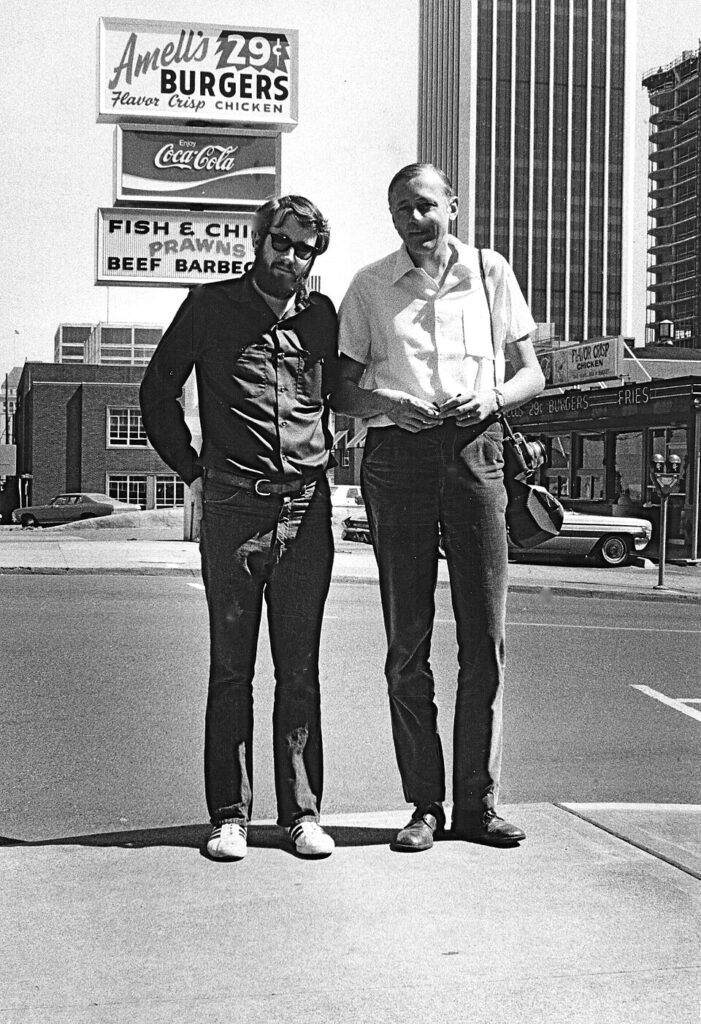
| caption = Eugen Strouhal (right) in 1975 at Portland, [[Oregon]], USA
| caption = Eugen Strouhal (right) in 1975 at Portland, [[Oregon]], USA
|
Eugen Strouhal |
|
|---|---|
_and_me,_Portland,_Oregon_(USA)_1970s.jpg) Eugen Strouhal (right) in 1975 at Portland, Oregon, USA
|
|
| Born | (1931-01-24)24 January 1931 |
| Died | Error: Need valid birth date (second date): year, month, day |
| Pen name | Evžen Strouhal |
| Occupation | Anthropologist, Archaeologist, Physician, Egyptologist, Paleopathology |
| Alma mater | |
Eugen Strouhal (January 24, 1931, Prague – October 20, 2016, Prague), in everyday life and in publications he used the name Evžen Strouhal, was a Czech anthropologist, archaeologist, physician and museum curator who contributed to the establishment of the scientific field of paleopathology. He was mainly involved in research on Ancient Egypt. He worked at the Czechoslovak Institute of Egyptology of Charles University (today the Czech Institute of Egyptology), subsequently at the Náprstek Museum of Asian, African and American Cultures, and later also at the First Faculty of Medicine of Charles University in Prague.[1] He was a practicising Catholic and advocated an ecumenical approach to his work who rejected joining the Communist Czechslavak Party he “was not considered for a higher ranking position at that time” by the ruling communist Czechoslovak government [2]
Life and work
Youth and studies
Eugen Strouhal was born in Prague, Czechoslavakia in 1931 into a scientific family. Both his parents were doctors.[3] His grandfather, Vincenc Strouhal, was a leading figure in the field of experimental physics, and Professor Čeněk Strouhal, the founder of Czech experimental physics, dedicated one of his last books to his biography. In 1956, he graduated from the Faculty of General Medicine at Charles University in Prague and three years later from the Faculty of Philosophy and History.[4]
Career
Early career
From 1956 to 1957 he worked as a doctor in Františkovy Lázně. Subsequently, in 1957, he joined the Institute of Biology of the Faculty of Medicine of Charles University in Pilsen as an assistant professor, where he worked until 1960. Here he began his teaching activities, which were very popular with students. Then he worked briefly at the inpatient department of the Endocrinology Research Institute in Prague-Motol. From 1961 he became a member of the Czechoslovak Institute of Egyptology of the Faculty of Arts of Charles University in Prague, where he worked until 1968. During these years he also taught anthropology and archaeology to foreign students in English and French at the University of 17 November.[5]
Political background
Due to the events of the Prague Spring of 1968, he was pressured to join the Communist Party of Czechoslovakia in order to remain at Charles University. He refused this and decided to take a job at the Náprstek Museum of Asian, African and American Cultures, where he was allowed to continue his work. He worked there as a curator of collections from 1969 to 1992.[6] There, he was instrumental in continuing expeditions and in establishing and organizing collections of prehistoric and ancient artefacts from the region of Egypt.[7] He returned to Charles University as a teacher after the Velvet Revolution in 1989. He began teaching at the First Faculty of Medicine in 1990 at its Institute of the History of Medicine and Foreign Languages, of which he was the head from 1993 (in the same year he ended his employment at the Náprstek Museum) to 1998 when he stepped down as the head of this institution.[8] and then as its professor emeritus.[9] He was instrumental in the rebirth of this institute.
Career Achievements
He transferred a significant part of the ancient Egyptian mummies to the Náprstek Museum. In 1971, he organized the exhibition Ancient Egyptian Mummies, which he examined together with the radiologist Luboš Vyhnánek. This collaboration resulted in the publication Egyptian Mummies in Czechoslovak Collections, published in 1979, which was one of the most recognized works of its type.[10] Thanks to his popularity among students, he was instrumental in promoting paleopathology as an individual component of the medical program. He organized several conferences at the Faculty of Medicine of Charles University, such as the Conference on the History of Medicine in 1996 and the 12th Congress of the Paleopathological Association in Prague and Pilsen in 1998.
In 2004, he recovered from a serious, life-threatening illness. He subsequently decided to leave Charles University, and for his services to this institute he was awarded the title of professor emeritus. He continued to devote himself to the study and research of paleopathology.
Expeditions to Egypt
From 1961 to 1965, he repeatedly participated in expeditions to Nubia as part of a UNESCO program that sought to save monuments threatened by the waters of the newly built Aswan High Dam.[6] Here, he participated primarily in the research of burial grounds from the late Roman and early Byzantine periods at Wadi Qitna and Kalabsha South.[11] These expeditions inspired him to organize another series of research expeditions, which took place from 1965 to 1967, investigating the population resettled from the area flooded by the Aswan High Dam.
He participated in the Czechoslovak archaeological research in Abusir near Cairo. In 1961, 1966 and 1968, he was directly involved in the excavation of the Ptahshepses mastaba, which is one of the largest non-royal tombs in Egypt from the 3rd millennium BC.[12] He continued to participate in expeditions to Abusir even after leaving the Faculty of Arts at Charles University in 2004. He also collaborated with the British-Dutch expedition in northern Saqqara and the Austrian expedition in the Nubian Sajal.[13]
Contributions to Paleopathology
Strouhal was one of the greatest scientists in this field.[14] He co-founded the Paleopathological Association (Detroit 1982). He was primarily concerned with evidence of tumor growth and the research of the physical remains of historical figures of ancient Egypt, especially rulers and members of their families—and also secondarily in the ancient world.[15]
Some publications
References
- ^ VACHALA B. 2016. Prof. MUDr. PhDr. Eugen Strouhal, DrSc., Dr.habil. Anthropologia Integra 7/2, S:101-102.
- ^ Manfred Bietak, A FAREWELL TO OUR FRIEND AND COLLEAGUE EUGEN STROUHAL (24.1.1931–20.10.2016) Egypt and the Levant October 20, 2016
- ^ Životní momenty [online]. [cit. 2017-11-17]. Dostupné online
- ^ BAREŠ L. 2017. Evžen Strouhal (24. 1. 1931 – 20. 10. 2016). Nekrolog. Pražské egyptologické studie XVIII S: 83-86. ISSN 1214-3189.
- ^ ZINK A.R. 2012. Eugen Strouhal (1931-). In: Buikstra J.E., Roberts Ch.A. (Editors) 2012. The Global History of Paleopathology. Pioneers and Prospects. Oxford, Oxford University Press. S: 127-130. ISBN 978-0195389807.
- ^ ZINK A.R. 2012. Eugen Strouhal (1931-). In: Buikstra J.E., Roberts Ch.A. (Editors) 2012. The Global History of Paleopathology. Pioneers and Prospects. Oxford, Oxford University Press. S: 127-130. ISBN 978-0195389807.
- ^ Miroslav Verner, In memoriam Eugen Strouhal (24.1.1931 – 20.10.2016) – physician, anthropologist, archaeologist, P E S X V I I / 2 0 1 6
- ^ [1]%20Eugen%20Strouhal%20(24%20January%201931%20%E2%80%93%2020%20October%202016).pdf Eugen Strouhal (24 January 1931 – 20 October 2016)], ANNALS OF THE NÁPRSTEK MUSEUM 38/1, 2017, pp.3-6
- ^ VACHALA B. 2016. Prof. MUDr. PhDr. Eugen Strouhal, DrSc., Dr.habil. Anthropologia Integra 7/2, S:101-102.
- ^ BAREŠ L. 2017. Evžen Strouhal (24. 1. 1931 – 20. 10. 2016). Nekrolog. Pražské egyptologické studie XVIII S: 83-86. ISSN 1214-3189.
- ^ [ https://www.journals.uchicago.edu/doi/10.1086/373269 JSTOR] Journal of Near Eastern Studies, Volume 47, Number 2Apr., 1988
- ^ Eugen Strouhal & Ladislav Bares, SECONDARY СЕМЕТERY IN THE MASTАВА OF PTAHSHEPSES AT ABUSIR, Charles University, Prague 1993
- ^ STROUHAL, Eugen; JUNGWIRTH, Johan. Die Anthropologische Untersuchung der C-Gruppen- und Pan-Gräber-Skelette aus Sayala, Ägyptisch-Nubien. Wien: Verlag der Österreichischen Akademie der Wissenschaften, 1984. ISBN 3700106734.
- ^ WWW.FF.CUNI.CZ, Filozofická fakulta Univerzity Karlovy |. Zemřel prof. Eugen Strouhal, dlouholetý spolupracovník Českého egyptologického ústavu FF UK. Filozofická fakulta Univerzity Karlovy. 2016-11-02. Dostupné online [cit. 2017-11-17]
- ^ Eugen Strouhal & Alena Nemeckova, HISTORY AND PALAEOPATHOLOGY OF MALIGNANT TUMOURS, Anthropologie, XLVII/3 • 2009, pp. 289–294



