
• Seniority principle seen flouted as ex-CB judges sidelined
• Lawyers fear judges chosen for loyalty, not competence
• Five judges boycott oath-taking ceremony
• President accepts Mansoor, Minallah resignations; lawyers hail duo as ‘national heroes’
• Full court skips FCC, resignations issue; okays SC Rules
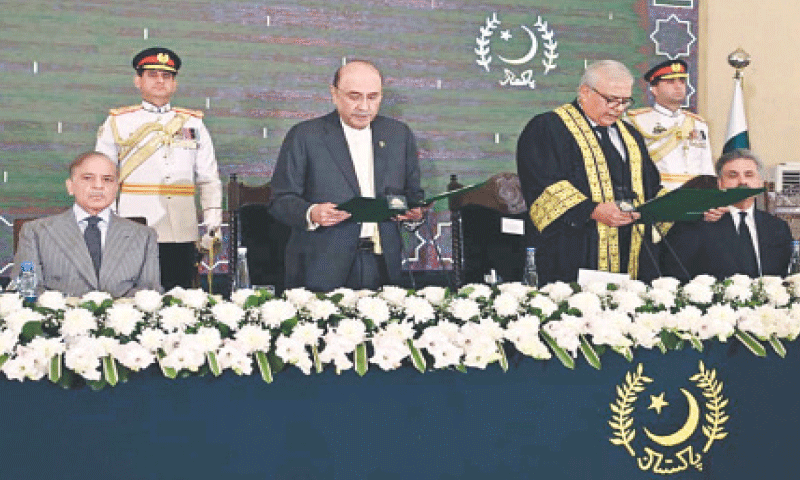
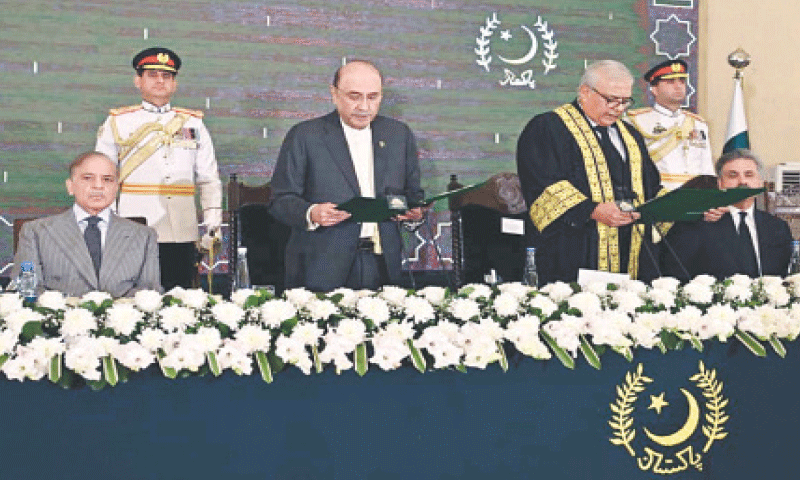
ISLAMABAD: The Federal Constitutional Court (FCC) formally commenced on Friday after its chief justice and four judges took oath, though the proceedings were overshadowed by a boycott from five senior judges of the Islamabad High Court (IHC) and questions are being raised over what principle, if any, guided these appointments.
Critics point out that if seniority was the yardstick, none of the appointees — except Justice Aminuddin Khan, who has been elevated as chief justice of the FCC — is senior to members of the now-defunct Constitutional Bench (CB) of the Supreme Court, several of whom have been ignored.
This, they argue, is done in contrast to the spirit of the 1996 Al-Jihad Trust case, which ruled that appointments to the superior courts should be transparent so that litigants and the people at large retain faith in the independence of the judiciary.
If constitutional expertise was the criterion, none of these judges is known for pursuing constitutional matters in their practice as lawyers or has to their credit any significant constitutional judgements, again, except for Justice Aminuddin, who, as a CB member, decided a number of constitutional matters.
“People have every right to know the transparent criteria on the basis of which these judges were picked to create history by becoming judges of the FCC, and on what basis other CB judges were sidelined,” commented a senior counsel on condition of anonymity, adding that the resignation of two Supreme Court judges before these appointments had already made the FCC controversial.
According to a notification issued on Friday, Justices Syed Hasan Azhar Rizvi, Aamer Farooq, Ali Baqar Najafi, Muhammad Karim Khan Agha, Rozi Khan Barrech and Arshad Hussain Shah were appointed FCC judges by President Asif Ali Zardari under Article 175A(3), read with Article 175C, of the newly amended Constitution through the 27th Amendment.
Soon after taking the oath, the FCC chief justice appointed retired district and sessions judge Muhammad Hafeez Ullah Khan as registrar of the new court for a period of three years and Mazhar Bhatti as the chief justice’s secretary. Their terms and conditions will be determined later.
Justice Aminuddin Khan, who in the morning was sworn in as FCC chief justice by the president at the Presidency, later administered the oath to Justices Syed Hasan Azhar Rizvi, Aamer Farooq and Ali Baqar Najafi in the courtyard of the IHC.
During the IHC ceremony, none of the judges of the Supreme Court, most conspicuously Chief Justice of Pakistan Yahya Afridi, were present. Five IHC judges — Justices Mohsin Akhtar Kayani, Tariq Mehmood Jahangiri, Sardar Ejaz Ishaq Khan, Babar Sattar and Saman Rafat Imtiaz — also did not attend.
However, Justices Arbab Mohammad Tahir, Mohammad Asif, Mohammad Azam Khan and Raja Inam Ameen Minhas were present. IHC Chief Justice Sardar Sarfraz Dogar was also present on the podium where the FCC judges were seated.
Earlier in the morning, seven seats had been placed on the podium, but four were later removed. The ceremony also began behind schedule.
Justice Aminuddin Khan hinted that more judges may be administered the oath in a day or two and that the FCC may eventually have a total strength of 13 judges. At the Presidency, both the CJP Yahya Afridi and Justice Aminuddin Khan arrived together for the oath-taking.
Whether the judges were selected for competence or on a subjective assessment of loyalty to the government and a perceived willingness to “toe the government’s line” was a matter of concern, the senior counsel said, warning that the impartiality of the FCC risked being compromised from the outset.
“If impartiality is suspected, no court has any ground in the eyes of the public,” he regretted, adding that the government should have moved to allay such perceptions when two Supreme Court judges resigned over making the apex court subordinate to the FCC.
Former additional attorney general Tariq Mehmood Khokhar described Friday’s oath-taking as an event that would be remembered “not as the commencement of a new judicial chapter, but as the death rites for the nation’s existing constitutional order and judicial independence”.
It had, he said, become a flashpoint for “intense nationwide criticism and public outrage” over its implications. An unelected executive, he argued, had moved an unelected legislature to enact a constitutional amendment, circumventing the Supreme Court by establishing the FCC and effectively empowering the latter by disempowering the former, with the FCC usurping the Supreme Court’s constitutional jurisdiction.
The amendment allows the executive to appoint FCC judges and to order non-consensual transfers of high court judges, he bemoaned.
Former Supreme Court Bar Association (SCBA) president Muneer A. Malik, who earlier spearheaded the 2007 lawyers’ movement, said he would oppose the controversial 27th Amendment “tooth and nail” and questioned the criteria under which the new judges had been elevated to the FCC.
“This is court-packing of the FCC to gain particularised judgements,” he alleged, asking what significant background some of the appointees possessed that justified their elevation.
At the very least, the names of those under consideration for the FCC should have been floated in advance so that the public could understand the criteria behind the selections, he said.
Mr Malik also questioned whether the chief justices of the respective high courts had been consulted before some of their judges were elevated, terming the entire appointment process “totally non-transparent and absolutely a joke”.
Full court
Despite popular belief, the scheduled full court meeting, presided over by CJP Afridi, did not take up for discussion the resignations of the two Supreme Court judges — Syed Mansoor Ali Shah and Athar Minallah — nor the appointment of judges to the FCC or the situation arising after the passage of the 27th Amendment.
Instead, a Supreme Court press release said, the full court gave its final approval to the newly adopted Supreme Court Rules, 2025.
According to the statement, the participants “unanimously updated the Rules on the recommendation of the committee, comprising Justice Shahid Waheed, Justice Irfan Saadat Khan, Justice Naeem Akhtar Afghan and Justice Aqeel Ahmed Abbasi, constituted under Rule 1(4) of Order I of the Supreme Court Rules, 2025, for removal of difficulties arising in giving effect to its provisions”.
The full court also unanimously approved the grant of the status of senior advocate of the Supreme Court to Muhammad Munir Paracha — an advocate of the apex court until now — in terms of Rule 5 of Order IV of the Supreme Court Rules, 2025.
FCC begins work
Separately, the FCC formally commenced on Friday after its chief justice and four judges took the oath.
The newly formed apex constitutional forum has begun work under makeshift arrangements, as its permanent premises have yet to be finalised.
The Ministry of Law and Justice issued notifications appointing six judges to the FCC following presidential approval.
Besides Justices Rizvi, Farooq and Najafi, the appointees include Sindh High Court’s Justice K.K. Agha and Balochistan High Court Chief Justice Rozi Khan Barrech. Arshad Hussain Shah has also been appointed after Justice Musarrat Hilali declined to join the FCC, according to sources.
Sources said Justice K.K. Agha’s oath-taking ceremony is scheduled for Saturday (today) at the IHC. The remaining two judges have not yet confirmed their availability, but if they appear on Saturday, they too will be administered the oath.
Initially, the FCC was proposed to be housed in the Federal Shariat Court (FSC) building, but FSC judges strongly resisted relocation to the third floor of the IHC building. Another proposal suggested accommodating the FCC temporarily within the IHC premises; however, sources said the FCC chief justice is seeking to retain courtrooms inside the Supreme Court until a permanent building is allocated. If the Supreme Court administration refused to accommodate the FCC in its premises, the Constitutional Court would resume its functions from the IHC from Monday.
Resignations accepted
Meanwhile, President Zardari on Friday accepted the resignations of Supreme Court judges Mansoor Ali Shah and Athar Minallah.
The two judges had handed in their resignations a day earlier, hours after the contentious 27th Amendment was signed into law by the president, describing the legislation as an affront to the judiciary and the 1973 Constitution.
In a separate development, 14 prominent lawyers — including Muneer A. Malik, Makhdoom Ali Khan, Faisal Siddiqui and Salahuddin Ahmed — issued a joint statement expressing regret over the resignations.
They declared that Justice Shah and Justice Minallah had “permanently etched their names in the short list of national heroes who prized principles over expediency, but at the demise of the Supreme Court and the extinguishment of the last members of an independent judiciary”.
Published in Dawn, November 15th, 2025

