


From Wikipedia, the free encyclopedia
Content deleted Content added
|
|
|||
| Line 80: | Line 80: | ||
|
== References == |
== References == |
||
|
{{commonscat|Frucht graph}} |
{{commonscat|Frucht graph}} |
||
| ⚫ | |||
|
==External links== |
==External links== |
||
|
*{{MathWorld|urlname=FruchtGraph|title=Frucht Graph|mode=cs2}} |
*{{MathWorld|urlname=FruchtGraph|title=Frucht Graph|mode=cs2}} |
||
| ⚫ | |||
|
[[Category:Individual graphs]] |
[[Category:Individual graphs]] |
||
Latest revision as of 06:01, 14 December 2025
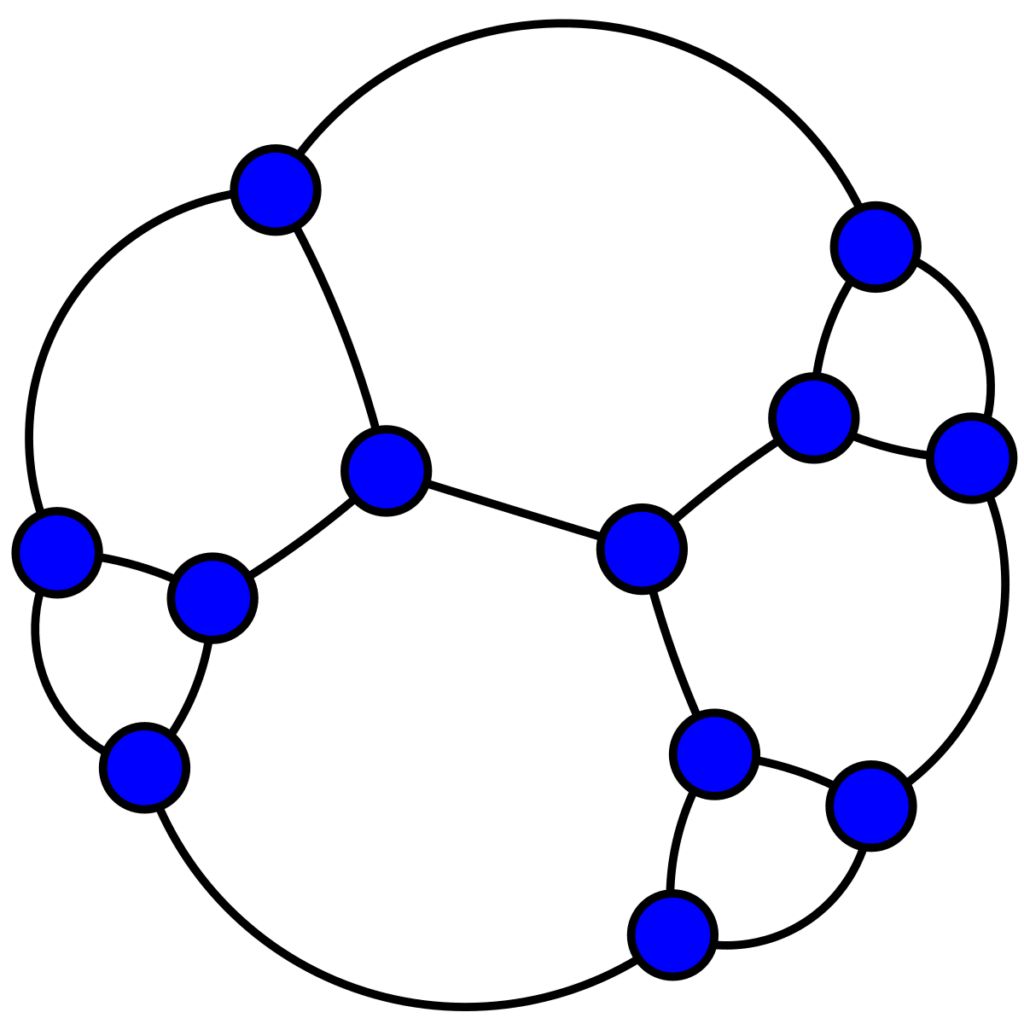
Cubic graph with 12 vertices and 18 edges
In the mathematical field of graph theory, the Frucht graph is a cubic graph with 12 vertices, 18 edges, and no nontrivial symmetries.[1] It was first described by Robert Frucht in 1949.[2]
The Frucht graph can be constructed from the LCF notation: [−5,−2,−4,2,5,−2,2,5,−2,−5,4,2].
The Frucht graph is one of the five smallest cubic graphs possessing only a single graph automorphism, the identity: every vertex can be distinguished topologically from every other vertex.[3] Such graphs are called asymmetric (or identity) graphs. Frucht’s theorem states that any finite group can be realized as the group of symmetries of a graph,[4] and a strengthening of this theorem, also due to Frucht, states that any finite group can be realized as the symmetries of a 3-regular graph.[2] The Frucht graph provides an example of this strengthened realization for the trivial group.
The characteristic polynomial of the Frucht graph is ( x − 3 ) ( x − 2 ) x ( x + 1 ) ( x + 2 ) ( x 3 + x 2 − 2 x − 1 ) ( x 4 + x 3 − 6 x 2 − 5 x + 4 ) {\displaystyle (x-3)(x-2)x(x+1)(x+2)(x^{3}+x^{2}-2x-1)(x^{4}+x^{3}-6x^{2}-5x+4)} .


The Frucht graph is a Halin graph.[1] It is pancyclic, with chromatic number 3, chromatic index 3, radius 3, and diameter 4. Like every Halin graph, the Frucht graph is polyhedral (planar and 3-vertex-connected)[5] and Hamiltonian, with girth 3. Its independence number is 5.
- ^ a b Ali, Akbar; Chartrand, Gary; Zhang, Ping (2021), Irregularity in Graphs, Springer, pp. 24–25, doi:10.1007/978-3-030-67993-4, ISBN 978-3-030-67993-4
- ^ a b Frucht, R. (1949), “Graphs of degree three with a given abstract group”, Canadian Journal of Mathematics, 1 (4): 365–378, doi:10.4153/CJM-1949-033-6, ISSN 0008-414X, MR 0032987, S2CID 124723321
- ^ Bussemaker, F. C.; Cobeljic, S.; Cvetkovic, D. M.; Seidel, J. J. (1976), Computer investigation of cubic graphs, EUT report, vol. 76-WSK-01, Department of Mathematics and Computing Science, Eindhoven University of Technology
- ^ Frucht, R. (1939), “Herstellung von Graphen mit vorgegebener abstrakter Gruppe.”, Compositio Mathematica (in German), 6: 239–250, ISSN 0010-437X, Zbl 0020.07804
- ^ Weisstein, Eric W., “Halin Graph”, MathWorld



