
From Wikipedia, the free encyclopedia
Content deleted Content added
Latest revision as of 07:18, 15 October 2025
|
Georg Carl August du Plat |
|
|---|---|

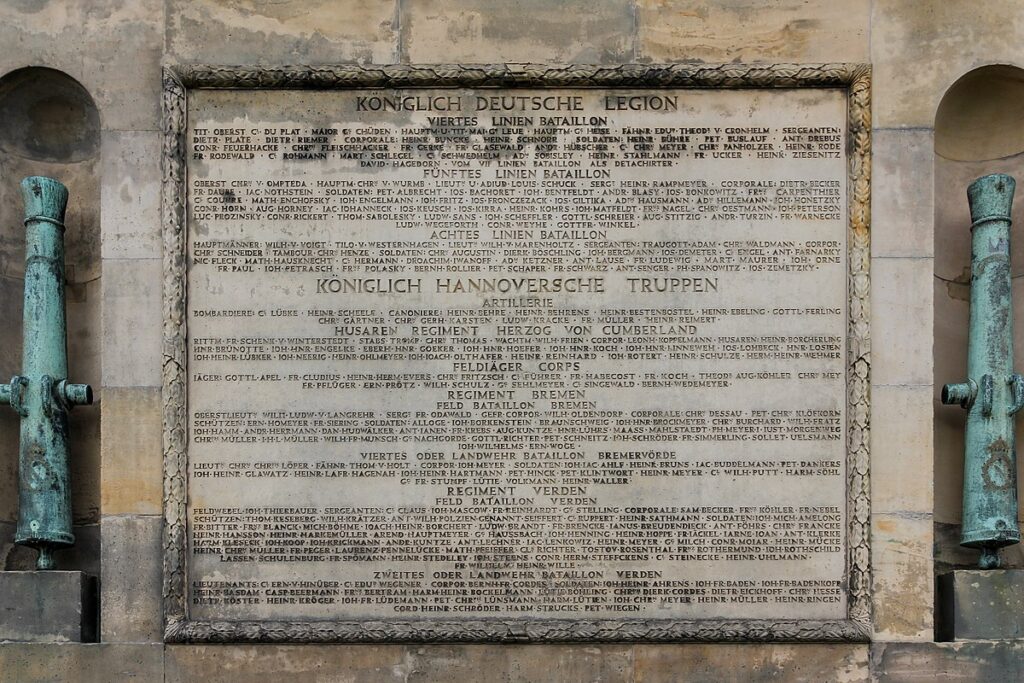
Commemorative plaque on the Waterloo Column in Hanover with the heading ‘King’s German Legion / Fourth Line Battalion’, followed first by the French name of the titular Colonel Charles du Plat |
|
| Nickname | George Charles Augustus |
| Born | March 3, 1770
Hanover, Electorate of Brunswick-Lüneburg |
| Died | June 21, 1815 (aged 45)
Brussels or Waterloo, Belgium |
| Allegiance |  Hanover / Hanover /  United Kingdom United Kingdom |
| Branch | Hanoverian Army / British Army |
| Years of service | 1790–1815 |
| Rank | Colonel |
| Unit | King’s German Legion |
| Commands | 1st Brigade, King’s German Legion |
| Battles / wars |
|
Georg Carl August du Plat (3 March 1770 – 21 June 1815) was a Hanoverian officer who served in the King’s German Legion of the British Army during the Napoleonic Wars. He commanded the 1st Brigade of the KGL at the Battle of Waterloo, where he was mortally wounded.
Du Plat was born in Hanover, then part of the Electorate of Brunswick-Lüneburg within the Holy Roman Empire. He was baptized at St. Clement’s Church, a prominent Lutheran parish associated with military and noble families. His family descended from Pierre Joseph du Plat (1657–1709), a French nobleman who settled in Germany.
Family and Connections
[edit]
He was the son of Lieutenant General Georg Josua du Plat (1722–1795) and Bernhardine von Derenthall (1749–1782). The du Plat family produced several officers who served in Hanoverian, British, and Danish military service during the 18th and early 19th centuries.
Early Military Career
[edit]
He entered the Hanoverian Army as a Captain in the 1st Infantry Regiment, prior to the formation of the King’s German Legion. He joined the British Service in King’s German Legion with temporary rank in the army 1803 got promoted to a Major in 4th Line Battalion in 1804, Lieutenant Colonel 4th Line Battalion 1807. Due to his exemplary service he secured a permanent rank in British Army 1812, breveted to colonel 1813.His early service included posting in Hanover (1805) and campaigns of Baltic expedition (1807) and Sicily (1808–1812).
During the peninsular war his regiment served on the East Coast of Spain (1812-1814). After the return of Napoleon Bounaparte from his abdication during the Hundred Days Colonel Georg Carl August du Plat serving in the King’s German Legion (KGL). By 1815, du Plat had risen to command the 1st Brigade of the KGL, which formed part of Major General Sir Charles Alten’s 3rd Division under the Duke of Wellington. During the Battle of Waterloo his brigade was deployed on Wellington’s left-center, near the La Haye Sainte farm, which was a key strongpoint of the Brussels Road. On 6 June Wellington wrote to him-
“always be relied on to keep his head”.
His troops defended the approaches to La Haye Sainte. His brigade constantly absorbed repeated assaults of the Imperial Guard and D’Erlon’s Corps
Du Plat was mortally wounded during the battle, likely in the early afternoon. He was evacuated to Brussels and died of his wounds on 21 June 1815.

