
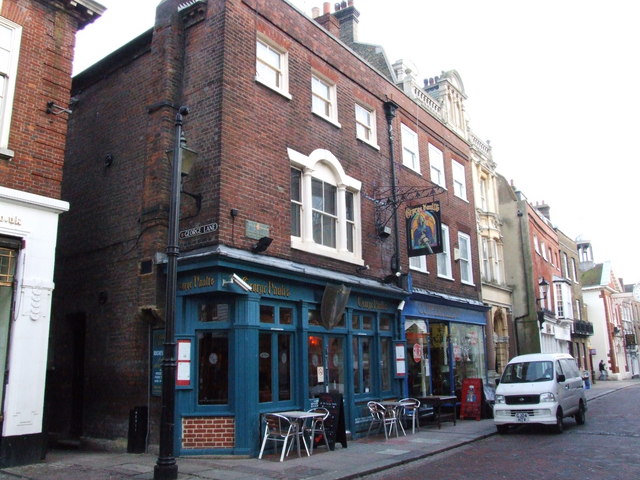
Historic building in Kent, England
The George Vaults (formerly the George Inn) at 35 High Street in Rochester, Kent, is a public house built over a remarkable early 14th-century vaulted undercroft. The undercroft dates to circa 1320–1325 and is of exceptional historical importance, giving the building its Grade II* listing. The present three-storey brick pub front (added in the late 18th/19th century) features a central glazed double door and large windows at street level, with a Venetian window on the first floor. The pub is situated just below Rochester Castle and Cathedral on the old High Street – a location that aligns with the medieval street plan of Roman Watling Street.[1]
Medieval origins (c.1320–1325)
[edit]
Excavation and architectural analysis indicate that the vaulted crypt beneath today’s George Vaults was constructed around 1320–1325.[2] No contemporary documents name its builder, but its quality suggests a wealthy patron. Later tradition attributed the crypt’s origin to a chamberlain of Rochester Priory under Bishop Gundulf (d.1108).[3] This is now regarded as a chronologically inconsistent legend; archaeologists note that the vault’s ribbed Gothic style and the Historic England listing clearly date it to the early 14th century.[4] The undercroft was almost certainly a domestic or commercial cellar (for example, a wine tavern) rather than an underground tunnel. A 1998 archaeological assessment describes the vault as “an excellent example of a 14th-century urban commercial premises in a vaulted cellar, most likely used as a wine tavern”.[4] In contrast, popular accounts sometimes romanticize the space as a secret “tunnel” to the castle or cathedral,[5] but no evidence supports such a passage.
Some have speculated that the vault might sit on the site of the long-lost Church of St. Mary within Rochester’s medieval walled town. Local lore (reflected on the venue’s own website) holds that the crypt “is also said to mark the site of the Church of St Mary… but [this church] has never been found” . This theory remains unconfirmed by archaeology. In summary, all reliable evidence points to the crypt’s original function as a high-status vaulted cellar or undercroft (for storage and service) attached to an early 14th-century house or inn.[2]
The George Inn and the 1768 fire
By the 18th century the site was operating as an inn. Early records call it the “Saint George and Dragon”,[6] later simply the George Inn.[7] On 6 May 1768 (the Great Fire of Rochester), a large blaze swept through the High Street. Contemporary accounts report that dozens of buildings were destroyed in the fire. In particular, the adjacent structure to the east of the vault (also part of the George Inn) was “largely destroyed in the great fire of Rochester”.[8] According to later descriptions, the wooden George Inn burned down in 1768, leaving only the stone crypt intact beneath the ruins. The fire’s date and extent are noted in local histories: the wedding-venue site explicitly states “the building [St George and Dragon] burnt down in 1768”. After the fire, the present brick superstructure was erected atop the surviving vault.[9]
Architecture and Structure
[edit]
Exterior and superstructure
[edit]
The present building is a late 18th/19th-century brick structure of three storeys, built over the medieval undercroft. It presents a regular three-window façade with a decorative brick parapet and cornice band. The ground floor has a late-Victorian pub front: a glazed brick plinth with a centrally placed half-glazed double door (with overlight) flanked by large side windows. The first floor features a distinctive Venetian window (2:4:2 light with horned sash frames) under a flat brick arch. Many sash windows elsewhere have replacement frames typical of the Georgian style. According to the Historic England listing, the building’s “early C18 [sic] pub front…decorative detailing” is notable, but its “early C14 undercroft…gives George Vaults its starred listing grade”.[2] In short, the above-ground architecture is largely Georgian/Victorian in style (reflecting post-1768 rebuilding), whereas the vaulted cellar below is medieval.
The Grade II* Undercroft (List Entry 1186209)

The crypt is the key feature justifying the building’s Grade II* status. This undercroft is built of chalk ashlar and rubble and consists of four bays of quadripartite rib vaulting . The vault measures 54 ft × 16 ft 8½ in with an overall height of 11 ft.[2] The longitudinal ribs are chamfered, springing from shafts and wall corbels; where the ribs intersect are nine carved foliated bosses, each about 12–15 inches in diameter . These bosses are decorated with varied motifs (oak leaves and acorns, vine leaves with grapes, a lizard within foliage, a grotesque bearded face, acanthus scrolls, etc.),[10] though many details are now weathered. The ribs rest on moulded capital bases with foliated neckings and pyramid stops.[2] There are three pointed-arch doorways (now blocked) and splayed window openings on the walls. In summary, the crypt is an unusually grand and well-preserved example of a medieval vaulted cellar. Historic accounts note that successive buildings above have come and gone, but the vault “yet remains in almost an uninjured state” despite centuries of use.[11]
The official listing text provides the architectural specifics: it notes “chalk ashlar and rubble; 4 bays; quadripartite vaults with longitudinal rib; chamfered ribs with rubble infill; foliated bosses with various creatures”, and records the exact measurements and features including a reference to George Payne’s 1900 documentation. Payne himself drew plans of the undercroft (see below) and describes it as part of a 14th-century house of “considerable importance”. In brief, the crypt’s finely worked ribs and foliage bosses – albeit eroded – mark it as high-status medieval craftsmanship .
Payne’s Drawings (1900)
The archaeologist George Payne made a detailed study of the vault, publishing “Medieval Crypts at Rochester” in Archaeologia Cantiana in 1900.[2] He produced measured plans and drawings (plate and figures) of the undercroft.[12] Payne’s paper reports the same dimensions and notes the nine ornamental bosses (illustrating motifs from oak leaves to a bearded face).[13] Unfortunately the original plates are not readily online, but the listing confirms their existence. We cite the listing’s bibliographic reference: George Payne, Archaeologia Cantiana Vol.24 (1900), 220–224.[2] This remains a key source for the vault’s medieval architecture.
Rediscovery and Conservation
The crypt was effectively hidden until the early 21st century. In 2002 father-and-son entrepreneurs Mark Lucas and Lloyd Haines-Lucas uncovered and cleared the vault as part of a renovation project . They transformed it into a feature of the pub/restaurant, complete with atmospheric lighting and stained-glass decorations. Their work won a City of Rochester Society Conservation Award (reported in society archives) for preserving this rare medieval interior. (One news source notes Lucas had already won awards in 2002 and 2007 for similar restorations.) The venue’s promotional site proudly describes the vault as “celebrated as a Conservation award winner” , and local press confirms the award around that time. The restored crypt is now open to the public as part of the George Vaults venue, and has become popular for guided tours and events.
Modern use
Today the George Vaults operates as a pub, restaurant and events space (notably a licensed wedding venue).[14] The restored crypt is the “star of the show”, an atmospheric dining or ceremony hall with its 14th-century arches.[15] Visitors enter through moody colored lights[16] and decorative stained glass[17] (not original, but installed for ambiance) and look up at the stone bosses and ribs.[18] Above ground, four bar areas allow separate functions: for example, a modern Lounge Bar at street level and the two-story Affinity Bar (sometimes called Affinity Barn) above. These additions respect the historic fabric: as one site notes, an access route was created “without damaging any original fabric”. In sum, the George Vaults today is a striking fusion of medieval architecture and contemporary pub design, illustrating how a rare historic vault can be adapted for modern hospitality.
Location and access
[edit]
The George Vaults is at 35 High Street, Rochester, Kent ME1 1LN, on Rochester High Street near Rochester Bridge. By train, Rochester railway station (managed by Southeastern) is a short, easy walk into the High Street / town centre.[19] By bus, the closest stops are Rochester Guildhall Museum and Star Hill / Furrell’s Road, each about a 2–4 minute walk to the High Street; services that call at nearby stops include routes such as the 140, 190, 191 and 700.[20]
- ^ “Wayback Machine” (PDF). eprints.oxfordarchaeology.com. Archived from the original (PDF) on 2024-07-06. Retrieved 2025-10-27.
The George Vaults lie on the north side of High Street within the walled medieval city, just below the Castle and Cathedral. The medieval and present High Street also approximated to the line of Roman Watling Street as it passed through the Roman town of Durobrivae, and substantial remains of Roman buildings have been found
- ^ a b c d e f g “GEORGE VAULTS, Non Civil Parish – 1186209”. historicengland.org.uk. Retrieved 2025-10-27.
ROCHESTER HIGH STREET TQ 7468 NW 7/109 No 35 (George Vaults) (formerly 24.10.50 listed as George Inn) GV II* Public house. Late C18 and C19, built over early C14 (c.1320-5) vaulted undercroft.
- ^ “The George Vaults | Wedding Venue in Kent”. www.theweddingsecret.co.uk. Archived from the original on 2025-10-27. Retrieved 2025-10-27.
The star of the show of this venue is the vaulted Crypt that dates back to 1325 AD. It owes its origin to a chamberlain of the priory during the time of Bishop Gundulph. The building burnt down in 1768 and the structure that stands today was built over the top of the vault.
- ^ a b “Wayback Machine” (PDF). eprints.oxfordarchaeology.com. Archived from the original (PDF) on 2024-07-06. Retrieved 2025-10-27.
Summary: The George Vaults excellent example of a 14th-century urban commercial premises in a vaulted cellar, most likely used as a wine tavern. Although damaged by partial collapse of the vault, and deterioration through disuse, the Grade II* building can beneficially be brought back
- ^ “The George Vaults | Wedding Venue in Kent”. www.theweddingsecret.co.uk. Archived from the original on 2025-10-27. Retrieved 2025-10-27.
The 14th century vault was only rediscovered in 2002 and since then has become a popular tourist attraction that demonstrates architecture that would have been a tunnel passage to Rochester Castle and Cathedral.
- ^ “GEORGE VAULTS Pubs of Rochester”. www.dover-kent.com. Retrieved 2025-11-01.
- ^ “Wayback Machine” (PDF). static1.squarespace.com. Archived from the original (PDF) on 2025-11-01. Retrieved 2025-11-01.
Many persons know, or have heard, that beneath the ” George Inn,” in the High Street, there is an interesting cellar ….
- ^ “Wayback Machine” (PDF). eprints.oxfordarchaeology.com. Archived from the original (PDF) on 2024-07-06. Retrieved 2025-11-01.
The rnedieval cellar is a Grade II* building, and is deservedly graded as an exceptional example of domestic architecture of the 14th century (Appendix 1). It was at one time part of the George Inn, which gave its name to the adjacent George Lane, and architecturally the cellar seems to have conneÇted with the next building its east, but this area was largely destroyed in the -qreat fire of Rochester, and the superstructure (not investigated for this report) appears to be of post-fire date.
- ^ “The George Vaults | Wedding Venue in Kent”. www.theweddingsecret.co.uk. Archived from the original on 2024-11-07. Retrieved 2025-11-01.
The building burnt down in 1768 and the structure that stands today was built over the top of the vault.
- ^ “Wayback Machine” (PDF). static1.squarespace.com. Archived from the original (PDF) on 2025-11-01. Retrieved 2025-11-01.
- ^ “Wayback Machine” (PDF). static1.squarespace.com. Archived from the original (PDF) on 2025-11-01. Retrieved 2025-11-01.
- ^ “Mediaeval Crypts at Rochester”. Kent Archaeological Society. Retrieved 2025-11-01.
- ^ “Mediaeval Crypts at Rochester”. Kent Archaeological Society. Retrieved 2025-11-01.
- ^ “George Vaults Wedding Venue Rochester, Kent | Historic & Elegant | Guides for Brides”. guidesforbrides.co.uk. Archived from the original on 2025-11-01. Retrieved 2025-11-01.
- ^ “The George Vaults | Wedding Venue in Kent”. www.theweddingsecret.co.uk. Archived from the original on 2024-08-12. Retrieved 2025-11-01.
- ^ “The George Vaults – Reviews, Photos & Phone Number – Updated November 2025 – Venues & Event Spaces Services in Rochester Town, Medway County – Wheree”. Wheree. Archived from the original on 2025-11-01. Retrieved 2025-11-01.
- ^ “About us – The George Vaults”. Retrieved 2025-11-01.
- ^ “GEORGE VAULTS Pubs of Rochester”. www.dover-kent.com. Retrieved 2025-11-01.
- ^ “Rochester Station | Southeastern Railway”. www.southeasternrailway.co.uk. Retrieved 2025-11-01.
- ^ “Rochester Guildhall Museum (Stop A) – Bus Times”. bustimes.org. Retrieved 2025-11-01.

