
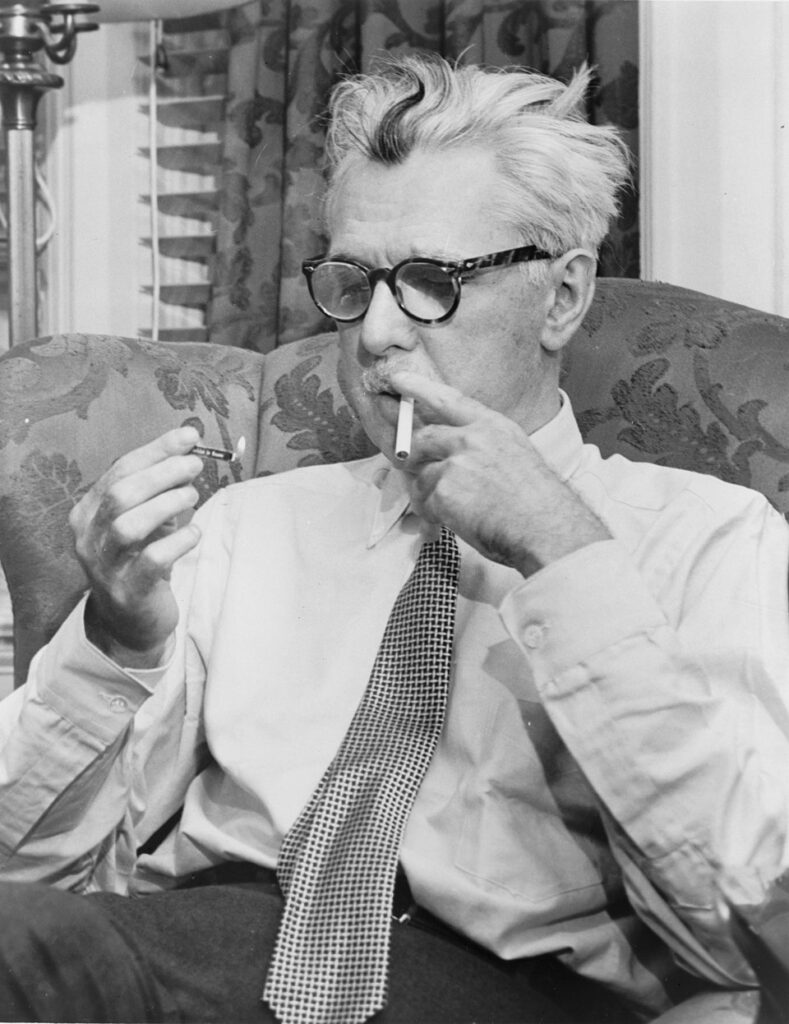
American cartoonist, author, journalist, and playwright (1894–1961)
|
James Thurber |
|
|---|---|

Thurber in 1954 |
|
| Born |
James Grover Thurber December 8, 1894 |
| Died | November 2, 1961 (aged 66) |
| Occupation | Cartoonist, writer |
| Spouse |
Althea Adams (m. 1925; div. 1935) Helen Wismer (m. 1935) |
| Children | 1 |
James Grover Thurber (December 8, 1894 – November 2, 1961) was an American cartoonist, writer, humorist, journalist, and playwright. He was best known for his cartoons and short stories, published mainly in The New Yorker and collected in his numerous books.
Thurber was one of the most popular humorists of his time and celebrated the comic frustrations and eccentricities of ordinary people. His works have frequently been adapted into films, including The Male Animal (1942), The Battle of the Sexes (1959, based on Thurber’s “The Catbird Seat“), and “The Secret Life of Walter Mitty” (adapted twice, in 1947 and in 2013).
Early life and education
[edit]
James Grover Thurber (known as “Jamie” to his family) was born in Columbus, Ohio, on December 8, 1894. His father, Charles Leander Thurber,[note 1] was a clerk working for the Ohio Republican Party at the time James was born; his wife, Mary Agnes Fisher (known as “Mame”) was from a wealthy local family. The couple were given stock in the Fisher Company, a produce company founded by Mame’s father, when they married, and the income from this stock supplemented Charles’ meager salary. James was the middle son of three; his older brother, William, was born in 1893, and Robert was born in 1896.[1] In 1900 Charles lost his job when Asa Bushnell, the Republican governor of Ohio, lost the gubernatorial election.[2] At some point in 1901 Charles was appointed to the staff of David K. Watson, who had been appointed to lead a Justice Department commission by President McKinley, and in April 1902 Charles moved the family to Washington D.C.[3][4]
The Thurbers rented a house in Falls Church, Virginia that August.[4] One Sunday while they were in Falls Church, James and William were playing with a bow and arrow in the yard, and William told James to stand facing the fence so William could try to hit him in the back with a blunt arrow. James turned around just as William shot, and the arrow hit James in his left eye. After the initial shock the eye was not very painful, and Mame took James to a local doctor to have it treated. A few days later it was hurting, and Charles and Mame took him to a specialist in Washington, who removed the eye.[5][note 2]

In 1902 Charles lost his job with the federal government, and the Thurbers moved back to Columbus in June 1903.[6][7] Charles fell ill in 1904, and when he did not recover quickly the family moved into Mame’s parents house.[8] James hated living there, and arrangements were made for him to stay frequently with Margery Albright, the practical nurse who had attended his birth. Albright was known as Aunt Margery to the family, and between 1905 and 1910 James stayed with her often, sometimes for weeks at a time. James’ brother Robert later described Albright as “a second mother” to James.[9] Charles recovered after a few months, and by 1906 the Thurbers were living in Norwich Hotel.[10]
James missed a year of school in Washington. He was enrolled in Sullivant Elementary School in Columbus, a year behind his age group, but was not the oldest in his grade—it was in a working-class area and many pupils were several years behind in their schooling.[11] In third grade he met Eva Prout at Sullivant; they shared classes for the next six years. By the seventh grade he was infatuated with her. Prout left school after the eighth grade to pursue a singing and acting career, and Thurber occasionally saw her in silent movies over the next few years.[12]
Thurber spent seventh and eighth grades at Douglas Junior High School. He was more successful socially there than he had been at Sullivant, and was chosen to write the Class Prophecy in 1909, in eighth grade. This was a common essay format at the time. Thurber imagined his schoolmates and himself in an adventure in a flying machine, in which the class appears to be doomed, but were surprised “to see James Thurber walking out on the beam”, over the side of the plane, to remove a rope that was tangling a piece of equipment. The class “learned that James was a tight-rope walker with Barnsels and Ringbailey’s circus”. The story includes made-up technical terms such as “hythenometer” and “curobater”, and is considered by Thurber scholars to contain the roots of the ideas that would later become Thurber’s story “The Secret Life of Walter Mitty“.[13][14]
Thurber attended East High School, starting in September 1909. He was a favorite with the teachers. A classmate recalls him as a “much better [writer] than the rest of us … He was constantly drawing, and then throwing the drawings away, as if he had no further use for them”.[15] His first published story, “The Third Bullet”, appeared in the high school magazine, X-rays; it was a western, and showed “not the slightest clue of literary promise”, according to his biographer Burton Bernstein.[16] Another biographer, Harrison Kinney, agrees that Thurber showed no sign of literary precocity, and that his high school years were not remarkable in any way. Thurber himself considered that he was a “late bloomer”.[17]
Ohio State University
[edit]

In about 1913 the Thurbers moved to 77 Jefferson Avenue.[18][19][note 3] The house was the setting for Thurber’s story “The Night the Ghost Got In”,[19] and is now maintained as an arts center and museum.[20] Thurber graduated from East High in June, and was accepted at Ohio State University, beginning classes in September that year.[21] A highlight of his freshman year was a test given by Albert Weiss, Thurber’s psychology professor, which made it apparent that Thurber had an astonishingly good memory. Thurber was proud of his performance and often mentioned it to acquaintances throughout his life.[22] He also took English Composition, which focused on paragraphing, a form of humorous writing popular in newspapers of the day. Robert O. Ryder, the editor of the Ohio State Journal, was a popular paragrapher of the time, and Thurber was a great admirer of his work.[23] There were two compulsory classes: Military Science and Tactics, and Gym: Thurber hated both.[24][21] The military science class was taught by Captain Converse, who took a dislike to Thurber, who was incompetent at military drill.[21] Thurber started to miss both gym and military drill classes:[21] as a result, although only two years of the military class were required to graduate, Thurber had to register for the class in each of the five years he attended Ohio State.[25]
Thurber’s grades were good in his first year, but socially it went badly. His best friend, Ed Morris, abandoned Thurber after Morris joined a fraternity that would not accept Thurber. Only one fraternity was interested in Thurber, but he was eventually blackballed: socially, in Bernstein’s words, this was “akin to a terminal case of leprosy”.[25][21] Thurber registered for classes for the 1914 fall semester, but dropped out of college for a year, spending his time at libraries instead. He was living at home, but his family did not realize he was not attending classes.[26][27] He began taking classes again in the fall of 1915, but continued to miss the drill classes, and as a result was briefly forbidden from registering for the spring semester. After a meeting with Converse the ban was lifted, but he earned no credits that semester and may not have attended any classes. William Oxley Thompson, the president of the university, intervened to prevent another ban in the fall of 1916, and Thurber returned to class once again.[28]
Thurber worked on both the Ohio State student publications: the Sundial, a monthly magazine, and the Ohio State Lantern, a newspaper; and became friends with Elliott Nugent, who was also writing for the Lantern.[29] Nugent was much more successful than Thurber socially,[30] and along with Jack Pierce, another student working on the Lantern, decided to get Thurber into Phi Kappa Psi, one of the most prestigious fraternities at Ohio State.[31] Others in the fraternity were initially unconvinced: Thurber didn’t seem to have the money required to join an expensive fraternity, and seemed unlikely to fit in socially. He was eventually accepted that winter.[32] Thurber became editor-in-chief of the Sundial the next academic year (1917-1918), and chose Nugent as his assistant editor.[29] He was called up for military service, and immediately rejected because of his missing eye.[33] Many of his fellow students were now serving in the armed forces, and Thurber wrote much of the Sundial‘s material himself.[34] Thurber finally became well-known and well-liked on campus, and both he and Nugent were nominated to Sphinx, an exclusive society for high-profile students.[34] That year Thurber decided to leave OSU—without a degree, as he had not completed the mandatory graduation requirements. In January 1918 he applied for a job with the State Department, with the help of a recommendation letter from Thompson.[35][36]

Thurber was hired as a code clerk, and moved to Washington, D.C. on June 21, 1918. After several months of training he was assigned to the American Embassy in Paris;[38] he arrived in France on November 13, two days after the Armistice.[39] While in Washington and Paris Thurber corresponded with both Eva Prout, whom he had idealized for years, and with Minnette Fritts, a popular student at Ohio State whom he had dated in Columbus.[40] He asked Prout to marry him in one of his letters; she refused, insisting that they meet in person before she could commit herself.[41] Thurber had become an admirer of Henry James at Ohio State, and had thought of retaining his virginity “for his Jamesian ideal” woman, but he lost his virginity to a Folies Bergère dancer.[42] By the time he left Paris he was conflicted about his experiences: Thurber’s sixteen months in Paris was in some ways when he matured,[43] but he came home guilty and depressed.[41] He left Paris in February 1920 and returned to Columbus.[44] Fritts was married by the time Thurber came home, and he began a more intense courtship of Prout, who had quit her acting career because the film industry was much reduced by the war, and was now living in Zanesville, Ohio. By the end of 1920 she had rejected him.[45]
Thurber worked briefly for the Ohio Department of Agriculture in the summer of 1920, while considering a return to Ohio State and also applying for newspaper jobs.[46] In August 1920 Thurber was hired as a reporter for The Columbus Dispatch,[47] and after a few weeks was assigned to cover Columbus City Hall.[48] The pay began at $25 a week, and by the time Thurber left in 1924 had only risen to $40 a week.[49] He took second jobs to augment his income: he was a correspondent for The Christian Science Monitor, and did publicity work for Columbus’s Indianola Park and Majestic Theatre.[50]
He became friends with John McNulty, and Joel Sayre, then journalists for the Ohio State Journal, and Herman Miller, who was teaching English at Ohio State University.[51][52] Miller and Thurber were involved with The Strollers, an Ohio State dramatic society. Only one of The Strollers’ performances is known to have been by Thurber: Psychomania, a spoof of Freudianism, which was performed at Christmas 1922.[53] Thurber was also active in The Scarlet Mask Club, the college’s musical theatre group, and wrote and directed (and sometimes performed in) their annual show from 1921 to 1924.[54] He met Althea Adams, an Ohio State student, at The Strollers in 1921. Adams had been elected an Ohio State “Rosebud” and “Magic Mirror”, both titles given to accomplished and beautiful women students, and many of Thurber’s and Adams’ acquaintances thought they were an odd couple when they began dating.[55][56] They married in May 1922, and spent a honeymoon week as guests of Elliott Nugent and his wife, in Connecticut, where they went to see a play together every night. Neither Thurber nor his new wife were well off, and Thurber reviewed each of the plays for the Dispatch in order to make some extra income.[57] On their return to Columbus, James and Althea moved out of James’s parents’ house into an apartment.[58]
Starting in early 1923, the Dispatch gave Thurber a half-page every Sunday to write whatever he wanted. He titled the column “Credos and Curios”, and filled it with a mixture of literary criticism, humorous writing, verse, and commentary.[59][60] The column was canceled by the publisher in December, to Thurber’s disappointment,[61] and Althea persuaded him to try his hand at writing full-time.[62] A friend offered the use of a cottage in Jay, in upstate New York, for the summer, and Thurber left the Dispatch,[62] but his efforts met with little success: he sold one story to The Kansas City Star, and a short piece to the New York World, but The Saturday Evening Post and The American Mercury rejected everything he submitted.[63] The Thurbers returned to Columbus in late 1924.[63] The Dispatch did not rehire Thurber, but he was paid his work for the Scarlet Mask that winter, and he picked up more publicity work, with the result that he earned more over the next few months than if he had kept his newspaper job.[64]
Normandy, Paris, and Nice
[edit]
Althea was still confident that Thurber could succeed as a writer, and in May 1925 the Thurbers left Columbus again, this time for France.[64][65] They spent several weeks traveling in France, Switzerland, and Italy, sightseeing. In July they rented a cottage in Granville, in Normandy, and Thurber wrote the first five thousand words of a novel. Althea read it, and the two of them agreed it was terrible. He abandoned the manuscript and never tried to write a novel again.[65] The Thurbers initially decided to return to the US, but a pleasant evening at a café in Paris convinced them to stay, and Thurber got a job with the Paris edition of the Chicago Tribune, rewriting stories from French newspapers in English.[66][67] There was stiff competition among expatriate Americans to work at the Tribune, but Thurber’s four years at the Dispatch and his ability to write newspaper headlines got him the job immediately.[66] Among Thurber’s colleagues at the Tribune was a young William Shirer, and the two became close friends.[68][69] Shirer later recalled the material they wrote as “primarily a work of the imagination”, since they were given so little material from the original story to work with.[68] Thurber was able to produce a column about Christy Mathewson‘s career entirely from his knowledge of baseball, when Mathewson died, but on other topics, such as Admiral Richard Byrd‘s flight over the North Pole, or the history of the Polish złoty, he was less reliable.[70]
Thurber’s salary was low, and to supplement it he wrote articles in his off-hours, sending them to his agent in New York. His most prestigious sale was to Harper’s Magazine; the money arrived just in time to pay off accumulating debts.[71] Towards the end of the year he was sent to Nice, on the Mediterranean coast, to work on the Tribune‘s Riviera edition.[72] His assignments included coverage of the tennis match between Helen Wills and Suzanne Lenglen, known as the Match of the Century,[73][74] and interviewing Isadora Duncan after her husband died—she had not heard of his death and learnt of it from Thurber when he met with her.[74] Althea was also now working for the Tribune, as society editor, but despite the extra income they were going further into debt, and Thurber decided he had to return to the US, feeling that his best chance of making a living from writing was in New York.[75] The Thurbers’ time on the French Riviera was for a while the most idyllic period of their marriage,[72] but there were problems in the relationship.[76][77] Althea was more interested in sex than James was, and their sex lives were “a frustration to them both”.[77] Althea decided not to return to the US at the same time as James,[76] and stayed in Nice for a couple of months after he sailed for New York.[77][note 4]
New York Evening Post
[edit]
Thurber arrived in New York in June 1926, rented an apartment and began submitting his pieces to The New Yorker, which had been launched only a year earlier. Everything he sent in was quickly rejected.[78][79] He wrote a thirty-thousand-word parody of several then-bestselling books, but no publishers were interested.[80][note 5] In Paris in 1925 Thurber had been offered a job at the New York Evening Post, and had turned it down; he was able to get the offer renewed and now accepted it. He also made another substantial sale: a humorous piece that took up half a page of the New York World and brought in $40.[80] Thurber started on the city desk, and was soon moved to writing feature articles, including interviews with Thomas Edison and the widow of Harry Houdini.[81] He kept trying to sell to The New Yorker, eventually accumulating twenty rejections. One day Althea suggested he set a timer and complete an article in forty-five minutes; he tried it, sent it to The New Yorker, and it sold immediately.[82]
Early years at The New Yorker
[edit]
In February 1927 Thurber met E. B. White at a party in Greenwich village. White was working at The New Yorker, and helped Thurber to get hired there. He began as an editor, with long hours, often seven days a week, with very little time for writing.[83] Harold Ross, the editor-in-chief, agreed to “demote” him (as Thurber put it) to a writer instead of an editor late that year.[84][85] Thurber had produced a handful of short pieces even while working as an editor, and became a mainstay of the magazine once he gave up editorial duties.[86] One of his first sales in this period was “Menaces in May”, a short story—not a humorous piece—with heavily autobiographical elements. The protagonist, whose sophisticated wife, Lydia, is away from home, meets an old flame and her husband, wonders what life would have been like with her, and later blames Lydia for the dull state of his life. The old flame was based on Eva Prout. This was following by a series of humorous pieces about a Mr. Monroe and his efficient, sophisticated, emasculating wife; each episode was based on something that had happened between James and Althea.[87] The Thurber’s marriage was still in difficulties; by the time Thurber was hired by The New Yorker Althea was sleeping with other men, without concealing her affairs from James,[88][89] and at one point Althea went to Europe without James for two months.[90] In 1929 they agreed to begin living more separate lives: they rented a house in Silvermine, Connecticut, and Althea stayed there; James spent most of his time in Manhattan, visiting Silvermine occasionally.[91]

White shared an office with Thurber, and soon became a fan of Thurber’s rapidly sketched pencil drawings. In 1929 he picked up a discarded cartoon of Thurber’s, of a seal seeing explorers in the distance. He inked in the faint pencil lines and submitted it to the weekly art meeting. It was rejected with a note from the art director saying “This is the way a seal’s whiskers go”; White resubmitted it with a note saying “This is the way a Thurber seal’s whiskers go”, but it was rejected again.[92] At about the same time White and Thurber discovered that they were both working on parodies of serious psychological books about sex. They decided to combine their efforts, writing alternate chapters, and White asked Thurber to create the illustrations. They took the manuscript and drawings to Harper, who had recently published a book of White’s. The editor assumed that Thurber’s simple sketches were just outlines of the planned final artwork, but White told them “No … these are the drawings themselves”. The book, titled Is Sex Necessary? came out that November, and was very successful, selling fifty thousand copies in its first year in print.[93]
Ross had been surprised to discover that Thurber’s drawings were popular, and in 1930 began printing his artwork, in a series of parodies of advice columns about readers’ pets.[94] These were collected in 1931 in Thurber’s second book, The Owl in the Attic, which also included the Monroe stories and a series of articles that had appeared in The New Yorker parodying H. W. Fowler’s Modern English Usage, which had become Ross’s favorite style guide.[95] Ross asked Thurber for the seal cartoon, but it had been discarded. Thurber attempted to recreate it, but as he drew it he realized the rock on which the seal sat looked like the headboard of a bed, so he added a couple in bed beneath the headboard, with the caption “All Right, Have It Your Way—You Heard a Seal Bark!” The cartoon appeared in The New Yorker in 1932, in the January 30 issue, and became “one of the most celebrated and often-reprinted cartoons of the twentieth century”, in Bernstein’s words.[96]
In 1931, Althea moved back to Manhattan, and for a short time the marriage seemed healthy,[97] but after a few weeks, James decided to leave Althea and live with Paula Trueman, an actress he had a relationship with.[98] Althea told James she was pregnant, and they agreed to stay together.[97] They bought a farmhouse with twenty acres of land in Sandy Hook, Connecticut, and lived together there.[99] Their daughter, Rosemary, was born in Manhattan on October 7, 1931.[100]
Success, divorce and remarriage
[edit]
After the success of the first two books, Harper arranged to publish a collection of Thurber’s art, titled The Seal in the Bedroom. Forty-seven of the works included had already appeared in The New Yorker, and Thurber quickly drew another thirty-eight to fill out the book. It appeared in November 1932 and sold well.[101] Among the pieces Thurber wrote for The New Yorker was a series about his life in Columbus; these appeared in 1933 in the magazine, and then in November 1933 in book form, titled My Life and Hard Times.[102] The reviews were positive, and the book became a bestseller. It is generally regarded as Thurber’s best work.[103][104][102] Thurber was in debt to The New Yorker, which had loaned him part of the money to buy the property in Sandy Hook. To raise money sold his cartoons to an art dealer in Manhattan, and also provided drawings to advertising agencies. His drawings were used in advertisements for the French Line, the American Radiator Company, and Heinz, among others.[105] In 1934 he began a series of radio broadcasts on WABC, filling in for Alexander Woollcott, another New Yorker writer who was in hospital.[106] His art began to receive serious critical attention: in 1933 drawings by Thurber and George Grosz were shown at Smith College, and in 1934 there was a Thurber show at the Valentine Gallery in Manhattan.[107] He also drew many cartoons on the walls of a bar named Costello’s on Third Avenue. When the bar relocated to 49th Street in 1949, the walls with his cartoons were carefully moved to the new location to preserve them.[108]
By this time the Thurbers’ marriage was foundering again: they agreed that Althea would stay in Sandy Hook, and James would live in Manhattan and occasionally visit.[109] Thurber began to drink more in the wake of his success, and had affairs,[110] one of which was with Helen Wismer, whom he had met in 1930 and dated occasionally since then.[111] In late 1934 Althea filed for divorce. James was surprised, but cooperative, arranging financial support for Althea, giving her the Sandy Hook property, and agreeing a visitation plan for Rosemary.[112] The divorce proceedings were in Connecticut, and required the Thurbers to show intolerable cruelty as grounds for the divorce. The resulting testimony at the trial, on May 24, was fodder for tabloids nationwide, though Thurber felt that the New York press were relatively restrained, as he was a fellow newspaperman.[113] At the time of the divorce, Thurber had heard that Ann Honeycutt, one of the women he had been closest to over the previous few years, was getting married. The day after the divorce Thurber met Helen Wismer for a date, and asked her to marry him. She agreed, acknowledging later that it was “on the rebound” from the relationship with Honeycutt, and they were married on June 25, 1935.[114][115] They had little money, and honeymooned on Martha’s Vineyard in a cottage with no water or power.[116]
Thurber began covering tennis matches in the northeast for The New Yorker that summer, and continued to do so for three years. In October they moved back to an apartment in Manhattan, and for a few months kept up a hectic schedule; James would work all night, stop at the New Yorker offices during the day, and spend the evening in bars; he and Helen would host parties at the apartment or visit others. Helen recalled that “Neither of use was getting any sleep, and it began to show”.[117] In November Harper brought out Thurber’s The Middle-Aged Man on the Flying Trapeze, which collected pieces from The New Yorker with some additional drawings; again it was a success, with four printings that year.[118] He began a series of non-fiction profiles in The New Yorker under the title “Where Are They Now?”‘ that ran for two years, published under the pseudonym “Jared L. Manley”. The subjects included one-time New York governor William Sulzer, Willie Stevens, one of the suspects in a notorious murder case, and Virginia O’Hanlon, famous for writing the letter that led to the “Yes, Virginia, There Is a Santa Claus” newspaper column.[119]
By March 1936 the pace of the Thurbers’ life began to tell on them, and they spent two months in Bermuda, relaxing, though Thurber continued to work. Returning to New York in May, they decided to make a change to a more relaxed lifestyle, and began planning a move to Connecticut. They rented a house in Litchfield for the winter of 1936–1937.[120] By the turn of the year Thurber’s eye was starting to lose vision; he had cataracts, and was warned by his opthalmologist that he would have to have an operation.[121] The Thurbers went to Europe that May, delaying the eye operation; they toured France, and then visited London, where the Storran Gallery was putting on a one-man show of Thurber’s artwork. Enough of the art sold that the Thurbers were able to rent a flat and stay in London until August; they met H. G. Wells, David Garnett, Alexander Korda and Charles Laughton while there, and became good friends with the architect John Duncan Miller.[122] Trips to Wales and Scotland were followed by a return to London in September, then to Holland, Paris, and down to the Riviera in November to escape the French winter. From there they drove down through Italy to Rome, returning to the Riviera and renting a cottage at Cap d’Antibes for the first four months of 1938.[123][124] From there they drove to London, via Paris, and stayed in Piccadilly. Thurber was a celebrity in London; Hamish Hamilton were planning a collection of his work, to be called Cream of Thurber, and he was popular socially. They were enjoying London, but rumors of war were growing, and in August they left for the US.[125][126]
The Thurbers arrived in New York in September 1938. They rented a house in Woodbury, Connecticut, and Thurber spent some time with his daughter Rosemary, whom he had not seen in over a year.[127] Thurber’s vision had deteriorated further while he was in Europe; he was still driving during the daytime, but on one trip with Helen had to stop and change drivers when he could not see well enough to continue.[128] He was busy, contributing art to books by several friends and connections, and thinking about a play he wanted to write. He began a series of fables for The New Yorker and a series of illustrations for famous poems such as “Barbara Frietchie” by John Greenleaf Whittier, and Henry Wadworth Longfellow‘s “Excelsior“.[129] In the winter of 1938–1939 he wrote “The Secret Life of Walter Mitty“; the story was published in the March 18, 1939 issue of The New Yorker, and was an immediate success.[130] In early 1939 Elliott Nugent, his old college friend, who was now a well-known figure in Hollywood, became interested in Thurber’s play outline, and Thurber decided to move to California and try a collaboration. They went by boat, via the Panama Canal, and the brilliant sun made Thurber’s vision problems worse; by the time they arrived he was unable to read at all.[131]
After a couple of weeks Thurber’s vision settled down and he was able to read and type. The Thurbers stayed with the Nugents for a few weeks before renting a place in Beverly Hills. They stayed in California for four months, by the end of which the play was more or less completed: the original name had been Homecoming Game, which was changed to The Male Animal. The play’s theme was academic freedom, with the central device the question of whether a professor at a Midwestern University was be allowed to read a letter from the anarchist Bartolomeo Vanzetti to his English composition class.[132] Nugent arranged for tryouts and then rehearsals in California, while the Thurbers returned east by train, with James planning to bring in some much-needed income by returning to his usual writing and drawing.[133] Shortly after returning to New York he had a complete book sketched out: a parable about a future World War, told in the format of a picture book. He showed it to Harper, who had been planning to publish a collection of his fables in time for Christmas, and they agreed to replace Fables For Our Time with the new book, titled The Last Flower.[134] He returned to California for The Male Animal‘s opening night in San Diego on October 16, 1939; it was well-received for the two nights it ran, and Thurber and Nugent worked on changes over the following week, until it opened in Los Angeles. It closed after a week, and its future was uncertain.[135] Meanwhile, in November, The Last Flower appeared, to very positive reviews.[136]
Nugent came to New York and he and Thurber completely revised the play, and persuaded Herman Shumlin to produce and direct it. It tried out in Princeton and Baltimore, before opening at the Cort Theatre in New York on January 9, 1940, with Ruth Matteson, Matt Briggs, and Gene Tierney in the leading roles.[137] The show was a hit; it stayed in New York until the summer, then moved to Chicago, and finally went on the road until early 1941.[138][139] The money from royalties and film rights meant that the Thurbers no longer had any financial worries, but they both had health issues: Helen had anemia, and James had another incident with his eyesight.[140]
His cataract operation was scheduled for June 1940, and early in the year the Thurbers went to Bermuda to relax.[141] The cataract operation improved Thurber’s sight for a while, and he started a series of columns for PM, a New York newspaper, that ran from September 1940 to July 1941.[142] Another operation in October 1940 was necessary, for glaucoma and iritis, but it was unsuccessful; Thurber was in hospital for a month, still in pain and with very little vision. Three more operations in the next six months, but by May 1941 he was legally blind—he now had to write longhand with plenty of space between the words, as he could not read what he had just written; Helen typed up these drafts for him.[143] They moved to a house on Martha’s Vineyard for the summer.[144] Two stories he wrote for The New Yorker in this period are among his darkest: “The Whip-Poor-Will” “seethes with despairing madness”, in Bernstein’s words; the protagonist goes mad and murders his wife and servants before killing himself. “The Cane in the Corridor” is a story inspired by a friend’s refusal to visit Thurber in hospital; the story’s hero attempts to take revenge for a friend’s failure to visit him, and Bernstein describes it as “venomous … unThurberish in its inherent meanness”.[145] At the same time he worked on a children’s book titled Many Moons; it would not be illustrated by Thurber, because of his vision problems.[146]
Once Many Moons was done Thurber’s mental state deteriorated dramatically. He insisted they move in with friends of theirs on Martha’s Vineyard, saying he needed to be around other people, but it did not help: he was depressed, drinking too much, antisocial, and worried about his health. He “went into a tailspin, crashed, and burst into flames” for four weeks, as he put it in a late August letter to his surgeon, by which time he was improving, thanks to Ruth Fox, a local doctor who specialized in alcoholism and treated him with shots of vitamin B1.[147] While recuperating, Thurber met Mark Van Doren, and they become lifelong friends. The Thurbers left Martha’s Vineyard in September, and left the manuscript of Many Moons behind; it was found the following year and published in 1943.[148]
The Thurbers decided to stay in New York while James continued his recovery. He met with a psychiatrist who quickly decided that he needed no treatment, which calmed his fears that he was falling into clinical insanity. He started to write again, via dictation, and sent caption ideas to Ross for consideration; and he managed a few rough drawings, which the New Yorker’s art staff inked in.[149] Over the winter of 1941–1942 he had an affair with a secretary, but as he could not drive he had to rely on the New Yorker office boy to chauffeur him; this was the young Truman Capote, then eighteen years old.[150][note 6] In March 1942 the film version of The Male Animal premiered in Columbus, and Thurber spent several days at the festivities as a hometown celebrity. The film, which starred Henry Fonda and Olivia de Havilland, was a great success.[151]
Cornwall, Connecticut
[edit]
Back in New York he was advised by Dr. Fox to move out of the city, and the Thurbers rented a house in Cornwall, Connecticut, near the Van Dorens.[152] While in Cornwall James wrote “The Catbird Seat“, one of his best-known stories, and the positive reception it received helped restore his confidence. That October My World—And Welcome to It was published; this was a collection of his recent pieces, and it too was a success. He and Helen had hoped to stay in Cornwall over the winter of 1942–1943, but the fuel oil they needed to heat the house was unavailable because of wartime rationing, so they returned to New York in January.[153] With the aid of a Zeiss loupe, a helmet-mounted magnifying device, he began to draw again on large paper in bright light; he was limited to ten minutes a day because of the strain on his eyes, but it enabled him to produce more drawings.[154] They spent the summer of 1943 in Cornwall again, and two more Thurber books were published that year: Many Moons finally appeared, followed by Men, Women and Dogs, a collection of drawings. Bernstein describes the book as “the ultimate in Thurber art”; it contains many of his most famous cartoons, and a series of drawings chronicling “The War Between Men and Women”: “essential reading”, in Bernstein’s view. It quickly sold out and went into a second printing.[155] The following year he published another children’s book, The Great Quillow, in which Quillow, a village toymaker, defeats a giant named Hunder. Hunder was a straightforward allegory for Adolf Hitler, and Quillow, as drawn by the book’s illustrator, Doris Lee, looked rather like Thurber.[156] That year they summered near Geneva, New York, instead of Cornwall,[157] and Thurber became seriously ill with pneumonia there, recovering after getting sulfa drugs from a nearby Naval Training Station. He relapsed after he returned to New York, and was hospitalized for three weeks. In November, after he had recovered, they went to Hot Springs in Virginia for a vacation, and he had to be hospitalized again, this time for peritonitis caused by a ruptured appendix. By mid-December 1944 he was well enough to return to New York, where he gradually regained his health.[158]
The Thurber Carnival, an anthology of Thurber’s work that included a handful of uncollected pieces such as “The Catbird Seat”, appeared in early 1945 to rapturous reviews. It was a Book-of-the-Month selection for February, which meant a print run of 375,000 copies beyond the publisher’s initial run of 50,000.[159] He was still able to draw, and produced a series of drawings for The New Yorker that pretended to illustrate phrases, such as “A Hopeless Quandary”—a horse, weeping, on a hill under a lonely star.[160] Another fairy tale, The White Deer, was published that year: it was full of wordplay and literary allusions, and Thurber did not consider it to be a book for young children, commenting later that no child was likely to understand all the references in it.[161]
The money from The Thurber Carnival enabled the Thurber’s to buy a house in Cornwall, not far from their rental, that they referred to as “The Great Good Place”.[162] Thurber became part of a small group of artists and writers who lived or summered there, including Van Doren, Armin Landeck, and Marc Simont. Thurber had long been prone to unpleasant behaviour at night, when drinking, and Cornwall was no exception: he goaded and needled almost all his acquaintances there, most of whom put up with him “only because he was blind and famous”, as one of them later said. He also had affairs; when one became serious enough for the woman to boast to Helen that she could have James whenever she wanted, Helen replied, “What will you do with him? He’s blind, clumsy, and he needs constant help.”[163]
Thurber’s behavior became erratic in his last year. Thurber was stricken with a blood clot on the brain on October 4, 1961, and underwent emergency surgery, drifting in and out of consciousness. Although the operation was initially successful, Thurber died a few weeks later, on November 2, aged 66, due to complications from pneumonia. The doctors said his brain was senescent from several small strokes and hardening of the arteries. His last words, aside from the repeated word “God”, were “God bless… God damn”, according to his wife, Helen.[164]
Thurber also became well known for his simple, outlandish drawings and cartoons. Both his literary and his drawing skills were helped along by the support of, and collaboration with, fellow New Yorker staff member E. B. White, who insisted that Thurber’s sketches could stand on their own as artistic expressions. Thurber drew six covers and numerous classic illustrations for The New Yorker.[165]
Many of Thurber’s short stories are humorous fictional memoirs from his life, but he also wrote darker material, such as “The Whip-Poor-Will”, a story of madness and murder. His best-known short stories are “The Dog That Bit People” and “The Night the Bed Fell“; they can be found in My Life and Hard Times, which was his “break-out” book. Among his other classics are “The Secret Life of Walter Mitty“, “The Catbird Seat“, “The Night the Ghost Got In”, “A Couple of Hamburgers“, “The Greatest Man in the World”, and “If Grant Had Been Drinking at Appomattox“. The Middle-Aged Man on the Flying Trapeze has several short stories with a tense undercurrent of marital discord. The book was published the year of his divorce and remarriage.
Although his 1941 story “You Could Look It Up”,[166] about a three-foot adult being brought in to take a walk in a baseball game, has been said[167] to have inspired Bill Veeck‘s stunt with Eddie Gaedel with the St. Louis Browns in 1951, Veeck claimed an older provenance for the stunt.[168]
In addition to his other fiction, Thurber wrote more than seventy-five fables, some of which were first published in The New Yorker (1939), then collected in Fables for Our Time and Famous Poems Illustrated (1940) and Further Fables for Our Time (1956). These were short stories that featured anthropomorphic animals (e.g. “The Little Girl and the Wolf”, his version of Little Red Riding Hood) as main characters, and ended with a moral as a tagline. An exception to this format was his most famous fable, “The Unicorn in the Garden“, which featured an all-human cast except for the unicorn, which does not speak. Thurber’s fables were satirical, and the morals served as punch lines as well as advice to the reader, demonstrating “the complexity of life by depicting the world as an uncertain, precarious place, where few reliable guidelines exist.”[169] His stories also included several book-length fairy tales, such as The White Deer (1945), The 13 Clocks (1950) and The Wonderful O (1957). The latter two were among several of Thurber’s works illustrated by Marc Simont.
Thurber’s prose for The New Yorker and other venues included numerous humorous essays. A favorite subject, especially toward the end of his life, was the English language. Pieces on this subject included “The Spreading ‘You Know’,” which decried the overuse of that pair of words in conversation, “The New Vocabularianism”, and “What Do You Mean It Was Brillig?”. His short pieces – whether stories, essays or something in between – were referred to as “casuals” by Thurber and the staff of The New Yorker.[170]
Thurber wrote a five-part New Yorker series, between 1947 and 1948, examining in depth the radio soap opera phenomenon, based on near-constant listening and researching over the same period. Leaving nearly no element of these programs unexamined, including their writers, producers, sponsors, performers, and listeners alike, Thurber republished the series in his anthology, The Beast in Me and Other Animals (1948), under the section title “Soapland.” The series was one of the first to examine such a pop-culture phenomenon in depth.[171]
The last twenty years of Thurber’s life were filled with material and professional success in spite of his blindness. He published at least fourteen books in that era, including The Thurber Carnival (1945), Thurber Country (1953), and the extremely popular book about New Yorker founder/editor Harold Ross, The Years with Ross (1959). A number of Thurber’s short stories were made into movies, including The Secret Life of Walter Mitty in 1947.
While Thurber drew his cartoons in the usual fashion in the 1920s and 1930s, his failing eyesight later required changes. He drew them on very large sheets of paper using a thick black crayon (or on black paper using white chalk, from which they were photographed and the colors reversed for publication). Regardless of method, his cartoons became as noted as his writings; they possessed an eerie, wobbly feel that seems to mirror his idiosyncratic view on life. He once wrote that people said it looked like he drew them under water. Dorothy Parker, a contemporary and friend of Thurber, referred to his cartoons as having the “semblance of unbaked cookies”. The last drawing Thurber completed was a self-portrait in yellow crayon on black paper, which was featured as the cover of Time magazine on July 9, 1951.[172] The same drawing was used for the dust jacket of The Thurber Album (1952).
Thurber described his mother as a “born comedian” and “one of the finest comic talents I think I have ever known”. She was a practical joker and on one occasion pretended to be disabled, and attended a faith healer revival only to jump up and proclaim herself healed.[173]
In 1995 he was posthumously awarded a degree by Ohio State University.[174]
- ^ Charles changed his middle name to “Lincoln” shortly after the marriage.[1]
- ^ Thurber believed in later life that if the eye had been removed promptly he would not have eventually lost the use of his other eye, but according to Harrison Kinney, one of his biographers, this is uncertain.[5]
- ^ Bernstein says the move was “by 1912”,[19] but Kinney says it took place in 1913.[18]
- ^ According to Bernstein, Althea stayed in Nice for two months because the Thurbers’ marriage was in trouble, and Althea was attracted to a member of the Tribune staff.[76] Kinney gives Helen Thurber (James’s second wife) as the source for this explanation, but also gives Althea’s own explanation: that she was waiting until he was earning money, though she expected them then to live “comparatively independent lives”.[77]
- ^ Thurber’s manuscript was titled Why We Behave Like Microbe Hunters; it was a parody of Microbe Hunters by Paul de Kruif, Nize Baby by Milt Gross, Gentlemen Prefer Blondes by Anita Loos, and Why We Behave Like Human Beings by George Dorsey.[80]
- ^ Thurber’s vision was too weak for him to dress himself, so Capote had to dress him after each assignation. Once he got Thurber’s socks on inside out, and Helen noticed the change that evening, and “asked him a lot of questions”, as Capote later put it.[150]
- ^ a b Bernstein (1975), pp. 7, 12-15.
- ^ Bernstein (1975), pp. 17, 20.
- ^ Kinney (1995), p. 34.
- ^ a b Kinney (1995), p. 1080.
- ^ a b Kinney (1995), pp. 35-36.
- ^ Bernstein (1975), p. 20.
- ^ Kinney (1995), p. 36.
- ^ Bernstein (1995), p. 21.
- ^ Bernstein (1975), pp. 14, 22-23.
- ^ Kinney (1995), p. 1081.
- ^ Bernstein (1975), pp. 24-26.
- ^ Kinney (1995), pp. 205-206.
- ^ Kinney (1995), pp. 108-109.
- ^ Bernstein (1975), pp. 108-109.
- ^ Bernstein (1975), p. 29.
- ^ Bernstein (1975), pp. 30-31.
- ^ Kinney (1995), pp. 114-115.
- ^ a b Kinney (1995), p. 1081.
- ^ a b c Bernstein (1975), p. 36.
- ^ “Thurber House — Literary Center and James Thurber Museum”. Thurber House. Retrieved December 13, 2025.
- ^ a b c d e Kinney (1995), pp. 129-130.
- ^ Bernstein (1975), pp. 39-40.
- ^ Bernstein (1975), pp. 40-41.
- ^ Bernstein (1975), p. 39.
- ^ a b Bernstein (1975), pp. 42.
- ^ Kinney (1995), p. 133.
- ^ Bernstein (1975), p. 43.
- ^ Bernstein (1975), pp. 44-47.
- ^ a b Bernstein (1975), pp. 49-50.
- ^ Bernstein (1975), pp. 48-49.
- ^ Kinney (1995), p. 149.
- ^ Kinney (1995), pp. 149-150.
- ^ Bernstein (1975), pp. 61-62.
- ^ a b Bernstein (1975), pp. 51-53.
- ^ Kinney (1995), pp. 175-176.
- ^ Bernstein (1975), pp. 61-62.
- ^ The Thurber House website
- ^ Kinney (1995), p. 1082.
- ^ Bernstein (1975), p. 79.
- ^ Kinney (1995), pp. 47-48.
- ^ a b Kinney (1995), p. 200.
- ^ Bernstein (1975), p. 92.
- ^ Holmes (1972), p. 51.
- ^ Bernstein (1975), p. 93.
- ^ Kinney (1995), pp. 214-217.
- ^ Bernstein (1975), p. 108.
- ^ Kinney (1995), p. 223.
- ^ Bernstein (1975), p. 109.
- ^ Holmes (1972), pp. 53, 56.
- ^ Holmes (1972), p. 56.
- ^ Bernstein (1975), pp. 112-114.
- ^ Kinney (1995), p. 265.
- ^ Bernstein (1975), pp. 114-115.
- ^ Holmes (1972), p. 58.
- ^ Kinney (1995), p. 255.
- ^ Bernstein (1975), pp. 116-117.
- ^ Kinney (1995), pp. 255, 261-262.
- ^ Kinney (1995), p. 263.
- ^ Bernstein (1975), p. 130.
- ^ Kinney (1995), p. 267.
- ^ Bernstein (1975), p. 132.
- ^ a b Bernstein (1995), pp. 134-135.
- ^ a b Bernstein (1975), pp. 135-137.
- ^ a b Bernstein (1975), pp. 137-138.
- ^ a b Kinney (1995), pp. 288-292.
- ^ a b Bernstein (1975), pp. 139-140.
- ^ Kinney (1995), pp. 292-294.
- ^ a b Kinney (1995), p. 295.
- ^ Bernstein (1975), p. 141.
- ^ Holmes (1972), p. 75.
- ^ Bernstein (1975), pp. 142-143.
- ^ a b Bernstein (1975), p. 143.
- ^ Engelmann (1988), p. 390.
- ^ a b Bernstein (1975), p. 145.
- ^ Bernstein (1975), pp. 143, 147.
- ^ a b c Bernstein (1975), p. 147.
- ^ a b c d Kinney (1995), pp. 302-303.
- ^ Bernstein (1975), p. 149.
- ^ Yagoda (2000), p. 40.
- ^ a b c Bernstein (1975), pp. 150-151.
- ^ Bernstein (1975), pp. 154-155.
- ^ Bernstein (1975), pp. 157-158.
- ^ Bernstein (1975), pp. 158-161.
- ^ Holmes (1972), pp. 88-89.
- ^ Bernstein (1975), pp. 161-162.
- ^ Bernstein (1975), pp.162-164.
- ^ Bernstein (1975), pp. 171-173.
- ^ Kinney (1995), p. 315.
- ^ Bernstein (1975), p. 166.
- ^ Bernstein (1975), pp. 166-169.
- ^ Bernstein (1975), p. 178.
- ^ Bernstein (1975), p. 184.
- ^ Bernstein (1975), pp. 185-186.
- ^ Bernstein (1975), pp. 190-191.
- ^ Bernstein (1975), p. 193.
- ^ Bernstein (1975), p. 190.
- ^ a b Bernstein (1975), p. 197.
- ^ Bernstein (1975), pp. 179-180.
- ^ Bernstein (1975), p. 198.
- ^ Kinney (1995), p. 1084.
- ^ Bernstein (1975), pp. 203-204.
- ^ a b Bernstein (1975), pp. 217-218.
- ^ Kinney (1995), p. 4.
- ^ Holmes (1972), p. 148.
- ^ Kinney (1995), pp. 500-501.
- ^ Kinney (1995), pp. 269, 539-540.
- ^ Bernstein (1975), p. 238.
- ^ Bernstein (1975), pp. 238-239.
- ^ Bernstein (1975), p. 205.
- ^ Bernstein (1975), pp. 211-213.
- ^ Kinney (1995), pp. 552-553.
- ^ Bernstein (1975), pp. 241-246.
- ^ Bernstein (1975), p. 246.
- ^ Kinney (1995), pp. 597-599.
- ^ Bernstein (1975), p. 247.
- ^ Bernstein (1975), pp. 253-254.
- ^ Bernstein (1975), p. 258.
- ^ Bernstein (1975), p. 259.
- ^ Bernstein (1975), pp. 261-262.
- ^ Bernstein (1975), pp. 268-270.
- ^ Bernstein (1975), pp. 277-278.
- ^ Bernstein (1975), pp. 278-280.
- ^ Bernstein (1975), pp. 281, 285-290.
- ^ Kinney (1995), pp. 693.
- ^ Kinney (1995), pp. 698-700.
- ^ Bernstein (1975), pp. 299-301.
- ^ Bernstein (1975), pp. 301-302.
- ^ Bernstein (1975), pp. 306-307.
- ^ Bernstein (1975), pp. 307-309.
- ^ Bernstein (1975), pp. 310-313.
- ^ Bernstein (1975), pp. 313-314.
- ^ Bernstein (1975), pp. 314-315.
- ^ Bernstein (1975), p. 318.
- ^ Bernstein (1975), pp. 318-319.
- ^ Bernstein (1975), pp. 321-322.
- ^ Bernstein (1975), pp. 320-321.
- ^ Bernstein (1975), pp. 322-323, 327.
- ^ Bernstein (1975), p. 327.
- ^ Kinney (1995), p. 751.
- ^ Bernstein (1975), pp. 327-328, 332.
- ^ Bernstein (1975), pp. 327-328.
- ^ Bernstein (1975), pp. 331-333.
- ^ Bernstein (1975), pp. 335-338.
- ^ Bernstein (1975), p. 337.
- ^ Bernstein (1975), pp. 337-338.
- ^ Bernstein (1975), pp. 338.
- ^ Bernstein (1975), pp. 340-341.
- ^ Bernstein (1975), pp. 343-344.
- ^ Bernstein (1975), pp. 344-345, 348.
- ^ a b Bernstein (1975), pp. 348-349.
- ^ Bernstein (1975), pp. 349-350.
- ^ Bernstein (1975), p. 350.
- ^ Bernstein (1975), pp. 351-352.
- ^ Bernstein (1975), pp. 352-353.
- ^ Bernstein (1975), pp. 354-355.
- ^ Bernstein (1975), p. 363.
- ^ Kinney (1995), p. 841.
- ^ Bernstein (1975), pp. 364-367.
- ^ Bernstein (1975), pp. 368-369.
- ^ Bernstein (1975), pp. 369-370.
- ^ Bernstein (1975), pp. 373-374.
- ^ Kinney (1995), p. 863.
- ^ Bernstein (1975), pp. 376-381.
- ^ Bernstein, Burton (1975). Thurber. New York: Dodd, Mead & Company. p. 501. ISBN 978-0-396-07027-6.
- ^ “Dec. 8, 2015: birthday: James Thurber”. The Writer’s Almanac. Archived from the original on March 7, 2017.
- ^ Thurber, James, “You Could Look It Up” Archived July 20, 2011, at the Wayback Machine, The Saturday Evening Post, April 5, 1941, pp. 9–11, 114, 116.
- ^ Kinney, Harrison (1995). James Thurber: His Life and Times. Henry Holt & Co., p. 672. ISBN 9780805039665
- ^ Veeck, Bill; Ed Linn (1962). “A Can of Beer, a Slice of Cake—and Thou, Eddie Gaedel”, from Veeck – As In Wreck: The Autobiography of Bill Veeck. Chicago, IL: The University of Chicago Press. pp. 11–23. ISBN 978-0-226-85218-8. Archived from the original on February 6, 2007. Retrieved February 1, 2007.
- ^ Maharg, Ruth A. (Summer 1984), “The Modern Fable: James Thurber’s Social Criticisms”; Archived February 2, 2016, at the Wayback Machine, Children’s Literature Association Quarterly, Volume 9, Number 2, pp. 72–73.
- ^ Sorel, Edward (November 5, 1989). “The Business of Being Funny”. The New York Times. Archived from the original on August 31, 2024. Retrieved August 17, 2007.
- ^ Grauer, Neil A. (1994). Remember Laughter: A Life of James Thurber. University of Nebraska Press. p. 101. Retrieved April 8, 2024.
- ^ “Time Magazine Cover: James Thurber – July 9, 1951”. Time Archive: 1923 to the Present. Time Inc. July 9, 1951. Archived from the original on December 7, 2006. Retrieved January 31, 2007.
- ^ Liukkonen, Petri. “James Thurber”. Books and Writers (kirjasto.sci.fi). Finland: Kuusankoski Public Library. Archived from the original on August 19, 2006.
- ^ Thurber House. “James Thurber: His Life & Times”. Archived from the original on January 14, 2006. Retrieved October 14, 2007.
- ^ Grossberg, Michael (October 5, 2009). “Frazier first to win Thurber Prize twice”. The Columbus Dispatch. Archived from the original on August 9, 2016. Retrieved July 28, 2016.
- ^ “True Crime: An American Anthology”. Library of America. Archived from the original on December 22, 2015. Retrieved July 28, 2016.
- ^ “CONNECTICUT – Fairfield County”. National Register of Historic Places. Archived from the original on August 31, 2024. Retrieved July 28, 2016.
- ^ “OHIO – Franklin County”. National Register of Historic Places.
- ^ Kelly, John (April 7, 2018). “Perspective | Why is there a street in Falls Church, Va., named after James Thurber?”. Washington Post. ISSN 0190-8286. Archived from the original on December 13, 2019. Retrieved May 17, 2018.
- Ervolino, Bill (December 17, 1995). “JAMES THURBER’S WORLD AND WELCOME TO IT”. The Record (North Jersey). Bergen County, NJ: HighBeam Research. Archived from the original on November 2, 2012. Retrieved April 23, 2023.
- Holmes, Charles S. (1972). The Clocks of Columbus: The Literary Career of James Thurber. New York: Atheneum.
- Kinney, Harrison (1995). James Thurber: His Life and Times. New York: Henry Holt & Company. ISBN 0-8050-3966-X.
- Plimpton, George; Steele, Max (1955). “The Art of Fiction, No. 10 : James Thurber”. Paris Review. Fall 1955 (10). ISSN 0031-2037. Archived from the original on September 27, 2010. Retrieved April 24, 2023.
- Yagoda, Ben (2000). About Town: The New Yorker and the World It Made. New York: Scribner. ISBN 0-684-81605-9.

- Provided to YouTube by Masterworks Broadway; ℗ Originally released 1960 Sony Music Entertainment
- The Ohio State University Libraries Rare Books and Manuscripts Collection
- Works

