


From Wikipedia, the free encyclopedia
Content deleted Content added
|
|
|||
| Line 118: | Line 118: | ||
|
</references> |
</references> |
||
|
}} |
|||
|
[[Category:1940s United States experimental aircraft]] |
[[Category:1940s United States experimental aircraft]] |
||
Latest revision as of 05:26, 26 January 2026
1930s United States experimental twin-engine aircraft
| Johnson-Funke monoplane | |
|---|---|
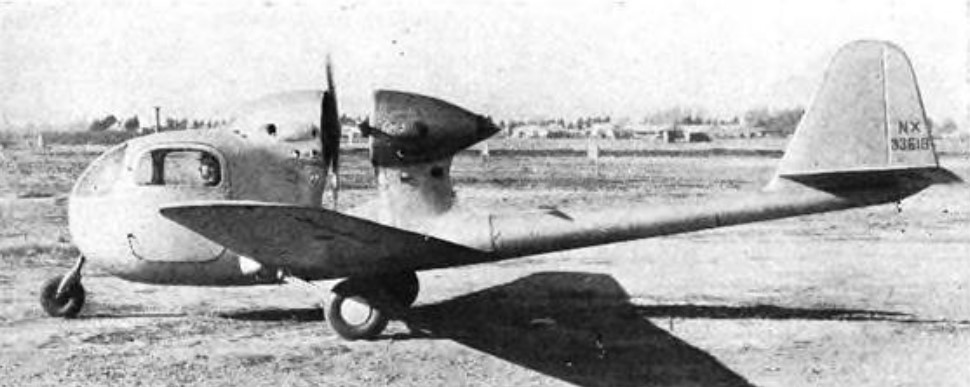
 Side view of the Johnson-Funke monoplane |
|
| Type | Experimental aircraft |
| National origin | United States |
| Manufacturer | Johnson-Funke Aircraft Co. |
| Designer |
Alfred C. Johnson |
| First flight | 1941 |
| Retired | 1941 |
The Johnson-Funke monoplane was an experimental twin-engine monoplane with the engines arranged in a push-pull configuration.
Design and development
[edit]
In 1941, the Johnson-Funke Aircraft Company was set up with a capital of $500,000, with the intention of building a plane capable of taking 3 to 5 passengers. Its two principals were Alfred C. Johnson and Henry W. Funke.[1] Johnson had designed a twin-engine airplane whose engines were placed in a tandem push-pull arrangement. It was a low-wing monoplane, with a pod-and-boom style of fuselage and a tricycle undercarriage. The fuselage and wings were made of plywood, with dural used for the tail surfaces and the engine cowlings. The monoplane’s most notable feature was the arrangement of the two engines and propellers, which were positioned facing each other.[2][3] It had the registration NX33618.[4]
The airframe reached approximately 200 flight-hours before the United States’ entry into World War II suspended the project; the airframe was dismantled and stored for the duration of the war.[2] In 1942, Johnson and Funke were granted patent No. 134,458, for “Design for an Airplane”.[5] In 1946, it was reported that the aircraft was being reassembled for tests leading to a production version.[2]
Data from Aviation Week[2]
General characteristics
- Crew: 1, pilot
- Capacity: 1 passenger
- Length: 29 ft (8.8 m)
- Wingspan: 36 ft (11 m)
- Gross weight: 2,000 lb (907 kg)
- Powerplant: 2 × Franklin , 80 hp (60 kW) each
- Propellers: 2-bladed, 6 ft (1.8 m) diameter
Performance
- Cruise speed: 135 mph (217 km/h, 117 kn)
- Range: 400 mi (640 km, 350 nmi)
- ^ “Manufacturing Digest”. American Aviation Daily. 13 (29). Washington, DC: American Aviation Associates: 145. February 4, 1941.
- ^ a b c d “Twin-Engine Plane Has Radical Design”. Aviation Week. 5 (24). New York, NY: McGraw-Hill Publishing Company: 16. June 24, 1946. Retrieved June 5, 2023.
- ^ Davis, B.G., ed. (December 1941). “Have you seen?”. Flying and Popular Aviation. XXIX (6). Chicago, ILL: Ziff-Davis Publishing Company: 53.
- ^ United States Civil Aircraft Register. Oklahoma City, OK: Federal Aviation Agency. July 1, 1964. p. 424.
- ^ “List of Design Inventions”. Official Gazette. 545 (1). Washington, DC: United States Patent Office: 216. December 1, 1942.




