
From Wikipedia, the free encyclopedia
Content deleted Content added
|
|
|||
| Line 39: | Line 39: | ||
|
== Developments == |
== Developments == |
||
|
The ”’Kazinga Channel Bridge”’ previously known as Katunguru Bridge constructed in 1954 connects the two sections of [[Queen Elizabeth National Park]]. It plays a vital role in facilitating transportation and access within the park, making it easier for visitors to explore different areas.<ref>{{Cite web |last=K |first=Doreen |date=2024-12-05 |title=Intriguing Facts about the Kazinga Channel: How deep, attractions, |url=https://www.hailtoursuganda.com/kazinga-channel/ |access-date=2025-12-13 |website=Hail Tours |language=en-US}}</ref> |
The ”’Kazinga Channel Bridge”’ previously known as Katunguru Bridge constructed in 1954 connects the two sections of [[Queen Elizabeth National Park]]. It plays a vital role in facilitating transportation and access within the park, making it easier for visitors to explore different areas.<ref>{{Cite web |last=K |first=Doreen |date=2024-12-05 |title=Intriguing Facts about the Kazinga Channel: How deep, attractions, |url=https://www.hailtoursuganda.com/kazinga-channel/ |access-date=2025-12-13 |website=Hail Tours |language=en-US}}</ref> |
||
|
== External links == |
== External links == |
||
Latest revision as of 15:07, 16 December 2025
River in Uganda


Kazinga Channel in Uganda is a wide, 32-kilometre (20 mi) long natural channel that links Lake Edward and Lake George, which are part of the African Great Lakes system.
Kazinga Channel is located in South Western Uganda near Katunguru area within the famous Queen Elizabeth National Park.

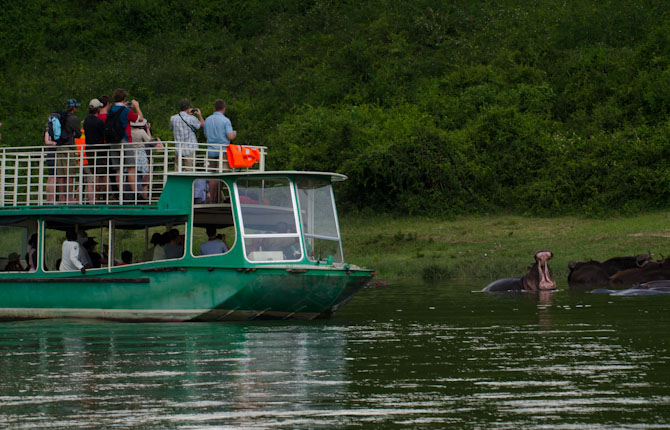
The channel is a dominant feature of Queen Elizabeth National Park. It attracts a varied range of animals and birds, boasting one of the world’s largest concentration of hippos and numerous Nile crocodiles.
In 2005, a large number of hippos were killed in the channel as a result of an anthrax outbreak, which occurs when animals eat remnants of vegetation during the driest months, leading to the absorption of bacterial spores that can live for decades in dry soil.

The channel is described as a popular wildlife tourism area.[1]
The Kazinga Channel Bridge previously known as “Katunguru Bridge”, constructed in 1954, connects the two sections of Queen Elizabeth National Park.[2] It plays a vital role in facilitating transportation and access within the park, making it easier for visitors to explore different areas.[3]

