


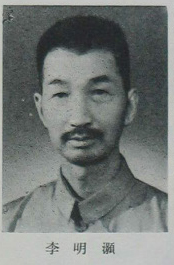
Chinese politician
|
Li Minghao |
|
|---|---|
 |
|
| Born | September 1897 (1897-09)
Liling County, Hunan, China |
| Died | August 25, 1980(1980-08-25) (aged 82) |
| Party | Kuomintang |
Li Minghao (Chinese: 李明灏; September 19, 1897 – August 25, 1980), courtesy name Zhongjian, was a Chinese military officer and political figure. He was a lieutenant general in the National Revolutionary Army and later served in senior governmental positions of the People’s Republic of China, including vice governor of Hubei Province and vice chairman of the Hubei Provincial Committee of the Chinese People’s Political Consultative Conference. He was a recipient of the First Class Order of Liberation in 1956.[1]
Li Minghao was born on 19 September 1897 in Hengtiantang, Xinyang Township, Liling County (now Liling, Zhuzhou), Hunan Province. He received a traditional private education in his early years and entered Lijiang Middle School in 1914. In 1919, he was admitted to the Imperial Japanese Army Academy in Tokyo, from which he graduated in July 1922. After returning to China, he served as a deputy company commander with the rank of major at the Hunan Military Academy.[2]
In 1923, Li was invited by Cheng Qian to Guangzhou, where he served as director of the Personnel Evaluation Section of the Military and Political Department of Sun Yat-sen’s Generalissimo Headquarters. During this period, he joined the Kuomintang.[3] He subsequently held a series of senior military education and staff positions, including director of education at the Guangzhou Army Academy and chief of staff positions in forces participating in the Eastern Expeditions against Chen Jiongming. During the Northern Expedition, he served as regimental commander and later divisional commander of units within the National Revolutionary Army.[4]
Following the political upheavals of 1927, Li continued to serve in various senior military and training posts. He was repeatedly involved in protecting members of the Chinese Communist Party during periods of political repression, successfully rescuing more than seventy detained Communists in Hunan. In the early 1930s, while holding senior advisory and educational posts within the Nationalist military establishment, he covertly assisted Communist underground networks, including procuring large numbers of military maps of central China for the CCP leadership.[5]
During the Second Sino-Japanese War, Li served as a lieutenant general and held command and training positions, including director of the Chengdu and Wuhan branches of the Central Military Academy and later commander of the 97th Army, concurrently serving as Chongqing garrison commander.[6] His contacts with the Eighth Route Army and figures such as Zhou Enlai were frequent. Due to suspicions regarding his political stance, he was later removed from active command and sidelined.[7]
In late 1948, Li entered Communist-controlled areas and was received at Xibaipo by Mao Zedong, Zhu De, Liu Shaoqi, and Zhou Enlai. He participated in efforts leading to the peaceful liberation of Beijing and later played a significant role in negotiations contributing to the peaceful liberation of Hunan Province in 1949.[8] After the founding of the People’s Republic of China, he served as a member and secretary-general of the Hunan Military and Administrative Committee, a member of the National Defense Commission of the People’s Republic of China, and a member of the Central-South Military and Administrative Committee.[9]
Li later served as vice minister of civil affairs in the Central-South Administrative Region and, from 1954, as vice governor of Hubei Province. Between 1966 and 1980, he was a standing committee member and vice chairman of the Hubei Provincial Committee of the Chinese People’s Political Consultative Conference. He was elected as a delegate to the First, Second, and Third National People’s Congress and as a member of the First through Fifth National Committees of the CPPCC.[10]
Li Minghao died of lung cancer in Wuchang on August 25, 1980 at the age of 83.[11]



