


*Piano concerto in B-flat major, K. 456
*Piano concerto in B-flat major, K. 456
*Piano sonata in c minor, K. 457
*Piano sonata in c minor, K. 457
*String quartet in B-flat major, K. 458
*String quartet in B-flat major, K. 458
The consecutive numbers in the [[Köchel catalog]] (the primary compilation by scholars of Mozart’s works) attest the importance of Mozart’s personal catalogue in establishing dates.
The consecutive numbers in the [[Köchel catalog]] (the primary compilation by scholars of Mozart’s works) attest the importance of Mozart’s personal catalogue in establishing dates.
Mozart’s personal catalog is a hand-written document that the composer created over the years 1784–1791. In it, he attempted to provide a clear description, with both verbal annotation and musical incipit, of every work he wrote. The catalog survives today (in both original and published form) and serves as a standard basis for dating and authenticating Mozart’s works.
Title
Mozart entitled the document “Verzeichnüss aller meiner Werke” (“Catalog of all my works”). The spelling “Verzeichnüss” is an oddity, perhaps of dialectal origin; modern Standard German has “Verzeichnis” for this word.
Format
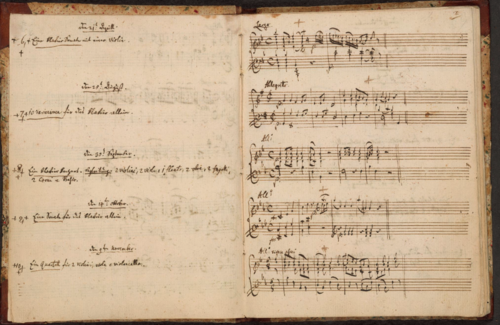
Mozart used the left page of each page-pair for verbal descriptions, and the right page for the corresponding incipits. There are five works recorded on each pair of pages.

The five works on this pair of pages are as follows (Mozart’s identifications):[1]
- Den 21ten April. No. 6. Eine Klavier Sonata mit einer Violin
- Den 25ten August. No. 7. 10 Variationen für das Klavier allein
- Den 30ten September. No. 8. Ein Klavier Konzert Begleitung. 2 Violini, 2 Viole, 1 Flauto, 2 Oboe, 2 Fagotti, 2 Corni et Basso
- Den 14ten October. No. 9. Eine Sonata für das Klavier allein
- Den 9ten November. No. 10. Ein Quartett für 2 Violini, Viola e Violoncello
Mozart’s combination of German and Italian may be translated thus:
- 21 April. No. 6. A piano sonata with a violin
- 25 August. No. 7. 10 variations for piano solo
- 30 September. No. 8. A piano concerto. Accompaniment: 2 violin (parts), 2 violas, 1 flute, 2 oboes, 2 bassoons, 2 horns, and bass [instruments]
- 14 October. No. 9. A sonata for piano solo.
- 9 November. No. 10. A quartet for 2 violins, viola, and violoncello
In modern terminology, these works might referred to as follows:
- Violin sonata in B-flat major, K. 454
- Ten variations on an air by Gluck for solo piano, K. 455
- Piano concerto in B-flat major, K. 456
- Piano sonata in c minor, K. 457
- String quartet in B-flat major, K. 458
The consecutive numbers in the Köchel catalog (the primary compilation by scholars of Mozart’s works) attest the importance of Mozart’s personal catalogue in establishing dates.
History
Hermann Abert treats the origin of the catalog as part of his assessment of Mozart’s personality: “It is entirely typical of Mozart that from time to time he made a sincere effort to put his affairs in order.” Abert notes that at the same time Mozart began to keep his musical catalog, he also made a catalog of all household expenditures (in which, for instance, he recorded his purchase of a pet starling. The expenditures catalog, unlike the musical one, was soon abandoned.
The first entry in the musical catalog was on 9 February 1784[2] for the Piano Concerto No. 14, K. 449. It was continued up to the last possible moment: Mozart recorded his last completed work, the Little Masonic Cantata K. 623, on 15 November 1791, and took to (what turned out to be) his deathbed five days later. The catalog was retained for a time after Mozart’s death (5 December 1791) by his widow Constanze, who used it as a resource for her campaign of publishing her husband’s works. Constanze eventually sold the catalog (along with many musical works) to the publisher Johann Anton André, who in 1805 published it. The original made its way into the prodigious autograph collection of Stefan Zweig, from which it eventually entered the collections of the British Library.
The work is currently available in published form, both as a facsimile (photographs of what Mozart wrote) and in versions (such as André’s) that convert Mozart’s handwriting into more legible printed form. For a time the entire autograph was available for inspection from the website of the British Library where it resides, but as of this writing it has been taken down.
Significance
Commentators on Mozart’s music often cite the catalog. For instance, many have gotten a sense of quasi-miracle that the last three symphonies (39, 40, 41) all pinnacles of the classical literature, were composed, according to the catalog, within a very short period in 1786 (26 June, 25 July, 10 August, respectively) The view that Mozart’s final opera The Magic Flute is perhaps not best regarded as a mere Singspiel receives, perhaps, some support from the fact that in the catalog Mozart calls it simply “A German opera.”
The famous Mozart serenade “Eine kleine Nachtmusik” almost certainly owes its familiar title to its catalog entry, where Mozart probably was not inventing a title but simply recording that he had finished a short notturno or night-music.
A fraud?
The scholars Anna Trombetta, Martin W. B. Jarvis, and Luca Bianchini have put forth, in published work,[3] the view that the catalog is a forged document, created probably by Constanze to facilitate the sale of her husband’s work. Thus far the mainstream musicological literature has not provided an assessment of this claim.
Notes
References
- Abert, Hermann (2016). W. A. Mozart. Translated by Stewart Spencer. new footnotes by Cliff Eisen (revised ed.). New Haven: Yale University Press.
- Deutsch, Otto Erich (1965). Mozart: A Documentary Biography. Stanford, California: Stanford University Press.



