
|}
|}
== Graha Cāra (Path of the Planet) ==
The term Graha Cāra is derived from two Sanskrit words: graha meaning ‘planet’, and cāra meaning ‘path, route, or journey’. Therefore, graha cāra signifies the ‘path/journey of the planet.’ Which planet is being referred to? Considering the consistency with other elements of the dating system, the ‘path of the planet’ refers to the Sun (Sūrya). From a geocentric perspective, the Sun revolves around the Earth, rising in the east and setting in the west, then reappearing in the east the following day, and so on. Thus, graha cāra indicates the daily journey of the Sun over 24 hours (a solar day/wara).<ref>{{cite book
| last1 = Trigangga
| first1 =
| last2 = Wardhani
| first2 = Fifia
| last3 = Retno W.
| first3 = Desrika
| title = Prasasti dan Raja-Raja Nusantara
| publisher = Museum Nasional Indonesia, Kementerian Pendidikan dan Kebudayaan
| location = Jakarta
| year = 2015
| url = https://repositori.kemendikdasmen.go.id/24363/1/Prasasti%20dan%20raja-raja%20nusantara.pdf
| page = 23
| language = id
| format = PDF
| access-date = 13 November 2025
}}</ref>
There are eight directions (or positions) that refer to the Sun’s position:
{| class=”wikitable sortable”
|+
! Graha Cāra
! English Name
! Time Range
|-
| Purwāstha
| East
| 04:30 – 07:30
|-
| Aiśānyastha
| Northeast
| 07:30 – 10:30
|-
| Uttarāstha
| North
| 10:30 – 13:30
|-
| Bāyabyastha
| Northwest
| 13:30 – 16:30
|-
| Paścimastha
| West
| 16:30 – 19:30
|-
| Nairītistha
| Southwest
| 19:30 – 22:30
|-
| Dakṣiṇāstha
| South
| 22:30 – 01:30
|-
| Āgneyastha
| Southeast
| 01:30 – 04:30
|}
Since one solar day equals 24 hours, each of these eight positions has a time duration of 3 hours. Because the Sun rises in the east, which marks the start of a new day, the position must begin in the east (Purwāstha), which is approximately from 04:30 to 07:30 in the morning. Therefore, Nairītistha graha cāra means the ‘position of the Sun is in the southwest,’ which corresponds to the time between 19:30 and 22:30 (at night).
=== Zodiac ===
=== Zodiac ===
Unlike the Western (Tropical) zodiac, which uses the Sun as its primary parameter resulting in 12 zodiac signs over the course of a year, the utilization of the zodiac (rāśi) in the Old Javanese calendar is based on the lunar cycle. Consequently, the duration of each zodiac sign in the Old Javanese calendar is significantly shorter. For instance, the Aries zodiac sign (Meṣa) in the Old Javanese calendar begins on November 4, 2025, at 14:05 (2:05 PM) and concludes on November 6, 2025, at 13:17 (1:17 PM).<ref>{{cite web
Unlike the Western (Tropical) zodiac, which uses the Sun as its primary parameter resulting in 12 zodiac signs over the course of a year, the utilization of the zodiac (rāśi) in the Old Javanese calendar is based on the lunar cycle. Consequently, the duration of each zodiac sign in the Old Javanese calendar is significantly shorter. For instance, the Aries zodiac sign (Meṣa) in the Old Javanese calendar begins on November 4, 2025, at 14:05 (2:05 PM) and concludes on November 6, 2025, at 13:17 (1:17 PM).<ref>{{cite web
Ancient Javanese dating system
Old Javanese calendar (or Ancient Javanese calendar) was a dating system previously used in inscriptions from various kingdom eras, starting from the Medang Kingdom up to the Majapahit Empire. This dating system was widely used, particularly for writing inscriptions in Java and Bali. Unlike the present-day Javanese and Balinese calendar system, the Old Javanese calendar incorporates a greater number of chronological elements (features more dating components)[1] However, the Balinese calendar continues to follow the year number system derived from the Old Javanese calendar.[2] It can be said that the Old Javanese calendar is a synthesis of the Hindu Indian calendar and pre-existing indigenous Javanese calendrical traditions.
Calendar Component
Year
The year (which in Old Javanese is referred to as Warsa) in the Old Javanese dating system often utilizes the Saka Year; however, some existing inscriptions show the use of the Sanjaya Year in their chronology.[3]
Month
The month, which in Old Javanese is referred to as Wulan or Masa, was written in ancient inscriptions using names derived from Sanskrit months. The names of the months listed in these inscriptions are: Caitra, Waiśākha, Jyeṣṭha, Āṣāḍha, Śrāvaṇa, Bhādrapāda, Āśvina (or Āśuji), Kārttika, Mārgaśīrṣa, Pauṣa (or Poṣya), Māgha, and Phālguna. The Old Javanese calendar had years that consisted of either twelve or thirteen months. The system itself utilized a solar year for calculating one year, while the months were calculated using lunar movements, making it a lunisolar system.[4]
| Western Year (Approx.) | Saka Year | Number of Months | Intercalary Month Added (IAST) |
|---|---|---|---|
| 2020 | 1942 | 13 | Āśvina |
| 2021 | 1943 | 12 | — |
| 2022 | 1944 | 12 | — |
| 2023 | 1945 | 13 | Śrāvaṇa |
| 2024 | 1946 | 12 | — |
| 2025 | 1947 | 12 | — |
| 2026 | 1948 | 13 | Jyeṣṭha |
| 2027 | 1949 | 12 | — |
| 2028 | 1950 | 12 | — |
| 2029 | 1951 | 13 | Caitra |
| 2030 | 1952 | 12 | — |
| 2031 | 1953 | 13 | Bhādrapada |
| 2032 | 1954 | 12 | — |
| 2033 | 1955 | 12 | — |
| 2034 | 1956 | 13 | Āṣāḍha |
| 2035 | 1957 | 12 | — |
| 2036 | 1958 | 12 | — |
| 2037 | 1959 | 13 | Jyeṣṭha |
Titi (Lunar Day) and Paksa (Lunar Fortnight)

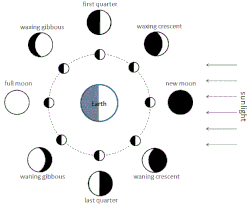
The 30 Titis are grouped into two halves called Paksas (lunar fortnights)[6].
| Tithi Number | Śuklapakṣa (Waxing Fortnight) | Kṛṣṇapakṣa (Waning Fortnight) |
|---|---|---|
| 1 | Pratipadā | Pratipadā |
| 2 | Dvitīyā | Dvitīyā |
| 3 | Tṛtīyā | Tṛtīyā |
| 4 | Caturthī | Caturthī |
| 5 | Pañcamī | Pañcamī |
| 6 | Ṣaṣṭhī | Ṣaṣṭhī |
| 7 | Saptamī | Saptamī |
| 8 | Aṣṭamī | Aṣṭamī |
| 9 | Navamī | Navamī |
| 10 | Daśamī | Daśamī |
| 11 | Ekādaśī | Ekādaśī |
| 12 | Dvādaśī | Dvādaśī |
| 13 | Trayodaśī | Trayodaśī |
| 14 | Caturdaśī | Caturdaśī |
| 15 | Pañcadaśī (Full Moon) | Pañcadaśī (New Moon) |
Note on Tithi 15: The 15th Tithi is called Pūrṇimā (Full Moon) in Śuklapakṣa and Amāvasyā (New Moon/Dark Moon) in Kṛṣṇapakṣa.
Karana
Karana (sometimes write Karaṇa) is a half lunar day, equivalent to half a tithi.A full lunar month is composed of 60 karaṇas, but only 11 distinct names are used.
The 11 names of the Karaṇa are: Kiṃstughna, Vava, Valava, Kaulava, Taitila, Gara, Vaṇija, Viṣṭi, Śakuni, Catuṣpāda, and Nāga.
The first karaṇa ends at the midpoint of the tithi, and the second karaṇa ends when the tithi is completed.
The naming convention is as follows:
- The first tithi (1st śuklapakṣa) begins with the Kiṃstughna karaṇa and ends with the Vava karaṇa.
- The second tithi (2nd śuklapakṣa) up to the 29th tithi (14th kṛṣṇapakṣa) consists of a combination of the paired karaṇas: Vava, Valava, Kaulava, Taitila, Gara, Vaṇija, and Viṣṭi.
- The second karaṇa of the 29th tithi is Śakuni. Subsequently, the last tithi (15th kṛṣṇapakṣa) begins with the Catuṣpāda karaṇa and ends with the Nāga karaṇa. [7]
Days
A day, or Wāra in Old Javanese dating terminology, is a unit of time that begins at sunrise and lasts until the next sunrise. In the Old Javanese dating system, the day (wara) is organized into several concurrent cycles: the 5-day cycle (Pancawara), the 6-day cycle (Sadwara), and the 7-day cycle (Saptawara).[8]
Five Day Cycle (Pancawara)
| Pasaran (Pancawara) | Old Javanese Name |
|---|---|
| Legi | Umanis |
| Paing | Pahing |
| Pon | Pon |
| Wagé | Wagai |
| Kliwon | Kaliwwan |
Sadwara (Six Day Cycle)
| No. | Paringkelan/Sadwara Name |
|---|---|
| 1 | Tunglé |
| 2 | Aryang |
| 3 | Wurukung |
| 4 | Paningron |
| 5 | Uwas |
| 6 | Mawulu |
Saptawara (Seven Day Cycle)
| No. | Day (Saptawara) | Old Javanese Name |
|---|---|---|
| 1. | Sunday | Raditya/Aditya |
| 2. | Monday | Soma |
| 3. | Tuesday | Anggara |
| 4. | Wednesday | Buda |
| 5. | Thursday | Wraspati |
| 6. | Friday | Sukra |
| 7. | Saturday | Tumpak/Saniscara |
Wuku

The Wuku is a chronological cycle derived from the combination of the Sadwāra (6-day cycle), Pañcawāra (5-day cycle), and Saptawāra (7-day cycle). This combination results in a 210-day cycle, which occurs once or twice a year. The 210-day cycle is grouped into 30 distinct wuku, with each wuku lasting 7 days and defined by a unique combination of the three aforementioned week cycles. Along with Sadwāra and Pañcawāra, the wuku is believed to be an indigenous Javanese dating element. For example, the date “Ma Ka Bu” (Mawulu Kliwon Budha) marks the 144th day in the 210-day cycle and belongs to Wuku Mahatal (the 21st wuku).[10]
| No. | Wuku Name | Starting Day (of 210-Day Cycle) |
Saptawara (7-day cycle) |
Sadwara (6-day cycle: Paringkelan) |
Pancawara (5-day cycle: Pasaran) |
|---|---|---|---|---|---|
| 1 | Sinta | 1 | Sunday | Tunglé | Pahing |
| 2 | Landep | 8 | Sunday | Aryang | Wagé |
| 3 | Wukir | 15 | Sunday | Wurukung | Legi |
| 4 | Kurantil | 22 | Sunday | Paningron | Pon |
| 5 | Tolu | 29 | Sunday | Uwas | Kliwon |
| 6 | Gumbrèg | 36 | Sunday | Mawulu | Pahing |
| 7 | Wariga ning Wariga (Warigalit) | 43 | Sunday | Tunglé | Wagé |
| 8 | Wariga (Warigagung) | 50 | Sunday | Aryang | Legi |
| 9 | Julung Wangi | 57 | Sunday | Wurukung | Pon |
| 10 | Sungsang | 64 | Sunday | Paningron | Kliwon |
| 11 | Dungulan (Galungan) | 71 | Sunday | Uwas | Pahing |
| 12 | Kuningan | 78 | Sunday | Mawulu | Wagé |
| 13 | Langkir | 85 | Sunday | Tunglé | Legi |
| 14 | Madasih (Mandasiya) | 92 | Sunday | Aryang | Pon |
| 15 | Julung Pujut | 99 | Sunday | Wurukung | Kliwon |
| 16 | Pahang | 106 | Sunday | Paningron | Pahing |
| 17 | Kuruwulut | 113 | Sunday | Uwas | Wagé |
| 18 | Marakih (Marakeh) | 120 | Sunday | Mawulu | Legi |
| 19 | Tambir | 127 | Sunday | Tunglé | Pon |
| 20 | Madangkungan | 134 | Sunday | Aryang | Kliwon |
| 21 | Mahatal (Maktal) | 141 | Sunday | Wurukung | Pahing |
| 22 | Wuyai (Wuye) | 148 | Sunday | Paningron | Wagé |
| 23 | Manahil | 155 | Sunday | Uwas | Legi |
| 24 | Prangbakat | 162 | Sunday | Mawulu | Pon |
| 25 | Bala | 169 | Sunday | Tunglé | Kliwon |
| 26 | Wugu | 176 | Sunday | Aryang | Pahing |
| 27 | Wayang | 183 | Sunday | Wurukung | Wagé |
| 28 | Kulawu | 190 | Sunday | Paningron | Legi |
| 29 | Dukut | 197 | Sunday | Uwas | Pon |
| 30 | Watu Gunung | 204 | Sunday | Mawulu | Kliwon |
Time Unit
Muhūrtta (sometimes write Muhurta, Muhurtta) is the smallest unit of time in the Old Javanese dating system. One solar day (wāra) is divided into 30 muhūrtta. Thus, one muhūrtta is equivalent to 48 minutes.[12]
| Muhūrtta 1–15 (Daytime) | Muhūrtta 16–30 (Nighttime) | ||||
|---|---|---|---|---|---|
| No. | Name | Time Range | No. | Name | Time Range |
| 1. | Rudra | 06:00 – 06:48 | 16. | Giriśa | 18:00 – 18:48 |
| 2. | Āhi | 06:48 – 07:36 | 17. | Ājapāda | 18:48 – 19:36 |
| 3. | Mitra | 07:36 – 08:24 | 18. | Āhiir Budnya | 19:36 – 20:24 |
| 4. | Pitṛ | 08:24 – 09:12 | 19. | Pusya | 20:24 – 21:12 |
| 5. | Wasu | 09:12 – 10:00 | 20. | Āświni | 21:12 – 22:00 |
| 6. | Wārāha | 10:00 – 10:48 | 21. | Yama | 22:00 – 22:48 |
| 7. | Wiśwedewā | 10:48 – 11:36 | 22. | Āgni | 22:48 – 23:36 |
| 8. | Widi | 11:36 – 12:24 | 23. | Widātr | 23:36 – 00:24 |
| 9. | Sutamukī | 12:24 – 13:12 | 24. | Kanda | 00:24 – 01:12 |
| 10. | Puruhūta | 13:12 – 14:00 | 25. | Āditi | 01:12 – 02:00 |
| 11. | Wāhinī | 14:00 – 14:48 | 26. | Jīwa | 02:00 – 02:48 |
| 12. | Naktanakarā | 14:48 – 15:36 | 27. | Wiṣṇu | 02:48 – 03:36 |
| 13. | Waruṇa | 15:36 – 16:24 | 28. | Dyumadgadyuti | 03:36 – 04:24 |
| 14. | Āryyamana | 16:24 – 17:12 | 29. | Brahma | 04:24 – 05:12 |
| 15. | Baga | 17:12 – 18:00 | 30. | Samudra | 05:12 – 06:00 |
Graha Cāra (Path of the Planet)
The term Graha Cāra is derived from two Sanskrit words: graha meaning ‘planet’, and cāra meaning ‘path, route, or journey’. Therefore, graha cāra signifies the ‘path/journey of the planet.’ Which planet is being referred to? Considering the consistency with other elements of the dating system, the ‘path of the planet’ refers to the Sun (Sūrya). From a geocentric perspective, the Sun revolves around the Earth, rising in the east and setting in the west, then reappearing in the east the following day, and so on. Thus, graha cāra indicates the daily journey of the Sun over 24 hours (a solar day/wara).[13]
There are eight directions (or positions) that refer to the Sun’s position:
| Graha Cāra | English Name | Time Range |
|---|---|---|
| Purwāstha | East | 04:30 – 07:30 |
| Aiśānyastha | Northeast | 07:30 – 10:30 |
| Uttarāstha | North | 10:30 – 13:30 |
| Bāyabyastha | Northwest | 13:30 – 16:30 |
| Paścimastha | West | 16:30 – 19:30 |
| Nairītistha | Southwest | 19:30 – 22:30 |
| Dakṣiṇāstha | South | 22:30 – 01:30 |
| Āgneyastha | Southeast | 01:30 – 04:30 |
Since one solar day equals 24 hours, each of these eight positions has a time duration of 3 hours. Because the Sun rises in the east, which marks the start of a new day, the position must begin in the east (Purwāstha), which is approximately from 04:30 to 07:30 in the morning. Therefore, Nairītistha graha cāra means the ‘position of the Sun is in the southwest,’ which corresponds to the time between 19:30 and 22:30 (at night).
Zodiac
Unlike the Western (Tropical) zodiac, which uses the Sun as its primary parameter resulting in 12 zodiac signs over the course of a year, the utilization of the zodiac (rāśi) in the Old Javanese calendar is based on the lunar cycle. Consequently, the duration of each zodiac sign in the Old Javanese calendar is significantly shorter. For instance, the Aries zodiac sign (Meṣa) in the Old Javanese calendar begins on November 4, 2025, at 14:05 (2:05 PM) and concludes on November 6, 2025, at 13:17 (1:17 PM).[14]
| No. | Old Javanese Name | English Name |
|---|---|---|
| 1 | Meṣa | Aries |
| 2 | Wṛṣabha | Taurus |
| 3 | Mithuna | Gemini |
| 4 | Karkaṭa | Cancer |
| 5 | Siṅha | Leo |
| 6 | Kanyā | Virgo |
| 7 | Tulā | Libra |
| 8 | Wṛścika/Mṛcchika | Scorpio |
| 9 | Dhanu | Sagittarius |
| 10 | Makara | Capricorn |
| 11 | Kumbha | Aquarius |
| 12 | Mīna | Pisces |
Example of the chronological notation (calendar element) used in inscriptions.
| No. | Inscription Transcript | Calendar Element |
|---|---|---|
| 1. | / 0 / i śaka ; 1214 ; jyeṣṭa māsa irika diwaśani | Month (Māsa) |
| 2. | kamoktan pāduka bhaṭāra sang lumah ring śiwa buddha /’/’ swa- | — |
| 3. | sti śrī śaka warṣatīta ; 1273 ; weśakamāsa tithi pratipā- | Year (warṣa), Tithi (Lunar Day), Month (Māsa) |
| 4. | # da śuklapakṣa ; ha ; po ; bu ; wara ; tolu ; niritistha graha- | Fortnight (Pakṣa), Day Cycle (Wara), Wuku |
| 5. | cara ; mṛgāśira nakṣatra ; śāśidewata ; bāyabyamaṇḍala ; | Grahacara, Lunar Mansion (Nakṣatra), Maṇḍala, Dewata |
| 6. | sobhanayoga ; śweta muhurtta ; brahmāparwweśa ; kistughna ; | Parwweśa, Time Unit (Muhūrtta) |
| 7. | kāraṇa vṛṣabharāśi ; ‘irika diwaśa sang mahāmantrimukya ; ra- | Half-Tithi (Karaṇa), Zodiac (Rāśi) |
References
- ^ Trigangga; Wardhani, Fifia; Retno W., Desrika (2015). Prasasti dan Raja-Raja Nusantara (PDF) (in Indonesian). Jakarta: Museum Nasional Indonesia, Kementerian Pendidikan dan Kebudayaan. p. 18. Retrieved 13 November 2025.
- ^ “Pustaka (Bibliography)”. KalenderBali.org (in Indonesian). Yayasan Bali Galang. Retrieved November 13, 2025.
- ^ Trigangga; Wardhani, Fifia; Retno W., Desrika (2015). Prasasti dan Raja-Raja Nusantara (PDF) (in Indonesian). Jakarta: Museum Nasional Indonesia, Kementerian Pendidikan dan Kebudayaan. p. 19. Retrieved 13 November 2025.
- ^ Trigangga; Wardhani, Fifia; Retno W., Desrika (2015). Prasasti dan Raja-Raja Nusantara (PDF) (in Indonesian). Jakarta: Museum Nasional Indonesia, Kementerian Pendidikan dan Kebudayaan. p. 19. Retrieved 13 November 2025.
- ^ “Adhik Maas”. Hindu Jagruti. Hindu Janajagruti Samiti. Retrieved November 13, 2025.
- ^ Trigangga; Wardhani, Fifia; Retno W., Desrika (2015). Prasasti dan Raja-Raja Nusantara (PDF) (in Indonesian). Jakarta: Museum Nasional Indonesia, Kementerian Pendidikan dan Kebudayaan. p. 20. Retrieved 13 November 2025.
- ^ Trigangga; Wardhani, Fifia; Retno W., Desrika (2015). Prasasti dan Raja-Raja Nusantara (PDF) (in Indonesian). Jakarta: Museum Nasional Indonesia, Kementerian Pendidikan dan Kebudayaan. p. 21. Retrieved 13 November 2025.
- ^ Trigangga; Wardhani, Fifia; Retno W., Desrika (2015). Prasasti dan Raja-Raja Nusantara (PDF) (in Indonesian). Jakarta: Museum Nasional Indonesia, Kementerian Pendidikan dan Kebudayaan. p. 21. Retrieved 13 November 2025.
- ^ Tanojo, R. (1967). Pawukon Pasemon dalah Pardikane (in Javanese). Surabaya: Jajasan Penerbitan “Djaja Baja”. Retrieved November 13, 2025 – via Scribd.
- ^ Trigangga; Wardhani, Fifia; Retno W., Desrika (2015). Prasasti dan Raja-Raja Nusantara (PDF) (in Indonesian). Jakarta: Museum Nasional Indonesia, Kementerian Pendidikan dan Kebudayaan. p. 19. Retrieved 13 November 2025.
- ^ Tanojo, R. (1967). Pawukon Pasemon dalah Pardikane (in Javanese). Surabaya: Jajasan Penerbitan “Djaja Baja”. p. 35-78. Retrieved November 13, 2025 – via Scribd.
- ^ Trigangga; Wardhani, Fifia; Retno W., Desrika (2015). Prasasti dan Raja-Raja Nusantara (PDF) (in Indonesian). Jakarta: Museum Nasional Indonesia, Kementerian Pendidikan dan Kebudayaan. p. 25. Retrieved 13 November 2025.
- ^ Trigangga; Wardhani, Fifia; Retno W., Desrika (2015). Prasasti dan Raja-Raja Nusantara (PDF) (in Indonesian). Jakarta: Museum Nasional Indonesia, Kementerian Pendidikan dan Kebudayaan. p. 23. Retrieved 13 November 2025.
- ^ “November 2025 Month Panchang, Hindu Calendar”. Drikpanchang. Adarsh Mobile Applications LLP. Retrieved November 14, 2025.

