
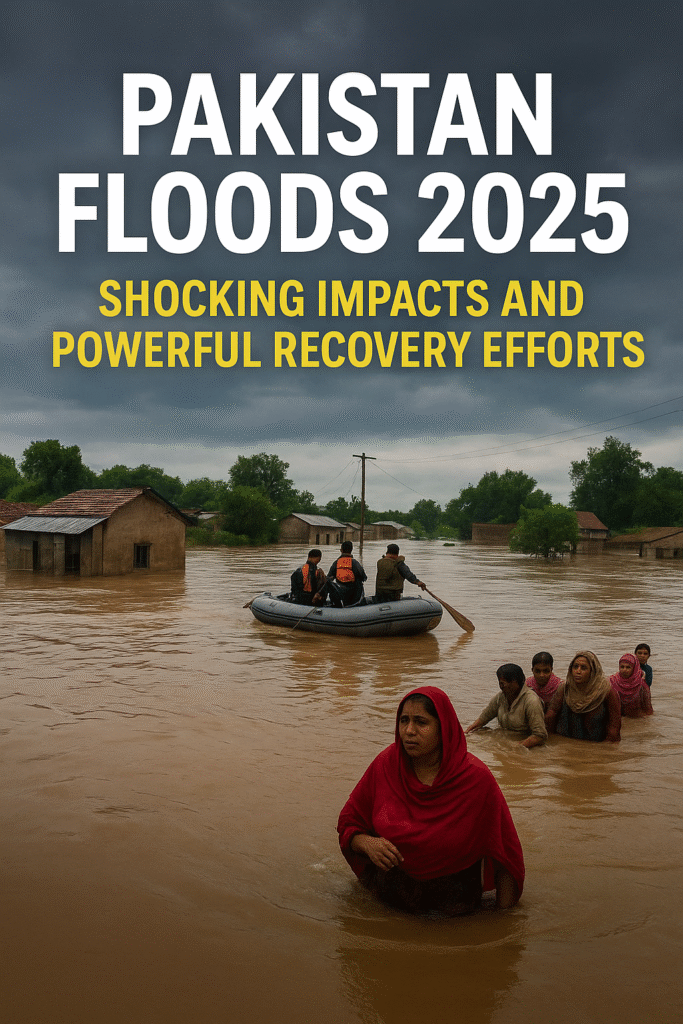
Pakistan Floods 2025 Shocking Impacts Recovery
Pakistan Floods 2025 have once again highlighted the country’s growing vulnerability to climate change. Every year, thousands of families are displaced, infrastructure is damaged, and agricultural lands are ruined. The recent floods have been described as one of the most destructive in recent years, leaving policymakers, scientists, and local communities deeply concerned about the future. This article explores the causes, impacts, and possible solutions to mitigate the devastating effects of Pakistan Floods 2025.
Understanding the Causes of Floods in Pakistan
Flooding in Pakistan is not a new phenomenon. However, the intensity and frequency have increased significantly in the past decade due to multiple factors.
1. Climate Change
Rising global temperatures are melting glaciers in the northern regions of Pakistan at an alarming rate. This contributes to excessive water flow in rivers, ultimately increasing the risk of floods.
2. Poor Urban Planning
Rapid urbanization without proper drainage systems has made cities like Karachi, Lahore, and Islamabad more prone to urban flooding. Streets turn into rivers even with moderate rainfall.
3. Monsoon Intensity
The 2025 monsoon season brought unusually heavy rainfall in Punjab, Sindh, and Khyber Pakhtunkhwa. Meteorologists confirmed that this year’s rainfall was almost 30% higher than average.
4. Deforestation
Loss of forests in northern areas reduces the land’s natural capacity to absorb water, causing flash floods.
Impact of Pakistan Floods 2025
The floods of 2025 have left deep scars on Pakistan’s economy, infrastructure, and society.
🏠 Humanitarian Crisis
- Thousands of families have been displaced.
- Over 500,000 people are living in temporary camps.
- Access to clean water and food remains a major challenge.
🌾 Agricultural Losses
- Rice, cotton, and wheat fields have been destroyed, threatening food security.
- Livestock mortality has risen, directly impacting farmers’ incomes.
🛤️ Infrastructure Damage
- Roads, bridges, and railway tracks have collapsed in flood-hit areas.
- Billions of rupees are required for reconstruction.
💰 Economic Burden
- According to early estimates, the 2025 floods have caused over $5 billion in damages.
- Export crops such as rice and mangoes have been severely affected.
Government Response and Relief Efforts
The government of Pakistan has initiated multiple steps to address the crisis.
Emergency Relief
- Pakistan Army and NDMA (National Disaster Management Authority) have carried out rescue operations.
- International aid has been requested from the UN and other global agencies.
Financial Support
- Temporary cash relief programs have been launched for affected families.
- Subsidized food and medicine are being provided in flood-hit districts.
Long-Term Measures
- Work has started on improving dams and barrages.
- Urban drainage systems are being redesigned for better water management.
Role of Technology in Flood Management
In 2025, technology has become an essential tool for flood prediction and response.
- Satellite Monitoring: NASA and SUPARCO data are being used to monitor rainfall and river levels.
- Mobile Alerts: Citizens are receiving flood warnings through SMS alerts.
- AI-Based Prediction Models: Advanced systems help forecast heavy rainfall with better accuracy.
How Pakistan Can Prepare for Future Floods
To reduce the risks of floods in coming years, Pakistan needs a comprehensive strategy.
1. Building Stronger Infrastructure
- Dams, levees, and embankments must be strengthened.
- Urban areas should have modern drainage systems.
2. Climate-Resilient Agriculture
- Farmers should be supported with flood-resistant crop varieties.
- Water management techniques like drip irrigation can reduce losses.
3. Afforestation Programs
- Planting more trees in northern areas can help absorb excessive rainwater.
4. Public Awareness
- Community training programs on disaster preparedness can save lives.
- School curriculums should include climate change education.
Global Context: How Other Countries Handle Floods
Countries like Bangladesh, Japan, and the Netherlands have adopted advanced flood management systems. Pakistan can learn from:
- Bangladesh: Use of cyclone shelters and early warning systems.
- Japan: Earthquake and flood-proof urban planning.
- Netherlands: Innovative water canals and embankments.
FAQs on Pakistan Floods 2025
Q1: What caused the 2025 floods in Pakistan?
Heavy monsoon rains, glacier melting, and poor urban planning were the main causes.
Q2: Which areas were most affected?
Sindh, Punjab, and parts of Khyber Pakhtunkhwa faced the worst flooding.
Q3: How much economic loss has Pakistan faced?
The estimated loss is over $5 billion in damages to agriculture and infrastructure.
Q4: What steps is the government taking?
Rescue operations, relief camps, and infrastructure rebuilding projects are ongoing.
Q5: How can floods be prevented in the future?
Through better planning, advanced technology, stronger infrastructure, and public awareness.
Final Thought
The floods in Pakistan 2025 are a wake-up call to take climate change seriously. While natural disasters cannot be entirely avoided, their impact can be minimized through planning, technology, and sustainable practices. Pakistan must invest in climate resilience today to protect future generations from the devastating cycle of floods.
Related : Writozy

