
From Wikipedia, the free encyclopedia
Content deleted Content added
|
|
|||
| Line 23: | Line 23: | ||
|
== Technical details == |
== Technical details == |
||
|
* Original title: ”Pour que vive l’Algérie |
* Original title: ”Pour que vive l’Algérie!”<ref name=”IMDb” /> |
||
|
* Directors: [[Mohamed Nadir Azizi]]; [[Sid Ali Mazif]]; [[Rabah Laradji]]; [[Ahmed Rachedi (director)|Ahmed Rachedi]]; [[Ahmed Kerzabi]] (collective work)<ref name=”Africultures” /> |
* Directors: [[Mohamed Nadir Azizi]]; [[Sid Ali Mazif]]; [[Rabah Laradji]]; [[Ahmed Rachedi (director)|Ahmed Rachedi]]; [[Ahmed Kerzabi]] (collective work)<ref name=”Africultures” /> |
||
|
* Screenplay: Mohamed Nadir Azizi<ref name=”Africultures” /> |
* Screenplay: Mohamed Nadir Azizi<ref name=”Africultures” /> |
||
Latest revision as of 22:03, 11 November 2025
1972 Algerian film
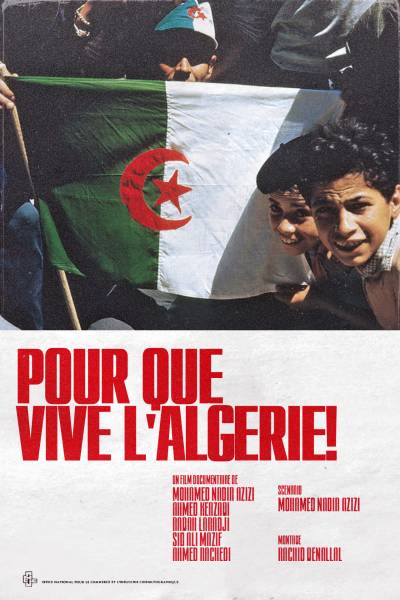
Pour que vive l’Algérie! is a 1972 collective Algerian documentary film produced by the ONCIC.
The film brings together several short narratives and documentary segments directed by a team of Algerian filmmakers — including Mohamed Nadir Azizi, Sid Ali Mazif, Rabah Laradji, Ahmed Rachedi, and Ahmed Kerzabi — focusing on the achievements and transformations of post-independence Algeria.[3][1]
A collective documentary presenting — through several segments directed by different filmmakers — the institutional projects, rural reform, and social achievements of independent Algeria in the early 1970s.[2]
As a collective documentary, the film does not emphasize individual cast members.
Most public records list only the directors and the producing institution (ONCIC).[4]
Production and context
[edit]
The film was produced by the ONCIC as part of a collective effort to document and promote the government’s projects and policies after Algerian independence.
Several notable Algerian filmmakers of the time collaborated on this work.[2]

