


Etymology
| ← Previous revision | Revision as of 18:46, 24 January 2026 | ||
| Line 26: | Line 26: | ||
|
==Etymology==
|
==Etymology==
|
||
|
The origin of the word comes from the [[Polish language|Polish]] word rogaliki. The ”{{lang|yi-Latn|-ach}}” ending ({{lang|yi|־ך}}) indicates plural, while the ”{{lang|yi-Latn|el}}” ({{lang|yi|־ל}}) can be a diminutive, as, for example, ”{{lang|yi-Latn|shtetlekh}}” ({{lang|yi|שטעטלעך}}, villages) is the plural of ”{{lang|yi-Latn|[[shtetl]]}}” ({{lang|yi|שטעטל}}, village), the diminutive of ”{{lang|yi-Latn|shtot}}” ({{lang|yi|שטאָט}}, town). In this case, the root means something like “twist” so the translation would be “little twists
|
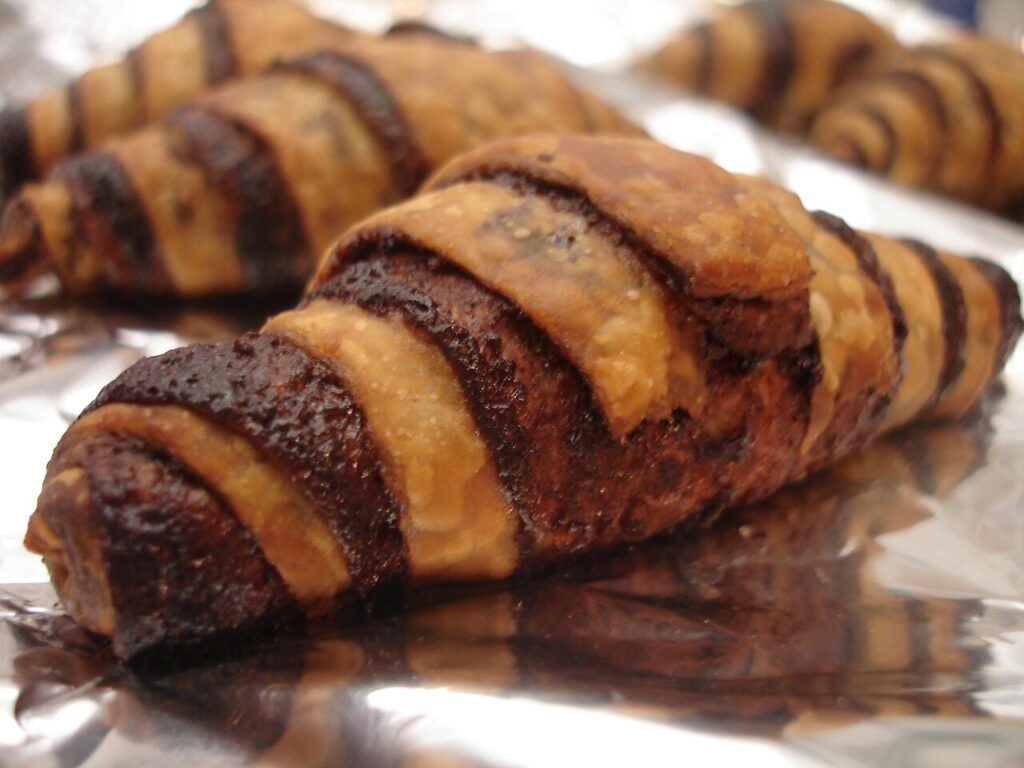
The origin of the word comes from the [[Polish language|Polish]] word rogaliki. The ”{{lang|yi-Latn|-ach}}” ending ({{lang|yi|־ך}}) indicates plural, while the ”{{lang|yi-Latn|el}}” ({{lang|yi|־ל}}) can be a diminutive, as, for example, ”{{lang|yi-Latn|shtetlekh}}” ({{lang|yi|שטעטלעך}}, villages) is the plural of ”{{lang|yi-Latn|[[shtetl]]}}” ({{lang|yi|שטעטל}}, village), the diminutive of ”{{lang|yi-Latn|shtot}}” ({{lang|yi|שטאָט}}, town). In this case, the root means something like “twist” so the translation would be “little twists” a reference to the shape of this [[pastry]].<ref name=”Marks” /> In this context, note that ”{{lang|yi-Latn|rog}}” ({{lang|yi|ראָג}}) means “corner” in Yiddish.<ref>Alexander Harkavy, [https://books.google.com/books?id=dnMVAAAAYAAJ&pg=PA312 A Dictionary of the Yiddish Language], 1898; page 312.</ref> In Polish, ”{{lang|pl|róg}}” can mean “corner”, but can also mean “horn” – both the kind on an animal and the musical instrument. Croissant-shaped pastries, which look like horns, are called ”{{lang|pl|rogale}}” in Polish, see {{lang|pl|[[St. Martin’s croissant|rogal świętomarciński]]}}. ”{{lang|pl|Rogale}}” is almost identical in pronunciation and meaning to the Yiddish word ”{{lang|yi-Latn|rugelach}}”.
|
||
|
Alternatively, some assert that the root is ”{{lang|yi-Latn|rugel}}”, meaning “royal”, possibly a reference to the taste.<ref>Lois Young-Tulin, Chapter 5: Mandelbrot, Rugelach and a Family Quilt, in ”[https://books.google.com/books?id=ZFdDPXB7eikC&pg=PA45 Jewish Mothers Tell their Stories]”, Hayworth Press, 2000; page 45</ref> This explanation conflicts with Yiddish usage, where the word ”{{lang|yi-Latn|keniglich}}” ({{lang|yi|קעניגליךּ}}) is the dominant word meaning “royal”.<ref>Alexander Harkavy, [https://books.google.com/books?id=dnMVAAAAYAAJ&pg=PA308 A Dictionary of the Yiddish Language], 1898; page 308.</ref>
|
Alternatively, some assert that the root is ”{{lang|yi-Latn|rugel}}”, meaning “royal”, possibly a reference to the taste.<ref>Lois Young-Tulin, Chapter 5: Mandelbrot, Rugelach and a Family Quilt, in ”[https://books.google.com/books?id=ZFdDPXB7eikC&pg=PA45 Jewish Mothers Tell their Stories]”, Hayworth Press, 2000; page 45</ref> This explanation conflicts with Yiddish usage, where the word ”{{lang|yi-Latn|keniglich}}” ({{lang|yi|קעניגליךּ}}) is the dominant word meaning “royal”.<ref>Alexander Harkavy, [https://books.google.com/books?id=dnMVAAAAYAAJ&pg=PA308 A Dictionary of the Yiddish Language], 1898; page 308.</ref>
|
||



