
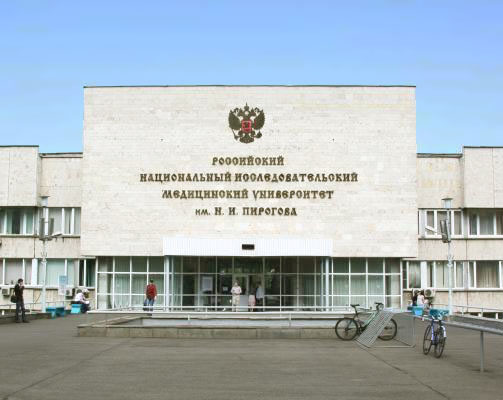
University
Pirogov Russian National Research Medical University (formerly known as Russian State Medical University) is a medical university in Moscow, Russia founded in 1906. It is fully accredited and recognized by Russia’s Ministry of Education and Science and is under the authority of the Ministry of Health and Social Development.[1] It was named after Russian surgeon and pedagogue N.I. Pirogov (1810-1888).[2] In 2024 US News & World Report ranked it #1,563 in the world.[3]
1906 – University Founded
1930 – World’s First Pediatric Faculty Launched
1954 – Nation’s First University Biomedical Laboratory Established
1959 – Doors Opened to First International Students
1963 – Country’s First Biomedical Faculty Established
1977 – Nation’s First Advanced Physician Training Faculty Launched
1991 – Conferred University Status
2010 – Conferred the Category of National Research University
2019 – Pirogov University Enters Global THE and QS Rankings
2021 – Pirogov University Joins Leader Group of ‘Priority 2030’ Federal Program, Uzbekistan Branch Development Initiated
2022 – Advanced Engineering School Launched
The history of the University began in 1906, when a medical school was established as part of the Moscow Higher Women’s Courses. This opened new avenues for women to pursue higher education at a time of pressing need for medical specialists in the country. The medical program proved incredibly popular.
In 1918, these courses were reorganized into the Second Moscow State University (2nd MSU). At that time, students and graduates of the medical faculty of 2nd MSU, like those from other medical universities, faced numerous challenges: they not only treated the wounded during the Civil War but also fought epidemics and the consequences of famine and devastation throughout the country. They also participated in organizing measures to combat cholera, typhoid, typhus, and malaria. Thanks to these young doctors, a wide range of different preventive measures were swiftly implemented across the country, preventing mass mortality from these infections.
In 1930, 2nd MSU was transformed into three independent higher education institutions, including the Second Moscow State Medical Institute. At the same time, the world’s first Faculty of Pediatrics was established within our institution. By 1940, these efforts had led to a significant improvement in the health of women and children in the country, and a reduction in infant and maternal mortality. As a result, the faculty served as a model for similar faculties in other universities around the world.
During the Great Patriotic War (World War II), faculty, graduates, and students of the Institute took an active part in the nation’s defense. The entire graduating class of 1941 was sent to the front, with many voluntarily joining medical battalions. Blood donation became widespread. Throughout the war, the Institute continued its vital work, preparing doctors for the front lines and the home front.
The post-war period of our history was marked by the active advancement of science and contributions to space exploration. In 1954, the nation’s first Central Research Laboratory at a medical institute was launched. In 1963, the Faculty of Biomedical Sciences was established, training specialists in the fields of biophysics, biochemistry, and medical cybernetics. Graduates of this faculty work in leading scientific and medical research centers across Russia and worldwide.
In 1991, the Second Moscow State Medical Institute was transformed into Pirogov Russian State Medical University. Soon after, new faculties were opened, and innovative educational programs were introduced, including Dentistry, Pharmacy, Clinical Psychology, and Social Work. All these areas quickly became competitive in Russia’s educational market.
In 2013, the University began working on dual-degree programs with universities all over the world. Some educational programs were also adapted for delivery in English.
Throughout its history, our University has occupied a leading position in the national system of medical education. Its distinctive feature has always been its vital connection to the urgent needs of practical medicine and biomedical science.
During its existence, the University has trained over 80,000 physicians who have upheld and continue to uphold their professional duty across Russia and around the world. The University’s achievements are the contribution of several generations of professors, faculty, researchers, students, and administrative staff. The University’s mission, now and for the future, is to be a worthy successor of this legacy, upholding the honor of previous generations while continuing to build upon its esteemed traditions.[5]
In 2024 US News & World Report ranked it # 1,563 in the world, tying it with Siberian Federal University.[3] In 2014, the Russian rating agency “Expert RA” included it in its list of rated universities of higher educational of the Commonwealth of Independent States, assigning it a rating of “D”.[2][better source needed][6]
‘Priority 2030’ Federal Program
[edit]
Currently, Pirogov University is a powerful scientific, medical, and educational complex, possessing significant reputational, personnel, intellectual, and infrastructural resources, as well as an extensive network of partnerships in the scientific, medical, and educational spheres. It also has organizational and legal capabilities stemming from its status as a National Research University and a state autonomous organization. As part of its development strategy, the university plans to efficiently utilize and enhance these resources to achieve its strategic development goals, participate actively in the “PRIORITY 2030” Program, maximize its contribution to the national development objectives, and realize the university’s mission.
The goal of the university’s technological leadership is to develop and introduce into global practice cutting-edge (unparalleled) technologies for health preservation, disease treatment, and diagnosis, thereby positioning Russia as a leader in critical fields of biomedicine and medicine. To achieve this goal, the university initiates and implements strategic technological projects (STP).[7]
- General Medicine: 6 years
- Pediatrics: 6 years
- Medical Biochemistry: 6 years
- Medical Biophysics: 6 years
- Medical Cybernetics: 6 years
- Dentistry: 5 years
- Pharmacy: 5 years
- Clinical Psychology: 5 years
- Social Work: 5 years
- Obstetrics and Gynecology
- Dermatovenereology
- Ultrasonic diagnosis
- Plastic surgery
- Urology
- Allergology and immunology
- Anesthesiology and critical care medicine
- Hematology
- Pediatric endocrinology
- Cytology
- Neuroscience
- Neonatology
- Oncology
- ENT
- Ophthalmology
- Psychiatry and Addiction Medicine
- Forensic Pathology
- Gastroenterology
- Medical Genetics
- Family Medicine
- Pathology
- Psychiatry
- Psychotherapy
- Pulmonology
- Rheumatology
- Public Health
- Physical Therapy and Rehabilitation
- Pediatric surgery
- Endoscopic Surgery
- General Surgery
- Dental and Maxillofacial surgery
- Infectious diseases
- Cardiology
- Clinical pathology
- Clinical pharmacology
- Pediatrics
- Radiology
- Radiation oncology
- Internal Medicine
- Cardiovascular surgery
- Trauma and Orthopedic Surgery
- Endocrinology
- Clinical Physiology
Clinical Fellowships, Research, Teaching and Postdoctoral Positions
[edit]
- Obstetrics and Gynaecology
- Anesthesiology and Critical Care Medicine
- ENT
- Internal medicine
- Gastroenterology
- Hematology
- Ophthalmology
- Pediatric surgery
- Dentistry
- Urology
- Trauma and Orthopedic Surgery
- Clinical Physiology
- General Surgery
- Infectious diseases
- Cardiology
- Clinical Immunology and Allergy
- Clinical pathology
- Dermatology and STDs
- Radiology
- Neurology
- Public health
- Medical Oncology
- Pathology
- Pediatrics
- Psychiatry and Addiction Medicine
- Pulmonology
- Rheumatology
- Cardiovascular Surgery
- Forensic Pathology
- Toxicology
- Clinical Pharmacology
- Endocrinology
- Sports medicine
- Physical Therapy and Rehabilitation
- Clinical Biochemistry
- Biology
Clinical internship training
[edit]
- Internal Medicine
- Emergency Medicine
- Anesthesiology and Critical Care Medicine
- Obstetrics and Gynaecology
- Psychiatry
- General Surgery
- Paediatrics
- Radiology
- Dermatology and STDs
- Forensic Pathology
- Infectious diseases
- Pathology
- Neurology
- Neonatology
- Oncology
- Ophthalmology
- ENT
- Paediatric surgery
- Trauma and Orthopedic Surgery
- Public health
- Pulmonary Medicine
Superior Authority of Russian National Research Medical University is the Academic Council.[citation needed]
Rectorate is the executive authority of the university. At its head is the Rector, and the structure of administration also includes five vice-chancellors, two vice-rector for Academic Affairs, Vice-Rector, Vice Rector for Clinical Work, and Vice President for Quartermaster.[citation needed]
- Vladimir Guerrier, 1872–1888, 1900–1905[8]
- Sergey Chaplygin, 1905–1919
- Sergey Namyotkin, 1919–1924
- Albert Pinkevich, 1924–1930
- Eugene Tsukershteyn, 1930–1931
- Joseph Rybak, 1932–1936
- Love Basias, 1937
- Abraham Cot, 1937–1946
- Sergei Milovidov, 1946–1956
- Oleg Kerbikov, 1956–1958
- Maria Sirotkin, 1958–1964
- Yuri Lopukhin, 1965–1984
- Vladimir Yarygin, 1984–2007
- Nikolai Volodin, 2007–2011
- Natalia Polunina, 2011–2012
- Andrei Kamkin, 2013–2015
- Sergey Lukyanov, 2015–
- Leonid Roshal – professor, MD, director of the Moscow Institute of Children’s Emergency Surgery and Traumatology,[9] member of Public Chamber of Russia, expert of the World Health Organization, Member of the Commission on Human Rights under President of Russian Federation, “Doctors of the World”, “European of the Year” “Russian of the Year”, “Star of Europe 2005”, the president of the National Medical Chamber of Russia
- Galina Savelyeva – professor, gynaecologist and Doctor of Medical Sciences, Honored Scientist of Russia, laureate of the Russian Federation Government awards
- Vera Sidelnikov – professor, Doctor of Medical Sciences, Honored Scientist of Russia, laureate of the Russian Federation Government, the premium LS Persianinova
- Yakob D. Kahn – professor of urology in Moscow Medical Stomatological Institute, MD
- Michael Kechker – Soviet and Russian physician, cardiologist, MD, professor, academician of the Russian Academy of Medical and Technical Sciences, Honoured Doctor of the Russian Federation
- Georgy Znamensky (1903-1946) – Soviet athlete and prize winner of the USSR, Honored Master of Sports (1936), member of the CPSU (b) since 1941
- Serafim Ivanovich Znamensky (1906-1942) – Soviet athlete and prize winner of the USSR. Honored Master of Sports (1936)
- Dr Muhamad Akmal Saleh, Malaysian politician, Youth Chief of UMNO and Malacca State Exco for Health and Anti-Drugs

