
From Wikipedia, the free encyclopedia
Content deleted Content added
| Line 61: | Line 61: | ||
|
==Accolades== |
==Accolades== |
||
|
The film received multiple nominations at the 8th [[Japan Academy Film Prize]], including [[Japan Academy Film Prize for Director of the Year|Director of the Year]] and [[Japan Academy Film Prize for Outstanding Performance by an Actress in a Leading Role|Outstanding Performance by an Actress in a Leading Role]] ([[Keiko Matsuzaka]]).<ref>{{cite web |url=https://www.japan-academy-prize.jp/prizes/?t=8 |title=第8回日本アカデミー賞 |language=ja |trans-title=8th Japan Academy Film Prize |publisher=Japan Academy Film Prize Association |access-date=2021-11-28}}</ref> |
The film received multiple nominations at the 8th [[Japan Academy Film Prize]], including [[Japan Academy Film Prize for Director of the Year|Director of the Year]] and [[Japan Academy Film Prize for Outstanding Performance by an Actress in a Leading Role|Outstanding Performance by an Actress in a Leading Role]] ([[Keiko Matsuzaka]]).<ref>{{cite web |url=https://www.japan-academy-prize.jp/prizes/?t=8 |title=第8回日本アカデミー賞 |language=ja |trans-title=8th Japan Academy Film Prize |publisher=Japan Academy Film Prize Association |access-date=2021-11-28}}</ref> |
||
|
Kazuhisa Takahashi won the Best Sound Recording award at the 1985 Mainichi Film Concours. |
|||
|
Etsuko Shihomi won the 1985 Yokohama Film Festival Prize for Best Supporting Actress. |
|||
|
== References == |
== References == |
||
Revision as of 04:12, 6 February 2026
1984 Japanese musical drama film
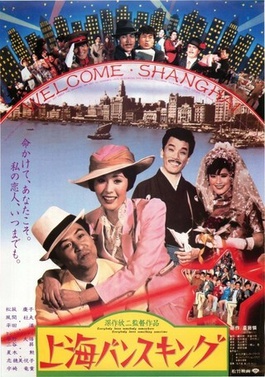
Shanghai Rhapsody (上海バンスキング, Shanhai bansukingu) is a 1984 Japanese musical drama film directed by Kinji Fukasaku, adapted from the 1979 musical of the same name.[1]
Plot
Promising to take his wife Madoka Masaoka on a cruise to France in 1939, Shirō Hatano tricks her into stopping over in Shanghai, where he has plans to get involved in the local jazz scene as a clarinet player together with his friend Wataru Matsumoto, a trumpet player. Matsumoto has become involved with Lily, the former girlfriend of the club owner Larry, who forces Matsumoto, Shirō, Madoka, and Lily to work performing jazz shows at his St. Louis club in exchange for giving up Lily. When Japan invades China, life becomes more complicated and it is no longer possible for Shirō to get work as a jazz performer. Matsumoto is drafted into the military and Shirō turns to alcohol, even selling his clarinet for a bottle of alcohol. Shirō is then persuaded by Hirota, a member of the Japanese Special Service Organization, to begin using opium. Shirō becomes addicted and completely dependent upon the aid of Madoka.
Cast
Other credits
- Art Direction:
- Kyohei Morita
- Yutaka Yokoyama
- Assistant Director: Hideo Nanbu
- Sound recordist: Kazuhisa Takahashi
Production
Keiko Matsuzaka said, “The filming took half a year, and we finally wrapped on September 6, 1984”.[2] It was reported that the Shanghai location shoot was scheduled for July 1984.[3]
Accolades
The film received multiple nominations at the 8th Japan Academy Film Prize, including Director of the Year and Outstanding Performance by an Actress in a Leading Role (Keiko Matsuzaka).[4] It was also nominated for Best Music Score (Nobuyoshi Koshibe), Best Sound (Kazuhisa Takahashi), Best Supporting Actor (Ryûdô Uzaki), and Best Supporting Actress (Etsuko Shihomi).
Kazuhisa Takahashi won the Best Sound Recording award at the 1985 Mainichi Film Concours.
Etsuko Shihomi won the 1985 Yokohama Film Festival Prize for Best Supporting Actress.
References
External links

