| ← Previous revision | Revision as of 03:05, 24 January 2026 | ||
| Line 56: | Line 56: | ||
|
}}
|
}}
|
||
|
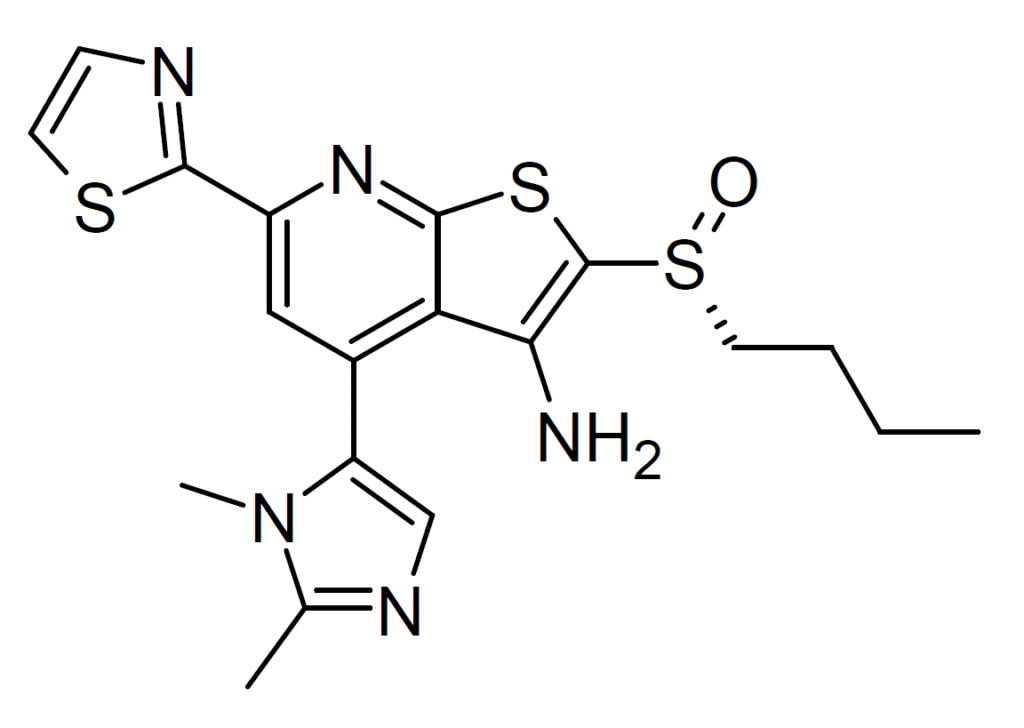
”’SW209415”’ is a drug that acts as a potent inhibitor of the enzyme [[15-hydroxyprostaglandin dehydrogenase (NAD+)|15-hydroxyprostaglandin dehydrogenase]] (15-PGDH), which increases levels of [[prostaglandin E2]] and promotes tissue regeneration. The (R) or (+) enantiomer is the more active. It has slightly lower potency ”in vitro” than the earlier and better studied related compound [[SW033291]], but its solubility is far higher and its pharmacokinetic properties and bioavailability significantly improved, making it more suitable for development for potential clinical applications. It is being researched for improved healing of [[broken bone]]s and accelerating recovery from [[bone marrow transplant]].<ref>Desai A, Zhang Y, Park Y, Dawson DM, Larusch GA, Kasturi L, Wald D, Ready JM, Gerson SL, Markowitz SD. A second-generation 15-PGDH inhibitor promotes bone marrow transplant recovery independently of age, transplant dose and granulocyte colony-stimulating factor support. ”Haematologica”. 2018 Jun;103(6):1054-1064. {{doi|10.3324/haematol.2017.178376}} {{pmid|29472361}}</ref><ref>Cheng H, Huang H, Guo Z, Chang Y, Li Z. Role of prostaglandin E2 in tissue repair and regeneration. ”Theranostics”. 2021 Aug 13;11(18):8836-8854. {{doi|10.7150/thno.63396}} {{pmid|34522214}}</ref><ref>Huang W, Li H, Kiselar J, Fink SP, Regmi S, Day A, Yuan Y, Chance M, Ready JM, Markowitz SD, Taylor DJ. Small molecule inhibitors of 15-PGDH exploit a physiologic induced-fit closing system. ”Nat Commun”. 2023 Feb 11;14(1):784. {{doi|10.1038/s41467-023-36463-7}} {{pmid|36774348}}</ref>
|
”’SW209415”’ is a drug that acts as a potent inhibitor of the enzyme [[15-hydroxyprostaglandin dehydrogenase (NAD+)|15-hydroxyprostaglandin dehydrogenase]] (15-PGDH), which increases levels of [[prostaglandin E2]] and promotes tissue regeneration. The (R) or (+) enantiomer is the more active. It has slightly lower potency ”in vitro” than the earlier and better studied related compound [[SW033291]], but its solubility is far higher and its pharmacokinetic properties and bioavailability significantly improved, making it more suitable for development for potential clinical applications. It is being researched for improved healing of [[broken bone]]s and accelerating recovery from [[bone marrow transplant]].<ref>Desai A, Zhang Y, Park Y, Dawson DM, Larusch GA, Kasturi L, Wald D, Ready JM, Gerson SL, Markowitz SD. A second-generation 15-PGDH inhibitor promotes bone marrow transplant recovery independently of age, transplant dose and granulocyte colony-stimulating factor support. ”Haematologica”. 2018 Jun;103(6):1054-1064. {{doi|10.3324/haematol.2017.178376}} {{pmid|29472361}}</ref><ref>Cheng H, Huang H, Guo Z, Chang Y, Li Z. Role of prostaglandin E2 in tissue repair and regeneration. ”Theranostics”. 2021 Aug 13;11(18):8836-8854. {{doi|10.7150/thno.63396}} {{pmid|34522214}}</ref><ref>Huang W, Li H, Kiselar J, Fink SP, Regmi S, Day A, Yuan Y, Chance M, Ready JM, Markowitz SD, Taylor DJ. Small molecule inhibitors of 15-PGDH exploit a physiologic induced-fit closing system. ”Nat Commun”. 2023 Feb 11;14(1):784. {{doi|10.1038/s41467-023-36463-7}} {{pmid|36774348}}</ref>
|
||
|
== References ==
|
== References ==
|
||
SW209415