


* [[ISO 14064]], an international standard specifying requirements for the quantification, reporting, and verification of greenhouse gas emissions.
* [[ISO 14064]], an international standard specifying requirements for the quantification, reporting, and verification of greenhouse gas emissions.
* [[Life-cycle assessment]] (LCA), which evaluates emissions across all stages of a product’s life cycle, from raw material extraction to end-of-life disposal.
* [[Life-cycle assessment]] (LCA), which evaluates emissions across all stages of a product’s life cycle, from raw material extraction to end-of-life disposal.
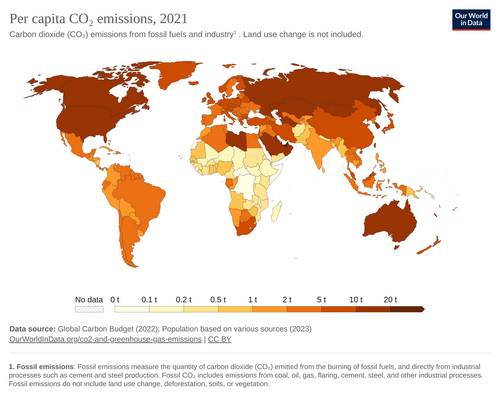
[[File:20210626 Variwide chart of greenhouse gas emissions per capita by country.svg|thumb|left|450px|Greenhouse gas emissions per capita by country (RCraig09, CC BY‑SA 4.0). Source: Wikimedia Commons]]
== Climate-Driven Transformation of Global Trade Rules ==
== Climate-Driven Transformation of Global Trade Rules ==
Carbon Footprint as a Basis for Competitiveness in Global Trade is an encyclopedic article examining the role of carbon footprint in shaping international trade competitiveness and economic policy. It explores methodologies for measuring carbon emissions, regulatory frameworks such as the Carbon Border Adjustment Mechanism, and the implications for firms, countries, and global supply chains.
Introduction
The global trading system has undergone a profound structural transformation over recent decades. International trade is no longer determined solely by price competitiveness, production costs, and product quality. Instead, environmental considerations, particularly those related to climate change, have become central factors shaping the competitiveness of countries and firms. Within this context, the carbon footprint has emerged as a quantitative indicator used to assess the climate impact of goods and services, as well as a regulatory tool that increasingly influences access to global markets.

The carbon footprint refers to the total greenhouse gas emissions generated directly and indirectly by an activity, product, organization, or country. These emissions are typically expressed in carbon dioxide equivalent (CO₂e) and include gases such as carbon dioxide, methane, and nitrous oxide, converted into a common metric based on their global warming potential.
Carbon footprint measurement relies on internationally recognized frameworks and standards, including:
 * Scope 1: Direct emissions.
 * Scope 2: Indirect emissions from purchased electricity and energy.
 * Scope 3: Indirect emissions across the value chain.
- ISO 14064, an international standard specifying requirements for the quantification, reporting, and verification of greenhouse gas emissions.
- Life-cycle assessment (LCA), which evaluates emissions across all stages of a product’s life cycle, from raw material extraction to end-of-life disposal.

Climate-Driven Transformation of Global Trade Rules
Climate Change and International Trade
Growing awareness of climate-related risks has led to the integration of environmental criteria into trade policy. Many advanced economies have begun linking market access to compliance with emissions reduction requirements. This trend has resulted in the emergence of environmental trade measures aimed at preventing carbon leakage and ensuring fair competition between domestic and foreign producers.
Carbon Border Adjustment Mechanism
The Carbon Border Adjustment Mechanism (CBAM), introduced by the European Union, represents a prominent example of this shift. CBAM applies a carbon cost to imports of carbon-intensive goods equivalent to the carbon pricing faced by producers within the EU. The mechanism seeks to protect the competitiveness of low-carbon industries while incentivizing trading partners to adopt low-carbon economy strategies.
Firm-Level Impacts
At the corporate level, carbon footprint performance has become a key determinant of competitiveness. It affects:
- Production costs and pricing strategies.
- Access to environmentally regulated markets.
- Investment decisions by institutions prioritizing sustainable finance and climate risk management.
National-Level Impacts
At the national level, carbon intensity increasingly shapes comparative advantage. Countries with lower carbon intensity are better positioned to maintain export competitiveness, while carbon-intensive economies face higher risks of carbon tariffs and non-tariff barriers.
Global Supply Chains
Carbon footprint requirements have contributed to the restructuring of global supply chains. Multinational corporations increasingly require suppliers to disclose and reduce emissions, particularly under Scope 3 accounting. This has led to:
- Partial reshoring of production.
- Supplier selection based on carbon performance.
- Greater investment in digital tools for emissions tracking and reporting.
Implications for Developing Countries
For developing countries, carbon footprint requirements present both challenges and opportunities. Limited technical capacity and access to finance may constrain compliance. However, alignment with low-carbon standards can facilitate:
Regulatory and Governance Debate
The use of carbon footprint measures in trade policy has sparked debate regarding climate justice and compatibility with World Trade Organization rules, particularly the principle of non-discrimination. International organizations emphasize the need for technical assistance and financial support to ensure an equitable transition toward low-carbon trade systems.
Conclusion
The carbon footprint has evolved from a purely environmental metric into a strategic economic and regulatory instrument shaping global trade competitiveness. As climate policies continue to tighten, effective carbon management is expected to play an increasingly decisive role in determining trade flows, investment patterns, and industrial competitiveness worldwide.
See also
References
Cite error: A list-defined reference has no name (see the help page).



