


= Candidates of the 2026 Thai general election =
= Candidates of the 2026 Thai general election =
The [[2026 Thai general election]] will be held on 8 February to elect 500 seats of the House of Representatives – 400 will be elected from constituency seats and 100 from a party-list. Registration for candidates and political parties seeking to contest seats was open from. By the end of the period, 57 parties were registered. In total, 5,096 individuals registered as candidates with 3,526 seeking to contest constituency seats and 1,570 seeking to contest party-list seats. 93 politicians from 47 parties were also nominated as candidates for Prime Minister. Candidates were allowed to nominate up to 3 candidates for Prime Minister and the Prime Minister can only be elected if they were nominated.<ref>{{Cite news |date=2026-01-21 |title=Thailand’s election in numbers |url=https://www.straitstimes.com/asia/thailands-election-in-numbers |access-date=2026-01-28 |work=The Straits Times |language=en |issn=0585-3923}}</ref>
== Registration ==
== Parties ==
== Parties ==
{| class=”wikitable collapsible sortable” style=”text-align:left”
! {{No.}}
! colspan=”2″ |Name
! Lead candidate
! Candidates
|-
!{{center|1}}
|
|Thai Sub Thawee Party
|Melda Ketwichit
|3
|-
!{{center|2}}
| style=”color:inherit;background:{{party color|Pheu Chart Thai Party}}” |
|{{ill|Pheu Chart Thai Party|th|พรรคเพื่อชาติไทย}}
|Pongthawat Techadetruangkul
|6
|-
!{{center|3}}
| style=”color:inherit;background:{{party color|New Party (Thailand)}}” |
|[[New Party (Thailand)|New Party]]
|Surasit Matchadet
|41
|-
!{{center|4}}
| style=”color:inherit;background:{{party color|New Dimension Party}}” |
|New Dimension Party
|Preecha Khaikaew
|12
|-
!{{center|5}}
| style=”color:inherit;background:{{party color|Thai Ruam Thai Party}}” |
|{{ill|Ruam Jai Thai Party|th|พรรครวมใจไทย}}
|Bunrawee Yomchinda
|12
|-
!{{center|6}}
| style=”color:inherit;background:{{party color|United Thai Nation}}” |
|[[United Thai Nation Party]]
|[[Pirapan Salirathavibhaga]]
|100
|-
!{{center|7}}
| style=”color:inherit;background:{{party color|Movement Party (Thailand)}}” |
|[[Movement Party (Thailand)|Movement Party]]
|[[Kannavee Suebsang]]
|24
|-
!{{center|8}}
| style=”color:inherit;background:{{party color|New Democracy Party (Thailand)}}” |
|[[New Democracy Party (Thailand)|New Democracy Party]]
|Suratin Pichan
|21
|-
!{{center|9}}
| style=”color:inherit;background:{{party color|Pheu Thai Party}}” |
|[[Pheu Thai Party]]
|[[Yodchanan Wongsawat]]
|100
|-
!{{center|10}}
| style=”color:inherit;background:{{party color|New Alternative Party}}” |
|[[New Alternative Party (Thailand)|New Alternative Party]]
|Rachen Tagunviang
|20
|-
!{{center|11}}
| style=”color:inherit;background:{{party color|Economic Party (Thailand)}}” |
|[[Economic Party (Thailand)|Economic Party]]
|Rangsi Kitiyansap
|63
|-
!{{center|12}}
| style=”color:inherit;background:{{party color|Thai Liberal Party}}” |
|[[Thai Liberal Party]]
|[[Sereepisuth Temeeyaves]]
|43
|-
!{{center|13}}
|
|People’s Power Party
|Thanaporn Vaithayanuvat
|10
|-
!{{center|14}}
| style=”color:inherit;background:{{party color|Party of Thai Counties}}” |
|[[Party of Thai Counties]]
|Bancha Dejcharoensirikul
|14
|-
!{{center|15}}
| style=”color:inherit;background:{{party color|Thailand’s Future Party}}” |
|{{ill|Thailand ‘s Future Party|th|พรรคอนาคตไทย}}
|Prawat Thiamkhunthod
|1
|-
!{{center|16}}
| style=”color:inherit;background:{{party color|Power Thai Party}}” |
|Power Thai Party
|Ekawornpong Amnuaysap
|4
|-
!{{center|17}}
| style=”color:inherit;background:{{party color|Thai Chana Party}}” |
|{{ill|Thaichana Party|th|พรรคไทยชนะ}}
|Chakraphong Chinduang
|28
|-
!{{center|18}}
|
|Plung Sungkom Mai Party
|Wichai Rakbida
|4
|-
!{{center|19}}
| style=”color:inherit;background:{{party color|Thai Social Democratic Party}}” |
|[[New Politics Party|Thai Social Democratic Party]]
|Sawit Kaewwan
|8
|-
!{{center|20}}
|
|Fusion Party
|Kittipat Liengprasert
|13
|-
!{{center|21}}
| style=”color:inherit;background:{{party color|Thai Ruam Palang Party}}” |
|[[Thai Ruam Palang Party]]
|Wasawat Puangphonsri
|15
|-
!{{center|22}}
|
|{{ill|Independent Party (Thailand)|lt=Independent Party|th|พรรคก้าวอิสระ}}
|Kochaporn Werojn
|15
|-
!{{center|23}}
| style=”color:inherit;background:{{party color|Thai People Power Party}}” |
|{{ill|Thai People’s Party|th|พรรคปวงชนไทย}}
|Ekasit Kunanantakul
|41
|-
!{{center|24}}
|
|Vision Mai Party
|Thongrob Danampai
|28
|-
!{{center|25}}
|
|Phue Cheevit Mai Party
|Thongprasert Chantharamphon
|4
|-
!{{center|26}}
| style=”color:inherit;background:{{party color|Klong Thai Party}}” |
|Klong Thai Party
|Sayan Intharapak
|16
|-
!{{center|27}}
| style=”color:inherit;background:{{party color|Democrat Party (Thailand)}}” |
|[[Democrat Party (Thailand)|Democrat Party]]
|[[Abhisit Vejjajiva]]
|98
|-
!{{center|28}}
| style=”color:inherit;background:{{party color|Thai Progress Party}}” |
|[[Thai Progress Party]]
|Watcharapol Butsomkorn
|14
|-
!{{center|29}}
| style=”color:inherit;background:{{party color|Thai Pakdee Party}}” |
|[[Thai Pakdee Party]]
|[[Warong Detkitvikrom]]
|24
|-
!{{center|30}}
| style=”color:inherit;background:{{party color|Nation Building Labour Party}}” |
|Nation Building Labour Party
|Manas Kosol
|16
|-
!{{center|31}}
| style=”color:inherit;background:{{party color|Thai Citizen Party}}” |
|[[Thai Citizen Party]]
|Kanisorn Sommaluan
|18
|-
!{{center|32}}
| style=”color:inherit;background:{{party color|Thai Teachers for People Party}}” |
|[[Thai Teachers for People Party]]
|Prida Boonphleung
|22
|-
!{{center|33}}
|style=”color:inherit;background:{{party color|Prachachart Party}}” |
|[[Prachachart Party]]
|[[Tawee Sodsong]]
|37
|-
!{{center|34}}
|
|{{ill|Futurise Thailand Party|th|พรรคสร้างอนาคตไทย}}
|Wirach Witoonthien
|10
|-
!{{center|35}}
| style=”color:inherit;background:{{party color|Palang Thai Rak Chart Party}}” |
|Rak Chart Party
|Jetsada Tonawanik
|25
|-
!{{center|36}}
| style=”color:inherit;background:{{party color|Thai Prompt Party}}” |
|{{ill|Thai Prompt Party|th|พรรคไทยพร้อม}}
|Suphongphit Roongpao
|10
|-
!{{center|37}}
| style=”color:inherit;background:{{party color|Bhumjaithai Party}}” |
|[[Bhumjaithai Party]]
|[[Anutin Charnvirakul]]
|98
|-
!{{center|38}}
| style=”color:inherit;background:{{party color|New Palangdharma Party}}” |
|[[New Palangdharma Party]]
|Ravee Maschamadol
|5
|-
!{{center|39}}
| style=”color:inherit;background:{{party color|Green Party (Thailand)}}” |
|{{ill|Green Party (Thailand)|lt=Green Party|th|พรรคกรีน (ประเทศไทย)}}
|Arun Kongcharoen
|12
|-
!{{center|40}}
| style=”color:inherit;background:{{party color|Thai Morality Party}}” |
|Thai Morality Party
|Supisarn Pakdeenarunath
|8
|-
!{{center|41}}
| style=”color:inherit;background:{{party color|Land of Dharma Party}}” |
|The Land of Dharma Party
|Boonyatelert Sara
|9
|-
!{{center|42}}
|style=”color:inherit;background:{{party color|Kla Tham Party}}” |
|[[Kla Tham Party]]
|[[Thamanat Prompow]]
|100
|-
!{{center|43}}
| style=”color:inherit;background:{{party color|Palang Pracharath Party}}” |
|[[Palang Pracharath Party]]
|[[Trinuch Thienthong]]
|35
|-
!{{center|44}}
| style=”color:inherit;background:{{party color|New Opportunity Party}}” |
|{{ill|New Opportunity Party|th|พรรคโอกาสใหม่}}
|[[Jatuporn Buruspat]]
|33
|-
!{{center|45}}
| style=”color:inherit;background:{{party color|Fair Party (Thailand)}}” |
||[[Fair Party (Thailand)|Fair Party]]
|Pitipong Temcharoen
|23
|-
!{{center|46}}
|style=”color:inherit;background:{{party color|People’s Party (Thailand, 2024)}}” |
|[[People’s Party (Thailand, 2024)|People’s Party]]
|[[Natthaphong Ruengpanyawut]]
|99
|-
!{{center|47}}
|style=”color:inherit;background:{{party color|Thai Population Party}}” |
|Thai Population Party
|Boonyong Chansang
|9
|-
!{{center|48}}
|style=”color:inherit;background:{{party color|Thai Sang Thai Party}}” |
|[[Thai Sang Thai Party]]
|[[Sudarat Keyuraphan]]
|79
|-
!{{center|49}}
| style=”color:inherit;background:{{party color|Thai Kao Mai Party}}” |
|[[Thai Kao Mai Party]]
|[[Suchatvee Suwansawat]]
|60
|-
!{{center|50}}
|
|The Nation Thai’s People Volunteer Party
|Jiradech Prommana
|3
|-
!{{center|51}}
|
|{{ill|Promp Party|th|พรรคพร้อม}}
|Pichcha Khamsuwann
|9
|-
!{{center|52}}
|
|{{ill|The Farmer Network of Thailand Party|th|พรรคเครือข่ายชาวนาแห่งประเทศไทย}}
|Wachira Supharam
|6
|-
!{{center|53}}
|
|Thai Pitak Tham Party
|Phakchanok Thapthiang
|10
|-
!{{center|54}}
| style=”color:inherit;background:{{party color|New Aspiration Party}}” |
|[[New Aspiration Party]]
|[[Chingchai Mongkoltham]]
|8
|-
!{{center|55}}
| style=”color:inherit;background:{{party color|Thai Ruam Thai Party}}” |
|Thai Ruam Thai Party
|Sopon Somprasong Beaudoin
|4
|-
!{{center|56}}
|
|Party For The Country
|Prasop Busarakam
|44
|-
!{{center|57}}
| style=”color:inherit;background:{{party color|
Palang Thai Rak Chart Party}}” |
|Palang Thai Rak Chart Party
|Nares Inthaprom
|2
|}
== Prime Ministerial candidates ==
== Prime Ministerial candidates ==
Russian-Soviet writer (1896 – 1986)
The Battle of Nong Sarai was a Siamese (Thai) victory against the Burmese in 1593, which led to the end of the 1584-1593 Burmese-Siamese War and Siamese independence from Burmese vassalage. The battle is most famous for a supposed elephant duel where Naresuan, King of Ayutthaya, slain Mingyi Swa, heir (uparaja) to the Burmese throne. Due to limited sources and evidence, many details of the battle are uncertain – such as where it occurred – and the authenticity of many accounts have been questioned by historians.
In the Burmese-Siamese War of 1563-1564, King Bayinnaung of the Toungoo dynasty of Burma attempted to force the neighbouring Kingdom of Ayutthaya into submission. The Siamese surrendered when the Burmese laid siege to Ayutthaya, their capital city, and entered a period of vassalage to Burma. Siam’s vassalage was confirmed following the fall of Ayutthaya in the Burmese-Siamese War of 1568-1569. Prince Naret (who later became known as Naresuan) was forcibly sent to Burma as a royal hostage following the 1563-1564 war. By 1571, he was returned to Ayutthaya where he organised a rebellion against the Burmese and became King in 1590.[1]
It has been proposed that the exact location of where the Battle of Nong Sarai took place was either in modern-day Suphanburi or Kanchanaburi provinces. Siamese documents that may have revealed the battle’s location were destroyed in the 1767 sack of Ayutthaya by the Burmese. Prince Damrong Rajanubhap, a Siamese historian and half-brother of King Chulalongkorn, led the first major effort to locate where the battle occurred. Relying on reconstructed Siamese chronicles, he became certain that Naresuan had constructed a stupa at the battle’s location, inspired by the large stupa created by King Dutugamunu of Anuradhapura to commemorate his victory against King Ellalan in Sri Lanka. Damrong’s search for the stupa was confined to Kanchanaburi and Suphanburi provinces. In 1913, he concluded that the ruins of stupa in Suphanburi was Naresuan’s stupa. In 1935, the Fine Arts Department registered the Suphanburi stupa as the place where the battle had occurred.[1]
In the late 1960s, village headman (kamnan) Chup Buyachoawonsa began claiming that the Governor of Kanchanaburi never actually searched for the stupa in the province and fabricated his report to Damrong as any search would be tiresome. In 1972, a group of publishers, writers and researchers presented evidence that the battle occurred in Kanchanaburi. The Fine Arts Department established a committee that found in 1975 that the battle did happen in Suphanburi and the supposed stupa in Kanchanaburi was built about a century after the Naresuan’s reign. The pro-Suphanburi view additionally had the support of Damrong, who was vehemently defended by royalists who viewed any doubts as tantamount to lèse-majesté. For the pro-Kanchanaburi view, they presented evidence that the stupa was actually from the Dvaravati period alongside marching distance calculations that favoured Kanchanaburi. In 1988, the Fine Arts Department stated that there was little evidence the battle occurred at the Suphanburi stupa and the Kanchanaburi stupa was from the Dvaravati period.[1]
Around the 1970s, the emergence of a no-stupa hypothesis argued that Naresuam did not construct a stupa to commemorate the battle. Piset Jiajantrapong was an early proponent of this theory and wrote an article describing it published in Arts & Culture in 1973. Piset argued that there was no knowledge of a stupa before Damrong, the construction of a stand alone stupa as a commemoration would have been unusual, and no Siamese chronicle made reference to a stupa. Following the sack of Ayutthaya, reconstructed documents were significantly inspired by Sri Lankan Buddhist chronicles. In 1982, Srisak Walliphokom argued that Damrong had also wrongly claimed that a stupa in Sukhothai was a monument to an elephant duel won by King Ram Khamhaeng. In 1994, historian Tepmonthri Limpapayom proposed another theory that the battle took place at Wat Pukao Tong near Ayutthaya based off evidence written by German doctor in Siam eighty years after the battle had occurred. Tepmonthri’s claim was widely dismissed.[1]
Accounts of the battle
[edit]
Questioning of the authenticity of traditional Thai accounts have led to people facing lèse-majesté charges. At a university seminar in 2014, Sulak Sivaraksa questioned the authenticity of the elephant duel and was subsequently charged by police for lèse-majesté. The charges were revived in 2017.[2]
European and Persian accounts
[edit]
Literature and poetry
[edit]

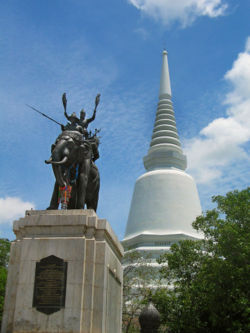
In 1914, Damrong accompanied King Vajiravudh to the ruins of a stupa Damrong had identified as the stupa Naresuan built to commemorate the battle. A royal ceremony was then performed to consecrate the stupa. Damrong conceived the idea of constructing a monument at this site to honour the battle. A monument and large community complex commemorating the battle was later constructed by the government of Prime Minister Plaek Phibunsongkram and opened on 25 January 1959 in Suphanburi province. Revised plans for a monument were developed in 1950 and the project was approved in 1952. The monument depicts Naresuan and Mingyi Swa mounted on elephants during their duel. The surrounding complex included a Buddhist stupa that claimed to have been built on the original stupa Naresuan built to commemorate the battle, a wat, a primary and secondary school, as well as roads connecting the isolated area to nearby cities. The opening ceremony was led by King Bhumibol Adulyadej.[1]
Following the construction of the Suphanburi monument, the authenticity of the site was questioned as some believed the actual battle and original stupa were located in Kanchanaburi province, about 85 kilometres (53 mi) southwest. A second monument was subsequently began construction in Kanchanaburi province in 1999. The monument marked the 400th anniversary of Naresuan passing through the Three Pagoda Pass to invade Burma via Kanchanaburi and did not openly confront the Suphanburi monument’s claim. It was opened in February 2003 by Crown Prince Vajiralongkorn. However, the monument and museum do subtly claim to the be the site of the Battle of Nong Sarai.[1]
Between 1870 and 1875, a pandemic of smallpox afflicted Europe and killed around 500,000 people. The pandemic originated from France and, because of the movement of infected soldiers during the Franco-Prussian War of 1870-1871, came to spread across Europe.[3]
Smallpox was an infectious disease caused by the Variola virus, and causes in humans the appearance of characteristic fluid-filled blisters with a dent in the centre that follow the beginning of a skin rash. Smallpox was primarily an airborne disease that was transmitted by prolonged face-to-face contact.[4] Unlike typical smallpox, the variety that caused the pandemic had a higher frequency of malignant and haemorrhagic cases.[5] It also had a far higher mortality rate.
By the time the 1870-1875 pandemic began, vaccinations for smallpox had already been invented and were in use. However, these vaccines were of poor quality and only provided immunity for a few years. To remain immunised, revaccinations at regular intervals would have to be carried out. So although almost 93% of the 115,000 recruits in the French army were vaccinated in 1869, only around a half had an active immunity to smallpox.[4] In 1868, the number of smallpox cases in the army was three times greater than what it was in 1867. According to medical historian Friedrich Prinzing, only 59% of French infants born between 1860 and 1869 were vaccinated against smallpox. By 1870 when war with Prussia began, a third of the French population had not received any smallpox vaccinations, with Averyron and Corsica having the lowest vaccinated populations at only one fifth.[5]
Smallpox had already been an epidemic in Paris since 1865, causing on average around 700 deaths per year.[4] For the years between 1860 and 1869, monthly smallpox deaths were always below 100 except for October 1861 and the winter of 1865 and 1866. In October 1869, Paris recorded 39 deaths, rising to 93 in November and 113 in December.[5] The French philosopher and science historian Gérard Jorland wrote in 2011 that the pandemic was the result of the smallpox that had been affecting Paris since 1865 becoming more virulent and severe from December 1869, spreading then to the rest of France.[4] From Paris, the pandemic managed to spread across all of France by the end of 1870. Between December 1869 and July 1870, the outbreak caused the deaths of 4,200 people in France. In the first months of 1870, large cities became major centres for infection, especially Bordeaux, Bourges, Lyon and Orléans. In June and July 1870, Bordeaux recorded a daily death rate of 9 to 10 people from smallpox. By the time war with Prussia began, the worst affected departments were Ardèche, Haute-Saône, Ille-et-Vilaine, Morbihan, Nièvre, and Vaucluse.[5]
Its spread prompted 200 to 500 doctors from across France to attend the first medical conference, convened in Paris to study and combat the outbreak. The conference spanned six sessions between 25 May and 29 June 1870.[4]
During the Franco-Prussian War
[edit]

The beginning of the Franco-Prussian War on 19 July 1870 only worsened the pandemic. In Metz, near the German border, the garrison there produced a much larger number of smallpox victims than it usually did. At the beginning of the war, the French army was organised into three groups: the active army, reserve and mobile guard. The mobile guard were deployed along borders, coasts and other strongholds in case of war. They, however, became the main vector for the pandemic in the war as they were often transported around. Combined with the concentration of soldiers in particular areas, the pandemic became more severe.[4] Additionally, new recruits were not vaccinated due to a lack of time. Of the 600,000 French soldiers mobilised in 1870 and 1871, 125,000 of them became infected and 23,470 later died at a fatality rate of 18.7%. In contrast, the pandemic was less severe on the Prussian army who suffered a fatality rate of 5.43%.[5]
During the war, the army stationed in Paris was the most severely affected. Outside of Paris, the main centres in the north were Chatres, Le Mans and Orleans. In the south, it were the fortresses at Belfort and Langres, and the cities of Besançon, Dijon, and Pontarlier. At Bicêtre on the outskirts of Paris, about 7,000 soldiers were admitted to the hospital because of smallpox. Although smallpox patients at Bicêtre had a fatality rate of 14.6%, France’s civilian population was worse at 19%. During the Siege of Paris from September 1870 to January 1871, the fatality rate grew to 35%. The lower fatality rate amongst soldiers was attributed to revaccinations being more common and the soldiers being younger and stronger.[5]
The capture of French soldiers in the war by the Prussians would lead the transmission of the pandemic to Germany. A total of 78 locations formed the interconnected system of Prussian prisoner of war camps in the war, often also attached to an urban city. In East Prussia, French POWs began arriving from 7 August 1870 onwards, leading too the first case appearing among the POWs at the Königsberg camp on August 15. The initial spread in Germany was centred on East Prussia. In the following weeks, POWs became ill in the camps at Custrin, Danzig, Graudenz and Thorn. Around mid-August, the smallpox started appearing in Western Prussia first at Düsseldorf. In September, smallpox appeared at the largest camps across Prussia, including at Cologne, Cosel, Koblenz, Neisee, Posen and Wesel. A great influx of POWs occurred between October 1870 and February 1871 in addition to the transfer of POWs from one camp to another, mainly POWs captured from the earlier stages being moved east.[6]
French soldiers fleeing to Belgium, Switzerland and Italy helped spread the pandemic to those countries.[7]
From French POWs, smallpox was spread to German civilians. By 3 September 1870, smallpox appeared first amongst the civilian population of Königsberg.[6] During the entire pandemic, Hamburg had the worst mortality rate in Germany at 15.4 deaths per 1000 inhabitants. In the years prior, Hamburg had not suffered a major outbreak of smallpox in the 1800s prior to the 1870-1875 pandemic. Hamburg’s medical board was also initially reluctant to take much notice of the outbreak. By June 1871, 900 Hamburgers had died to smallpox. In total, 4,053 people in Hamburg died to the pandemic in 1871 – making it Hamburg’s deadliest pandemic in the 19th century and being responsible for 29% of the city’s deaths in 1871. The reason for the pandemic hitting Hamburg so hard was largely blamed on the city’s inaction to introduce mandatory vaccinations. Although Berlin suffered a higher death toll at 5,216 deaths in 1871 and 1,198 deaths in 1872, it only reached a mortality rate of 6.3 deaths per 100. Danzig had the second worst mortality rate. As was typical for smallpox, the very young and old were most at risk.[8]

In the United Kingdom
[edit]
An official report into the epidemic in the United Kingdom (UK) issued by the Medical Officer of the Local Government Board in 1876 defined the epidemic as lasting between 1871 and 1873 within the UK.[3] Prior to smallpox cases reaching a considerable proportion in the last quarter of 1871 as a result of an influx of French refugees, a gradual increase in cases had occurred since the end of 1869. William Munk and J.F. Marson, who were working at the Highgate Smallpox Hospital, considered that the epidemic began in November 1869.[5]
Initially, the epidemic was confined to London and Liverpool. In London, weekly deaths from smallpox rose from 2 around April to 110 by the end of December 1870. About 879 to 1,229 deaths from smallpox occurred in both cities by the end of 1870. In London, new hospitals for smallpox patients were opened such as the Hampstead Smallpox Hospital, the Fulham Smallpox Hospital and the Stockwell Hospital. About 16,000 patients were admitted to hospitals in London during the epidemic and 10,841 died between 1870 and 1874. Deaths in London peaked in May 1871. For both unvaccinated and vaccinated patients, the mortality rate was higher in hospitals than private care.[5]
Smallpox was then spread to South Wales and the mining districts of North England. In 1871 the epidemic rapidly spread across the UK and by mid-1871 almost every registration district in England and Wales was infected. Deaths in England and Wales peaked at 7,720 in the first quarter of 1872 before declining. In the last quarter of 1873, only 277 deaths were registered. In total, 69,018 people died from smallpox in England and Wales between 1870 and 1874. The Northern division (Cumberland, Durham, Northumberland and Westmorland) had the worst mortality rate at 2.36 per thousand, followed by London at 1.48. Sunderland had the worst mortality rate of any town at 8.6 per thousand.[5]
The epidemic was less severe in Scotland and Ireland than in Wales and England. The epidemic reached Scotland in 1871 and caused 6,262 deaths between 1871 and 1874. Edinburgh was the worst affected city. In Ireland, the epidemic appeared around mid-1871 and lasted up to 1873. A total of 4,292 deaths occurred and peaked in 1872. For Cork, the death rate was 9.6 per thousand – a rate higher than any large town in England and worst than Sunderland. The fatality rate in Irish hospitals was also higher than London hospitals. Although the epidemic in the UK was one of the most severe outbreaks, it did not reach the same level of deaths as outbreaks prior to vaccinations. Additionally, the UK had one of the lowest mortality rate when compared to other affected European countries. This was attributed to the 1853 Vaccination Act having introduced compulsory smallpox vaccinations prior to the epidemic.[5]
In Belgium and the Netherlands
[edit]
In Italy and Switzerland
[edit]
French doctor Georges Borne estimated in 1914 that during between 1870 and 1871, France suffered 220,000 cases of smallpox and 60,000 deaths. Additionally, 24,603 patients were left either disfigured or disabled. Borne, however, suggests that these numbers may be less than what they were.[9] Another estimate puts the number of deaths in France to 89,954, although that too is also probably an understatement. During the same period, Paris was recorded having 10,331 smallpox deaths with 1,158 of those deaths being children under one year of age.[5]
In Germany, the pandemic caused 180,000 deaths between 1870 and 1873.[10] 125,000 of those deaths originated from Prussia – Germany’s largest and most populated kingdom.
Unlike Germany who introduced mandatory smallpox vaccinations in 1874, France made vaccinations compulsory only in 1902.
In Hamburg, one of Germany’s hardest affected cities, the medical board received extreme criticism from the public for its failure to introduce compulsory smallpox vaccination. Amidst the pandemic, the Senate of Hamburg established 15 vaccination stations by 3 August 1871. In the same year, Hamburg introduced compulsory vaccinations against smallpox and the city never suffered another smallpox pandemic to the same scale as the 1870-1875 pandemic.[8] On 8 April 1874, Reichstag passed the Imperial Vaccination Act, making it compulsory for all children in Germany to receive smallpox vaccinations.[10] Following the act’s passing, the mortality rate of smallpox dramatically dropped in Germany. In Prussia, it recorded a rate of less than 0.05% in 1876 from its normal rate of 0.2% or 0.3% In 1877, only 88 people died from smallpox in Prussia.[8]
Terminology
Epidemic: [3]
Pandemic: [5]
Years cited:
The 2026 Thai general election will be held on 8 February to elect 500 seats of the House of Representatives – 400 will be elected from constituency seats and 100 from a party-list. Registration for candidates and political parties seeking to contest seats was open from. By the end of the period, 57 parties were registered. In total, 5,096 individuals registered as candidates with 3,526 seeking to contest constituency seats and 1,570 seeking to contest party-list seats. 93 politicians from 47 parties were also nominated as candidates for Prime Minister. Candidates were allowed to nominate up to 3 candidates for Prime Minister and the Prime Minister can only be elected if they were nominated.[11]
Prime Ministerial candidates
[edit]
By parliamentary parties
[edit]
By non-parliamentary parties
[edit]
Party-list candidates
[edit]
?
Constituency candidates
[edit]
?
- Evans, Richard J. (1987). Death in Hamburg: society and politics in the cholera years, 1830-1910. Oxford [Oxfordshire] : Clarendon Press ; New York : Oxford University Press. ISBN 978-0-19-822864-6.



