
London boxing club founded in 1891
The National Sporting Club (NSC) was a private members’ sporting club founded in London on 5 March 1891 by John Fleming and Arthur Frederick Bettinson. Operating from premises at 43 King Street, Covent Garden, the club promoted professional boxing in a controlled, members-only environment and became closely associated with the organisation and presentation of elite professional contests in Britain during the late nineteenth and early twentieth centuries.[1][2]
The NSC enforced strict codes of conduct on boxing nights, including formal dress requirements, appointed officials, and the mandatory enforcement of silence during rounds, which contemporaries and later historians identified as central to its claim to authority and respectability.[2][3] In 1909, the club formally adopted standardised weight divisions for British championship contests and introduced the Lonsdale Belt as the principal prize for national titleholders.[4]
The club also played a significant role in the legal toleration of professional boxing in Britain. Following fatalities at contests held under its rules, inquests and court proceedings clarified the distinction between regulated boxing and illegal prize-fighting, contributing to the sport’s acceptance as a lawful activity when conducted under recognised rules and supervision.[5][6]
During the early twentieth century, British championship boxing operated within racial restrictions applied through administrative practice rather than formal statute, and eligibility for national titles was effectively limited to white boxers until the abandonment of the colour bar in 1947.[7][8] Alongside boxing, the club also hosted fencing, billiards and wrestling contests, reflecting its identity as a broader sporting and social institution.[1]
Following the establishment of the British Boxing Board of Control (BBBofC) in 1929, formal responsibility for the national governance of professional boxing and for the administration of the Lonsdale Belt passed to the Board, and the NSC’s role became primarily promotional.[9][10] The club ceased operating from its Covent Garden premises in 1929 and the original National Sporting Club Ltd. (“Old Company”) entered voluntary liquidation in 1930.[11] Later organisations adopted the National Sporting Club name for promotional and social purposes and were described in period sources as distinct from the pre-1929 institution.[12][13]
The NSC was founded on 5 March 1891 by John Fleming and Arthur Frederick Bettinson. The concept for the club was reportedly formed during a train journey between Sunbury and Waterloo, where Fleming, previously the boxing manager of the Pelican Club, proposed a new venue devoted entirely to boxing, with Bettinson providing the initial capital.[14] Following Fleming’s death on the club’s premises on 15 November 1897, Bettinson emerged as the central figure in the club’s management and public identity, a position he retained for the next three decades.[15][16]
The club was established with the explicit aim of reforming professional boxing. Writing retrospectively, Bettinson stated that the NSC was intended to rescue the sport “from the gutter” and the “pub,” separating it from the disorderly environment of earlier prize-fighting.[4] To achieve this, the founders conceived the club as a strictly private institution with a strong emphasis on decorum. This structure was designed to place boxing on a secure social footing, avoiding the “scandals” and legal difficulties that had plagued its predecessors.[4]
The establishment of the NSC followed the decline of the Pelican Club in Gerrard Street, which had attracted aristocratic patronage but became associated with gambling and disorder. Legal action by residents and public criticism contributed to its closure in the early 1890s. Press commentary suggested that the NSC was deliberately organised to avoid the perceived excesses of such predecessors.[17][18]
Although associated with the club from an early stage, Hugh Lowther, 5th Earl of Lonsdale, did not formally accept the position of president until 1902. While he accepted the title, historian Guy Deghy notes that Lonsdale initially “remained aloof” from the club’s social activities, which were more middle-class than the bohemian aristocracy of the Pelican Club.[14]
Despite its prestigious membership, the club’s early finances were fragile. The premises were furnished entirely on the hire-purchase system, with monthly instalments exceeding expected income. Consequently, the club narrowly avoided insolvency in its first year, surviving only through a private donation from the founder member Charles Blacklock.[14]

The NSC occupied 43 King Street, Covent Garden, a building now Grade II* listed, constructed in 1716–1717 for Edward Russell, 1st Earl of Orford.[19][20] The design is attributed on stylistic grounds to the Baroque architect Thomas Archer.[19] Before the NSC’s tenancy, the building had housed Evans’s Supper Rooms, a well-known song-and-supper venue which closed in 1880, followed by the Falstaff Club (1882) and the New Club (1884), short-lived proprietary clubs that had established the venue’s association with aristocratic entertainment.[19] The building’s Grade II* listing reflects both its early eighteenth-century architectural significance and its later cultural importance as a centre of elite social and sporting life.[20]
Bettinson also stressed the symbolic importance of the club’s location, noting that the selection of a long-established West End venue associated with elite dining and entertainment was intended to reinforce the club’s social respectability. By situating professional boxing within a building already identified with fashionable society, the founders sought to distinguish the NSC from earlier prize-fighting venues and to align the sport with established patterns of gentlemanly club life.[21]
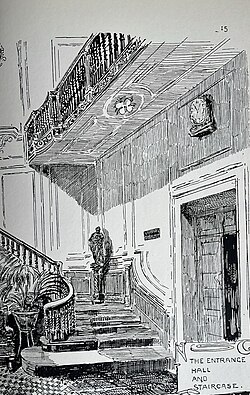
The NSC acquired the lease and reopened the venue on 5 March 1891.[19] Although the interior refurbishment attracted favourable comment, later accounts noted that the furniture was, at the time of the reopening, officially still the property of the hire-purchase store.[22] The opening night was attended by “Corinthian London,” who inspected the refurbished “Temple of Sport,” which featured a staircase from the HMS Britannia and a room dedicated to “Old London” relics.[1][23]
The club’s layout utilised the existing architecture to separate social and sporting functions. Members dined in the original house fronting King Street, while contests were held in a large hall at the rear, added to the building in 1855 by the architect W. Finch Hill.[19] This hall, often referred to as the “theatre”, featured a gallery, a raked floor designed to ensure uninterrupted views of the ring and a high coved ceiling with compartments containing ventilation grilles and gas-lit lustres.[24]
In a contemporary account written in 1902, the club’s manager Arthur Frederick Bettinson described the King Street premises as deliberately arranged to maintain clear authority over proceedings on boxing nights. He emphasised that the physical separation between dining rooms and the boxing hall, together with the enclosed design of the theatre and its controlled points of access, enabled officials to supervise both boxers and spectators closely. Bettinson presented the layout of the premises as an essential feature of the club’s identity as a private sporting institution rather than a public entertainment venue.[25]
In the summer of 1922, the club purchased the freehold of the King Street building.[26] By this time, the limited capacity of the theatre was increasingly inadequate for major international contests, leading the club to acquire the Holland Park Rink as an annexe for staging world championship bouts.[27] Despite this expansion, the King Street premises retained their symbolic importance, with the club’s vestibule serving as a hall of fame in which the names of Lonsdale Belt holders were inscribed in letters of gold.[28]
Rules and organisation
[edit]

The club operated under strict internal regulations governing both boxers and spectators. To align the club with the norms of West End society, a strict requirement for formal evening dress was enforced for all members.[29] Referees and timekeepers were appointed by the committee, and contests were overseen closely by club officials, reinforcing the club’s emphasis on discipline and controlled conduct.[30] To further ensure order, the club limited boxers to two seconds in the ring.
The club’s insistence on silence during contests was rigorously enforced by its early co-manager, John Fleming. Accounts at the time describe Fleming halting bouts to demand complete quiet and, on one occasion, ordering members and guests to “extinguish their Havanas” before proceedings could continue.[31] Writing in 1902, Arthur Frederick Bettinson argued that silence was essential to ensure that bouts were judged solely on skill and conduct, free from crowd influence, and described its enforcement as fundamental to the club’s claim to authority over professional boxing.[32]
By early 1909, the question of championship weight divisions had become a subject of sustained public and specialist debate. In January of that year, the sporting press reported that the NSC had formally taken up the issue of weight classifications and championship conditions.[33] As part of this effort to impose technical clarity, the club revised its rules to address perceived loopholes in earlier regulations, specifically instituting safeguards against “holding and hitting” to prevent the prolonged clinching that had characterised the original Queensberry framework.[34]
Referees associated with the club included Eugene Corri, an original member who became one of the most prominent officials in British boxing during the early twentieth century.[35] Corri officiated regularly at NSC contests and has been credited with popularising the practice of refereeing from inside the ring rather than from a chair outside the ropes.[35][36] The club was also instrumental in consolidating officiating authority. Reports from the time describe the replacement of the earlier practice of using two referees with a single official appointed by the NSC, a change associated with referees such as B. J. Angle, John H. Douglas and Eugene Corri.[31]

The governance of the NSC has been characterised by historians as intentionally uncompromising. Deghy notes that Bettinson and Fleming “arrogated dictatorial rights” over the sport, establishing a system where the club’s word was law—a style of management Deghy elsewhere termed a “rough-and-ready patriarchy”.[31] Bettinson defended this authoritarian approach as necessary to separate boxing from its disorderly past, arguing that the sport required absolute discipline to maintain its social legitimacy.[31]
While the NSC exercised significant influence over professional boxing within Britain, historians have noted that its regulatory authority was practical rather than statutory. The club enforced standards through custom, precedent and control over elite contests rather than through formal legal power. As a result, the NSC functioned as a national regulatory centre within a loosely connected transnational boxing world rather than as an international governing authority.[37]
Membership, governance and legal status
[edit]
The NSC operated as a private members’ institution, with access restricted to members and their guests. Historian Andrew Horrall notes that this strict privacy was strategic: given the “uncertain legal status” of prize-fighting, operating as a private venue allowed the club to be “tolerated by the local magistracy” where a public venue might have faced immediate police intervention.[38] Admission was typically controlled through a ticket system issued by members, who remained responsible for their guests’ conduct and expenses. Contemporary notices posted within the club stated that only members were entitled to be served refreshments, reflecting the committee’s efforts to distinguish the club from public houses and commercial entertainment venues.[39]
The NSC was incorporated in 1891 as the National Sporting Club Limited. While nominally managed by a committee, the club was effectively controlled by its manager, A.F. “Peggy” Bettinson, whose capital had underwritten the venture and who, according to Horrall, “ruled the club as an opinionated, outspoken patriarch” for over thirty years.[38] This corporate structure became the focus of legal scrutiny in the late 1890s, when the Inland Revenue initiated proceedings against the club for supplying alcohol without a licence.[39]
The prosecution arose from a covert operation on 24 April 1899, described by Bettinson as a “charade” in which two Excise officers disguised as masqueraders entered the club and successfully ordered “a Gin and Soda and a bottle of Bass” to establish proof of sale.[40] In July 1899, evidence presented at Bow Street Police Court described the club’s admission procedures and refreshment service, and the case was adjourned following argument that the supply of alcohol to members did not constitute retail sale within the meaning of licensing legislation.[39]
The matter was determined by the High Court in the case of National Sporting Club, Limited v. Cope (1900). Bettinson attributed the club’s defeat to a “technical slip” in the Articles of Association. While the defence argued that the club was simply distributing property to its own members, the court found that because some original shareholders had died or resigned, the “Company” was no longer identical to the “Club” membership.[41] Consequently, the transaction was ruled a retail sale requiring a licence. The club was ordered to pay costs totaling £500, a verdict Bettinson wryly described as a case of “Law triumphant, and Common Sense prostrate”.[41] Later legal commentary cited the decision as illustrative of the wider principle that incorporation altered the legal relationship between clubs and their members, exposing them to statutory licensing requirements.[42]
A more significant test of the club’s sporting legality occurred in 1901, following the death of the boxer Murray Livingstone (fighting under the alias “Billy Smith”). The Crown prosecuted the directors for manslaughter in the case of Rex v. Roberts and Others.[43] The defence argued that the contest was a test of skill conducted under strict rules rather than a fight to the finish; witnesses including the Earl of Lonsdale testified that the club’s regulations were designed “to minimize danger and to increase science”.[43] The jury returned a verdict of not guilty, a decision which established that a boxing contest conducted under the Queensberry Rules was legal provided the intent was not to inflict serious injury.[43]

Boxing exhibitions and contests formed the core of the club’s activities, with its directors acting as a “de facto national supervisory agency” for the sport.[38] The NSC hosted bouts involving many leading fighters of the period, including championship-level contests and exhibition matches featuring prominent professionals. Reports consistently emphasised the unusually orderly conduct of audiences and the comfort of the surroundings, even when large crowds were present.[30]
Writing retrospectively, Deghy described the club’s programme as consciously privileging defensive skill, balance and technical precision over aggressive infighting, a preference that shaped both the selection of boxers and the conduct of contests.[44]
Notable contests and landmark events
[edit]

The bout between Peter Jackson and Frank Slavin on 30 May 1892 has been described by historians as a turning point in the establishment of boxing as a respectable professional sport in Britain. Staged under the NSC’s strict regulations and conducted before a silent, socially elite audience, the contest demonstrated that heavyweight boxing could be presented as a disciplined and technical athletic display rather than an illegal or disorderly prize-fight. Contemporary observers praised the scientific skill and controlled conduct of the boxers, while later historians have identified the fight as instrumental in establishing the NSC’s reputation and in reshaping public perceptions of the sport.[45][46][47]
The bantamweight Pedlar Palmer was among the most prominent boxers associated with the club during the 1890s. Contemporary accounts record that he first appeared at the NSC in February 1893, and that in November 1895 he defeated Billy Plimmer in a bout recognised at the time as the English bantamweight championship. Palmer’s technical, defensive style exemplified the form of “scientific” boxing favoured by the club’s membership, and his contests at the NSC attracted sustained attention from the sporting press.[48]
The club’s preference for “scientific” boxing was most closely associated with the Welsh featherweight Jim Driscoll. Driscoll fought regularly at the NSC between 1907 and 1919, and his technical style was widely regarded as an ideal expression of the “noble art”, contrasting with the more aggressive infighting styles commonly attributed to American prize-fighting of the period.[49][50][51] His British title defence against Spike Robson at the club in January 1911 has been cited by historians as a definitive exhibition of this approach.[52]
In December 1913, the club hosted a highly anticipated contest between the French light-heavyweight Georges Carpentier and the British heavyweight Billy Wells. Carpentier’s first-round knockout victory attracted considerable press attention and demonstrated the club’s capacity to stage events of international significance, while also exposing the limitations of British heavyweight boxing during the period.[53]
The club also became a venue for high-profile contests, which occasionally attracted members of the royal family. On 31 March 1919, the Prince of Wales attended a fifteen-round bout in which the British flyweight champion Jimmy Wilde defeated the American challenger Joe Lynch on points. Contemporary newspaper reports recorded that the Prince entered the ring after the decision to congratulate both boxers, an episode that attracted prolonged applause and was widely noted as emblematic of boxing’s growing social acceptance in post-war Britain.[54][55]
The death of **Walter Croot** in December 1897 became a consequential test of the NSC’s regulatory model. Croot, a boxer from Leytonstone, fought the American Barry (of Chicago) at the club on 6 December 1897. The contest was stopped in the 19th round, and although Croot walked to his corner, he collapsed shortly afterwards and died without recovering consciousness.[56]
The fatality prompted a “public outcry” and the arrest of club officials, including the manager Arthur Bettinson, who were charged with manslaughter. At the inquest at Bow Street, medical evidence established that Croot’s injury resulted from a fall rather than an illegal blow. The jury returned a verdict of accidental death, a decision Bettinson described as a victory for “Common Sense” which quelled the “hysterical” demands for the sport’s abolition.[56]
Historians have identified the Croot case as a defining moment in the legal toleration of professional boxing in Britain. The proceedings clarified the distinction in English law between illegal prize-fighting and regulated contests conducted under recognised rules and medical supervision, reinforcing the NSC’s position as a legitimate regulatory authority rather than a clandestine promoter of violence.[57]
A similar case arose in January 1900, when boxer Mike Riley collapsed following a bout with Matt Precious at the club and died the following day. Precious, together with club officials including the manager Arthur Frederick Bettinson, was charged with manslaughter and remanded on bail following proceedings at Bow Street.[58] The defendants were subsequently acquitted, with the verdict reinforcing the legal distinction between regulated boxing contests and illegal prize-fighting established in the earlier Croot proceedings.[57]
Broadcasting and media significance
[edit]
The NSC was an early participant in the relationship between boxing and mass media, serving as a venue for both experimental broadcasting and the exhibition of boxing films.[59]
In February 1926, the club arranged an experimental radio broadcast of a flyweight contest between Elky Clark and Kid Socks. The bout was formally listed in the evening’s wireless programmes for 22 February 1926, with a scheduled start time of 9:45 pm.[60] Contemporary discussion of boxing broadcasting described plans to transmit “noises and effects”, such as the sound of the bell and the referee’s count, to enhance the listening experience.[61] However, the transmission was cancelled at short notice after Clark fell ill, and the broadcast did not proceed on that date.[62]
The club had a more established association with cinema. By 1909, the NSC was used for the exhibition of major boxing films, including footage of the world heavyweight championship contest between Jack Johnson and Tommy Burns, reflecting its role as a site for elite and semi-private screenings.[63] During World War I, the club was also involved in arrangements through which boxing contests were filmed for topical newsreels, which were distributed to troops as part of wider efforts to promote morale and physical fitness.[59]

In 1909, Lord Lonsdale, the club’s president, introduced the Lonsdale Belt (originally the Lord Lonsdale Challenge Belt) on behalf of the NSC as a championship prize intended for British titleholders.[64] The initiative was driven by a desire to systematise professional titles; Bettinson recorded that prior to 1909, championships “lacked definiteness,” making it difficult to distinguish legitimate champions from those he termed “hole-and-corner” pretenders.[4]
The NSC’s manager, Bettinson, published the belt’s terms and conditions in Sporting Life in December 1909. These stipulated that the belt could be won outright after three successful victories, making the trophy the boxer’s “own property”.[65][4] Unusually for sporting trophies of the era, the award included a financial annuity to support fighters in retirement; the NSC guaranteed a pension of “one pound a week” to permanent belt holders upon reaching the age of fifty.[4]
The original belts were issued in 1909 for seven weight divisions ranging from flyweight to heavyweight; a trophy for the light-heavyweight class was added later in 1914.[4] The first belt was awarded in November 1909 after Freddie Welsh defeated Johnny Summers for the NSC British lightweight title.[66]
Following the establishment of the British Boxing Board of Control (BBBofC) in 1929, responsibility for the administration and awarding of the Lonsdale Belt was transferred from the NSC to the Board. The belt continued to be awarded under the same basic principles, reinforcing its position as the foremost symbol of British professional championship boxing.[10]
Racial restrictions and the colour bar
[edit]
During the early twentieth century, the NSC operated within a racial framework that reflected wider anxieties surrounding professional boxing in Britain, particularly following the international prominence of Black heavyweight champions. Historians have noted that the club’s attitude marked a shift from its earlier years; in the 1890s, the Black heavyweight Peter Jackson had been a favourite of the membership, described by Bettinson as a man of “unassuming demeanour”.[67] However, regulatory practices hardened in the years preceding the First World War. By 1911, eligibility for British championship contests promoted under the club’s authority was effectively restricted to white boxers.[68]
This exclusion was most visibly codified in the legal deeds for the Lonsdale Belt. While the club continued to stage non-title bouts involving Black boxers—such as “the amazing” Joe Walcott, whom Bettinson praised for his “terrific hitting”—the championship conditions were eventually drafted to stipulate that contestants must be “born of white parents”.[69][8]
Scholars have linked this hardening of policy to the “white hope” reaction against the reign of heavyweight champion Jack Johnson. Although the NSC excluded Johnson from its ring, it continued to profit from his global fame; the club hosted elite, semi-private screenings of the films of Johnson’s victory over Tommy Burns in 1909, separating the visual spectacle of Black success from the physical presence of the boxer.[70]
When a contest was proposed in London between Johnson and British champion Billy Wells in 1911, Home Secretary Winston Churchill declared it illegal on the grounds that it threatened a “breach of the peace”, an intervention connected to wider public unease generated by Johnson’s status.[71] Within this climate, the NSC’s leadership sought to protect boxing’s fragile social legitimacy by strictly limiting interracial competition at the elite domestic level.[8]
The colour bar remained a defining feature of British professional boxing governance for several decades. Later codified as “Rule 24” by the BBBofC, the restriction prevented boxers such as Len Johnson from competing for titles despite their domestic dominance. Although not enshrined in statute, it was reinforced through the control exercised by the NSC and the Board over licensing and championship recognition. The exclusion of boxers of colour from British title contention persisted until the formal abandonment of the colour bar in 1947.[8]
Other sporting activities
[edit]
Although boxing remained its principal focus, the NSC also functioned as a broader sporting and social institution. Alongside its boxing programme, the club hosted musical and dramatic evenings and was contemporaneously characterised as a private, business-like club aimed at a middle-class clientele rather than a purely commercial entertainment venue.[5] Writing in 1902, Arthur Frederick Bettinson described these social events as integral to the club’s identity, noting that evenings were often structured so that boxing or fencing contests were interspersed with musical or dramatic performances. He argued that this arrangement reinforced the club’s character as a private sporting institution rather than a public spectacle and helped cultivate an atmosphere of restraint and sociability among members.[72]
Fencing was a regular feature of the club’s programme during the late nineteenth and early twentieth centuries, and the NSC hosted major competitions organised by the Amateur Fencing Association, including national championship events and exhibition bouts by prominent British and continental fencers. Contemporary press commentary on these championships emphasised the increasing standardisation of judging, refereeing and competitive skill, contrasting the regulated bouts staged at the club with the less structured fencing competitions of earlier years.[73] Bettinson regarded fencing as a natural companion to boxing, arguing that its emphasis on balance, precision and controlled aggression aligned closely with the principles the NSC sought to promote across all its sporting activities.[74]
Other sports also formed part of the club’s life. Contemporary accounts describe the NSC as possessing a dedicated billiards room used for professional matches, exhibition games and organised tournaments, with leading players such as John Roberts Jr. appearing at the club. In January 1900, it staged a professional handicap billiards tournament that attracted significant press attention.[75] Wrestling contests were also held from the club’s foundation, primarily in the catch-as-catch-can and Greco-Roman styles, and were often staged on evenings when boxing was not scheduled.[76]
During the First World War, many British officers who were members of the NSC actively promoted boxing within the British Armed Forces as a means of physical training, discipline, and morale-building.[77] The club’s committee decided to continue operations throughout the conflict, creating what Bettinson termed a “playground for men of the Services” where troops on leave could attend contests.[78] Operations continued even during air raids; the middleweight title fight between Pat O’Keeffe and Bandsman Blake proceeded while bombs fell in the immediate vicinity of Covent Garden, with Bettinson recording that the raid visibly affected Blake’s performance.[79]

Members and associates of the NSC were also involved in wartime voluntary service beyond boxing. Writing retrospectively, Guy Deghy recorded that figures drawn from the club’s social and sporting circles helped to fund and organise the British Sportsmen’s Ambulance Fund, which raised sufficient resources to equip and dispatch a convoy of over fifty motor ambulances to the Western Front.[80] The public profile of the initiative was reinforced by royal patronage: contemporary photographs show Queen Alexandra inspecting the ambulance column, accompanied by Hugh Lowther, 5th Earl of Lonsdale, a prominent patron of boxing and the club’s first president.
Many professional boxers associated with the club enlisted in the armed forces. The middleweight Jerry Delaney trained with the 1st Sportsmen’s Battalion, while the heavyweight “Iron” Hague served in the Grenadier Guards.[81] Bettinson recorded the wartime exploits of several members, including Sergeant Braddock of the Royal Marines, who was awarded the Military Medal for rescuing a wounded comrade under shellfire.[82]
In December 1918, the club’s influence was evident at the British Empire and American Services Boxing Tournament held at the Royal Albert Hall. Contemporary reports noted that this event marked “the first time His Majesty King George accorded [boxing] his patronage”, signaling the sport’s growing social acceptance.[83] The tournament featured prominent National Sporting Club regulars, including heavyweight Billy Wells, who won the King’s Trophy for the British Army, and flyweight Jimmy Wilde, who defeated American future world champion Joe Lynch in the preliminary rounds.[84]
Relationship with the British Boxing Board of Control
[edit]
In 1929, the BBBofC was established as the national governing body for professional boxing in Britain. Its formation marked a transition from the club-based oversight that had characterised elite professional boxing since the 1890s to a centralised system of national governance.[9]
Historians have emphasised that the creation of the Board represented a process of formalisation rather than a sudden break with earlier practice. Many of the conventions adopted by the BBBofC, including the use of standardised rules, the licensing of officials and expectations of orderly conduct by both boxers and spectators, reflected practices that had previously been enforced within the NSC’s private regulatory environment.[9]
Contemporary and later historical analysis stresses that this continuity was personal and procedural rather than institutional.[3]
The BBBofC’s establishment also occurred against a wider international backdrop in which attempts to create supranational systems of professional boxing governance proved difficult to sustain. The failure of the International Boxing Union (IBU), founded in 1913, highlighted the obstacles posed by differing legal frameworks, commercial interests, and national traditions. Within this context, the British model of regulation that emerged from NSC practice was consolidated domestically rather than extended internationally. Historians have noted that figures associated with the NSC were involved in the early administration of the BBBofC, bringing with them experience of regulation and officiating developed during the pre-war period.[85]
Decline and closure of the original club
[edit]
By the late 1920s, the NSC’s long association with its Covent Garden premises was drawing to a close. Contemporary press reporting treated the sale of the club’s building at 43 King Street in October 1929 as a decisive moment, marking the end of the NSC as a fixed physical institution even as its membership and traditions continued in other forms.[12] Reporting confirmed that the freehold of the King Street premises, which had housed the club since 1891, was sold for redevelopment, with the interior to be demolished once boxing secured new headquarters elsewhere, although the historic façade was to be retained.[86]
The loss of the Covent Garden premises was widely linked to changes in the economics of professional boxing. Contemporary commentary observed that the scale of modern purses increasingly required venues capable of accommodating far larger audiences than the NSC’s former private club environment, reducing the viability of King Street as a centre of elite professional boxing.[12]
Despite the closure of its historic headquarters, the NSC continued to operate in a reduced form. In October 1929, the club opened a new season at the Stadium Club in London. Press coverage described the opening programme as weak and attendance as unexpectedly small, reflecting the diminished scale and prestige of the club’s post–King Street operations, while noting that some members remarked upon the absence of the distinctive atmosphere associated with the Covent Garden premises.[87][88]
Personal accounts from this period illustrate the symbolic character of the club’s final months as a central institution. Writing in June 1929, veteran referee Eugene Corri reflected on a testimonial held in his honour at the NSC, contrasting the legally precarious and semi-clandestine status of boxing in his early career with its widespread acceptance by the late 1920s, and observing that he had lived long enough to see the sport “come full into its kingdom”.[89]
By the early 1930s, contemporary press reporting described the NSC as continuing to organise individual contests but no longer operating from a permanent venue or exercising the central regulatory role it had held before 1929.[90] In the later 1930s, the NSC continued to promote major professional contests at large public venues. In February 1937 it staged a heavyweight bout at the Empress Stadium at Earls Court, where Jack Doyle defeated the Dutch heavyweight champion Harry Staal before a crowd reported at around 10,000 spectators.[91]
By November 1930, The London Gazette carried a formal notice to creditors stating that National Sporting Club Ltd. (Old Company) was being wound up voluntarily. The notice identified L. F. Bettinson and T. Howard Head as joint liquidators and described the company’s registered office as 43 King Street, Covent Garden.[11]
In March 1937, press reports described the NSC as operating through a newly formed limited company with a nominal capital of £40,000. The board of directors was chaired by Admiral Sir Lionel Halsey and included figures such as the Marquess of Queensberry and Woolf Barnato. Contemporary coverage framed this composition as a marker of social prominence rather than evidence of any renewed regulatory authority, noting that the organisation functioned primarily as a promoter staging tournaments at hired venues.[92]
The club faced increasing financial difficulties in the months leading up to the Second World War. On 8 May 1939, the National Sporting Club Limited was made subject to a compulsory winding-up order by the High Court in the Chancery Division following a petition by a creditor, bringing its role as a governing and promotional institution formally to a close.[93]
In February 1940, meetings of creditors and shareholders were held in London to consider the company’s future during wartime. Contemporary reporting stated that the meetings were adjourned to allow attempts to keep the club operating in a modified form, at least until the end of the Second World War, while shareholders considered a voluntary winding-up resolution subject to the views of creditors.[94]
Later organisations and post-war use of the name
[edit]
Contemporary reporting distinguished between the pre-1929 National Sporting Club and later organisations that adopted the same name for promotional and social purposes. A report in the Belfast News-Letter in December 1940 stated that the National Sporting Club, Ltd., established in 1936, was “quite distinct from the original National Sporting Club” and functioned as a promotional organisation operating from venues including the Empress Stadium at Earls Court.[13]
Notices in The London Gazette record the later company’s winding-up procedures during the Second World War, including meetings and liquidator appointments under the Companies Act 1929, with liquidation continuing into December 1940.[95][96]
In the post-war period, boxing contests organised under the National Sporting Club name were held at the Café Royal on Regent Street and continued there into the late twentieth century, reflecting the use of the NSC name for high-profile promotion rather than regulatory authority.[97][98]
One of the later organisations using the NSC name established the British Sports Book Awards in 2003, originally under the title NSC Book Awards.[99] The awards are a separate initiative and are not connected to the pre-Second World War club’s regulatory role.[100]

The NSC played a significant role in shaping the cultural and organisational framework of professional boxing in Britain. Its emphasis on regulated contests, appointed officials, standardised rules and controlled audience behaviour helped establish boxing as a respectable spectator sport within middle-class and elite social settings. Many of the conventions developed at the club, including defined weight divisions and the practice of referees officiating from inside the ring, were subsequently adopted and codified within the national regulatory framework of British professional boxing, reflecting the NSC’s lasting influence on the administration and presentation of the sport.[3]
Historians have identified the NSC’s wartime activities as influential in the wider development of organised sport within the British armed forces. Mason and Riedi argue that the First World War marked a turning point at which military sport shifted from informal regimental recreation towards a more structured and officially sanctioned system of competition.[101] In the post-war period, inter-service boxing was formalised through the establishment of the Imperial Services Boxing Association (ISBA) in 1919. Elements of this legacy persist in modern service sport, including the continued awarding of the Noble Statuette, first presented in 1922, as the principal trophy of the Combined Services championships.[102]
- ^ a b c Bettinson, A. F.; Tristram, W. Outram (1902). The National Sporting Club: Past and Present. London: Sands & Co. pp. 19–20.
- ^ a b Deghy, Guy (1956). Noble and Manly: The History of the National Sporting Club. London: Hutchinson & Co. Ltd. pp. 94–95.
- ^ a b c Horrall, Andrew (2001). Popular Culture in London c.1890–1918: The Transformation of Entertainment. Manchester: Manchester University Press. pp. 124–125. ISBN 0-7190-5783-3.
- ^ a b c d e f g Bettinson, A. F.; Bennison, B. (1922). The Home of Boxing. London: Odhams Press. pp. 20–21.
- ^ a b Horrall, Andrew (2001). Popular Culture in London c.1890–1918: The Transformation of Entertainment. Manchester: Manchester University Press. p. 125. ISBN 0-7190-5783-3.
- ^ “NSC, Limited v. Cope”. The Law Times Reports. 82. London: Law Times Office: 352–355. 28 April 1900.
- ^ Boddy, Kasia (2008). Boxing: A Cultural History. Reaktion Books. pp. 147–151. ISBN 978-1-86189-369-7.
- ^ a b c d Horrall, Andrew (2001). Popular Culture in London c.1890–1918: The Transformation of Entertainment. Manchester: Manchester University Press. pp. 130–131. ISBN 0-7190-5783-3. Cite error: The named reference “Horrall2001_pp130_131” was defined multiple times with different content (see the help page).
- ^ a b c Horrall, Andrew (2001). Popular Culture in London c.1890–1918: The Transformation of Entertainment. Manchester: Manchester University Press. p. 132. ISBN 0-7190-5783-3. Cite error: The named reference “Horrall2001_p132” was defined multiple times with different content (see the help page).
- ^ a b “History of the Lonsdale Belt”. British Boxing Board of Control. Retrieved 11 January 2026.
- ^ a b “In the Matter of the National Sporting Club Ltd. (Old Company)”. The London Gazette. No. 33663. 21 November 1930. p. 7442. Retrieved 29 January 2026.
- ^ a b c “Good-bye to the Old N.S.C.”. Evening News. London. 19 October 1929. p. 8. Retrieved 20 January 2026 – via British Newspaper Archive.
- ^ a b “National Sporting Club: Voluntary Winding Up Announced”. Belfast News-Letter. 21 December 1940. p. 7 – via British Newspaper Archive.
- ^ a b c Deghy, Guy (1956). Noble and Manly: The History of the National Sporting Club. London: Hutchinson & Co. Ltd. p. 94.
- ^ Deghy, Guy (1956). Noble and Manly: The History of the National Sporting Club. London: Hutchinson & Co. Ltd. p. 147.
- ^ “A.F. Bettinson: Biography”. International Boxing Hall of Fame. Retrieved 12 January 2026.
- ^ “The Pelicans and the noble art”. Sporting Life. 25 October 1887. Retrieved 10 January 2026 – via British Newspaper Archive.
- ^ “Closing of the Pelican Club”. Bridport News. 8 January 1892. p. 8. Retrieved 10 January 2026 – via British Newspaper Archive.
- ^ a b c d e Sheppard, F. H. W., ed. (1970). “King Street and Floral Street Area: King Street”. Survey of London: Volume 36, Covent Garden. London County Council. Retrieved 18 January 2026 – via British History Online.
- ^ a b “43, King Street WC2”. Historic England. Retrieved 18 January 2026.
- ^ Bettinson, A. F.; Tristram, W. Outram (1902). The National Sporting Club: Past and Present. London: Sands & Co. pp. 10–12.
- ^ Deghy, Guy (1956). Noble and Manly: The History of the National Sporting Club. London: Hutchinson & Co. Ltd. p. 96.
- ^ “Evans’s Transformed”. Sporting Life. 6 March 1891. p. 4. Retrieved 10 January 2026 – via British Newspaper Archive.
- ^ Bettinson, A. F.; Tristram, W. Outram (1902). The National Sporting Club: Past and Present. London: Sands & Co. pp. 18–21.
- ^ Bettinson, A. F.; Tristram, W. Outram (1902). The National Sporting Club: Past and Present. London: Sands & Co. pp. 28–33.
- ^ Bettinson, A. F.; Bennison, B. (1922). The Home of Boxing. London: Odhams Press Ltd. p. 13.
- ^ Bettinson, A. F.; Bennison, B. (1922). The Home of Boxing. London: Odhams Press Ltd. pp. 40–41.
- ^ Bettinson, A. F.; Bennison, B. (1922). The Home of Boxing. London: Odhams Press Ltd. p. 22.
- ^ Bettinson, A. F.; Bennison, B. (1922). The Home of Boxing. London: Odhams Press Ltd. pp. 15–16.
- ^ a b “Boxing at the NSC”. Illustrated Sporting and Dramatic News. 24 October 1891. p. 28. Retrieved 10 January 2026 – via British Newspaper Archive.
- ^ a b c d Deghy, Guy (1956). Noble and Manly: The History of the National Sporting Club. London: Hutchinson & Co. Ltd. pp. 95–96.
- ^ Bettinson, A. F.; Tristram, W. Outram (1902). The National Sporting Club: Past and Present. London: Sands & Co. pp. 53–57.
- ^ “The Need for Reform”. Sporting Life. 14 January 1909. p. 1. Retrieved 20 January 2026 – via British Newspaper Archive.
- ^ Deghy, Guy (1956). Noble and Manly: The History of the National Sporting Club. London: Hutchinson & Co. Ltd. pp. 98–99.
- ^ a b “Eugene Corri Biographical Information”. Olympedia. Retrieved 2 February 2026.
- ^ Corri, Eugene (1915). Thirty Years a Boxing Referee. London: Longmans, Green & Co. pp. 14–18.
- ^ Taylor, Matthew (2013). “The global ring? Boxing, mobility, and transnational networks in the anglophone world, 1890–1914”. Journal of Global History. 8 (2). Cambridge University Press: 231–255. doi:10.1017/S174002281300020X.
- ^ a b c Horrall, Andrew (2001). Popular Culture in London c.1890–1918. Manchester University Press. p. 126.
- ^ a b c “NSC: Inland Revenue Prosecution”. London Evening Standard. 20 July 1899. p. 6. Retrieved 11 January 2026 – via British Newspaper Archive.
- ^ Bettinson, A. F.; Tristram, W. Outram (1902). The National Sporting Club: Past and Present. London: Sands & Co. pp. 135–138.
- ^ a b Bettinson, A. F.; Tristram, W. Outram (1902). The National Sporting Club: Past and Present. London: Sands & Co. pp. 141–143.
- ^ Daly, Dominick (1923). Club Law and the Law of Unregistered Friendly Societies. London: Butterworth & Co. p. 15.
- ^ a b c “Central Criminal Court, June 28: The Alleged Manslaughter at the National Sporting Club”. The Times. No. 36494. 29 June 1901. p. 19.
- ^ Deghy, Guy (1956). Noble and Manly: The History of the National Sporting Club. London: Hutchinson & Co. Ltd. pp. 82–84.
- ^ Lynch, Bohun (1922). “Peter Jackson and Frank Slavin”. Knuckles and Gloves. London: W. Collins Sons & Co. pp. 121–126.
- ^ Boddy, Kasia (2008). Boxing: A Cultural History. Reaktion Books. pp. 140–145. ISBN 978-1-86189-369-7.
- ^ “Nineteen Rounds Fought”. Sporting Life. 3 June 1892. p. 4. Retrieved 11 January 2026 – via British Newspaper Archive.
- ^ Deghy, Guy (1956). Noble and Manly: The History of the National Sporting Club. London: Hutchinson & Co. Ltd. pp. 85–90.
- ^ “The Death of Jim Driscoll”. The Times. No. 43874. 31 January 1925. p. 5.
- ^ Boddy, Kasia (2008). Boxing: A Cultural History. London: Reaktion Books. pp. 140–145. ISBN 978-1-86189-369-7.
- ^ Boddy, Kasia (2011). ““A Straight Left against a Slogging Ruffian”: National Boxing Styles in the Years Preceding the First World War”. Journal of Historical Sociology. 24 (2): 200–223. doi:10.1111/j.1467-6443.2011.01413.x.
- ^ Harding, John (2016). Lonsdale’s Belt: Boxing’s Most Coveted Prize. Pitch Publishing. pp. 58–60.
- ^ “Carpentier Defeats Wells”. The Times. 9 December 1913. p. 8.
- ^ “Jimmy Wilde Again Victorious”. Dundee Courier. 1 April 1919. p. 4. Retrieved 11 January 2026 – via British Newspaper Archive.
- ^ Glynn, Stephen (2021). “When Giants Fought”. The British Boxing Film. Palgrave Macmillan. pp. 15–20. ISBN 978-3-030-74209-6.
- ^ a b Bettinson, A. F.; Tristram, W. Outram (1902). The National Sporting Club: Past and Present. London: Sands & Co. pp. 88–90.
- ^ a b Horrall, Andrew (2001). Popular Culture in London c.1890–1918. Manchester University Press. pp. 124–125.
- ^ “Death of a Boxer. Precious Charged with Manslaughter”. East Anglian Daily Times. 31 January 1900. p. 5. Retrieved 20 January 2026 – via British Newspaper Archive.
- ^ a b Horrall, Andrew (2001). Popular Culture in London c.1890–1918. Manchester University Press. pp. 129–133.
- ^ “Tonight’s Wireless Programmes”. Liverpool Evening Express. 22 February 1926. p. 7. Retrieved 20 January 2026 – via British Newspaper Archive.
- ^ “Boxing Broadcast”. Sheffield Independent. 3 February 1926. p. 5. Retrieved 20 January 2026 – via British Newspaper Archive.
- ^ “Broadcasting: Rehearsal of New London Revue”. Sheffield Daily Telegraph. 22 February 1926. p. 2. Retrieved 20 January 2026 – via British Newspaper Archive.
- ^ Runstedtler, Theresa (2012). Jack Johnson, Rebel Sojourner: Boxing in the Shadow of the Global Color Line. University of California Press. p. 65. ISBN 978-0-520-27160-9.
- ^ Cite error: The named reference
BBBofCLonsdalewas invoked but never defined (see the help page). - ^ “Conditions of which lord lonsdale trophies are held”. Sporting Life. 22 December 1909. p. 7. Retrieved 10 January 2026 – via British Newspaper Archive.
- ^ “Fred Welsh beats Summers”. Hereford Times. 13 November 1909. p. 16. Retrieved 10 January 2026 – via British Newspaper Archive.
- ^ Bettinson, A. F.; Tristram, W. Outram (1902). The National Sporting Club: Past and Present. London: Sands & Co. pp. 123–124.
- ^ Boddy, Kasia (2008). Boxing: A Cultural History. Reaktion Books. pp. 147–151. ISBN 978-1-86189-369-7.
- ^ Bettinson, A. F.; Bennison, B. (1922). The Home of Boxing. London: Odhams Press. p. 62.
- ^ Runstedtler, Theresa (2012). Jack Johnson, Rebel Sojourner: Boxing in the Shadow of the Global Color Line. University of California Press. p. 65. ISBN 978-0-520-27160-9.
- ^ “The fight that never was”. The London Archives. Retrieved 20 January 2026.
- ^ Bettinson, A. F.; Tristram, W. Outram (1902). The National Sporting Club: Past and Present. London: Sands & Co. pp. 38–42.
- ^ “The Amateur Fencing: Skilful”. Pall Mall Gazette. 27 March 1901. p. 10. Retrieved 11 January 2026 – via British Newspaper Archive.
- ^ Bettinson, A. F.; Tristram, W. Outram (1902). The National Sporting Club: Past and Present. London: Sands & Co. pp. 52–55.
- ^ “Billiards at the NSC”. Sheffield Daily Telegraph. 15 January 1900. p. 9. Retrieved 11 January 2026 – via British Newspaper Archive.
- ^ Bettinson, A. F.; Tristram, W. Outram (1902). The National Sporting Club: Past and Present. London: Sands & Co. pp. 60–63.
- ^ Mason, Tony; Riedi, Eliza (2010). “Sport in the Great War”. Sport and the Military: The British Armed Forces 1880–1960. Cambridge University Press. p. 87. ISBN 978-0521877145.
- ^ Bettinson, A. F.; Bennison, B. (1922). The Home of Boxing. London: Odhams Press. pp. 168, 178.
- ^ Bettinson, A. F.; Bennison, B. (1922). The Home of Boxing. London: Odhams Press. p. 185.
- ^ Deghy, Guy (1956). Noble and Manly: The History of the National Sporting Club. London: Hutchinson & Co. Ltd. p. 194.
- ^ Bettinson, A. F.; Bennison, B. (1922). The Home of Boxing. London: Odhams Press. p. 176.
- ^ Bettinson, A. F.; Bennison, B. (1922). The Home of Boxing. London: Odhams Press. p. 163.
- ^ “Boxing: The King’s Trophy”. The Journal. Adelaide. 13 December 1918. p. 1 – via Trove.
- ^ “King’s Boxing Trophy: Victory of British Army”. The Times. No. 41972. 13 December 1918. p. 8.
- ^ Loudcher, Jean-François; Day, Dave (2013). “The International Boxing Union (1913-1946): A European Sports and/or Political Failure?”. The International Journal of the History of Sport. 30 (17): 2016–2030. doi:10.1080/09523367.2013.828038.
- ^ “The N.S.C. Premises Sold”. Country Life. 26 October 1929. p. 72. Retrieved 20 January 2026 – via British Newspaper Archive.
- ^ “N.S.C. Bouts in New Home”. Daily Express. 8 October 1929. p. 11. Retrieved 20 January 2026 – via British Newspaper Archive.
- ^ ““Tiger” Smith Wins a Moderate Bout: N.S.C.’s First Show at the Stadium Club”. Evening News. London. 8 October 1929. p. 16. Retrieved 20 January 2026 – via British Newspaper Archive.
- ^ “About Myself”. Coventry Evening Telegraph. 15 June 1929. p. 6. Retrieved 20 January 2026 – via British Newspaper Archive.
- ^ “Boxing Notes”. Belfast Telegraph. 14 November 1931. p. 8. Retrieved 20 January 2026 – via British Newspaper Archive.
- ^ “Jack Doyle Smashes Way to Victory”. Dundee Courier. 16 February 1937. p. 9. Retrieved 20 January 2026 – via British Newspaper Archive.
- ^ “National Sporting Club”. Belfast Telegraph. 5 March 1937. p. 19. Retrieved 20 January 2026 – via British Newspaper Archive.
- ^ “High Court of Justice: Chancery Division, National Sporting Club Limited”. The Times. No. 48300. 9 May 1939. p. 5.
- ^ “The Future of National Sporting Club Meetings to Decide Position”. Evening Despatch. 12 February 1940. p. 8. Retrieved 20 January 2026 – via British Newspaper Archive.
- ^ “National Sporting Club Limited”. The London Gazette. 2 February 1940. p. 668. Retrieved 29 January 2026.
- ^ “National Sporting Club Limited”. The London Gazette. 20 December 1940. p. 7143. Retrieved 29 January 2026.
- ^ Bates, Stephen (23 December 2008). “Cafe Royal party is over as 143 years of high society goes under the hammer”. The Guardian. Retrieved 20 January 2026.
- ^ “N.S.C. Boxing at the Cafe Royal”. British Pathé. 1955. Retrieved 29 January 2026.
- ^ “Cross British Sports Book Awards to be shown on Sky Sports”. Sky Sports. 4 June 2015. Retrieved 11 January 2026.
- ^ “About the Awards”. Sports Book Awards. Retrieved 11 January 2026.
- ^ Mason, Tony; Riedi, Eliza (2010). “Sport in the Great War”. Sport and the Military: The British Armed Forces 1880–1960. Cambridge University Press. pp. 85–92. ISBN 978-0521877145.
- ^ “Inter Service & UK Armed Forces”. Army Boxing Association. Retrieved 20 January 2026.
- Deghy, Guy (1956). Noble and Manly: The History of the National Sporting Club. London: Hutchinson & Co. Ltd.
- Bettinson, A. F.; Tristram, W. Outram (1902). The National Sporting Club: Past and Present. London: Sands & Co.
- Bettinson, A. F.; Bennison, B. (1922). The Home of Boxing. London: Odhams Press.
- Boddy, Kasia (2008). Boxing: A Cultural History. London: Reaktion Books. ISBN 978-1-86189-369-7.
- Golesworthy, Maurice (1988). Encyclopaedia of Boxing (8th ed.). London: Robert Hale. ISBN 0-7090-3323-0.
- Harding, John (1994). Lonsdale’s Belt: The Story of Boxing’s Greatest Prize. London: Robson Books. ISBN 978-0-86051-846-4.
- Harding, John (2016). Lonsdale’s Belt: Boxing’s Most Coveted Prize. Durrington: Pitch Publishing. ISBN 978-1785312540.
- Horrall, Andrew (2001). Popular Culture in London c.1890–1918: The Transformation of Entertainment. Manchester: Manchester University Press. ISBN 0-7190-5783-3.
- Strieble, Dan (2008). Fight Pictures: A History of Boxing and Early Cinema. Berkeley: University of California Press. ISBN 978-0520940581.

