
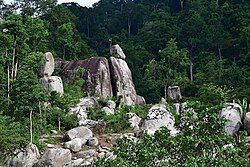
Wildlife sanctuary in northern Cambodia
Prey Lang Wildlife Sanctuary (Khmer: ព្រៃឡង់) is a protected area in north-central Cambodia spanning parts of Kratié, Kampong Thom, Stung Treng and Preah Vihear provinces.[2] Established in 2016, its boundaries were reclassified and expanded in 2023 to 4,896.63 km².[1]
The sanctuary protects a large remaining block of Cambodia’s lowland evergreen forests and associated wetlands within the wider Prey Lang forest landscape, including riverine evergreen forests, tall dipterocarp stands and evergreen swamp forests (choams).[3][4] The broader landscape straddles watersheds draining toward both the Tonlé Sap basin and the Mekong River system, and is frequently described as important for regional hydrology and dry-season water availability.[3]
Biodiversity surveys and subsequent studies report threatened wildlife including the Asian elephant and large bovids such as gaur and banteng, as well as primates including the pileated gibbon and heavily trafficked mammals such as the Sunda pangolin.[5][3] Scientific work in the sanctuary has also contributed to taxonomy, including the description of the gecko Cyrtodactylus phnomchiensis from Phnom Chi.[6]
Prey Lang is also closely associated with Indigenous and local communities (including many Kuy), whose livelihoods and cultural practices are linked to resin tapping and other non-timber forest products documented in ethnobotanical research.[7] Since the 2010s, the sanctuary has been the subject of sustained research and public debate concerning illegal logging and forest conversion, community-based monitoring, and carbon-finance initiatives framed as REDD+.[8][9]
Geography
_Figure_7.jpg)
Location and landforms
Prey Lang Wildlife Sanctuary lies within Cambodia’s central plains forest zone, west of the Mekong River, across low-relief terrain frequently described as a mosaic of evergreen forest, riparian corridors and seasonally inundated habitats.[3] Biodiversity reporting for the wider landscape also notes a substantial karst limestone formation in the northern part of the broader forest complex, with caves considered important for bat diversity and other cave-associated fauna.[3]
Hydrology and wetlands
The wider Prey Lang forest landscape spans the divide between the Tonlé Sap and Mekong basins and includes the Stung Sen, Stung Chinit and Siem Bok watersheds.[3] In technical reporting, large areas of the central landscape may be covered by water during the rainy season, contracting to smaller permanent ponds, spring-fed areas and lakes during the dry season.[3]
Evergreen freshwater swamp forests (choams) mapped in the broader Prey Lang forest complex occur at low elevations and include both permanently inundated and seasonally flooded areas, with forest structure and species composition shaped by persistent saturation and seasonal flooding.[10]
Geology and soils
Descriptions of the central plains evergreen forests in Cambodia emphasize the importance of watercourses and alluvial settings in structuring forest communities. In botanical surveys of the Prey Lang forest complex, riverine evergreen forests are described along streams and tributaries, associated with alluvial loamy soils that remain moist through the dry season.[4]
At a broader catchment scale relevant to the sanctuary’s surrounding basins, assessments of the Stung Chinit basin describe extensive areas of relatively poor soils dominated by Acrisols, with other major soil groups including Gleysols, Cambisols, Ferralsols and Plinthosols.[11]
Climate
The sanctuary lies in Cambodia’s tropical monsoon climate zone, with pronounced wet and dry seasons. Catchment-scale reporting for Stung Chinit describes a wet season from May to October delivering over 90% of annual rainfall, with peak rainfall typically in August; dry-season months can have very low or zero rainfall in some locations.[11] Basin management reporting likewise emphasizes strong seasonality in rainfall and river discharge and characterizes monsoon-driven flow peaks followed by extended low-flow periods in the dry season.[12]
Ecology
Habitats and vegetation
Landscape mosaic
Technical biodiversity reporting describes the wider Prey Lang landscape as a heterogeneous mosaic. While evergreen forest is prominent, semi-evergreen forest and deciduous dipterocarp forest are also described, alongside patches of mixed pine–broadleaf forest and open grasslands.[3] Freshwater swamp forests and permanent waterholes are highlighted as distinctive dry-season refuges for wildlife and local communities.[3]
Botanical research in the central plains emphasizes that “evergreen forest” in Cambodia’s lowlands comprises multiple distinct forest types with differing species composition, structure and ecological settings—patterns that are important for interpreting remote-sensing classifications and for conservation planning.[4]
Lowland evergreen forest types
A vegetation study based on botanical expeditions in the broader Prey Lang forest complex described four lowland evergreen forest types: (1) riverine forest dominated by Dipterocarpus costatus; (2) tall dipterocarp forest dominated by Anisoptera costata; (3) swamp forest dominated by Macaranga triloba; and (4) “Sralao”, an open forest community characterized by monodominance of Lagerstroemia cochinchinensis.[4] The authors reported that tall dipterocarp forest had the greatest basal area among their sampled forest types and supported the highest density of very large trees, reflecting the conservation value of remaining old-growth structural features in central lowland landscapes.[4]
Swamp forests and wetlands
Evergreen swamp forests in the broader complex have been described as floristically and structurally distinctive wetland forests at low elevations, with vegetation adapted to waterlogging (including pneumatophores and stilt roots).[10] Local dominance patterns differ from surrounding upland evergreen forests, supporting the interpretation of a distinct wetland forest community in Cambodia’s central lowlands.[10]
Fauna
Biodiversity surveys and subsequent research emphasize the importance of the Prey Lang landscape for wildlife in Cambodia’s central lowlands, including threatened species associated with evergreen forest, wetlands and karst formations.[3]
Mammals
.jpg)
Large mammals reported from the sanctuary and wider landscape in biodiversity reporting include the Asian elephant and wild cattle such as gaur and banteng, species generally associated with remaining forest blocks and habitat mosaics in northern and central Cambodia.[3][5] Research in the broader Prey Lang elephant landscape has used non-invasive genetic sampling and habitat modelling to assess population status and connectivity needs, highlighting the importance of maintaining forested linkages among protected areas for wide-ranging mammals.[5]
The northern karst formation within the broader Prey Lang landscape has been highlighted as important for bats. One survey reported 24 bat species recorded in the karst region, including a first national record for Marshall’s horseshoe bat, and noted that a high proportion of recorded bat species were associated with karst and cave habitats.[3]

The Sunda pangolin is reported from the sanctuary in biodiversity inventories and is classified as Critically Endangered by IUCN, with international trade pressure and habitat loss cited as major threats across its range.[3][13]
Birds
Survey reporting links wetlands and permanent waterholes to waterbird use, including records of the painted stork and oriental darter in the wider Prey Lang landscape.[3] Remaining lowland forest blocks are also described as important for regional bird diversity in the central plains forest zone.[3]
Reptiles, amphibians and invertebrates
Scientific surveys in the sanctuary have contributed to species documentation and taxonomy. In 2020, the gecko Cyrtodactylus phnomchiensis was described from Prey Lang Wildlife Sanctuary.[6]
Invertebrate diversity in the wider Prey Lang landscape has been noted in survey reporting as high, with cave systems and forest habitats likely to support many poorly documented or undescribed species, particularly in karst-associated habitats.[3]
Ecological importance and ecosystem services
Watershed functions
Hydrological functions are a recurring theme in technical reporting for the Prey Lang landscape. Forest cover is described as contributing to water availability for downstream users, with potential roles in flood regulation during peak rainy-season months and regulation of dry-season groundwater availability.[3] Basin planning for Stung Chinit similarly emphasizes strong seasonal variability in rainfall and discharge, illustrating dependence of river systems on wet-season hydrology and headwater conditions.[12][11]
Landscape connectivity
Landscape connectivity is emphasized in elephant-focused research in the broader Prey Lang elephant landscape, which highlights the importance of maintaining forested connections among protected and semi-protected forest blocks to support wide-ranging mammals over time.[5]
Indigenous peoples and local livelihoods

Ethnobotanical research describes Prey Lang as a long-inhabited cultural landscape closely linked to Indigenous and local livelihoods. In villages near the forest complex, Kuy and Khmer communities were documented as drawing on a diverse portfolio of forest and farm activities, including lowland rice cultivation, swidden agriculture and forest-based income strategies such as resin tapping.[7]
Resin tapping and customary tenure
Resin tapping from dipterocarp trees is widely described as a key livelihood in the Prey Lang landscape and is frequently linked in the literature to customary tenure and local incentives to protect resin trees. Technical reporting notes that resin tappers may be highly protective of their trees, creating localized stewardship incentives where tenure is socially recognized.[3]
Peer-reviewed research on resin extraction in forest-adjacent Cambodian communities (including communities in the broader Prey Lang landscape) reports that households were highly dependent on oleoresin as a source of cash income. Interviewed households spent on average 105 days annually on resin extraction, with mean annual household gross income from liquid resin reported at about US$3,236; the study also reported that yields varied with tree size and site conditions such as proximity to watercourses.[14]
Non-timber forest products and ethnobotany
Ethnobotanical study in the Prey Lang area documents extensive local plant knowledge and diverse use of forest resources. One study recorded 374 useful folk taxa spanning multiple use categories; medicinal uses were prominent and the study emphasizes the role of forest resources in local healthcare and everyday livelihoods.[7]
History
Establishment and boundary changes
Prey Lang Wildlife Sanctuary was established by Sub-Decree No. 74 on 9 May 2016 as a wildlife sanctuary spanning four provinces.[2] On 17 July 2023, Sub-Decree No. 181 reclassified and expanded the sanctuary’s boundaries to its current extent.[1]
Forest governance and land use
Academic work on forest governance and Cambodia’s timber economy has examined how illegal logging and political economy can intersect with development interventions and evolving conservation policies in and around the Prey Lang landscape.[15]
Management and governance
Legal framework and zoning
Prey Lang Wildlife Sanctuary is governed under Cambodia’s protected-area legislation administered by the Ministry of Environment. Cambodia’s Protected Areas Law provides for management zoning (core, conservation, sustainable use and community zones) and for establishing community protected areas within allocated parts of protected areas, subject to agreements with the conservation administration.[16][17]
Project documentation for a REDD+ carbon-finance initiative in the sanctuary states that Prey Lang Wildlife Sanctuary had not yet been formally zoned due to funding constraints, and describes carbon finance as a planned mechanism to support zoning work and related management functions while project activities proceed.[18]
Monitoring approaches
Research and technical assessments describe monitoring in Prey Lang as drawing on mixed approaches, including community-led observation and reporting, biodiversity survey work, and remote sensing for detecting forest disturbance and encroachment.[9][8]
Carbon finance and REDD+
Early feasibility and project framing
A feasibility study led by Conservation International assessed the potential for developing a REDD+ initiative in the wider Prey Lang forest landscape (Prey Long area), framing the area as a high-priority opportunity for avoided deforestation and reduced degradation linked to long-term financing for conservation and community development.[19] Related program documentation produced for Japanese climate-finance feasibility work similarly highlighted above-average deforestation pressure in the wider Prey Long area and assessed the potential for combining community-level conservation agreements with government forest management in a REDD+ framework.[20]
Peer-reviewed analysis has examined REDD+ and other forest-based climate-mitigation initiatives in the broader Prey Lang landscape, highlighting how project design, tenure arrangements and governance practices shape local impacts and the types of conflict that arise around forest-based climate policy interventions.[21]
JCM REDD+ project in the Stung Treng portion of the sanctuary
A REDD+ carbon project operates in the Stung Treng portion of the sanctuary under Japan’s Joint Crediting Mechanism, listed on the JCM registry as “Prey Lang Wildlife Sanctuary – Stung Treng REDD+ project” (Ref No. KH005).[22] The JCM project page identifies the Cambodian project participant as the Ministry of Environment and the Japanese project participant as Mitsui & Co., Ltd., with a listed third-party entity for validation/verification services.[22]
According to the JCM registry information, the project’s operation start date is 12 March 2018 and the expected operational lifetime is 13 years; the listed location includes Siem Bouk and Thala Barivat districts in Stung Treng Province, with the “activity area” comprising the communes Siem Bouk, Anlong Chrey Anlong Phe and Kang Cham.[22] The project design document describes project-area delineation and eligibility screening using national forest cover mapping, satellite imagery, and biodiversity monitoring data, and notes that formal zoning of the sanctuary had not been completed when the project was prepared.[18]
Credit issuance and safeguards reporting
Cambodia’s UNFCCC REDD+ safeguards reporting describes the “Northern Prey Lang” landscape as operational as a REDD+ project since 2018 and states that it is registered under Japan’s Joint Crediting Mechanism and jointly implemented by Conservation International, the Ministry of Environment and Mitsui; the same safeguards summary reports 612,525 tCO2e of carbon-offset credits generated through December 2023.[23]
Recent peer-reviewed discussion of Cambodia’s REDD+ landscape notes that the Prey Lang REDD+ project is registered through the Joint Crediting Mechanism rather than voluntary-market standards used by other Cambodian projects, and situates the project within broader debates over community forest governance, benefit-sharing and safeguards implementation.[24]
Threats and controversies

Illegal logging and forest conversion
Prey Lang Wildlife Sanctuary has faced persistent conservation challenges linked to illegal logging and forest encroachment. Technical biodiversity reporting emphasizes that logging can change forest composition and structure and contribute to increased sedimentation in waterways, with potential downstream impacts on aquatic habitats and the Tonlé Sap system.[3]
Remote-sensing assessments have been used to identify canopy disturbances and suspected logging activity within the sanctuary. A European Commission Joint Research Centre report assessed forest encroachments and logging using radar-based Forest Canopy Disturbance Monitoring (Sentinel-1), designed to detect forest canopy disturbance within (semi-)evergreen forests at relatively fine spatial resolution.[8]
Roads and access
Access routes and roads crossing or bordering the forest have been cited as drivers of pressure by facilitating encroachment and timber extraction, with wider land-use change and infrastructure development discussed in basin-scale planning documents as part of broader pressures on water and land resources in central Cambodia.[3][11]
Community monitoring and restrictions
Community-led monitoring has been prominent in academic research on Prey Lang. A peer-reviewed study characterizing the Prey Lang Community Network used interviews in four villages bordering the forest and reported that a minority of respondents were active monitors; many active monitors described threats and intimidation linked to interventions with illegal loggers and authorities, illustrating both risks and motivations shaping grassroots monitoring in contested governance contexts.[25]
Research and monitoring
Biodiversity inventories and taxonomic work
Biodiversity surveys conducted by conservation organisations and government partners have documented high species diversity in the wider Prey Lang landscape, including threatened species listed by IUCN and records described as new to Cambodia in some taxa.[3] Botanical research has refined descriptions of evergreen forest composition and structure in the central plains, underscoring the importance of distinguishing forest types often treated as a single “evergreen” class in remote-sensing forest maps.[4] Taxonomic work includes the description of Cyrtodactylus phnomchiensis from Phnom Chi within the protected area.[6]
Citizen-science research documents the use of smartphones and a “Prey Lang” application to record forest crimes and forest-resource observations, reporting 10,842 entries collected during 2015–2017 and discussing challenges of maintaining digital tools and data validation systems over time.[9][26]
See also
References
- ^ a b c “Sub-Decree no. 181 on reclassifying Prey Lang Wildlife Sanctuary”. OD Mekong Datahub. Open Development Cambodia. 17 July 2023. Retrieved 15 December 2025.
- ^ a b “Sub-Decree No. 74 on establishment of Prey Lang Wildlife Sanctuary”. OD Mekong Datahub. Open Development Cambodia. 9 May 2016. Retrieved 15 December 2025.
- ^ a b c d e f g h i j k l m n o p q r s t u Prey Lang Forest Landscape (picture booklet) (PDF) (Report). Winrock International. 2016. Retrieved 15 December 2025.
- ^ a b c d e f Turreira-García, Nerea; Argyriou, Dimitris; Phourin, Chhang; Srisanga, Prajak; Theilade, Ida (2022). “Evergreen forest types of the central plains in Cambodia: floristic composition and ecological characteristics”. Nordic Journal of Botany. 2022 (8): e03494. doi:10.1111/njb.03494.
{{cite journal}}: CS1 maint: article number as page number (link) - ^ a b c d “Giants in the landscape: status, genetic diversity, habitat suitability and conservation of the Asian elephant Elephas maximus in the Prey Lang Elephant Landscape, Cambodia”. PeerJ. 13: e18932. 2025. doi:10.7717/peerj.18932. PMC 12224408.
{{cite journal}}: CS1 maint: article number as page number (link) CS1 maint: unflagged free DOI (link) - ^ a b c Neang, T.; Henson, A.; Stuart, B. L. (2020). “A new species of Cyrtodactylus (Squamata, Gekkonidae) from Cambodia’s Prey Lang Wildlife Sanctuary”. ZooKeys. 926: 133–158. doi:10.3897/zookeys.926.48671.
{{cite journal}}: CS1 maint: unflagged free DOI (link) - ^ a b c Turreira-García, Nerea; Argyriou, Dimitris; Chhang, Phourin; Srisanga, Prachaya; Theilade, Ida (2017). “Ethnobotanical knowledge of the Kuy and Khmer people in Prey Lang, Cambodia” (PDF). Cambodian Journal of Natural History (1): 76–101. Retrieved 15 December 2025.
- ^ a b c Langner, Andreas; Desclée, Baudouin; Carboni, Silvia; Vancutsem, Christelle; Stibig, Hans-Jürgen; Achard, Frédéric; Theilade, Ida (2020). Forest encroachments and logging activities within the Prey Lang Wildlife Sanctuary, Cambodia: Assessment of a new monitoring approach—radar-based Forest Canopy Disturbance Monitoring (FCDM-radar) (Report). JRC Technical Report. European Commission, Joint Research Centre. JRC122187. Retrieved 15 December 2025.
- ^ a b c “Community-Based Monitoring of Tropical Forest Crimes and Forest Resources Using Information and Communication Technology – Experiences from Prey Lang, Cambodia”. Citizen Science: Theory and Practice. 3 (2): 4. 2018. doi:10.5334/cstp.129.
{{cite journal}}: CS1 maint: unflagged free DOI (link) - ^ a b c Theilade, Ida; Schmidt, Lars; Chhang, Phourin; McDonald, J. Andrew (2011). “Evergreen swamp forest in Cambodia: floristic composition, ecological characteristics, and conservation status”. Nordic Journal of Botany. 29 (1): 71–80. doi:10.1111/j.1756-1051.2010.01003.x.
- ^ a b c d “Stung Chinit catchment”. Climate Change and Water Governance in Cambodia (PDF) (Report). Transparency International Cambodia (TI Cambodia). 2016. Retrieved 15 December 2025.
- ^ a b The management of Stung Chinit basin (PDF) (Report). Water Resources Management and Development Working Group. August 2010. Retrieved 15 December 2025.
- ^ “The Sunda pangolin: one of the world’s most trafficked mammals”. IUCN. 12 December 2022. Retrieved 15 December 2025.
- ^ Hüls Dyrmose, Anne-Mette; Turreira-García, Nerea; Theilade, Ida; Meilby, Henrik (2017). “Economic importance of oleoresin (Dipterocarpus alatus) to forest-adjacent households in Cambodia” (PDF). Natural History Bulletin of the Siam Society. 62 (1): 67–84. Retrieved 15 December 2025.
- ^ Work, Courtney (2023). “Under the canopy of development aid: illegal logging and the shadow state in Cambodia”. The Journal of Peasant Studies. 50 (6): 1841–1865. doi:10.1080/03066150.2022.2103794.
- ^ “Protected Areas Law (Law on Nature Protection Areas)” (PDF). FAOLEX (Food and Agriculture Organization of the United Nations). February 2008. Retrieved 15 December 2025.
- ^ Zoning Guidelines for the Protected Areas in Cambodia (PDF) (Report). Royal Government of Cambodia. 2017. Retrieved 15 December 2025.
- ^ a b JCM Project Design Document (PDD): REDD+ project in Prey Lang Wildlife Sanctuary, Cambodia (Report). Joint Crediting Mechanism (JCM). 2023. Retrieved 15 December 2025.
- ^ REDD+ in the Prey Long Area: A feasibility study (preliminary results) (PDF) (Report). Conservation International. March 2011. Retrieved 15 December 2025.
- ^ New Mechanism Feasibility study for REDD+ in Prey Long Area, Cambodia (PDF) (Report). Global Environment Centre Foundation (GEC). 2011. Retrieved 15 December 2025.
- ^ Work, Courtney (2017). “Forest Islands and Castaway Communities: REDD+ and Forest Restoration in Prey Lang Forest”. Forests. 8 (2): 47. doi:10.3390/f8020047. Retrieved 15 December 2025.
{{cite journal}}: CS1 maint: unflagged free DOI (link) - ^ a b c “Prey Lang Wildlife Sanctuary – Stung Treng REDD+ project (KH005)”. Joint Crediting Mechanism (JCM). Retrieved 15 December 2025.
- ^ Cambodia: Second summary of information on how safeguards are being addressed and respected (2018–2022) (PDF) (Report). UNFCCC REDD+ Web Platform. 2024. Retrieved 15 December 2025.
- ^ Hyttten, Karen F.; Yy, Chaly; Pearson, Diane (2025). “Community Forest Management and REDD+: Pathways to Effective Implementation, Livelihood Improvement, and Climate Change Adaptation in Cambodia”. Land. 14 (5): 1122. Retrieved 15 December 2025.
- ^ Turreira-García, Nerea; Meilby, Henrik; Brofeldt, Søren; Argyriou, Dimitris; Theilade, Ida (2018). “Who Wants to Save the Forest? Characterizing Community-Led Monitoring in Prey Lang, Cambodia”. Environmental Management. 61 (6): 1019–1030. doi:10.1007/s00267-018-1039-0. PMID 29626224.
- ^ Theilade, Ida; Brofeldt, Søren; Turreira-García, Nerea; Argyriou, Dimitris (2021). “Community monitoring of illegal logging and forest resources using smartphones and the Prey Lang application in Cambodia”. In Skarlatidou, Artemis; Haklay, Muki (eds.). Geographic Citizen Science Design: No one left behind. UCL Press. pp. 266–281. Retrieved 15 December 2025.

