


__TOC__
__TOC__
== Background ==
== Background ==
Landslips occur all over the world wherever there are hills or mountains,<ref>{{cite book |title=Partnerships for reducing landslide risk : assessment of the National Landslide Hazards Mitigation Strategy |date=2004 |publisher=National Academies Press |location=Washington |isbn=9780309529952 |page=vii}}</ref> and the landslips themselves can have several different origins, but in [[Yorkshire]], they are not usually caused by tectonic activity. However, glacial activity, and natural processes have left the Yorkshire Dales with several scars within its valleys which were caused by landslips.<ref>{{cite book |last1=Waltham |first1=Tony |title=The Yorkshire Dales: landscape and geology |date=2007 |publisher=Crowood press |location=Ramsbury |isbn=9781861269720 |pages=71, 97}}</ref> Most landslips in Yorkshire are the result of water, either by saturation, groundwater changes, ingress of water into a slope, or by activity undertaken by humans that causes the event.<ref>{{cite journal |last1=Tiwari |first1=Binod |last2=Ajmera |first2=Beena |editor1-last=Sassa |editor1-first=Kyoji |title=advancement in shear strength interpretation, testing and use for landslide analysis |journal=Progress in Landslide Research and Technology |date=2023 |volume=2 |issue=2 |page=3 |doi=10.1007/978-3-031-44296-4}}</ref> Between the years 1981 and 2000, no-one died as a result of a landslide in Britain, but several have occurred during that time. However, a mudslide at [[Carlton in Cleveland]] in 2024 recorded the death of one person.<ref name=”BBC”/><ref>{{cite journal |last1=Tiwari |first1=Binod |last2=Ajmera |first2=Beena |editor1-last=Sassa |editor1-first=Kyoji |title=advancement in shear strength interpretation, testing and use for landslide analysis |journal=Progress in Landslide Research and Technology |date=2023 |volume=2 |issue=2 |page=4 |doi=10.1007/978-3-031-44296-4}}</ref> Whilst most landslips listed below are older ones, the British Geological Survey still consider some slopes in Yorkshire to be active.
Landslips occur all over the world wherever there are hills or mountains,<ref>{{cite book |title=Partnerships for reducing landslide risk : assessment of the National Landslide Hazards Mitigation Strategy |date=2004 |publisher=National Academies Press |location=Washington |isbn=9780309529952 |page=vii}}</ref> and the landslips themselves can have several different origins, but in [[Yorkshire]], they are not usually caused by tectonic activity. However, glacial activity, and natural processes have left the Yorkshire Dales with several scars within its valleys which were caused by landslips.<ref>{{cite book |last1=Waltham |first1=Tony |title=The Yorkshire Dales: landscape and geology |date=2007 |publisher=Crowood press |location=Ramsbury |isbn=9781861269720 |pages=71, 97}}</ref> Most landslips in Yorkshire are the result of water, either by saturation, groundwater changes, ingress of water into a slope, or by activity undertaken by humans that causes the event.<ref>{{cite journal |last1=Tiwari |first1=Binod |last2=Ajmera |first2=Beena |editor1-last=Sassa |editor1-first=Kyoji |title=advancement in shear strength interpretation, testing and use for landslide analysis |journal=Progress in Landslide Research and Technology |date=2023 |volume=2 |issue=2 |page=3 |doi=10.1007/978-3-031-44296-4}}</ref> Between the years 1981 and 2000, no-one died as a result of a landslide in Britain, but several have occurred during that time. However, a mudslide at [[Carlton in Cleveland]] in 2024 recorded the death of one person.<ref name=”BBC”/><ref>{{cite journal |last1=Tiwari |first1=Binod |last2=Ajmera |first2=Beena |editor1-last=Sassa |editor1-first=Kyoji |title=advancement in shear strength interpretation, testing and use for landslide analysis |journal=Progress in Landslide Research and Technology |date=2023 |volume=2 |issue=2 |page=4 |doi=10.1007/978-3-031-44296-4}}</ref> Whilst most landslips listed below are older ones, the British Geological Survey still consider some slopes in Yorkshire to be active.
[[File:Landslips along the edge of Fryup – geograph.org.uk – 4627655.jpg|thumb|left|Landslips along the edge of Fryup Dale]]
[[File:Landslips along the edge of Fryup – geograph.org.uk – 4627655.jpg|thumb|left|Landslips along the edge of Fryup Dale]]
A large portion of the landslips in Yorkshire have occurred at the coast, with [[Holderness]] having the fastest eroding coastline in Europe (see [[Coastal erosion in Yorkshire]]).<ref>{{cite news |last1=Wood |first1=Alex |title=Life on the edge as coastline is gradually devoured by the sea |work=The Yorkshire Post |date=22 February 2025 |page=14|issn=0963-1496}}</ref> Calculations have shown that since 1786, the coastline at [[Aldbrough, East Riding of Yorkshire|Aldbrough]] loses over {{convert|4,000,000|m3}} of material from the cliffs and shoreface each year.<ref>{{cite web |title=Landslides and coastal erosion at Aldbrough, East Riding of Yorkshire |url=https://www.bgs.ac.uk/case-studies/landslides-and-coastal-erosion-at-aldbrough-east-riding-of-yorkshire-landslide-case-study/ |website=bgs.ac.uk |access-date=17 December 2025}}</ref> Other instances of landslips, such as at [[Kettleness]], came about because of [[Alum industry in North Yorkshire|quarrying of alum]] on the coast, and several landslips in [[Robin Hood’s Bay]] led to a sea wall being constructed to protect the village. Two types of geological formations (Redcar Mudstone and Whitby Mudstone) are prone to landslips.<ref>{{cite web |title=Hollin Hill Landslide Observatory, Yorkshire |url=https://www.bgs.ac.uk/case-studies/hollin-hill-landslide-observatory-yorkshire-landslide-case-study/ |website=bgs.ac.uk |access-date=17 December 2025}}</ref> The mudstones contain a high volume of clay, which when overlaying harder strata below, causes movement in the mudstone formation when saturated. The Whitby Mudstone is recognised as having one of the highest density of landslips in the UK, with 42 landslips per {{convert|100|km2}}.<ref>{{cite journal |last1=Chambers |first1=J.E. |last2=Wilkinson |first2=P.B. |last3=Kuras |first3=O. |last4=Ford |first4=J.R. |last5=Gunn |first5=D.A. |last6=Meldrum |first6=P.I. |last7=Pennington |first7=C.V.L. |last8=Weller |first8=A.L. |last9=Hobbs |first9=P.R.N. |last10=Ogilvy |first10=R.D. |title=Three-dimensional geophysical anatomy of an active landslide in Lias Group mudrocks, Cleveland Basin, UK |journal=Geomorphology |date=February 2011 |volume=125 |issue=4 |page=472 |doi=10.1016/j.geomorph.2010.09.017}}</ref><ref>{{cite journal |last1=Gunn |first1=D. A. |last2=Chambers |first2=J. E. |last3=Hobbs |first3=P. R. N. |last4=Ford |first4=J. R. |last5=Wilkinson |first5=P. B. |last6=Jenkins |first6=G. O. |last7=Merritt |first7=A. |title=Rapid observations to guide the design of systems for long-term monitoring of a complex landslide in the Upper Lias clays of North Yorkshire, UK |journal=Quarterly Journal of Engineering Geology and Hydrogeology |date=August 2013 |volume=46 |issue=3 |page=323 |doi=10.1144/qjegh2011-028}}</ref> [[Relict (geology)|Relict landslips]] (landslips which have occurred some time ago in geological terms, but which are no longer prone to slipping) on the western edge of Fryup Dale have left permanent scarring along the valley.<ref>{{cite book |last1=Elgee |first1=Frank |title=The Moorlands of North-Eastern Yorkshire |date=2009|orig-date=1912 |publisher=Bibliolife |location=Charleston |isbn=9781113833761 |page=220}}</ref><ref>{{cite journal |last1=Boon |first1=David P. |last2=Chambers |first2=Jonathan E. |last3=Hobbs |first3=Peter R.N. |last4=Kirkham |first4=Mathew |last5=Merritt |first5=Andrew J. |last6=Dashwood |first6=Claire |last7=Pennington |first7=Catherine |last8=Wilby |first8=Philip R. |title=A combined geomorphological and geophysical approach to characterising relict landslide hazard on the Jurassic Escarpments of Great Britain |journal=Geomorphology |date=November 2015 |volume=248 |page=296 |doi=10.1016/j.geomorph.2015.07.005}}</ref>
A large portion of the landslips in Yorkshire have occurred at the coast, with [[Holderness]] having the fastest eroding coastline in Europe (see [[Coastal erosion in Yorkshire]]).<ref>{{cite news |last1=Wood |first1=Alex |title=Life on the edge as coastline is gradually devoured by the sea |work=The Yorkshire Post |date=22 February 2025 |page=14|issn=0963-1496}}</ref> Calculations have shown that since 1786, the coastline at [[Aldbrough, East Riding of Yorkshire|Aldbrough]] loses over {{convert|4,000,000|m3}} of material from the cliffs and shoreface each year.<ref>{{cite web |title=Landslides and coastal erosion at Aldbrough, East Riding of Yorkshire |url=https://www.bgs.ac.uk/case-studies/landslides-and-coastal-erosion-at-aldbrough-east-riding-of-yorkshire-landslide-case-study/ |website=bgs.ac.uk |access-date=17 December 2025}}</ref> Other instances of landslips, such as at [[Kettleness]], came about because of [[Alum industry in North Yorkshire|quarrying of alum]] on the coast, and several landslips in [[Robin Hood’s Bay]] led to a sea wall being constructed to protect the village. Two types of geological formations (Redcar Mudstone and Whitby Mudstone) are prone to landslips.<ref>{{cite web |title=Hollin Hill Landslide Observatory, Yorkshire |url=https://www.bgs.ac.uk/case-studies/hollin-hill-landslide-observatory-yorkshire-landslide-case-study/ |website=bgs.ac.uk |access-date=17 December 2025}}</ref> The mudstones contain a high volume of clay, which when overlaying harder strata below, causes movement in the mudstone formation when saturated. The Whitby Mudstone is recognised as having one of the highest density of landslips in the UK, with 42 landslips per {{convert|100|km2}}.<ref>{{cite journal |last1=Chambers |first1=J.E. |last2=Wilkinson |first2=P.B. |last3=Kuras |first3=O. |last4=Ford |first4=J.R. |last5=Gunn |first5=D.A. |last6=Meldrum |first6=P.I. |last7=Pennington |first7=C.V.L. |last8=Weller |first8=A.L. |last9=Hobbs |first9=P.R.N. |last10=Ogilvy |first10=R.D. |title=Three-dimensional geophysical anatomy of an active landslide in Lias Group mudrocks, Cleveland Basin, UK |journal=Geomorphology |date=February 2011 |volume=125 |issue=4 |page=472 |doi=10.1016/j.geomorph.2010.09.017}}</ref><ref>{{cite journal |last1=Gunn |first1=D. A. |last2=Chambers |first2=J. E. |last3=Hobbs |first3=P. R. N. |last4=Ford |first4=J. R. |last5=Wilkinson |first5=P. B. |last6=Jenkins |first6=G. O. |last7=Merritt |first7=A. |title=Rapid observations to guide the design of systems for long-term monitoring of a complex landslide in the Upper Lias clays of North Yorkshire, UK |journal=Quarterly Journal of Engineering Geology and Hydrogeology |date=August 2013 |volume=46 |issue=3 |page=323 |doi=10.1144/qjegh2011-028}}</ref> [[Relict (geology)|Relict landslips]] (landslips which have occurred some time ago in geological terms, but which are no longer prone to slipping) on the western edge of Fryup Dale have left permanent scarring along the valley.<ref>{{cite book |last1=Elgee |first1=Frank |title=The Moorlands of North-Eastern Yorkshire |date=2009|orig-date=1912 |publisher=Bibliolife |location=Charleston |isbn=9781113833761 |page=220}}</ref><ref>{{cite journal |last1=Boon |first1=David P. |last2=Chambers |first2=Jonathan E. |last3=Hobbs |first3=Peter R.N. |last4=Kirkham |first4=Mathew |last5=Merritt |first5=Andrew J. |last6=Dashwood |first6=Claire |last7=Pennington |first7=Catherine |last8=Wilby |first8=Philip R. |title=A combined geomorphological and geophysical approach to characterising relict landslide hazard on the Jurassic Escarpments of Great Britain |journal=Geomorphology |date=November 2015 |volume=248 |page=296 |doi=10.1016/j.geomorph.2015.07.005}}</ref>
_(geograph_3333836)_cropped.jpg)
This is a list of Landslips in Yorkshire England. It covers land and mudslips to have occurred within the traditional county of Yorkshire. Most of the listings below are of older landslips, but the British Geological Survey still consider some of the valleys within Yorkshire to have active landslips. The term landslip is more common in Britain than elsewhere (such as the railways which describes all slides as landslips). The term landslide is more common outside of Britain.[1]
Background
Landslips occur all over the world wherever there are hills or mountains,[2] and the landslips themselves can have several different origins, but in Yorkshire, they are not usually caused by tectonic activity. However, glacial activity, and natural processes have left the Yorkshire Dales with several scars within its valleys which were caused by landslips.[3] Most landslips in Yorkshire are the result of water, either by saturation, groundwater changes, ingress of water into a slope, or by activity undertaken by humans that causes the event.[4] Between the years 1981 and 2000, no-one died as a result of a landslide in Britain, but several have occurred during that time. However, a mudslide at Carlton in Cleveland in 2024 recorded the death of one person.[5][6] Whilst most landslips listed below are older ones, the British Geological Survey still consider some slopes in Yorkshire to be active.

A large portion of the landslips in Yorkshire have occurred at the coast, with Holderness having the fastest eroding coastline in Europe (see Coastal erosion in Yorkshire).[8] Calculations have shown that since 1786, the coastline at Aldbrough loses over 4,000,000 cubic metres (140,000,000 cu ft) of material from the cliffs and shoreface each year.[9] Other instances of landslips, such as at Kettleness, came about because of quarrying of alum on the coast, and several landslips in Robin Hood’s Bay led to a sea wall being constructed to protect the village. Two types of geological formations (Redcar Mudstone and Whitby Mudstone) are prone to landslips.[10] The mudstones contain a high volume of clay, which when overlaying harder strata below, causes movement in the mudstone formation when saturated. The Whitby Mudstone is recognised as having one of the highest density of landslips in the UK, with 42 landslips per 100 square kilometres (39 sq mi).[11][12] Relict landslips (landslips which have occurred some time ago in geological terms, but which are no longer prone to slipping) on the western edge of Fryup Dale have left permanent scarring along the valley.[13][14]
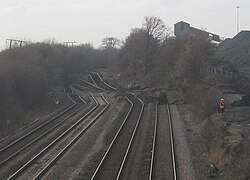
The slip at Hatfield Colliery was due to waste from the colliery process when coal was washed. The high moisture content enabled the slurry to burst out of its confines and the slip displaced the railway. Other inland slides are usually due to saturated mud, and in the case of the ones at Kex Gill, have shut the A59 road numerous times throughout the 21st century.[15]
Rockfalls at the coast are common, with some such as one in 2018 causing the death of a child who was playing on the beach. Geologists believe the rockfalls could actually be due to dryer weather rather than water ingress.[16]
List
| Name | Date | Details | Ref |
|---|---|---|---|
| Whitby | 1787 | A landslide on the East Cliff destroyed many of the houses on a road named Haggerlythe and a gun battery fell into the sea. Other landslides were recorded in 1870 and 1932. | [17][18] |
| Crow Hill bog burst | 2 September 1824 | During a violent thunderstorm, some 1,200 cubic yards (920 m3) of bog material, was sent down the valley through Ponden, Stanbury and on through the Worth Valley. The pollutive effects of the bog material affected businesses as far down the River Aire as Leeds. | [19] |
| Kettleness | 17 December 1829 | Due to the alum workings on the coast at Kettleness, the cliffs had become unstable because of the removal of the shales used in alum production. The whole village and alum works sipped into the sea, with all the local inhabitants taking shelter on a boat moored off the shore which had arrived to collect finished alum. | [20] |
| Fewston | 1880 | Land in the village began to slide downhill in 1880. One local measured the slippage at 0.5 inches (13 mm) per day, and this led to a depopulation of the village. Initially, it was blamed on the building of Fewston Reservoir, but a geologist refuted this, and stated it was down to the shale strata underneath the village, being bloated from excessive rainfall over three years. | [21][22] |
| Robin Hood’s Bay | Various occurrences | In 1893, some houses fell into the sea from the top of the 70 feet (21 m) cliff. | [23] |
| Dent Head landslip[note 1] | February 1935 | An aqueduct over the Settle–Carlisle line burst and flooded the earth around a cutting. This caused a landslip of over 500 tonnes (550 tons) to spill into the cutting. No trains were passing at the time, so no injuries or deaths occurred. | [24] |
| Holbeck Hall | June 1993 | The gardens of the hotel overlooking the sea extended for 70 metres (230 ft) to the shoreline, but on the morning of 3 June 1993, 55 metres (180 ft) had slid down the slope and onto the beach. The hotel soon collapsed, and the whole premises were later demolished. The cause of the landslip was not down to the sea, but the porosity of the land underneath the hotel and the amount of rain in the preceding months (140 millimetres (5.5 in)). | [25] |
| Heck | 2000 | 1.5 miles (2.4 km) of the East Coast Main Line near Heck was damaged by a landslip. Over 200,000 tonnes (200,000 long tons; 220,000 short tons) was needed to repair the stretch of railway. | [26] |
| Hatfield landslip | February 2013 | Saturated coal shale pushed the railway line between Hatfield and Stainforth railway station and Thorne South railway station. The line re-opened five months later. | [27] |
| Kex Gill (A59 road) | Various occurrences | Since the year 2000, the A59 has been closed 15 times due to landslips at the Kex Gill section. A bypass is being constructed, and is hoped to be open by 2026. | [28] |
| Ripon | Various occurrences | Larges swathes of Ripon are built on gypsum, which aquifers cut into and create cavities, opening up sinkholes around the city. These have caused landslips with many domestic properties having to be evacuated and at least one was demolished. Ripon can expect to suffer a sinkhole every three to five years. | [29][30] |
| Whitby | December 2012 | A landslip on the East Cliff underneath the churchyard. Five houses on Aelfleda Terrace had to be demolished after heavy rain and flooding underneath the houses washed the bank away. | [31] |
| Carlton in Cleveland mudslide | May 2024 | A month’s worth of rain fell on the area in 12 hours. A child was killed in the mudslide. | [5] |
Notes
- ^ Dent is now in Cumbria, but in 1935, it was in the West Riding of Yorkshire.
References
- ^ “LANDSLIP definition and meaning | Collins English Dictionary”. www.collinsdictionary.com. Retrieved 19 December 2025.
- ^ Partnerships for reducing landslide risk : assessment of the National Landslide Hazards Mitigation Strategy. Washington: National Academies Press. 2004. p. vii. ISBN 9780309529952.
- ^ Waltham, Tony (2007). The Yorkshire Dales: landscape and geology. Ramsbury: Crowood press. pp. 71, 97. ISBN 9781861269720.
- ^ Tiwari, Binod; Ajmera, Beena (2023). Sassa, Kyoji (ed.). “advancement in shear strength interpretation, testing and use for landslide analysis”. Progress in Landslide Research and Technology. 2 (2): 3. doi:10.1007/978-3-031-44296-4.
- ^ a b “One person dies in North Yorkshire mudslide”. BBC News. 22 May 2024. Retrieved 9 October 2024.
- ^ Tiwari, Binod; Ajmera, Beena (2023). Sassa, Kyoji (ed.). “advancement in shear strength interpretation, testing and use for landslide analysis”. Progress in Landslide Research and Technology. 2 (2): 4. doi:10.1007/978-3-031-44296-4.
- ^ Wood, Alex (22 February 2025). “Life on the edge as coastline is gradually devoured by the sea”. The Yorkshire Post. p. 14. ISSN 0963-1496.
- ^ “Landslides and coastal erosion at Aldbrough, East Riding of Yorkshire”. bgs.ac.uk. Retrieved 17 December 2025.
- ^ “Hollin Hill Landslide Observatory, Yorkshire”. bgs.ac.uk. Retrieved 17 December 2025.
- ^ Chambers, J.E.; Wilkinson, P.B.; Kuras, O.; Ford, J.R.; Gunn, D.A.; Meldrum, P.I.; Pennington, C.V.L.; Weller, A.L.; Hobbs, P.R.N.; Ogilvy, R.D. (February 2011). “Three-dimensional geophysical anatomy of an active landslide in Lias Group mudrocks, Cleveland Basin, UK”. Geomorphology. 125 (4): 472. doi:10.1016/j.geomorph.2010.09.017.
- ^ Gunn, D. A.; Chambers, J. E.; Hobbs, P. R. N.; Ford, J. R.; Wilkinson, P. B.; Jenkins, G. O.; Merritt, A. (August 2013). “Rapid observations to guide the design of systems for long-term monitoring of a complex landslide in the Upper Lias clays of North Yorkshire, UK”. Quarterly Journal of Engineering Geology and Hydrogeology. 46 (3): 323. doi:10.1144/qjegh2011-028.
- ^ Elgee, Frank (2009) [1912]. The Moorlands of North-Eastern Yorkshire. Charleston: Bibliolife. p. 220. ISBN 9781113833761.
- ^ Boon, David P.; Chambers, Jonathan E.; Hobbs, Peter R.N.; Kirkham, Mathew; Merritt, Andrew J.; Dashwood, Claire; Pennington, Catherine; Wilby, Philip R. (November 2015). “A combined geomorphological and geophysical approach to characterising relict landslide hazard on the Jurassic Escarpments of Great Britain”. Geomorphology. 248: 296. doi:10.1016/j.geomorph.2015.07.005.
- ^ “Kex Gill A59 bypass to receive extra £11.7m after project delay”. BBC News. 13 May 2025. Retrieved 24 October 2025.
- ^ “Staithes cliff fall: Girl, 9, dies as rocks fall on to beach”. BBC News. 8 August 2018. Retrieved 17 December 2025.
- ^ Yorkshire coast: Staithes to Bridlington. Clapham: Dalesman Books. 1982. p. 10. ISBN 0852066724.
- ^ Waters, Colin (2011). A history of Whitby & its place names. Stroud: Amberley. p. 60. ISBN 978-1-4456-0429-9.
- ^ Dewhirst, Ian (October 1974). “Crow Hill Flood”. Yorkshire Ridings Magazine. Vol. 11, no. 9. Driffield: Ridings Publishing. p. 9. ISSN 0960-0000. OCLC 1063391042.
- ^ Mead, Harry (1994) [1978]. Inside the North York Moors. Otley: Smith Settle. pp. 54–55. ISBN 1-85825-028-5.
- ^ “Subsidence of Land at Fewston: Threatened Destruction of the Village”. The Yorkshire Post. 24 September 1880. p. 5.
- ^ McTominey, Andrew (August 2020). “A Tale of Two Yorkshire Villages: The Local Environmental Impact of British Reservoir Development, c.1866-1966”. Environment and History. 26 (3): 331–358. doi:10.3197/096734018X15444572414083.
- ^ “Landslip in Yorkshire”. Reading Mercury. No. 8, 850. 25 February 1893. p. 8.
- ^ “Railway blocked by landslide”. The Times. No. 46994. 21 February 1935. p. 12. ISSN 0140-0460.
- ^ “Holbeck Hall, Scarborough”. bgs.ac.uk. Retrieved 9 October 2024.
- ^ “Line landslip Yorkshire”. Aberdeen Evening Express. 13 November 2000. p. 58.
- ^ “Rail line reopens after landslip”. BBC News. 8 July 2013. Retrieved 6 August 2025.
- ^ “A59 Kex Gill: Landslip-affected road reopens ahead of schedule”. BBC News. 24 January 2025. Retrieved 31 January 2025.
- ^ “Ripon sinkhole concerns halt Harrogate council homes plans”. BBC News. 3 October 2019. Retrieved 24 October 2025.
- ^ “Ripon Sainsbury’s evacuated after sinkhole opens up”. BBC News. 21 August 2018. Retrieved 24 October 2025.
- ^ “Whitby landslip exposes human bones at ‘Dracula graveyard’“. BBC News. 10 January 2013. Retrieved 1 May 2025.



