
From Wikipedia, the free encyclopedia
Content deleted Content added
|
|
|||
| Line 15: | Line 15: | ||
|
Measuring 22 cm in height with a diameter of 8.9 cm, carved in [[alabaster]], scripts in four languages are etched into the vessel, consisting of [[Old Persian]], [[Elamite cuneiform|Elamite]], [[Akkadian language|Akkadian]], and [[Egyptian hieroglyphs|Egyptian]], each inscribed with the title “[[Xerxes I|Xerxes]], the Great King”.<ref name=”:2″>{{Cite book |last=Scott |first=Gerry D. |url=http://archive.org/details/ancientegyptiana0000scot |title=Ancient Egyptian art at Yale |date=1986 |publisher=New Haven, Conn. : Yale University Art Gallery |others=Internet Archive |isbn=978-0-89467-038-1 |page=145}}</ref> An additional inscription in [[Demotic (Egyptian)|Demotic script]] reads “12 ”kepedj”-units”, or 1200 mL capacity.<ref name=”:0″ /><ref name=”:1″ /><ref name=”:3″>{{Cite web |title=Inscribed jar with demotic, hieroglyphic, and cuneiform {{!}} Echoes of Egypt {{!}} Yale Peabody Museum |url=https://echoesofegypt.peabody.yale.edu/hieroglyphs/inscribed-jar-demotic-hieroglyphic-and-cuneiform |access-date=2025-12-25 |website=echoesofegypt.peabody.yale.edu}}</ref> It is believed that ”kepedj” is an Egyptian word derived from [[Old Persian|Persian language]].<ref name=”:3″ /> The shape is consistent with Egyptian style and is presumably manufactured in Egypt, but where the subsequent inscriptions were carved remains unknown.<ref name=”:2″ /> Yale acquired the vessel in 1912 in [[Paris]] with traceable provenance to Ibrahim Elias Gejou (1868-1942), an Iraqi-French antiquities dealer, with funding financed by [[J. P. Morgan]].<ref name=”:0″ /><ref name=”:2″ /><ref>{{Cite web |date=2021-05-06 |title=Ibrahim Elias Gejou and Old Babylonian Omens – SOAS History Blog |url=https://blogs.soas.ac.uk/soashistoryblog/2021/05/06/ibrahim-elias-gejou-and-old-babylonian-omens/ |access-date=2025-12-25 |language=en-GB}}</ref><ref>{{Cite web |date=2023-03-21 |title=By studying ancient residues, scholar finds clues of humanity’s past {{!}} Yale News |url=https://news.yale.edu/2023/03/21/studying-ancient-residues-scholar-finds-clues-humanitys-past |access-date=2025-12-25 |website=news.yale.edu |language=en}}</ref> Aside from a chip in the lip of the vessel, it is mostly intact.<ref name=”:2″ /> |
Measuring 22 cm in height with a diameter of 8.9 cm, carved in [[alabaster]], scripts in four languages are etched into the vessel, consisting of [[Old Persian]], [[Elamite cuneiform|Elamite]], [[Akkadian language|Akkadian]], and [[Egyptian hieroglyphs|Egyptian]], each inscribed with the title “[[Xerxes I|Xerxes]], the Great King”.<ref name=”:2″>{{Cite book |last=Scott |first=Gerry D. |url=http://archive.org/details/ancientegyptiana0000scot |title=Ancient Egyptian art at Yale |date=1986 |publisher=New Haven, Conn. : Yale University Art Gallery |others=Internet Archive |isbn=978-0-89467-038-1 |page=145}}</ref> An additional inscription in [[Demotic (Egyptian)|Demotic script]] reads “12 ”kepedj”-units”, or 1200 mL capacity.<ref name=”:0″ /><ref name=”:1″ /><ref name=”:3″>{{Cite web |title=Inscribed jar with demotic, hieroglyphic, and cuneiform {{!}} Echoes of Egypt {{!}} Yale Peabody Museum |url=https://echoesofegypt.peabody.yale.edu/hieroglyphs/inscribed-jar-demotic-hieroglyphic-and-cuneiform |access-date=2025-12-25 |website=echoesofegypt.peabody.yale.edu}}</ref> It is believed that ”kepedj” is an Egyptian word derived from [[Old Persian|Persian language]].<ref name=”:3″ /> The shape is consistent with Egyptian style and is presumably manufactured in Egypt, but where the subsequent inscriptions were carved remains unknown.<ref name=”:2″ /> Yale acquired the vessel in 1912 in [[Paris]] with traceable provenance to Ibrahim Elias Gejou (1868-1942), an Iraqi-French antiquities dealer, with funding financed by [[J. P. Morgan]].<ref name=”:0″ /><ref name=”:2″ /><ref>{{Cite web |date=2021-05-06 |title=Ibrahim Elias Gejou and Old Babylonian Omens – SOAS History Blog |url=https://blogs.soas.ac.uk/soashistoryblog/2021/05/06/ibrahim-elias-gejou-and-old-babylonian-omens/ |access-date=2025-12-25 |language=en-GB}}</ref><ref>{{Cite web |date=2023-03-21 |title=By studying ancient residues, scholar finds clues of humanity’s past {{!}} Yale News |url=https://news.yale.edu/2023/03/21/studying-ancient-residues-scholar-finds-clues-humanitys-past |access-date=2025-12-25 |website=news.yale.edu |language=en}}</ref> Aside from a chip in the lip of the vessel, it is mostly intact.<ref name=”:2″ /> |
||
|
10 multilingual specimens of this era are known to have survived ranging from finds at the [[Mausoleum at Halicarnassus]] |
10 multilingual specimens of this era are known to have survived ranging from finds at the [[Mausoleum at Halicarnassus]] a burial mound in [[Russia]].<ref name=”:0″ /> |
||
|
== Pharmacology == |
== Pharmacology == |
||
Latest revision as of 04:58, 25 December 2025
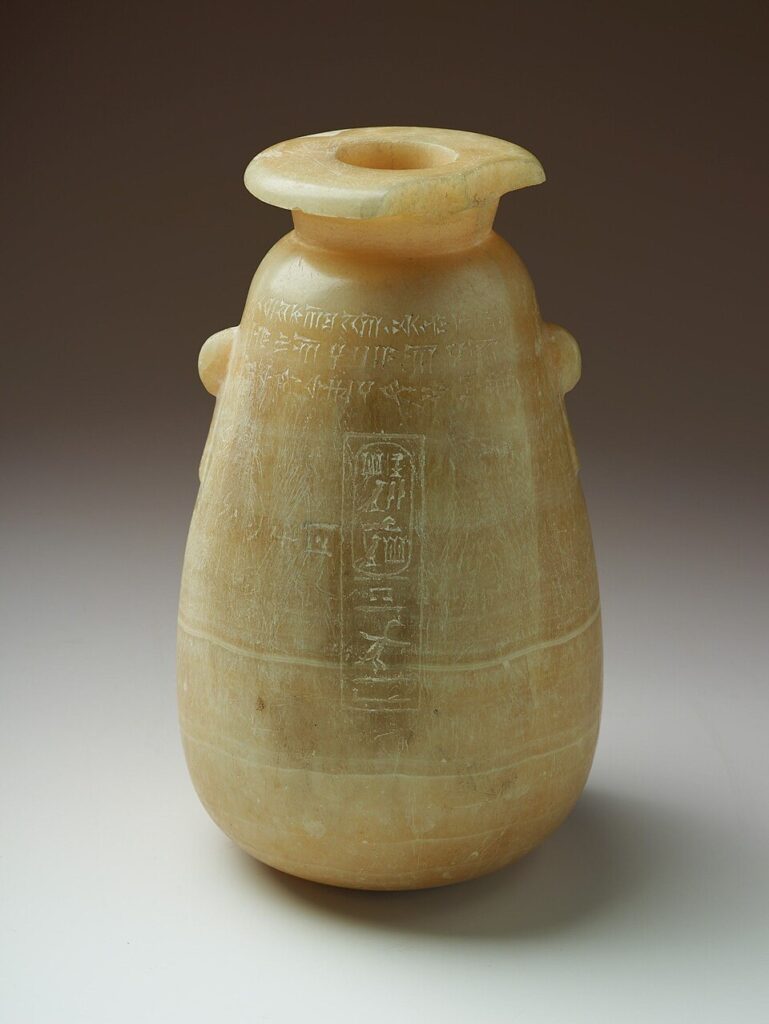
Egyptian/Persian Vessel with Opiates in held by Yale Babylonian Collection
The YBC Alabastron (Yale Babylonian Collection Alabastron), also known as YBC 02123 (YPM BC 016756) is a quadrilingual Ancient Egyptian alabastron vessel dating to Persian Egypt during the reign of Xerxes I (484-464 BC).[1] Acquired by Yale University’s Babylonian Collection in 1912, recent analysis of the vessel’s organic residue in 2022-2025 is indicative of opiate residuals, revealing the systemic usage of opium in Egyptian and Achaemenid Persian pharmacology.[2][3]
Measuring 22 cm in height with a diameter of 8.9 cm, carved in alabaster, scripts in four languages are etched into the vessel, consisting of Old Persian, Elamite, Akkadian, and Egyptian, each inscribed with the title “Xerxes, the Great King”.[4] An additional inscription in Demotic script reads “12 kepedj-units”, or 1200 mL capacity.[2][3][5] It is believed that kepedj is an Egyptian word derived from Persian language.[5] The shape is consistent with Egyptian style and is presumably manufactured in Egypt, but where the subsequent inscriptions were carved remains unknown.[4] Yale acquired the vessel in 1912 in Paris with traceable provenance to Ibrahim Elias Gejou (1868-1942), an Iraqi-French antiquities dealer, with funding financed by J. P. Morgan.[2][4][6][7] Aside from a chip in the lip of the vessel, it is mostly intact.[4]
10 multilingual specimens of this era are known to have survived ranging from finds at the Mausoleum at Halicarnassus to a burial mound in Russia.[2]
Developments in the study of pharmacology in antiquity often stemmed from texts such as that of the De materia medica by Dioscorides, to the Ebers Papyrus, which has five different recipes involving the usage of opiates.[3][8][9][10] Since 2023, the Yale Ancient Pharmacology Program (YAPP) has conducted research on organic residuals on ancient vessels to study ancient cuisine, medicine, and cosmetics.[2][3]
In 1933, vessels with aromatic, dark-brown residue were identified in Tutankhamun’s tomb at KV62, by Howard Carter’s analytical chemist Alfred Lucas.[3] Carter noted that tomb robbers attempted to scrape out the contents of the vessels, and at the time, Lucas was not able to ascertain the specific compounds, though he concluded that they did not contain perfume.[3] Those vessels are currently held by the Grand Egyptian Museum.[3]
In April 2022, ethyl acetate and ethanol were applied to the YBC vessel to extract the organic material.[2] Subjected to gas chromatography–mass spectrometry; noscapine, hydrocotarnine, morphine, thebaine, and papaverine, biomarkers of opium, were identified in the vessel.[2]
The finds are also consistent with vessels excavated in the necropolis at Sedment, now held by the Penn Museum, indicating that opiates are also valued cargo for the afterlife.[2]
- ^ “Vase. Vase inscribed in four languages to Xerxes, the Great King, plus Demotic addendum noting the capacity of the vessel. Early Achaemenid. Alabaster.; YPM BC 016756”. collections.peabody.yale.edu. Retrieved 2025-12-25.
- ^ a b c d e f g h Koh, Andrew J.; Lassen, Agnete W.; Crandall, Alison M. (2025-09-01). “The Pharmacopeia of Ancient Egyptian Alabaster Vessels: A Transdisciplinary Approach with Legacy Artifacts”. Journal of Eastern Mediterranean Archaeology and Heritage Studies. 13 (3): 317–333. doi:10.5325/jeasmedarcherstu.13.3.0317. ISSN 2166-3548.
- ^ a b c d e f g “New discovery suggests opium use in ancient cultures, from Xerxes to King Tut | Yale News”. news.yale.edu. 2025-11-11. Retrieved 2025-12-25.
- ^ a b c d Scott, Gerry D. (1986). Ancient Egyptian art at Yale. Internet Archive. New Haven, Conn. : Yale University Art Gallery. p. 145. ISBN 978-0-89467-038-1.
- ^ a b “Inscribed jar with demotic, hieroglyphic, and cuneiform | Echoes of Egypt | Yale Peabody Museum”. echoesofegypt.peabody.yale.edu. Retrieved 2025-12-25.
- ^ “Ibrahim Elias Gejou and Old Babylonian Omens – SOAS History Blog”. 2021-05-06. Retrieved 2025-12-25.
- ^ “By studying ancient residues, scholar finds clues of humanity’s past | Yale News”. news.yale.edu. 2023-03-21. Retrieved 2025-12-25.
- ^ Ouellette, Jennifer (2025-11-17). “Ancient Egyptians likely used opiates regularly”. Ars Technica. Retrieved 2025-12-25.
- ^ “Decoding the pharmacological past”. www.yalealumnimagazine.com. Retrieved 2025-12-25.
- ^ “By studying ancient residues, scholar finds clues of humanity’s past | Yale News”. news.yale.edu. 2023-03-21. Retrieved 2025-12-25.

