


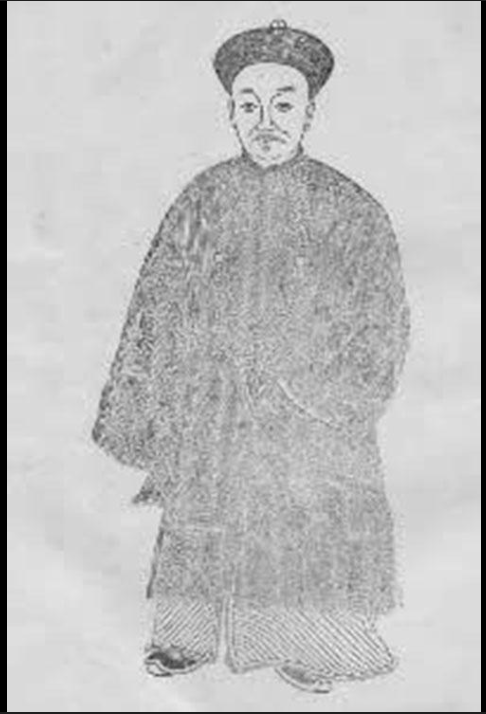
Official of Qing China (1790–1878)
|
Yishan |
|
|---|---|
 Portrait of Yishan in 1838 |
|
| In office 1838–1840 |
|
| Preceded by | Teyishunbao |
| Succeeded by | Guanfu |
| In office 1845–1854 |
|
| Preceded by | Saying’a |
| Succeeded by | Zhalafentai |
| In office 1855–1860 |
|
| Preceded by | Yige |
| Succeeded by | Tepuqin |
| Born | (1790-06-13)13 June 1790 |
| Died | 30 June 1878(1878-06-30) (aged 88) |
| Children | Zaizhuo |
Yishan (Manchu: 
Yishan was born in Beijing or Mukden (modern-day Shenyang), Qing Dynasty, on 13 June 1790. Being a distant relative of the Qing Dynasty Royal Family, he entered the Qing bureaucracy without taking the Imperial examination at the age of 20, in 1810. In 1821, after the Daoguang Emperor inherited the throne from the Jiaqing Emperor, Yishan was promoted to the emperor’s bodyguard. He served in several more positions in the following decade. Yishan governed Ili from 1838 to 1840, and from 1845 to 1854. He was chosen to be a military general in 1839 for the First Opium War, and was promoted to Imperial Commissioner and Viceroy of Liangguang in 1841. Mismanagement in Guangzhou and Humen lead to his defence failures, and he was forced to sign a convention and surrender to the British. He was sentenced to death (later became imprisonment) in late 1841, but was released in 1842. In 1843, he once again became the Daoguang Emperor’s bodyguard. After finishing his Ili governance term in 1854, he governed Liaoning, Heilongjiang, and Jilin as Viceroy of the Three Eastern Provinces from 1855 to 1860, signing the Treaty of Aigun with the Russian Empire regarding the Qing’s northeastern borders in 1858. He participated in the Second Opium War as a general from 1857 to 1860. Yishan died on 30 June, 1878.
Ancestry
Yishan was from the Aisin-Gioro Clan (愛新覺羅), the imperial family of the Qing Dynasty, and he was part of the Bordered Red Banner of the Eight Banners of the Qing. He was a direct descendant of Hong Taiji (Emperor Taizong, 皇太極), the second emperor of the Later Jin Dynasty and the founding emperor of the Qing. Yishan was connected to Hong through the latter’s 15th son, Prince Yu, who was Yishan’s great-great-great-grandfather. Yishan’s great-great-grandfather, Dong’e (董額), was the second son of Prince Yu and inherited Yu’s position of Beizi (貝子). Yishan’s great-grandfather, Hongchun (弘春; 1703–1739), once held the title of a junwang (second-rank prince) as “Prince Tai of the Second Rank” (多羅泰郡王). Yishan’s grandfather was named Fengxiang (奉祥), although his positions in the Qing bureaucracy were unknown. Yishan’s father was named Qiwei (奇偉), and he was appointed the hereditary title of Jiangjun (將軍).
The Aisin-Gioro clan originated from the Jurchen tribes situated in Manchuria, a region in Northeastern China and Southeasternmost Russia. The clan’s ancestral home is located near Yilan County, an area in modern-day Heilongjiang. In etymology, Aisin means ‘gold’, corresponding to Chinese 金 jīn. Gioro refers to the clan’s ancestral home in Yilan County. The Aisin-Gioro House had no system of automatic succession such as primogeniture or a law of succession. Instead, an emperor would name an heir in a secret edict. The edict would be read before senior members of the clan following the emperor’s death. An emperor could have numerous sons by women of various ranks.


The Aisin-Gioro’s ancestor is Bukūri Yongšon, a legendary warrior of the 13th century. Hong stated that Yongšon was conceived from a virgin birth. According to the legend, three heavenly maidens, Enggulen, Jenggulen, and Fekulen, were bathing at a lake called Bulhūri Omo near the Changbai Mountains. A magpie dropped a piece of red fruit near Fekulen, who ate it. She then became pregnant with Bukūri Yongšon. However, this legend belongs to another Manchu clan, the Hurha (Hurka). The actual ancestor of the Jurchen tribe and Aisin-Gioro clan is Mengtemu, the chieftain of a Jurchen tribe during the rule of the Mongol Empire and Yuan Dynasty. Before Nurhaci, the first emperor of the Later Jin Dynasty, renamed the clan, the Aisin-Gioro clan was initially named Gioro hala. During the Ming Dynasty, many Jurchens, including Nurhaci’s grandfather Giocangga and father Taksi, were officially considered vassals and granted titles by the Ming court, such as “Dragon Tiger General”. They were allowed to trade horses, fur, and ginseng for essential Chinese goods like salt, textiles, and iron tools. Rivalries were also extremely common.


Under Nurhaci and Hong, the Aisin-Gioro clan of the Jianzhou tribe won hegemony among the rival Jurchen tribes of the northeast, then through warfare and alliances extended its control into Inner Mongolia. Nurhachi created large, permanent civil-military units called “banners” to replace the small hunting groups used in his early campaigns. A banner was composed of smaller companies; it included some 7,500 warriors and their households, including slaves, under the command of a chieftain. Each banner was identified by a coloured flag that was yellow, white, blue, or red, either plain or with a border design. Originally there were four, then eight, Manchu banners; new banners were created as the Manchu conquered new regions, and eventually there were Manchu, Mongol, and Chinese banners, eight for each ethnic group. By 1648, less than one-sixth of the bannermen were actually of Manchu ancestry. The Qing conquest of the Ming dynasty was thus achieved with a multiethnic army led by Manchu nobles and Han Chinese generals. Han Chinese soldiers were organised into the Army of the Green Standard, which became a sort of imperial constabulary force posted throughout China and on the frontiers.
The change of the name from Jurchen to Manchu was made to hide the fact that the ancestors of the Manchus, the Jianzhou Jurchens, were ruled by the Chinese. The Qing dynasty carefully hid the 2 original editions of the books of “Qing Taizu Wu Huangdi Shilu” and the “Manzhou Shilu Tu” (Taizu Shilu Tu) in the Qing palace, forbidden from public view because they showed that the Manchu Aisin Gioro family had been ruled by the Ming dynasty. In the Ming period, the Koreans of Joseon referred to the Jurchen inhabited lands north of the Korean peninsula, above the rivers Yalu and Tumen to be part of Ming China, as the “superior country” which they called Ming China. The Qing deliberately excluded references and information that showed the Jurchens (Manchus) as subservient to the Ming dynasty, from the History of Ming to hide their former subservient relationship to the Ming. The Veritable Records of the Ming were not used to source content on Jurchens during Ming rule in the History of Ming because of this. This historical revisionism helped remove the accusation of rebellion from the Qing ruling family refusing to mention in the Mingshi the fact that the Qing founders were Ming China’s subjects. The Yongzheng Emperor of the Qing Dynasty attempted to rewrite the historical record and claim that the Aisin Gioro were never subjects of past dynasties and empires trying to cast Nurhaci’s acceptance of Ming titles like Dragon Tiger General (longhu jiangjun 龍虎將軍) by claiming he accepted to “please Heaven”.
The Qing emperors arranged marriages between Aisin Gioro noblewomen and outsiders to create political marriage alliances. During the Manchu conquest of the Ming Dynasty, the Manchu rulers offered to marry their princesses to Han Chinese military officers who served the Ming Empire as a means of inducing these officers into surrendering or defecting to their side. Aisin Gioro princesses were also married to Mongol princes, for the purpose of forming alliances between the Manchus and Mongol tribes.
The Manchus successfully induced one Han Chinese general, Li Yongfang (李永芳), into defecting to their side by offering him a position in the Manchu banners. Li Yongfang also married the daughter of Abatai, a son of Nurhaci. Many more Han Chinese abandoned their posts in the Ming Dynasty and defected to the Manchu side. There were over 1,000 marriages between Han Chinese men and Manchu women in 1632. Due to a proposal by Yoto (岳托), a nephew of Hong. Hong believed that intermarriage between Han Chinese and Manchus could help to eliminate ethnic conflicts in areas already occupied by the Manchus, as well as help the Han Chinese forget their ancestral roots more easily.

Manchu noblewomen were also married to Han Chinese men who surrendered or defected to the Manchu side. Aisin Gioro women were married to the sons of the Han Chinese generals Sun Sike (孫思克), Geng Jimao, Shang Kexi and Wu Sangui. The e’fu (額駙) rank was given to husbands of Manchu princesses. Geng Zhongming, a Han bannerman, was awarded the title “Prince Jingnan”, while his grandsons Geng Jingzhong, Geng Zhaozhong (耿昭忠) and Geng Juzhong (耿聚忠) married Hooge‘s daughter, Abatai’s granddaughter, and Yolo’s daughter respectively. Sun Sike’s son, Sun Cheng’en (孫承恩), married the Kangxi Emperor‘s fourth daughter, Heshuo Princess Quejing (和硕悫靖公主).
Yishan’s uncle, Yunti, was the Kangxi Emperor’s 14th son and the first in line in the Prince Xun peerage. A character in Yishan’s Chinese name, Yi (奕), was a generational character and part of a court-mandated poetic sequence devised by the Qianlong Emperor to name generations of the Aisin-Gioro clan.
Yishan’s family was incorporated into the Bordered Red Banner, which was part of the “Lower Five Banners” of the Qing Dynasty, meaning they were not governed directly by the Emperor.
Early Life

Yishan was born on 13 June, 1790, towards the end of the Qianlong Emperor’s reign. Whether he was born in Shenyang (called Mukden) or Beijing (called Peking) is debated among scholars. Due to his position as a member of a prestigious banner and ethnic lineage, Yishan had already received a position in the Qing bureaucracy by the time he was born. He was given the position “Feng’en Jiangjun” (奉恩將軍, “General Who Receives Grace”) which entitled him to a stipend. Being a Manchu bannerman, Yishan’s education was Manchu-centric.
During his childhood years, Yishan studied Manchu to fluency and Mandarin Chinese to high proficiency. He also trained rigorously in archery, becoming highly proficient. He was tutored in Chinese Confucian classics, and learnt the Four Books and Five Classics of Confucianism. His education mainly prepared him for future provincial administration, writing memorials, and understanding state ideology. He also mastered horsemanship and usage of weaponry like spears, swords, and bows. He also participated in military training. After his initial education, Yishan attended the Jiangshan High School, the official school established in Beijing for the education of imperial clansmen.
Yishan also had a Yin privilege, a system of where sons of high-ranking Qing officials were granted official titles or direct access to government posts by virtue of their father’s status and service, as Yishan was a young nobleman and part of a banner. This also meant that Yishan did not need to take the standard Imperial examination, and was able to enter the bureaucracy without any examination at the age of 20.
Career
Early career (1821-1838)
In 1821, after the Daoguang Emperor came to the throne, Yishan, then a fourth-grade noble was recruited to serve as a third-class imperial guard (三等侍衛) in the Forbidden City. He helped them train recurits Between 1821 and 1838, he held the following appointments, among others: lingdui dachen (領隊大臣) of Da’erbahatai (塔爾巴哈台; an administrative region in present-day Xinjiang); deputy dutong (都統; commander) of the Bordered Blue Banner Han Forces; canzan dachen (參贊大臣) of Ili (伊犁; an area within Xinjiang). In 1838, he was appointed as General of Ili to govern and maintain security in the area known as Dzungaria. He was recalled back to the capital, Beijing, two years later.
First Opium War (1839-1842)
In 1839, when the First Opium War began, Yishan was appointed by the Daoguang Emperor, the Qing emperor at the time, as a general of the Qing Imperial Army. From 1839 to 1840, he trained military recruits in Zhili, a northern administrative region in the Ming and Qing Dynasty comprising modern-day Beijing, Tianjin, Hebei, Western Liaoning, Northern Henan, and parts of Inner Mongolia, and Ili, before being called back to Beijing in late 1840. On February 27, 1841, Yishan was appointed as Imperial Commissioner to replace Qishan, who had been dismissed from the position and arrested for signing the Convention of Chuenpi in January 1841 without the Daoguang Emperor’s permission. Yishan was also appointed as the Viceroy of Liangguang, permitting governance over Guangxi and Guangdong provinces.

After his appointments, the Daoguang Emperor issued a mandate to Yishan: “annihilate the British forces and “wash away the national shame.” The Qing Imperial Court then issued Yishan an army of Manchu Bannermen and Green Standard Army troops, totalling up to 17,000 soldiers from multiple provinces to battle the Royal Navy of the British Empire. In April 1841, Yishan arrived in Guangdong. At this point, Guangdong had been without an Imperial Commissioner present for two months since Qishan’s dismissal, and their main military commandant, Guan Tianpei, had been dead since the end of February, leaving only Yang Fang and Yilibu as commanders present in Guangdong. Because of this lack of leadership, portions of Guangzhou and Macau had already fallen to the British. However, upon arrival, unlike the profound hope that people in Guangdong had anticipated in a new Imperial Commissioner, Yishan exhibited arrogant and ignorant behaviours, criticising the exceptional amount of defensive fortifications around Guangzhou while dismissing generals and civilians stating the fortifications were necessary, despite them observing British naval power firsthand. In one instance, Yishan openly criticised Fang, citing his cautious assessment as “wild talk to frighten people” and accused them of “a cowardly desire for peace.” Yishan believed the British successes so far had been due to Qing mismanagement and “luck”. To prepare for battle, Yishan travelled to Humen (called The Bogue in Britain) and reinforced defences there, despite it already being captured twice. He then hired local militias for night raids and fireboat attacks on the Pearl River. Yishan had a habit of relying on mystical tactics, frequently seeking divine assistance through sacrifices at temples. He also weirdly held a superstitious belief that flooding rice fields around Guangdong would stop British naval advance. Yishan also recruited inexperienced fresh recruits from Fujian to serve in his army instead of seasoned soldiers. He also spent his time partying with the officers.

On May 21, 1841, the British, who were already aware of Yishan’s preparations, launched an attack on The Bogue. The fortifications were destroyed in days, and the British navy continued north to continue their assault on Guangzhou. Despite Yishan rerouting land forces to Guangzhou, the British had captured hills north of Guangzhou by May 24 and positioned cannons towards the city. Despite being sent to annihilate the British, Yishan panicked and raised a white flag to signify surrender. He then sent a local merchant, Howqua, to negotiate with them. On May 27, Yishan presented the Convention of Canton to the British, a local ceasefire agreement where Yishan would pay $6 million Mexican pesos to the British to spare Guangzhou from bombardment and looting. The Convention also required the British to withdraw 100 kilometers from Guangzhou, and to withdraw forces from The Bogue once payment was received. This was euphemistically called a “compensatory payment for commercial losses.”
Knowing the Daoguang Emperor expected victory, Yishan filed a series of false victory memorials to the Qing Parliament. These memorials claimed that Yishan’s army had killed thousands of British troops, including a fabricated “chief commander”, the British were begging for mercy, the $6 million peso payment was from the British to the Qing, and that the British “kowtowed in submission and swore never to return to Guangdong.” In response, the Daoguang Emperor was delighted, bestowing honours to Yishan. However, the Daoguang Emperor discovered the truth when the Treaty of the Bogue, which had been signed by Yilibu, arrived in Beijing. Enraged by Yishan’s lies, the Daoguang Emperor stripped Yishan of all his titles, and he was arrested, brought to Beijing, and sentenced to death by beheading for “deceiving the emperor and losing the nation’s morale.” However, his death sentence was alleviated to imprisonment, and he was pardoned and released in 1842 when the First Opium War ended due to the signing of the Treaty of Nanking. Afterwards, he was promoted to second class imperial guard (二等侍衛) and acting banshi dachen (辦事大臣) of Khotan (an area within Xinjiang).[1]
General of Ili (1845-1855)
In 1845, he was appointed to serve as General of Ili for a second term. In 1847, he was awarded the rank of a first class zhenguo jiangjun, the fourth-lowest tier in the Qing dynasty’s hierarchy of noble ranks.
In mid-1851, Ivan Zakharov started negotiations with Yishan and Buyantai (布彥泰) at Ili to open up Kulja and Chuguchak to Sino–Russian trade. The Russians wanted the new treaty to be based on the earlier Treaty of Kyakhta (1727). Yishan agreed to almost all the Russian terms, except for trade in Kashgar. On 6 August 1851, the Russian and Qing Empires signed the Treaty of Kulja. In 1855, Yishan was reassigned to serve as General of Heilongjiang (黑龍江將軍) to oversee Heilongjiang Province.
Second Opium War and death (1857-1878)
During the Second Opium War (1857–1860), Nikolay Muravyov-Amursky approached Yishan and offered to provide Russian assistance to the Qing Empire against the British and French, in return for redefining the Sino–Russian border along the Amur and Ussuri rivers. The Russians also put up a display of their military power by firing artillery shells along the Amur River. Yishan was terrified but did not want to retaliate for fear of starting another war. In May 1858, the Russians and Yishan signed the Treaty of Aigun, which transferred the lands between the Stanovoy Range and Amur River to the Russian Empire. The Xianfeng Emperor was enraged by the territorial losses to the Russians, so he dismissed Yishan from his office as General of Heilongjiang, despite the latter’s attempts to explain himself. In 1860, the Russians intervened in the Convention of Beijing (which ended the Second Opium War), and forced the Qing Empire to recognize the Russian gains under the Treaty of Aigun and further cede its territories east of the Ussuri River, including Sakhalin, to them. This became known as the Amur Annexation. Meanwhile, Yishan returned to Beijing to await further orders but was soon back into service.
Yishan died of illness in Beijing on 30 June, 1878, aged 88. He had at least two sons, including his second son Zaizhuo (載鷟).
See also
References
- ^ Lovell, Julia (2015). The Opium War: Drugs, Dreams, and the Making of Modern China. The Overlook Press. ISBN 978-1468311730.



