


From Wikipedia, the free encyclopedia
Content deleted Content added
|
|
|||
| Line 2: | Line 2: | ||
|
{{distinguish|Yukagir mammoth}} |
{{distinguish|Yukagir mammoth}} |
||
|
{{Infobox animal |
{{Infobox animal |
||
|
| name |
| name = Yuka |
||
|
| image |
| image = Мамонтёнок Юка.JPG |
||
|
| image_upright |
| image_upright = |
||
|
| caption |
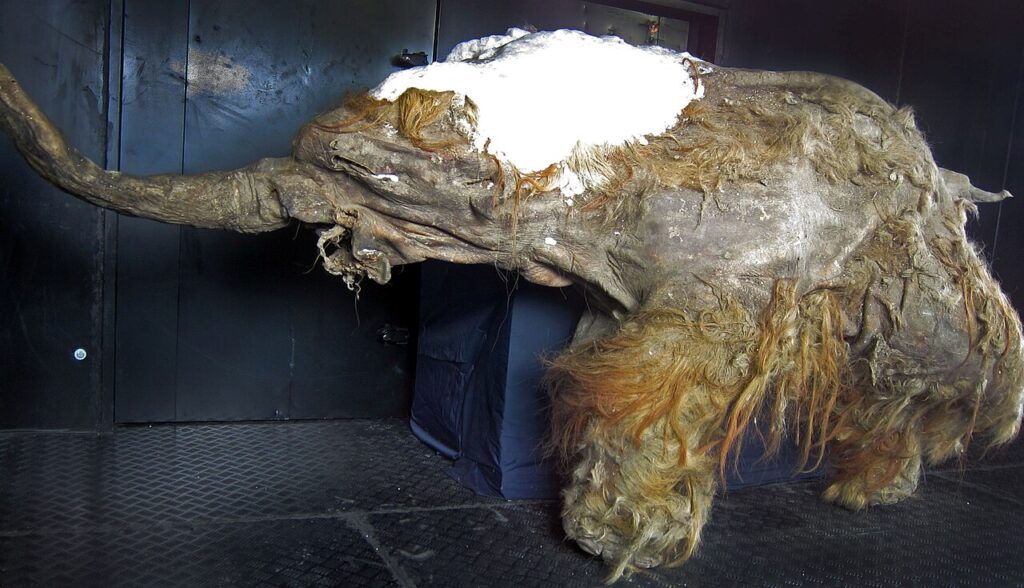
| caption = The mammoth’s mummified remains |
||
|
| birth_name |
| birth_name = |
||
|
| othername |
| othername = |
||
|
| species |
| species = Woolly Mammoth |
||
|
| breed |
| breed = |
||
|
| gender |
| gender = Male<ref name=””>{{Cite web |last= |first= |date=2025-11-15 |title= |url=https://www..//– |
||
|
|access-date=2026-01-27 |website=Cell |language=en}}</ref><ref name=”sex”>{{Cite web |last=Ferreira · |first=Becky |date=2025-11-15 |title=Scientists Make Genetic Breakthrough with 39,000-Year-Old Mammoth RNA |url=https://www.404media.co/scientists-make-genetic-breakthrough-with-39-000-year-old-mammoth-rna/ |access-date=2025-11-15 |website=404 Media |language=en}}</ref> |
|||
|
| birth_date |
| birth_date = |
||
|
| birth_place |
| birth_place = |
||
|
| death_date |
| death_date = 39,000 YA<ref name=BBC2014/> |
||
|
| death_place |
| death_place = Siberia |
||
|
| resting_place |
| resting_place = |
||
|
| resting_place_coordinates = |
| resting_place_coordinates = |
||
|
| known |
| known = Best preserved woolly mammoth |
||
|
| owner |
| owner = |
||
|
| residence |
| residence = Moscow |
||
|
| weight |
| weight = 5 tonnes |
||
|
| height |
| height = 3 metres |
||
|
| appearance |
| appearance = |
||
|
| namedafter |
| namedafter = |
||
|
| website |
| website = |
||
|
| module |
| module |
||
|
| module2 |
| module2 |
||
|
| module3 |
| module3 |
||
|
| module4 |
| module4 |
||
|
| module5 |
| module5 |
||
|
}} |
}} |
||
|
{{external media |
{{external media |
||
Latest revision as of 13:52, 27 January 2026
Mummified mammoth carcass
 The mammoth’s mummified remains |
|
| Species | Woolly Mammoth |
|---|---|
| Sex | Male[1][2] |
| Died | 39,000 YA[3] Siberia |
| Known for | Best preserved woolly mammoth |
| Residence | Moscow |
| Weight | 5 tonnes |
| Height | 3 m (9 ft 10 in) |
Yuka is the best-preserved woolly mammoth (Mammuthus primigenius) carcass ever found. It was discovered by local Siberian tusk hunters in August 2010.[4][5][6] They turned it over to local scientists, who made an initial assessment of the carcass in 2012.[7] It is displayed in Moscow.
The mammoth was found along the Oyogos Yar coast of the Dmitry Laptev Strait, approximately 30 kilometers (19 mi) west of the mouth of the Kondratievo River, Siberia (72° 40′ 49.44″ N, 142° 50′ 38.35″) in the region of the Laptev Sea. Yuka is a juvenile male[2] natural mummy that was found near and named after the village of Yukagir, whose local people discovered it. This mammoth mummy was found on an overhanging ledge about 4 meters (13 ft) above the beach level in a low wave-cut bluff that was about 5 meters (16 ft) high.
The north-facing bluff was composed of loess that forms part of a rich Late Pleistocene fossil-bearing yedoma exposed by coastal erosion. The yedoma consists of ice-rich silts and silty sand penetrated by large ice wedges, resulting from sedimentation and syngenetic freezing. AMS-dating of a fragment of Yuka’s rib from these deposits yielded a radiocarbon date of 34,300+260/−240 14C (GrA-53289). This date corresponds to the termination of Marine Isotope Stage 3, which is also called the Middle Weichselian, Kargin or Molotkov Interstadial.[6][8]
Research and analysis
[edit]
After its discovery, Yuka spent two years stored and preserved in a natural refrigerator, the local permafrost (‘lednik’), at Yukagir. At that time, a team led by Semyon Grigoriev from the Lazarev Mammoth Museum (North-Eastern Federal University, Yakutsk) arrived to study these mummified remains.[9] By then, more than 100 meters (330 ft) of the low bluff had washed away. From Yukagir, the Yuka mammoth was transported to the Sakha Academy of Sciences in Yakutsk.[6][8] Since October 2014, the mammoth has been on display in Moscow and is regarded as being the best preserved Siberian mammoth discovered thus far.[3]
An analysis of the teeth and tusks determined Yuka to be approximately 6–8 years old when he died. Although it is presumed that this mammoth had most likely been attacked by lions or other predators, evidence that the predators had killed the mammoth was not found.[6][8]
In March 2019, a Japanese research team led by Kazuo Yamagata, a biologist at Kindai University, worked with Yuka’s tissue.[10] Yamagata’s team reported that they were able to stimulate nucleus-like structures to perform some biological processes.[10] However, they could not activate cell division.[11]
- ^ Mármol-Sánchez, Emilio (2025-11-15). “Ancient RNA expression profiles from the extinct woolly mammoth”. Cell. Retrieved 2026-01-27.
- ^ a b Ferreira ·, Becky (2025-11-15). “Scientists Make Genetic Breakthrough with 39,000-Year-Old Mammoth RNA”. 404 Media. Retrieved 2025-11-15.
- ^ a b “39,000 year-old mammoth goes on display in Russia”. BBC News. October 29, 2014. Retrieved November 7, 2022.
- ^ Yirka, Bob (April 5, 2012). “Well preserved mammoth from Siberia shows signs of early man stealing from lions”. Phys.org. Retrieved February 4, 2021.
- ^ Potter, Ned (April 5, 2012). “Woolly Mammoth Apparently Butchered by Ancient Humans”. ABC News. Retrieved February 4, 2021.
- ^ a b c d Rudaya, Natalia; Protopopov, Albert; Trofimova, Svetlana; Plotnikov, Valery; Zhilich, Snezhana (December 20, 2014). “Landscapes of the ‘Yuka’ mammoth habitat: A palaeobotanical approach”. Review of Palaeobotany and Palynology. 214 (March 2015): 1–8. doi:10.1016/j.revpalbo.2014.12.003. Retrieved September 19, 2022.
- ^ Aviss, Ben (April 4, 2012). “Woolly mammoth carcass may have been cut into by humans”. BBC News. Archived from the original on April 5, 2012. Retrieved February 4, 2021.
- ^ a b c Maschenko, E., Potapova, O., Boeskorov, G., Agenbroad, L., 2012. Preliminary data on the new partial carcass of the Woolly mammoth, Mammuthus primigenius, from Yakutia, Russia. Abstracts of the 72nd Annual SVP Meeting, October 17–20, 2012. p.137.
- ^ Grigoriev, Semyon E.; Fisher, Daniel C.; Obadă, Theodor; Shirley, Ethan A.; Rountrey, Adam N.; et al. (July 2017). “A woolly mammoth ( Mammuthus primigenius ) carcass from Maly Lyakhovsky Island (New Siberian Islands, Russian Federation)”. Quaternary International. 445: 89–103. Bibcode:2017QuInt.445…89G. doi:10.1016/j.quaint.2017.01.007. Retrieved 23 April 2024.
- ^ a b Ferreira, Becky (March 12, 2019). “Scientists Reawaken Cells From a 28,000-Year-Old Mammoth”. Vice. Retrieved November 7, 2022.
- ^ Yamagata, Kazuo; et al. (March 11, 2019). “Signs of biological activities of 28,000-year-old mammoth nuclei in mouse oocytes visualized by live-cell imaging”. Scientific Reports. 9 (1): 4050. Bibcode:2019NatSR…9.4050Y. doi:10.1038/s41598-019-40546-1. PMC 6411884. PMID 30858410.




